
There is a difference between political disagreement and online obsession. In the age of Facebook gladiators, neighborhood watchdog pages, and keyboard constitutional scholars armed with Canva graphics, the line can get blurry fast. But lately, several Frisco residents have been asking a serious question about local physician Dr. Matt Rostami and his increasingly aggressive online commentary aimed at Frisco mayoral candidate Rod Vilhauer.
The concern is not simply that a doctor has political opinions. Doctors are citizens. They vote. They argue. They post memes just like everyone else. Some even discover Facebook Live and suddenly believe they are one podcast microphone away from becoming the next Joe Rogan.
Rostami’s online political presence is not new. Here are just a few posts sent to us by readers.
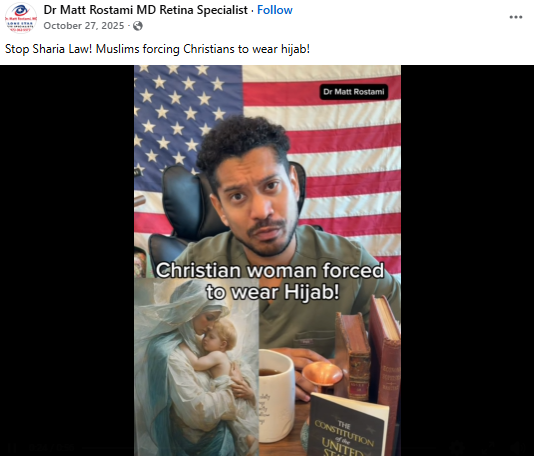
Video of Dr. Matt Rostami mocking the need to stop Sharia Law and making Christian woman to wear a Hijab. He specifically points out a woman named “Mary” who is holding a baby a reference to the bible. He goes on to say in our country Freedom is showing your butthole and cleavage because sharing is caring.
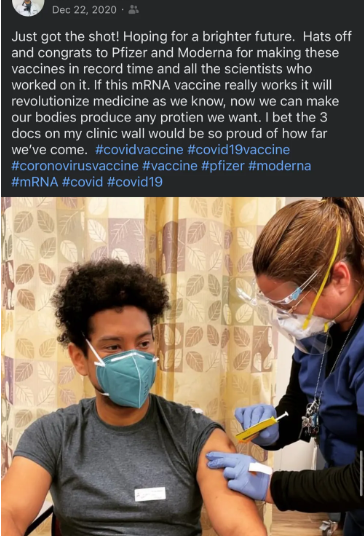
Current Revolt called out Dr. Matt Rostami for being a Democrat in disguise. He claims to be a Republican, but his voting Record says otherwise from what we can tell and Current Revolt called him out about it. We also noticed that he supported the vaccines during Covid which is odd for a Republican.
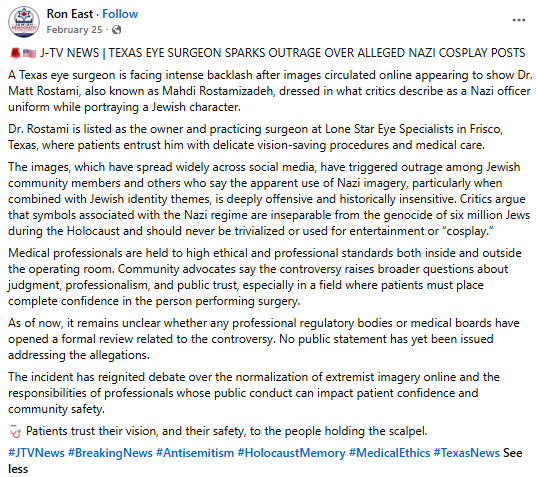
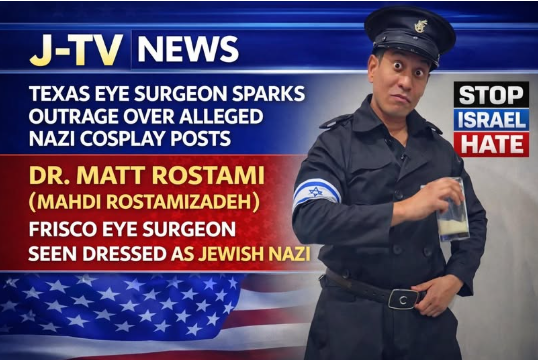
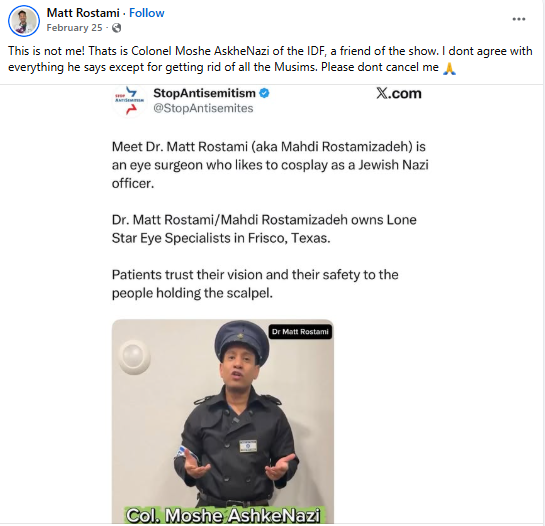
Then there is a post showing Dr. Matt Rostami dressed up in cosplay as a Jewish Nazi Officer. After it was posted he later mocked it, and in the words of Shaggy allegedly said, “it wasn’t me.”
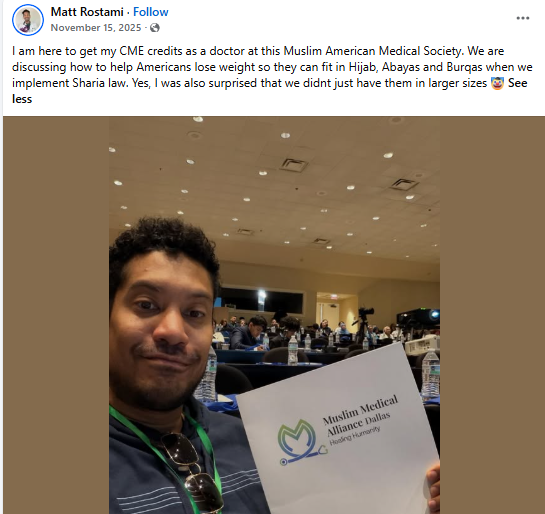
In another post, Rostami holds up a Muslim Medical Alliance folder and mocks obese woman saying “I am here to get my CME credits as a doctor at this Muslim American Medical Society. We are discussing how to help Americans lose weight so they can fit in Hijab, Abayas and Burqas when we implement Sharia law. Yes, I was also surprised that we didn’t just have them in larger sizes (clown face emoji).
The Concern
The concern being raised by residents is whether Dr. Rostami’s online behavior has crossed from political speech into something more concerning: harassment, intimidation, or conduct unbecoming of a licensed physician.
And perhaps the biggest mystery of all: why did it take nearly an entire day to even locate his Texas medical license?
The Name Game
Here is where the story starts feeling less like a medical directory and more like a witness protection subplot from a late-night cable drama.
Most Texans searching the Texas Medical Board database would naturally type in “Matt Rostami.” That search does not easily lead to his medical credentials because “Matt Rostami” is not his legal name.
According to Texas Medical Board records, Dr. Matt Rostami’s legal name is Dr. Mahdi Rostamizaden, and his Texas medical license is listed as #R2723.
To be clear, physicians are not generally required to publicly advertise their license numbers on websites or social media. Texas law typically allows doctors to practice and advertise under a professional name, practice name, DBA, or commonly used name. Nothing illegal there.
Still, some residents found it odd that locating the license information required what felt like a forensic accounting team, three cups of coffee, and the determination of a true-crime podcast listener.
What Does the Texas Medical Board Actually Regulate?
This is where things become important — and nuanced.
The Texas Medical Board does not regulate political beliefs. A physician can support a candidate, oppose a candidate, criticize policy, or post unpopular opinions online. The First Amendment protects a tremendous amount of speech, including speech many people dislike.
Texas law does not create one single “social media behavior statute” for physicians. Instead, physician conduct is regulated through broader standards found in the Texas Occupations Code and Texas Administrative Code involving:
- Professional ethics
- Dishonorable conduct
- Conduct likely to deceive, defraud, or injure the public
- Impairment issues
- Harassment or threatening behavior
- Professional character requirements
The board has previously disciplined physicians over online conduct, including inappropriate Facebook activity and harassment-related behavior. The key legal question is not whether someone is rude, loud, politically charged, or unpopular, but the threshold is evidence.
Not gossip. Not rumors. Not “he seems weird online.” Evidence.
When Does Free Speech Become Harassment?
That is the million-dollar constitutional question.
A physician posting criticism about a political candidate is protected speech. Even harsh criticism usually remains protected. At Frisco Chronicles we know where that line is and we do stand to protect it. The question is should those rules be different for licensed professionals in some categories.
If conduct escalates into targeted harassment, threats, stalking behavior, intimidation, discriminatory conduct, or actions suggesting impaired judgment that could affect patient safety, the equation changes dramatically.
Several Frisco residents who contacted Frisco Chronicles expressed concern that Dr. Rostami’s posts have become increasingly inflammatory and intensely focused on Vilhauer.
One resident wrote:
“The public rhetoric has become increasingly inflammatory.”
Another questioned whether the fixation had crossed into “stalking territory.”
To be very clear, those are serious accusations. We want to make sure folks understand these are opinions — not legal findings.
A skeptical observer might reasonably ask whether the behavior reflects the professional judgment expected from someone entrusted with patient care. But legally speaking, “poor judgment” and “disciplinable impairment” are not the same thing.
That distinction matters.
Because the law does not punish someone simply for acting eccentric online. If it did, half of Facebook would be under federal supervision and Nextdoor would require adult probation officers.
The “Good Professional Character” Standard
Under Texas Occupations Code Chapter 155, physicians are expected to maintain “good professional character.”
Chapter 164 goes further, allowing disciplinary action when a physician is unable to practice medicine safely because of:
- illness
- drunkenness
- excessive use of drugs or chemicals
- mental or physical conditions affecting safe practice
Recently, several residents emailed Frisco Chronicles asking whether Dr. Rostami’s online conduct raises concerns about impairment or mental fitness.
To be absolutely clear: there is currently no public evidence proving impairment, substance abuse, or mental incapacity.
However, Texas law does provide mechanisms for investigation if legitimate complaints and probable cause exist.
Under Section 164.053 of the Texas Occupations Code, the Texas Medical Board may request a physician submit to mental or physical examinations if there is probable cause involving professional behavior concerns, substance abuse issues, or mental health conditions affecting safe practice.
If a physician refuses, hearings may follow, during which the physician can present evidence and legal defense.
Again, the standard is not “people on Facebook think he’s acting strange.”
The standard is probable cause backed by evidence.
That is a very high bar — and intentionally so.
Targeting Rod Vilhauer
Perhaps the most comical part of this entire saga is that Dr. Rostami appears to be attacking Rod Vilhauer for a comment made during a podcast that he has later clarified, while Rostami engages in the very same style of online political commentary daily in his regular posts. One day it is “dangerous rhetoric” when Vilhauer speaks bluntly about controversial issues; the next day Rostami is unloading multi-post tirades, inflammatory accusations, taking out political hit pieces in magazines, putting up defamatory road signs, and posting political attacks with the enthusiasm of a late-night cable news host who just discovered espresso. Residents watching this unfold believe Rostami has gone over the line of two people arguing over who is being too loud… through bullhorns. If harsh political speech suddenly qualifies someone as unstable, offensive, or unfit for public discourse, then critics might reasonably ask whether Dr. Rostami’s own Facebook timeline should be entered into evidence as Exhibit A.
Politics, Medicine, and Public Trust
This entire situation raises broader questions that extend beyond one physician or one mayoral race. How much online behavior is too much for professionals entrusted with public safety and public health? Should physicians be held to higher standards in public discourse? At what point does political activism begin damaging public confidence in the medical profession? And perhaps most importantly: in an era where outrage drives clicks, likes, and engagement, are some people simply losing the ability to log off?
The internet has transformed ordinary citizens into full-time broadcasters. Every grievance becomes a livestream. Every disagreement becomes a crusade. Every Facebook thread becomes Gettysburg with emojis. But physicians occupy a unique place in society. Patients trust them with life-altering decisions. That trust depends not only on medical competence, but also on public confidence in their judgment.
The Texas Medical Board understands that balance. That is why it generally avoids policing mere political opinions while still maintaining authority to investigate conduct that may genuinely endanger the public or reflect professional impairment.
For now, Dr. Rostami’s conduct remains largely a matter of public debate — not public discipline.
But one thing is certain: when residents begin asking whether a Doctor’s Facebook feed belongs in a campaign office, a courtroom, or a psychiatric evaluation request, the conversation has already moved far beyond ordinary politics.
What do you think?
Rod Vilhauer For Frisco Mayor Facebook Page
For legal purposes we must post this Disclaimer: This blog includes satire, parody, and comic relief. It contains summarized accounts created solely for humor and commentary. Any resemblance to real events is either coincidental or intentionally satirical. Reader discretion — and a sense of humor — are advised.
0 Comments