Campaign finance reports are essentially the political world’s version of a receipt drawer—crumpled, confusing, and full of clues about who paid for dinner and who’s expecting dessert later. They’re those legally required spreadsheets where candidates reveal who’s funding their dreams of public service (or at least their yard signs), listing donors, amounts, and expenditures with all the excitement of a tax audit but twice the intrigue. Why do they matter? Because buried between the $50 “grassroots supporter” and the suspiciously generous “consulting fee,” you’ll often find the real story of influence, priorities, and alliances—like a financial whodunit where the plot twist is that the money usually knows exactly what it’s buying.
Frisco Chronicles has questioned current and former council members, as well as candidates campaign finance reports for a few years now. You can read about those as we have attached the links at the end of this article to each blog. Most recently we wrote about John Keatings two recent donations of $50,000 each for a total of $100,000 from Frisco 380 Partners in our blog Follow The $100K and how we could not locate much information on them.
1) What is your philosophy of accepting campaign contributions from developers?
2) Should there be a limit on the amount a contribution should be?
John Keating is the first to respond because everyone from coffee shops to whispers at lunch, want to know about that One Hundred Grand sitting in his campaign account. Keating made a few points we will summarize or for more humor you can watch his 2 minute clip here.
Point 1: Keating begins by explaining that donations must come from an individual or a sole proprietor LLC. The name of the individual donor is on there unless it is sole Proprietor LLC. Keating continues a Sole Proprietor, “it is not a developer per se, I mean, it could be a developer.” Not sure what Keating was trying to say here.
Point 2: Keating continues that over the past 15 years he has run several campaigns for council and one for state rep which cost him at least $200,000. Then he pointed out that it is money he will never get back.
Frisco Chronicles would like to be clear over the years Keatings employment on several of his campaign finance reports list him as a “stay at home dad” which is fine. But Keating did not have an income other than his military benefits so for full clarity his “campaign races” were funded by his ex-wife who was the bread winner and went to work every day all the years they were married. Keating should clarify his ex-wife is out $200K for those races because clearly, he did not have that kind of money on his own.
Point 3: Keating begins to explain the donor (his words vendor) is Primary Media, a digital billboard company owned by Josh Feferman and he is the individual who donated to the campaign.
Why would a billboard company donate $100K? Keating explains the company is based out of Dallas and over the years as Highway 380 was expanded they had to move and find a new place for the digital billboards. Keating points out at that time Frisco did not have a digital sign ordinance. At the same time Primary Media was negotiating with other cities to take down several traditional billboards and replace them with one digital billboard. Keating said that while working with him here in Frisco he also helped with those other cities to understand the benefit of the digital billboards.
Keating then says back in September 2025 when he was having a conversation with Feferman he mentioned the campaign would probably cost about $200,000 and that is when Feferman said he was in for $100K!
Keating makes sure to point out, “I have not taken a dime from him over the years that we were working together because I didn’t feel that was fair as we were trying to build here in Frisco.”
FACT CHECK TIME
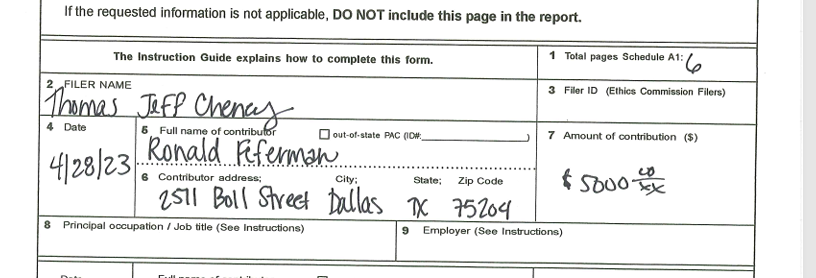
Fact, Ronald Feferman also donated $5,000 to Jeff Cheney in his last mayoral race in 2023 which can be seen on his campaign finance report.
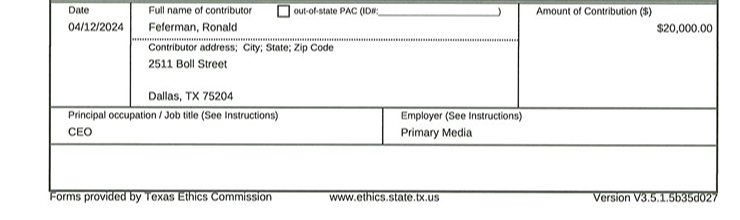
Fact, on a 2024 Campaign Finance Statement – John Keating shows a $20,000 donation made on 4/12/24 by Ronald Fefeman who is listed as the CEO of Primary Media!
Fact, a simple Google search reveals a memo that shows the Frisco City Council acted in August 2023 with Primary Media, LTD. The memo subject reads, “Consider and act upon authorizing the City Manager to execute the First Amended Settlement Agreement by and between the City of Frisco and Primary Media, LTD.”
The Mayor and City Council (including John Keating) voted 6-0 to approve the “Consent Agenda” and that included Item 18 about Primary Media, LTD. Interestingly the minutes read, Mayor Pro-Tem John Keating moved to approve Consent Agenda Items #15 through #32. Deputy Mayor Pro-Tem Angelia Pelham seconded the motion.”
Fact, according to Primary Media’s website, “Primary Media is a Dallas-based outdoor advertising company and the first digital billboard provider in Frisco, TX.” The website also lists Josh Feferman as the CEO of Primary Media and identifies Ronald Feferman as the Real Estate and Government Relations contact for the firm.
Just wondering, is there any possibility Josh and Ronald are one and the same as a simple internet search reveals the name Ronald Josh Feferman and R Josh Feferman as the names associated with Primary Media, or is it just coincidence?
Trust Is Broken
So here we are, staring at the glowing billboard in the room—the one that flashes $100,000 in bright, undeniable lights—and we’re supposed to just…not squint?
Because if Keatings claim is “I have not taken a dime from him over the years,” then how does a documented $20,000 contribution from Ronald Feferman in 2024 fit into that narrative? Is that a forgotten footnote…or a conveniently misplaced decimal in the story?
And if a $5,000 contribution went to Mayor Jeff Cheney’s campaign shortly before council action involving Primary Media, are we really expected to believe timing like that is just civic-minded coincidence? Three months. A donation. Then a council item. No raised eyebrows?
Maybe the bigger question isn’t about one vote, but about the next one. If another item involving Primary Media lands on the council agenda tomorrow, can John Keating truly walk into that discussion as a neutral party? Or does six figures—paired with prior contributions—quietly take a seat at the dais with him? Influence doesn’t always announce itself; sometimes it just shows up early, shakes a few hands, and waits patiently for the vote.
Keating is running for Mayor and his word MATTERS! He lied! He did take a donation in the past and it was not a small one! It was $20,000 dollars. Frisco deserves more than explanations that require this much interpretation. From a mayoral candidate, it deserves clarity that doesn’t change depending on which report you’re reading—or which microphone is on.
Because at the end of the day, this isn’t about one donation, or even one donor.
It’s about trust. Can we trust John Keating? No! Why?
He has made questionable personal decisions that became public.
He (along with Pelham) has taken dirty money in the past from Veton Krasniqi who was sued by Frisco ISD for back taxes of $24,000.
He (along with Cheney) took donations in the past from Phillip Carter who bilked millions out of elderly investors.
He promised, in writing, he would support 4-men staffing for Frisco Firefighters then went back on his word when an election was over.
He knows as a Mayoral Candidate someone is bound to fact check his statements. No one forgets a $20,000 donation less than two years earlier. The issues go on and on, and for once the public is asking whether the math adds up. In his stories, it usually doesn’t!
Disclaimer: This blog includes satire, parody, and comic relief. It contains summarized accounts created solely for humor and commentary. Any resemblance to real events is either coincidental or intentionally satirical. Reader discretion — and a sense of humor — are advised.
Previous Blogs About Campaign Finance Reports
Follow The $100,000 – about John Keatings recent donation from Frisco 380 Partners and fellow opponent Mark Hill
Follow The Money (Part 2) – about Shona Sowell and Rod Vilhauers campaign finance reports
Over the past 15–20 years, bringing “quality jobs” or corporate headquarters to Frisco has been a common campaign theme across many city council and mayoral candidates. As Frisco transitioned from a bedroom suburb into a regional employment center, candidates across political factions have run on platforms tied to economic development, corporate relocations, and high-wage job growth.
For communities like Frisco, smart corporate development isn’t just about landing big company logos—it’s about long-term financial health, balanced growth, and protecting taxpayers. Cities like Frisco have to think carefully about what kind of development they pursue and where it goes.
Mayor Cheney and other city leaders have frequently said Frisco “must pursue” major employers so the city becomes a regional job center instead of a commuter suburb. Cheney has emphasized pursuing large corporations and creating office districts where employees can live, work, and socialize.
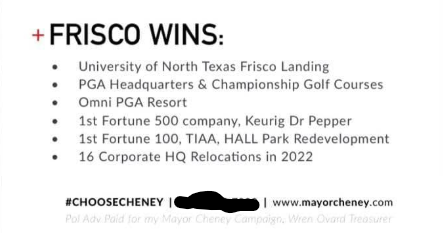
Lifestyle Frisco wrote an article in October 2019 titled “Mayor Jeff Cheney Announces Re-Election Campaign” which centered around Mayor Cheney’s own words. Cheney continues, he was seeking residents votes on May 2, 2020, so he can continue to bring more jobs, expand the tax base, create beautiful neighborhoods, and provide top tier entertainment. He notes that Frisco won our FIRST-EVER Fortune 500 relocation with Keurig Dr Pepper. He continues, the goal is to deepen our Sports City USA brand by adding the National Soccer Hall of Fame, professional lacrosse, and an esports team. His political mailer in 2020 listed his so-called wins. It still does not compare to Plano’s wins that will bring more high paying quality jobs that have a better economic impact to the city.
For years we have listened to candidates and current Council Members talk and campaign about bringing “high-paying primary jobs” to reduce commutes for residents, diversify the city’s tax base, and to support the city’s financial stability. In the most recent special election, we were shocked to learn our newly elected council woman, Ann Anderson stated she was glad that AT&T chose to relocate to Plano. Wait what?
Frisco Chronicles began to question have our city leaders fulfilled their obligations and promises to Frisco residents? Shockingly, no! Residents need to pay attention.
Frisco vs Plano Comparison
Who is the largest employer in each city?
Frisco: Frisco Indepenent School District – 8,800 employees vs Plano: JP Morgan Chase – 11,261 employees
Frisco vs Plano Economic & Corporate Landscape
Which city has added the most corporate jobs?
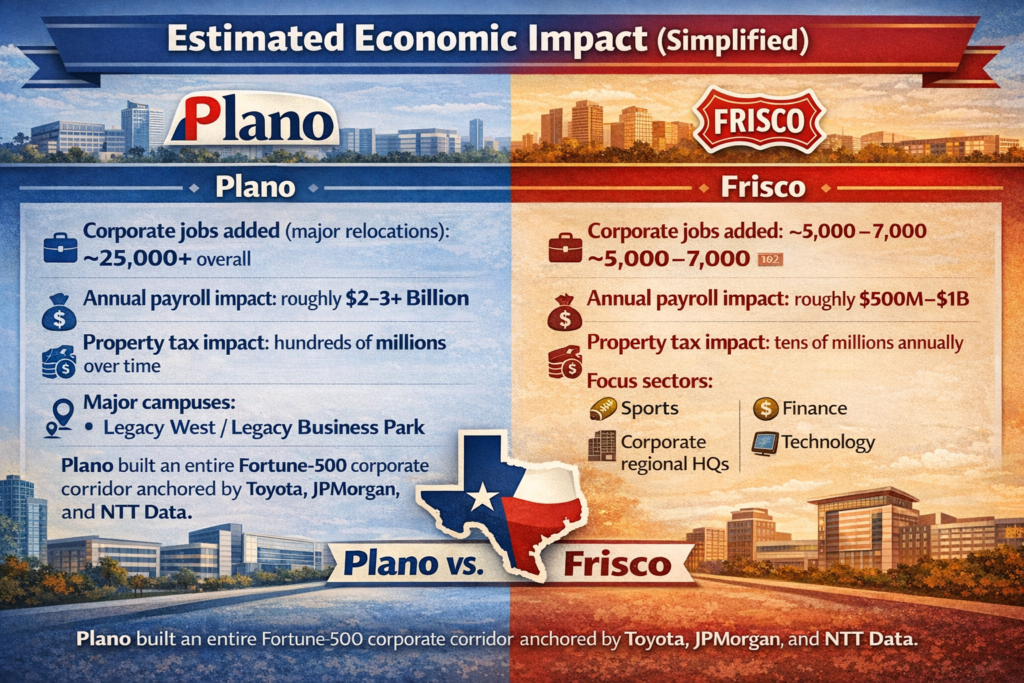
Frisco: 5000 to 7000 vs City of Plano: 25,000+
Which city has had the greatest Economic Impact?
Frisco Annual Payroll Impact: Roughly $500M to $1Billion vs Plano Annual Payroll Impact: Roughly $2 to $3 Billion
Frisco Property Tax Impact: Tens of millions annually vs Plano Property Tax Impact: Hundreds of Millions over time
Frisco
Major employers are a mix of private and public sector. Frisco has attracted some high-profile corporate offices, but its largest employers tend to be public sector or regional service-focused, rather than Fortune 500 headquarters.
The focus has been on building a diversified but smaller-scale corporate base rather than creating a dense Fortune 500 corridor.
There’s evidence of success in certain sectors, but less concentration of high-paying corporate headquarters jobs compared to Plano.
Plano
Plano has built a robust corporate ecosystem, especially along Legacy West/Legacy Business Park, attracting Toyota Financial Services, JPMorgan Chase, NTT Data, Fujitsu/Ericsson, and Capital One.
The city has successfully attracted major Fortune 500 companies which created tens of thousands of corporate jobs and generated billions in annual payroll and hundreds of millions in property taxes.
Plano’s strategy has emphasized large-scale corporate relocation and campus development, which creates a strong economic multiplier effect.
Community Impact Comparison:
Frisco’s Potential Issue: With a large portion of the top employers in the public sector, Frisco’s economic growth may be more sensitive to government budgets, policy changes, and public funding cycles, rather than the stable expansion seen in private corporate headquarters. This could limit long-term job growth and tax base expansion.
Resident Impact Comparison
Plano: Residents benefit from high-paying corporate jobs, a strong tax base that funds public services, and a built-in ecosystem that encourages additional businesses and amenities.
Frisco: While still attracting quality employers and offering amenities, the job base may be narrower in sectors that generate higher wages and broader economic spillover. Public sector dominance among top employers may limit diversity in employment opportunities.
WHO WINS: FRISCO OR PLANO
Plano emerges as the city with a more aggressive, high-impact corporate strategy that directly benefits residents through employment opportunities, payroll tax revenues, and large-scale infrastructure support.
Frisco has been moderately successful in attracting employers but may face long-term challenges due to the nature of its largest employers and a less concentrated corporate corridor.
ELECTION TIME: VOTE WISELY
You constantly here residents in Frisco complain they are tired of growth without infrastructure. Why is that? Because our city leaders have done nothing to reduce our commute to local jobs or bring quality paying jobs to our community. By putting a heavy emphasis on “TOURISM” and “HOSPITALITY” they have created more traffic issues and attracted less quality paying jobs.
A recent big win the city likes to talk about is Universal Kids Resort, which is bound to add to Frisco’s traffic congestion. City leaders are hoping that over the years tourist attractions will bring in enough tax revenue to offset what the corporate relocations could have brought to our community.
A search of the internet for jobs at Universal Kids Resort displays the following available jobs: Lobby Attendant, Quick Service Associate, Dispatcher, Full Time Lead Technician, Lifeguard, Ride Operator Attendant, Wardrobe and Costume Supervisor, and many more. The requirement a HS Diploma or GED, Customer Service Experience. No pay scale offered for any of the positions. Universal offers very few highly paid management positions.
We did find one job for a Senior External Affairs & Corporate Communications Manager which states a bachelor’s degree in political science, Public Relations, Communications, Business Administration or related field is required. It also says at least 7+ years of corporate communications, legislative, government or external affairs experience is required, or equivalent combination of education and experience.
Why is all this important?
Every election the same people stand before us and ask for our vote, and Frisco Residents who are none the wiser continue to just elect the same regime. The result is our leaders have failed to bring quality paying CAREERS to our community. This will affect us down the road when it comes time to paying the big bonds they have asked us to pass over the years.
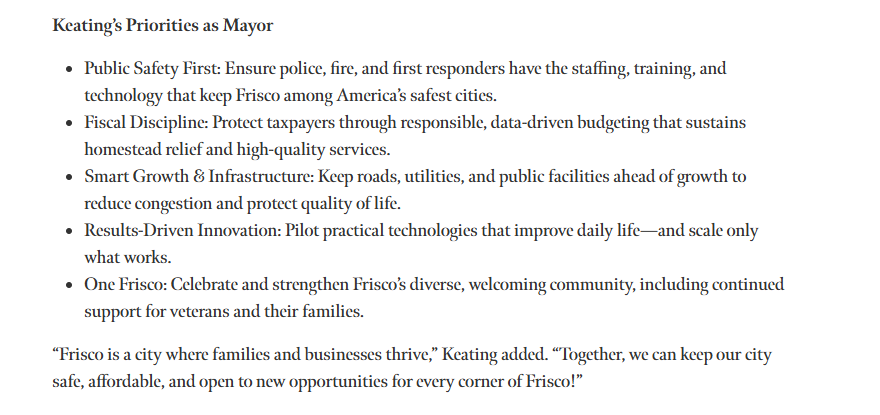
John Keating’s website brags he has served on the council “FOR MORE THAN A DECADE.” Frisco Chronicles is curious if he can name one Corporate Relocation (besides the PGA) that he pushed hard to win that brought high paying quality jobs to Frisco? Keating’s website lists his priorities as Mayor and not one of them directly states the goal to bring high quality CAREERS AND CORPORATIONS that protect taxpayers. He offers the same priorities just re-written that he has failed to complete before in his decade on the dais. Keating’s time is up!
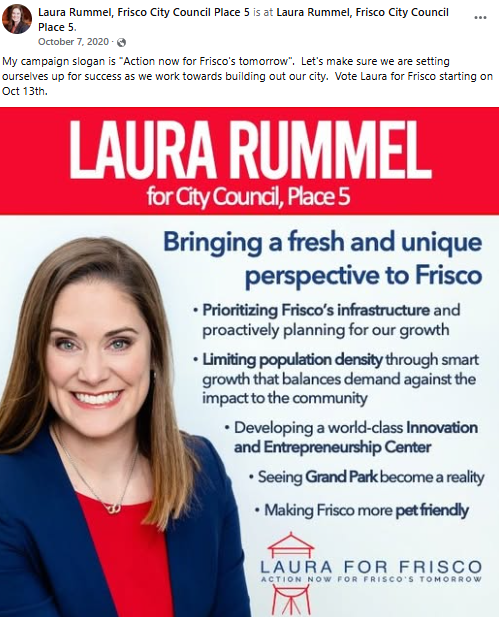
Laura Rummel is back to also ask for your vote! Her website states her priorities include Frisco’s infrastructure, smart growth by asking developers to offer smaller format housing options such as condos, townhomes, zero lot line home alternatives and fuel innovation and entrepreneurship. Her website states, “Start-ups typically provide slow and steady organic growth for the city, as well as bringing high-paying jobs, two attributes I would like to see us continue to recruit here to Frisco.
How will Laura Rummel help Frisco compete with Plano and the economic windfall they are having with corporate relocations? Rummel has had 5+ years on council now and she has no win to call her own! It takes a long time for startups to grow into a Capital One or AT&T and provide an economic impact to residents that we need here.
In closing, when will Frisco Residents say WE HAVE HAD ENOUGH AND WE WANT HIGH PAYING QUALITY JOBS THAT CREATE AN ECONOMIC IMPACT like other surrounding cities. The big wins Frisco claims are great, but they are nothing compared to our neighbor the City of Plano which has built one of the largest corporation corridors in North Texas. Plano employers include major financial institutions, corporate headquarters, tech firms, and large service centers that anchor Plano’s economy and make up a significant share of local jobs. A linear “corporate corridor” lined with major employer logos, emphasizing Plano’s role as a corporate hub
Frisco residents need to ask, “How will we repay the $1 Billion in debt we have?” Frisco leaders have dropped the ball and if you look down the road none of the “WINS” our current leaders like to claim will bring in the billions that major corporate relocations could have. At the last city council meeting you saw them approve a warehouse along the 121 roadway – is that the best use of that land or could it have gone to something else that would have brought in more high-quality paying jobs. Frisco’s future is not as bright as residents would think when it comes to financial stability. The One Billion in debt has to come from somewhere so where will it come from? Get Wise Frisco!
Disclaimer: This blog includes satire, parody, and comic relief. It contains summarized accounts created solely for humor and commentary. Any resemblance to real events is either coincidental or intentionally satirical. Reader discretion — and a sense of humor — are advised.
Largest Employers in Frisco
Employer
Sector
Employees
Frisco ISD
Education
~8,800
Dallas Cowboys
Sports & Entertainment
~2,000
City of Frisco
Government
~1,800
HCL Technologies
Corporate
~1,500
T-Mobile
Corporate
~1,300
Keurig Dr Pepper
Corporate
~1,200
AmerisourceBergen
Healthcare
700+
Baylor Scott & White Health
Healthcare
600+
Collin College
Education
500
Mario Sinacola & Sons
Construction
500
Oracle
Corporate
400
Baylor Medical Center of Frisco
Healthcare
450
Lexipol
Corporate
420
Top Employers in Plano, TX
Plano’s largest employers based on the most recent city and economic data (2025–2026 estimates):
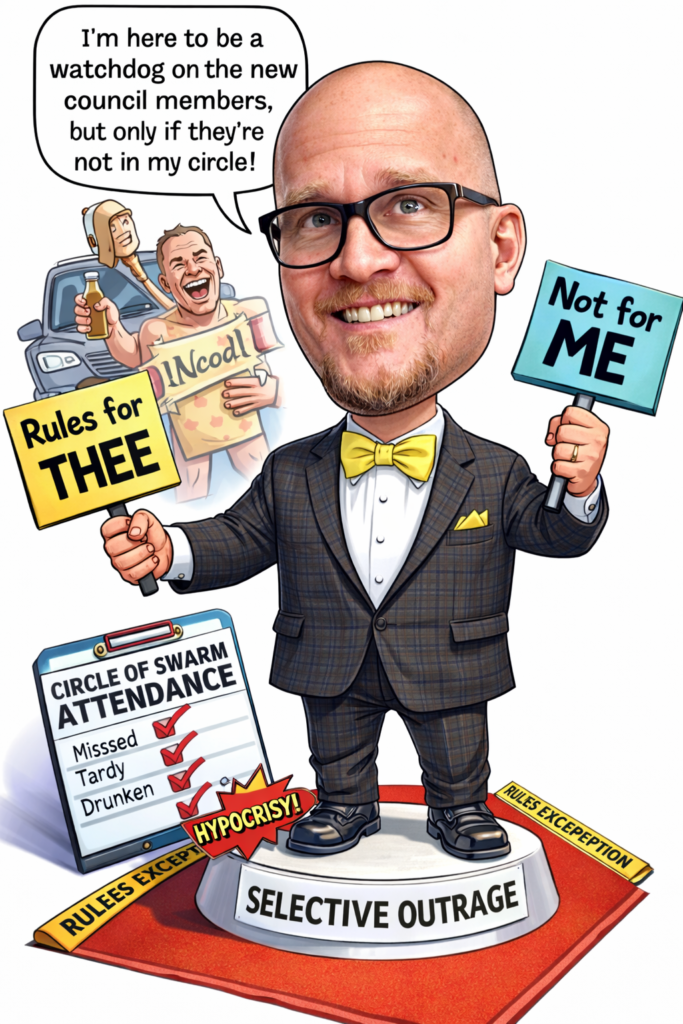
In politics, outrage is rarely accidental. It’s often carefully aimed, strategically timed, and—when necessary—conveniently forgotten. That’s what we call Selective Outrage: when politicians and their allies suddenly discover their moral compass, but only when it points at someone outside their circle.
On December 2, 2025, former Frisco councilman Bobblehead Bill Woodard stepped up to the podium during Citizens’ Input with a speech that sounded, at first, like a heartfelt defense of professionalism at City Hall. After all, according to Woodard, during his 20-plus years in Frisco one of the things he was “most proud of” was the professionalism shown by board and council members while serving on the dais.
Touching. Inspiring. Almost nostalgic.
But as the speech unfolded, what residents actually witnessed was less a thoughtful reflection and more what could best be described as an emotional support tantrum wrapped in a watchdog costume. By the time Woodard finished, his concern for the city’s reputation had been carefully aimed at two of the newest council members—members who, coincidentally, are clearly not part of the inner Frisco Swarm circle.
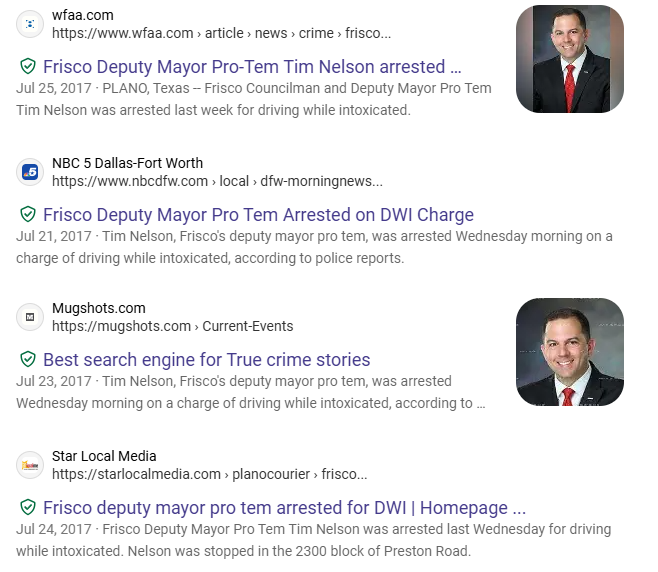
We’ve seen this movie before. In fact, we wrote about it in our earlier blog “Butt-Hurt Politics.” Because here’s the question no one asked from the podium that night: Where was this outrage before? Woodard didn’t rush to the microphone when former Frisco Deputy Mayor Pro Tem Tim Nelson was arrested for alleged drunk driving. There was no impassioned lecture about protecting the city’s reputation then.
He didn’t sound the professionalism alarm when John “Cheating” Keating was allegedly spotted a few years ago over a Fourth of July weekend at a community pool with a woman (not his wife) who happened to serve on one of the city’s boards.
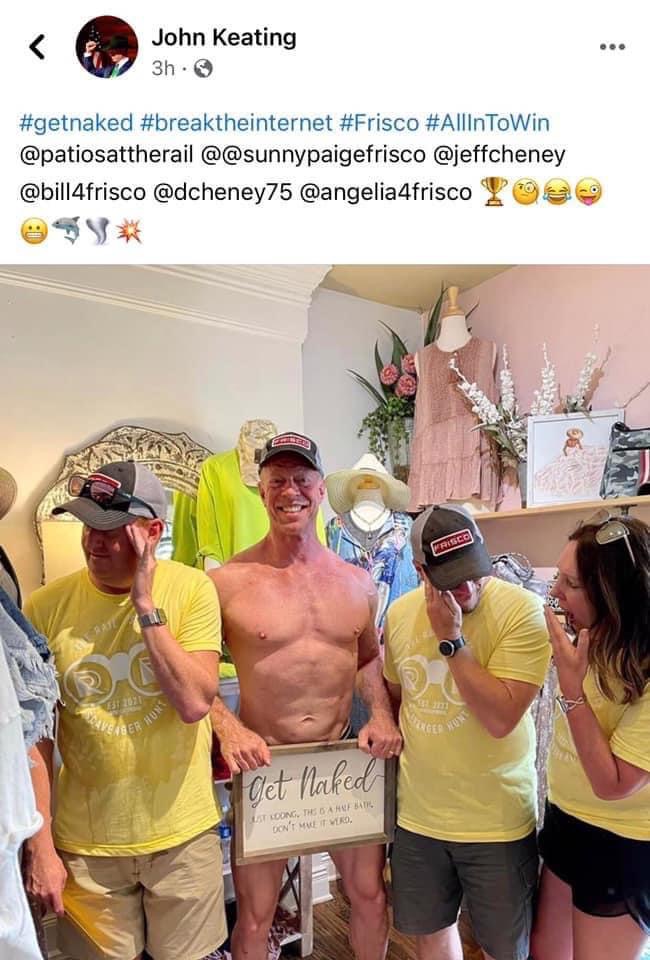
And apparently there was no emergency meeting of the Professionalism Police when Keating once posed holding a sign reading “Get Naked” over his private parts, creating the illusion he was standing there unclothed—while Mayor Jeff Cheney and the First Lady laughed along.
No speeches. No lectures. No watchdog warnings about Frisco’s reputation.
But suddenly, when two new council members stumble, miss a meeting, or crack a joke on the dais, Bobblehead Bill finds his whistle and climbs into the referee tower. That’s not accountability. That’s Selective Outrage.
From his self-appointed pulpit as an anonymous member of the Frisco Swarm, Woodard seems eager to call out mistakes made by newcomers while conveniently overlooking the long list of missteps made by those inside his own political circle. Even more interesting? After hearing Woodard’s lecture on attendance, preparedness, and professionalism, we decided to do something radical: We checked the receipts.
And what we found in the city’s own Governance Board meeting records raises a few questions about whether the standards Woodard preached on December 2 have actually been applied… consistently… fairly…or evenly. Spoiler alert: they haven’t.
But that’s where things get even more interesting. Because if Bobblehead Bill believes showing up late, missing meetings, or leaving early is a threat to the reputation of the City of Frisco… then residents deserve to know whether everyone is being held to the same standard—or just the people outside the Swarm. And that’s exactly what we started digging into.
According to Woodard, missing meetings, arriving late, or leaving early was not just disappointing… it was disrespectful to the citizens of Frisco and damaging to the reputation of the city. Those are strong words. So naturally, we decided to take Woodard’s advice and focus on the facts. If attendance and professionalism are truly the gold standard for serving the public, then it should apply to everyone—past and present. Right?
Let’s Check the Record: Previous Governance Meetings 2022 – 2025
We started by reviewing the Governance Board meeting minutes available through the city website. What we quickly discovered is that the online records are… incomplete.
Still, the minutes that are available tell an interesting story.
Here are a few examples:
June 23, 2022 – Bill Woodard was absent from the Governance Board meeting.
March 15, 2022 – John Keating was absent from the Governance Board meeting.
April 2, 2024 – Bill Woodard left the meeting early.
February 4, 2025 – Angelia Pelham arrived late to the Governance Board meeting.
Now remember Woodard’s speech. His words were clear:
“The citizens of Frisco expect and deserve representatives show up to do the work. On time and prepared.” Fair enough. But if attendance issues are grounds for public lectures at Citizens’ Input, it seems reasonable to ask: Does that standard apply to everyone—or just certain people?
The Curious Case of Missing Minutes of 2026
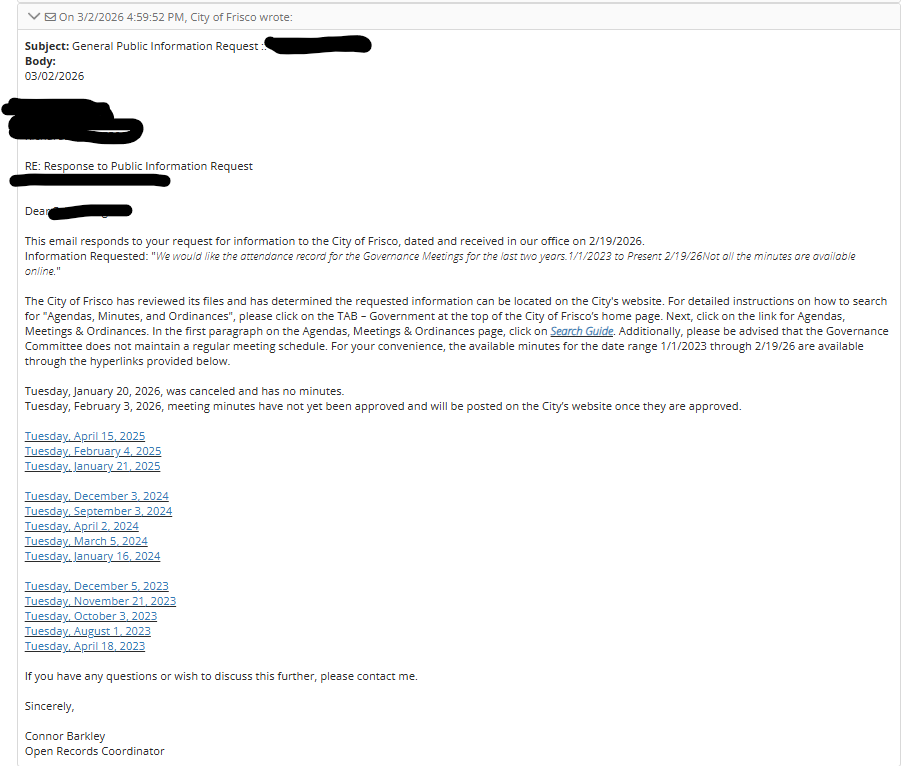
On February 19, 2026, Frisco Chronicles filed a Public Information Request (PIR) asking the City of Frisco for attendance records for Governance Board meetings from January 1, 2023, to the present. We also noted in the PIR that not all meeting minutes appear to be available on the city’s website.
The city responded on March 2, 2026 with a simple explanation:
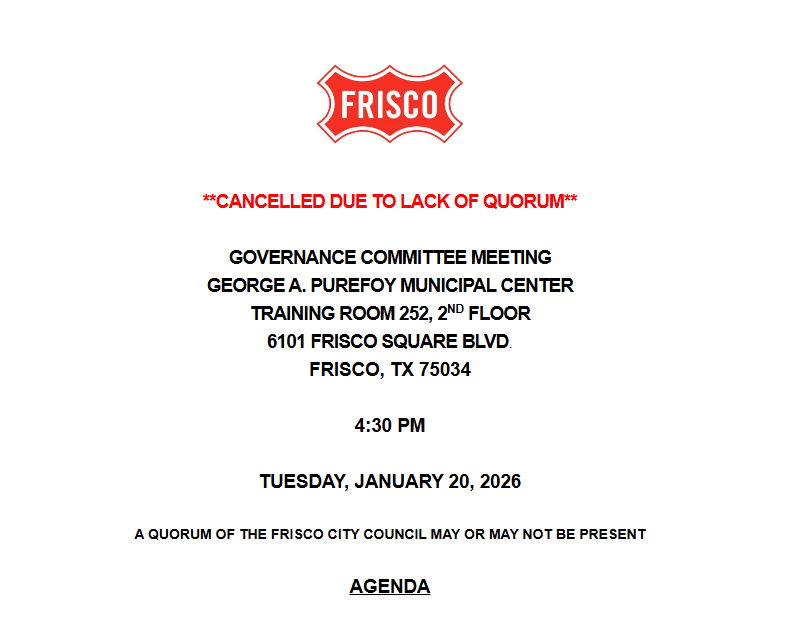
January 20, 2026 meeting shows it was canceled due to lack of quorum. No explanation was provided as the minutes are not posted to the city website.
February 3, 2026, minutes have not yet been approved, so they are not posted.
Then the city closed the request with the status: “Information on Website.”
Things got even more interesting when we looked at the 2026 Governance Board meetings minutes online at the city website.
According to a city insider, the January meeting reportedly lacked quorum because Burt Thakur and Jared Elad misunderstood the meeting date. The next meeting on February 3, a city insider told us the meeting was delayed 20 to 30 minutes because Angelia Pelham arrived late. But since the minutes aren’t publicly posted, residents can’t verify what actually happened. So, we did what any curious citizens would do.
Which raises a simple question: If the minutes exist but just haven’t been approved yet… why not post them with a note that they are subject to approval? Many cities do exactly that in the interest of transparency. But apparently in Frisco, some information moves at the speed of government… while outrage moves at the speed of politics.
The Real Question
Bobblehead Bill Woodard pretends to have an independent point of view and clearly has no issue stepping up to the podium to lecture two new council members about attendance and professionalism. Yet when members of the Frisco Swarm, including himself, miss meetings, arrive late, or leave early, the watchdog appears to take a nap.
No speeches. No Citizens’ Input lectures. No public scolding about the reputation of the city. That’s not accountability.
That’s Selective Outrage.
But Wait… There’s More
After hearing Woodard’s speech about high expectations, we decided to take the research one step further. How many council meetings or work sessions have sitting members council members been late to or been absent from? And, because council members aren’t the only ones expected to show up and do the work we looked into the dozens of boards and commissions, filled with citizen representatives, many of whom were appointed by the same political circle now demanding perfection from others.
The next logical question is simple: Do those appointees meet the same attendance standards? Or does the outrage stop there with just two new council members? That’s exactly what we started digging into next. And what we found might surprise you.
Stay tuned for Part 2: The Attendance Records of City Council and City Boards and Commissions
Disclaimer: This blog includes satire, parody, and comic relief. It contains summarized accounts created solely for humor and commentary. Any resemblance to real events is either coincidental or intentionally satirical. Reader discretion — and a sense of humor — are advised.
If you haven’t read Part 1 — “Mute The Mic?” — stop right here and go do that. Seriously. The backstory matters. The motives matter. The timing matters.
In this second installment, we’re breaking down the specific “procedural adjustments” being floated by the Frisco City Council — the technical tweaks that may sound harmless, even boring. They’re not.
This is where policy language meets practical impact. This is where the fine print decides who gets heard — and who gets managed. Let’s walk through it.
The Proposed Adjustments – aka Changes Discussed
When the Frisco City Council starts discussing “procedural adjustments” to public comment, Frisco Chronicles pays attention. Because history teaches us something simple: rights are rarely taken all at once. They’re trimmed. Tweaked. Managed.
What’s being proposed may sound administrative. It is not. Let’s walk through it.
Eliminating Public Comment on Non-Agenda Items Entirely: When the idea of eliminating public comment on non-agenda items even enters the room at the Frisco City Council, that’s not a small tweak — that’s a philosophical shift.
And let’s address the example offered by Jeff Cheney about the resident who says, “I know it’s not on the agenda, but I don’t want you to build the dog park next to my neighborhood, and I’m going to come every meeting and tell you that.” Here’s the uncomfortable truth: that residents have every right to do exactly that. When you ran for council, you knew that, sorry it inconveniences you now!
Non-agenda public comment exists precisely because government action is continuous, not episodic. It allows citizens to raise red flags before decisions are finalized. Eliminating it because someone might show up repeatedly is not governance — it’s discomfort management.
And let’s be candid: repeated speech is often a sign that someone feels unheard. The First Amendment does not protect speech only when it is convenient, concise, or agreeable. It protects persistence. It protects dissent. It protects the person who refuses to quietly accept a decision that affects their home, their taxes, or their quality of life.
Eliminating the entire category of non-agenda comment is using a sledgehammer where a scalpel would do. The residents worried about a dog park isn’t a problem. The MAYOR & COUNCIL who PREFERS NOT TO LISTEN or wants fewer microphones is.
Separating Agenda and Non-Agenda Comments: On paper, this sounds orderly. In practice, it fragments citizen speech. This one does not concern us to much because most cities have citizen input for non-agenda items and if you want to speak on item on the agenda you have to do so when the item is up before the council.
Moving Non-Agenda Comments to the End: Translation: Speak when the room is empty and the cameras have gone dark. Pushing non-agenda speakers to the end of long meetings discourages participation, particularly for working families, seniors, and parents. Public comment should not be a stamina contest. If the only people who can speak are those who can wait four hours on a Tuesday night, that is not expanded access — it’s filtered access.
Limiting Time Per Speaker: Time limits can be lawful, but when time limits tighten while the city grows, that sends a message. The First Amendment allows reasonable time and place. If reductions disproportionately silence critical voices or complex issues, the policy may be lawful on paper yet corrosive in practice. Efficiency is not a constitutional value. Liberty is.
Limiting Non-Agenda Comments to Every Other Meeting: This is not “streamlining.” It is rationing speech. Residents don’t experience government every other week. Development decisions, taxation, zoning conflicts, policing issues — they happen continuously. Restricting when citizens may address their government reduces immediacy and weakens accountability. The public does not work on a municipal convenience schedule.
Requiring ID to Speak: This is where the concern becomes serious. The Supreme Court has repeatedly affirmed the importance of anonymous speech in American history. From the Federalist Papers to modern whistleblowers, anonymity protects dissent. Requiring identification to speak at a public meeting can create a chilling effect, particularly for city employees, contractors, or residents afraid of retaliation. Public meetings are not airport security checkpoints. Citizens should not need to present papers to address their own government.
Requiring Speaker Cards to Be Completed in Full: If “in full” includes personal data, that again raises chilling-effect concerns. The more personal information required, the fewer people will participate — especially in contentious matters. Participation should be easy, not intimidating.
Deadlines for Submitting Speaker Cards: Reasonable structure is one thing. But rigid deadlines can be used to cut off spontaneous response to late-breaking discussions. Government agendas sometimes change mid-meeting. Citizens should not be locked out because a clock expired before the conversation evolved. Democracy is dynamic. Policy should reflect that.
Electronic Speaker Card Systems: Technology can increase efficiency — or create barriers. What about seniors? What about residents who are unfamiliar with digital systems? What about technical failures? If an electronic system becomes a gatekeeper participation could shrink.
Moving The Lectern To Avoid Having Audience Members Visible: It may sound like this is a cosmetic change, but it isn’t. It changes the psychology of transparency. Public meetings are not just about what is said at the podium. They are about the visible presence of the public itself. When viewers at home can see residents sitting behind a speaker — nodding, reacting, filling the chamber — it communicates something powerful: this issue matters to the community.
Moving the lectern would diminish the perception of public engagement. It creates a sterile controlled optic. It also weakens accountability through optics. Typically, elected officials are influenced — consciously or not — by visible public presence. A room full of residents’ signals urgency and concern.
The Bigger Issue
Individually, each proposal might be defended as minor. Collectively, they form a pattern: narrowing access, adding procedural hurdles, and shifting citizen input toward the margins of the meeting.
The First Amendment does not guarantee unlimited speaking time at a council meeting. But it does guard against policies that chill speech, discriminate by viewpoint, or unnecessarily burden the public’s right to address its elected officials.
Public comments are not decorative. They are not ceremonial. When residents begin to feel that speaking is inconvenient, risky, overly bureaucratic, or futile, civic engagement declines. Trust erodes. Suspicion grows. And once trust erodes, no ordinance can fix it.
One Voice For Free Speech
According to Community Impact, Burt Thakur, who received several comments directed at him during the February 3rd meeting, expressed concerns about taking action to restrict public comment.
Thakur was quoted as saying, “I think that the First Amendment is sacrosanct—and while I am the recipient of some of the invectives that have been hurled—I do think that there’s a very slippery slope the moment a governmental body shuts down someone’s right to speak, even if it’s odious, even if it’s something I think is absolutely morally reprehensible.”
Thank you Mr. Thakur and we hope you vote against changes to citizen’s input to protect residents of Frisco.
In Closing
Frisco is one of the fastest-growing cities in Texas. Growth demands more transparency, not less. More access, not fewer opportunities. The microphone at City Hall is not a courtesy extended by elected officials. It is an extension of the people’s voice. Those who pay taxes and spend money in our city have the RIGHT to speak. Policies that make that voice harder to use do not strengthen governance. They weaken it.
What is this about? What is the real motive behind the proposed changes? Do you really think it is about Palestinians, Agitators, Muslims and/or Indians? Probably not. This is about Mayor Jeff Cheney being questioned out loud, on the record, about campaign donations, his business, and his ethics as Mayor. This is about the council members who ran for office knowing they would have to face criticism now trying to neutralize it.
Instead of the proposed changes maybe the council should let Frisco Residents Go First! Let those who are stakeholders in our community Go First! Allow Frisco’s diversity of voices to speak.
Proposing to move citizen input to the end of the meeting would be disrespectful. If you have not been to meetings lately, our current council is usually 30 minutes, to 1 ½ hours late to start. Now you are asking residents to wait till the end of the meeting after they have already sat through your disrespect of being late. The goal of this is to make them go home, give up and lose the will to speak. That is not what the Texas Open Meetings Act stands for.
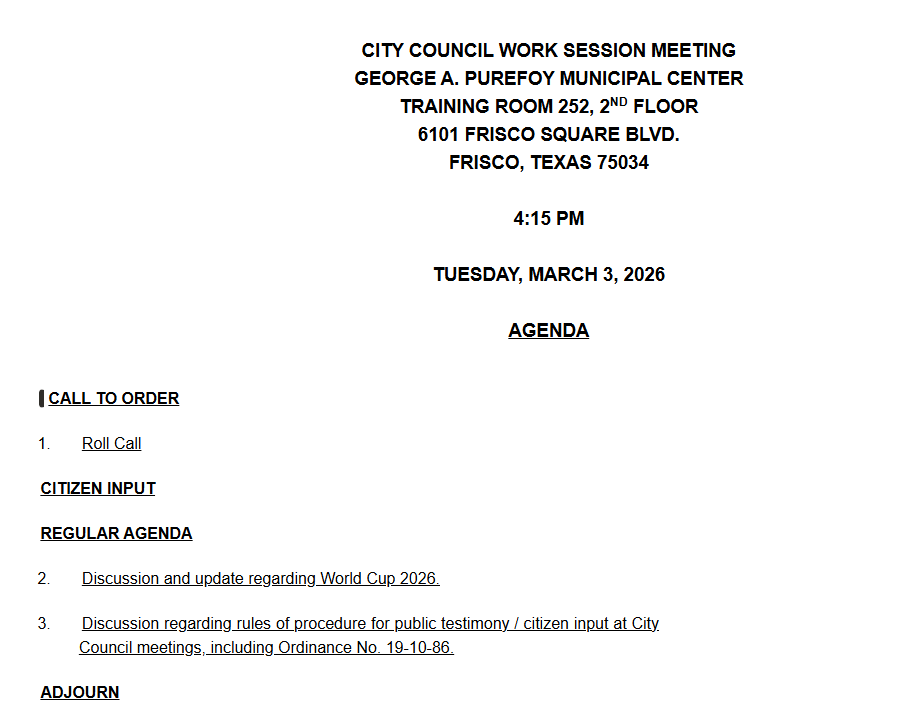
SHOW UP, STAND UP, SAY NO – MARCH 3RD: The city is holding another city work session and, on the agenda, PUBLIC TESTIMONY. The agenda reads it will be held in the Municipal Center (City Hall) second floor training room (Room 252). The meeting starts at 4:15 and if you want to be heard on this issue, then you had better show up and tell them no at the work session. This is the time you must voice your opinion.
WAKE UP FRISCO: The same people proposing to limit our speech are running for office again in a few weeks. DO NOT RE-ELECT THOSE WHO WANT TO TAKE AWAY OUR GOD GIVEN RIGHT BY LAW TO SPEAK.
Disclaimer: This blog includes satire, parody, and comic relief. It contains summarized accounts created solely for humor and commentary. Any resemblance to real events is either coincidental or intentionally satirical. Reader discretion — and a sense of humor — are advised.
The agenda for the February 17thcity work session reads, “Discussion regarding rules of procedure for public testimony / citizen input at City Council meetings, including Ordinance No. 19-10-86.”
Translation? The microphone is under review.
That leaves Frisco Chronicles asking the obvious question: why now? Why would Mayor Jeff Cheney and the Frisco City Council consider changing public testimony (aka citizen input) at City Council Meetings?
Is it because they are tired of hearing from local Palestinian residents?
According to Community Impact, “City attorney Richard Abernathy said council members previously asked him to review their options for changing the public comment policy when there was an issue about the Palestinians.”
Is it because they are tired of being questioned about inappropriate campaign contributions?
Is it because they are tired of hearing from the T-Mobile Whistleblower?
Is it because they are tired of agitators?
Just look at the Community Impact article that quotes Mayor Jeff Cheney as saying, “It has always been where agitators have moved along, but it’s becoming increasingly likely that this is not going away.”
Not going away? That is called civic engagement!
Let’s not forget: those same “agitators” also brought out our Frisco Community & Indian Community who stood at the podium and spoke about why they Frisco and call it home. Funny how public particpation works – when one group speaks, others feel empowered to speak too.
SELECTIVE TOLERANCE IS NOT LEADERSHIP
Point blank: if the motivation for changing citizen input rules is fatigue with certain voices — whether they are Palestinian residents, whistleblowers, critics of campaign donations, so-called agitators, or members of our Indian community — then the problem is not public comment.
The problem is selective tolerance from our Mayor and City Council.
Democracy does not work on a loyalty punch card. You don’t get to pull out the Muslims, Palestinians and Indians at election time and then put a mute button on them afterward. Communities are not props during campaign season and inconveniences during governing season.
Public office requires hearing from people you disagree with. If policy changes are driven by discomfort with who is speaking rather than how meetings are conducted, that erodes trust. And when trust erodes along cultural or political lines, communities understandably perceive bias — whether intentional or not.
Frisco’s strength has always been its diversity of voices: long-time residents, business owners, activists, skeptics, immigrant families, and yes — persistent neighbors worried about dog parks. Silencing or sidelining any segment because their message is inconvenient sends a dangerous signal: you are welcome to vote, donate, and celebrate growth… but not to challenge power. Last I checked … That is not the spirit of the First Amendment. And it is not the Frisco many residents believe in.
Current Citizen’s Input Policy – What’s the Emergency?
Back to the work session, we want to learn more but the minutes for this meeting have not been published on the city website. Without minutes or a video tapped work session, how are residents supposed to have transparency? At least we have Community Impact, who was able to write a full story about the agenda item.
The article reads, “Frisco City Council is considering changing the rules for public input at council meetings. City officials said the move comes after a Feb. 3 meeting where 23 people, including several who were not Frisco residents, spoke about perceived demographic changes in Frisco during the public comment period.”
The current policy allows people who want to speak during citizen input to submit a speaker card at any point during the meeting. They are given five minutes, unless there are 10 or more speakers on the same agenda item which allows them to reduce the time to 3 minutes.
Twenty-three speakers. In one of the fastest-growing cities in Texas. Seems like a drop in the bucket.
Next, we are going to look at the proposed changes being considered by our Mayor and Council.
What could they be?
Who was the 1 council member who voiced concerns for changes?
What is this really about?
Come back for Part 2: Frisco’s “Public Input Problem”
Disclaimer: This blog includes satire, parody, and comic relief. It contains summarized accounts created solely for humor and commentary. Any resemblance to real events is either coincidental or intentionally satirical. Reader discretion — and a sense of humor — are advised.
Back in 2023, one of our earliest blogs focused on the Texas Public Information Act — the law that ensures citizens have access to records showing what their government is doing on their behalf. Transparency is not a courtesy; it is a legal obligation.
Since then, residents regularly contact us with questions about Public Information Requests (PIRs). Sometimes they’re confused by the process. Sometimes they’re overwhelmed by what they receive. And sometimes, they suspect they’re being buried in paperwork rather than given what they actually asked for.
Recently, a resident forwarded several PIR responses and expressed frustration. They felt they were being flooded with documents but not real answers. They hoped we might spot something they missed.
We did!
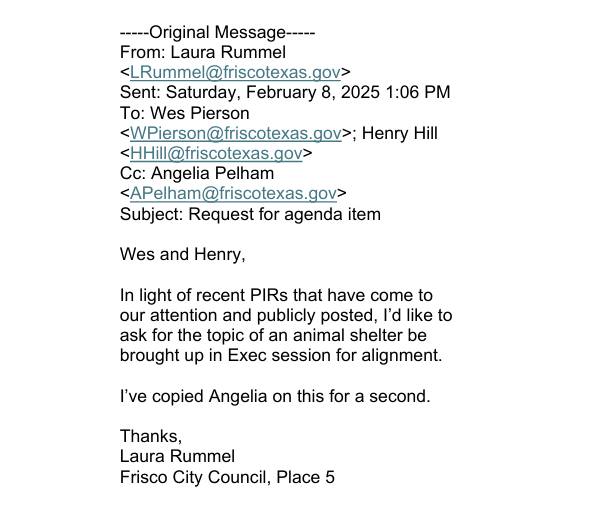
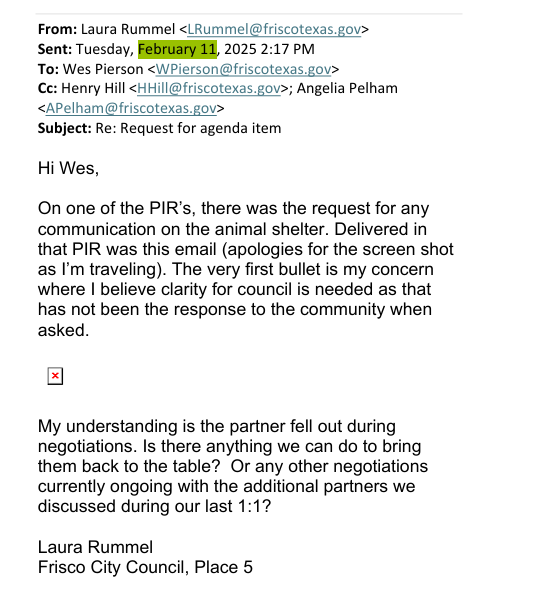
Among the documents was a February 8, 2025 email from Councilwoman Laura Rummell to City Manager Wes Pierson and Assistant City Manager Henry Hill, with Angelia Pelham copied:
“In light of recent PIRs that have come to our attention and publicly posted, I’d like to ask for the topic of an animal shelter be brought up in Executive Session for alignment.”
Let’s pause right there. “In light of recent PIRs…”
Not pending litigation. Not a personnel matter. Not real estate negotiations.
PIRs.
The Pushback
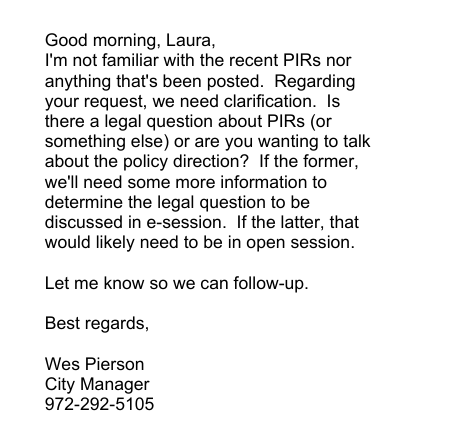
On February 11, 2025, Pierson responded that he was not familiar with the recent PIRs or what had been posted. He asked for clarification: Was there a legal question related to the PIRs? Or was she seeking policy direction?
He stated clearly that if it was policy direction, it would likely need to be discussed in open session.
Avoiding public scrutiny — or reacting to public records requests — is not on that list.
Separately, the Texas Public Information Act governs what records must be released. You do not make something confidential simply by discussing it in executive session. Closed doors do not create confidentiality by magic.
Why Copy Angelia?
Rummell copied Angelia Pelham “for a second.”
A second what? A second vote? A second opinion? A second set of marching orders?
We are not alleging how anyone would vote. But when one council member seeks “alignment” on moving a controversial topic into executive session — particularly in response to public records being released — reasonable citizens are going to ask reasonable questions.
Council members are permitted to discuss city business in limited ways. But deliberating outside public view in ways that circumvent open meeting requirements is exactly what TOMA was designed to prevent.
“Receive legal advice regarding proposed interlocal agreement with Collin County, Texas, and other political subdivisions for the use of the Collin County Animal Shelter and related issues.”
The Animal Shelter and proposed holding facility have been one of the most discussed issues in Frisco over the last several months. Residents have raised concerns at town halls, council meetings, and special sessions. So why is such a heavily debated issue about the Collin County Animal Services ILA headed into executive session?
Legal advice can properly be discussed in closed session. But policy direction? Alignment? Messaging? Those belong on the dais — under the lights — where the public can hear it.
The Consent Agenda Shuffle
Then there’s Item #24 on the Consent Agenda: An annual contract modification for payment to Collin County in the amount of $651,774 — along with rescinding prior council approval from February 3, 2026.
For those unfamiliar, consent agenda items are typically passed in one vote with little to no discussion unless pulled by a council member. A $651,774 contract modification tied to a controversial shelter arrangement seems like the kind of item that deserves public discussion — not a quiet glide path.
This isn’t about whether the city can receive legal advice. It can. This isn’t about whether executive session is ever appropriate. It is.
The question is motive. If executive session is being used as a shield in response to public information requests — if alignment is happening out of view of the public or because documents became public — then that is precisely what TOMA was designed to prevent.
Transparency does not end where discomfort begins.
Spotlight Moment
We have serious concerns and YOU SHOULD TOO!
A councilwoman asking to move a hot-button issue into executive session “in light of recent PIRs.” A city discussing a controversial shelter agreement behind closed doors. A six-figure contract modification sliding onto the consent agenda.
Maybe it’s all perfectly lawful. Maybe it’s all procedural. Maybe it’s all coincidence.
Or maybe Frisco residents are simply asking to see their government operate in the sunlight instead of the shadows.
Laura Rummell has championed this holding facility which many local animal advocates OPPOSE and calling it a Temporary Execution Hold Facility. Rummell’s email states, “the very first bullet is my concern where I believe clarity for the council is needed as that has not been the response to the community.” What response have you all been giving the community? Is this an admission they have been feeding the public one thing when in the background they are either doing something else or have no plan at all?
If everything is above board, then put it above the table. Discuss it openly. Debate it publicly. Vote on it transparently.
Because when public records trigger closed doors, citizens don’t stop asking questions. They start asking better ones like Laura Rummell, what are you hiding?
Links:
The Public Information Act Handbook can be found on the Texas Attorney General’s website and lays out the “how-to” to do open record requests.
Disclaimer: This blog includes satire, parody, and comic relief. It contains summarized accounts created solely for humor and commentary. Any resemblance to real events is either coincidental or intentionally satirical. Reader discretion — and a sense of humor — are advised.








I went to her to ask for help with an issue my child that was getting nowhere with the school,…
So whatever became of the $17 million dollars that the city council gave the Mayor to beautify a drainage ditch?
At last count, there are 3 different "spa/massage" businesses in the small office park at the northeast corner of John…
I literally just saw this. Yeah, she used to forward everybody’s emails behind their backs.
You're dropping truth bombs! These mom and pop shops are what should be the least of Karen's worries. If they…