Most cities and corporations use executive and senior-level search firms to hire the best of the best for important positions. According to open records, Affion Public appears to be one of the City’s go-to firms for executive and senior-level searches.
More importantly, recent 2026 recruiting activity shows Affion Public actively handling City of Frisco searches, including the Assistant City Manager search. A “Careers in Government” listing also identifies Affion Public as the recruiting firm for a City of Frisco executive search. The use of outside search firms is confirmed by the city’s website which reads, the city’s personnel policy uses outside search firms for executive, senior professional, and management positions when its normal recruiting process doesn’t quickly produce suitable candidates.
One important distinction: they don’t appear to handle most ordinary City jobs. The city generally recruits those positions directly through its own HR department and online application system.
Questionable Hiring Search
Back in April of 2026, when the city announced Fire Chief Lee Glovers retirement, Frisco City Manager Wes Pierson told Local Profile, “He will begin searching immediately for the next chief.”
According to information provided to Frisco Chronicles the City of Frisco hired Clear Career Professionals to conduct a nationwide search for the next Frisco Fire Chief. Frisco Chronicles knows the city likes to do things the “The Frisco Way” when it comes to operations. That is why Clear Career Professionals was a surprise when Affion Public was the city’s go-to-firm for years.
The fact is, a change in vendor can be perfectly legitimate, but the reason for the change may still be worth public scrutiny, leaving Frisco Chronicles with some important questions.
Question 1: Will the search be nationwide? Clear Career Professionals website describes it as a Texas-based professional recruiting and consulting firm. So, why not use a nationwide search firm? Will they publish the top 5 finalists for the job and hold a community meet and greet?
Question 2: When did the “SEARCH” start? Frisco Chronicles has not been able to determine the “TRUE” start date when Clear Career Professionals started the search process. Remember Wes Pierson said in April 2026, he will begin searching immediately for the next chief. The Clear Career Professionals website shows they posted the position on August 15, 2026.
Frisco Chronicles wants to know why the position was not posted on the Texas Commission on Fire Protection’s website? We did a search on August 22, 2026, and there is no job listed for City of Frisco?
Clear Career Professionals, a Texas-based firm, should know to post the job on the Texas Commission on Fire Protection if they have search experience in Fire Service Organizations. Why the delay in posting it to TCFP Careers? Frisco Chronicles did a new search today and guess what we found .. the job is now posted.
Question 3: Was the city aware of any potential relationships that could be an issue when choosing Clear Career Professionals? According to Frisco Chronicles sources inside the city a few have raised concerns about the selection of the firm, its leadership, and relationships involving people connected to the Frisco Fire Department.
At the bottom of the job posting, it lists the names of Michael Boese – President of Clear Career Professionals and Daniel T. Kistner as a Vice President. Immediately we wanted to know if Daniel Kistner doing the search was related to Frisco Fires Assistant Fire Chief, Kelly Kistner. From what we found there is NO FAMILIA RELATIONSHIP between the two gentlemen, however Kelly Kistner’s name will come up again in our investigation.
The Relationship Puzzle
Frisco Chronicles is going to put together a puzzle for you of these relationships. Daniel Kistner (search firm) previously served as the Assistant Fire Chief for the City of Garland. Les Stephens also began his career at the City of Garland. Why does that matter? If our source is correct in that Les Stephens is the front runner for the job, Frisco Chronicles wants to know if Daniel Kistner picked Stephens because he is the most qualified or because of a 30-year friendship. Was Stephens chosen because he was the best candidate or because he is Kistner’s buddy?
Remember the name Kelly Kistner, the current Assistant Fire Chief in Frisco, well we have learned he worked for Les Stephens (leading candidate), previously when he was with the San Marcos Fire Department. The source says they are good friends and that Kelly Kistner is allegedly quietly advocating for the Former San Marcos Fire Chief Les Stephens.
Does the relationship between Daniel Kistner and Les Stephens have anything to do with why Clear Career firm was chosen? Frisco Chronicles has not independently established that the recruitment firm was selected specifically because of any relationship with Les Stephens, nor have we established or believe that Kelly Kistner has attempted to influence the selection process. However, the influence of relationships is a legitimate public-interest question in Frisco based on its history.
Question 4: Is Les Stephens, the Former Fire Chief of the San Marcos Fire Department a front runner in the search?
Les Stephens career speaks for itself. He spent 15 years with the San Marcos Department and has been recognized as Texas Fire Chief of the Year and inducted into the Texas Fire Service Hall of Honor. He seems well respected by others in the Texas Fire Services industry. Frisco Chronicles also learned the Les Stephens applied for the Frisco Fire Chief position in 2023 before they appointed Goofy Glover as the new Chief. Stephens later withdrew his application because he worked out a deal with San Marcos to stay on as Fire Chief.
Residents, taxpayers and possibly some fire fighters would like to know where he stands on the new 24/72 or 48/96 work model? While San Marcos already works on a flex schedule we have been told by a San Marcos local that Les Stephens did not like the flex models as much his Assistant Chief. So, where does Les Stephens stand on some type of flex work model?
Can Les Stephens rebuild a department as described in the 2011 Climate Report? He is walking to a department that was led for years by bad leadership, then in 2012 new leadership came in but the bad leaders still on the payroll worked against him behind the scenes and after he left, they brought back the leadership, being Lee Glover, who was mentioned in the 2011 Climate Report as part of the problem in the department.
When Glover was named Fire Chief in 2023, internally the department fell back years hurting our front-line firefighters. Ordering more bulky apparatuses which have a hard time maneuvering our city streets and traffic. Promotions were handed out based on friendships and not actual qualifications. The act of managing by fear and intimidation came right back up to the surface.
Does Les Stephens have what it takes to rebuild a department that is 2 to 3 times the size he has ever managed? A 2020 article by KXAN discussed how Stephens would like to hire 33 new firefighters to keep up with growth at the time in San Marcos. The article states, “Right now, the department staffs a minimum of 17 firefighters per 24-hour shift (though a typical shift is 22 firefighters).” Compare that to Frisco who needs a minimum of 62 per shift.
We would also like to know the plan Les Stephens has to rebuild the fire fighter’s relationship with the city management and city council members which has been in turmoil for several years now. Our city leaders know when to show up for a selfie with the department, but they don’t actually know how to stand up for the fire department
It sounds like Les Stephens is the front runner because he aligns with what Wes Peirson wants which is the same reason San Marcos maybe happy to see him go… As an Anti-48/96 Fire Chief.
If Les Stephens is the new fire Chief – we will welcome him. However, I would still like to know if he was chosen because he is the best of the best, because he has solutions to Frisco’s issues, that he will be a voice for our firefighters and residents. I hope he is not leading the pack because he has relationships with the recruiting firm and an Assistant Fire Chief already in the city and he will be a YES MAN FOR WES PIERSON.
Final Thoughts
We have hired a city manager with no experience running a city the size of Frisco which was a mistake. Now the city is considering hiring a Fire Chief who has never managed a fire department of this size. The concern with that is Frisco operates ten stations (62 minimum staff) and staffs eight engine/quint companies, three truck companies, a heavy rescue, HAZMAT/EOC unit, seven ambulances and a squad around the clock over 64 square miles.
Compare that to San Marcos which operates six stations and describes six fire districts covering about 39.9 square miles. Its website says it has three engines and three quints, with a minimum of three firefighters on each apparatus. Stephens would be walking to a considerably larger and more heavily resourced operation.
ISO Comparison
Frisco has maintained an ISO Class 1 rating since 2000. That puts Frisco among the very highest-rated fire departments nationally and in Texas. Stephens in San Marcos maintained a Class 2 in most of the city, with some areas classified 2X or 10 because of distance from hydrants or stations
EMS
One of the bigger changes is EMS. Frisco’s Fire Department operates its own EMS apparatus. Its current configuration includes seven ambulances staffed around the clock. San Marcos is different. The city’s website says that while ambulances are housed at San Marcos fire stations, San Marcos-Hays County EMS operates the ambulances.
Current Challanges
Les Stephens on paper looks like a great candidate for a Fire Chief but maybe for a slightly smaller department. Frisco Chronicles is having a hard time believing the city conducted a Nationwide Search for a Fire Chief and Les Stephens is the supposed front runner.
The operational challenge alone is enough to be concerned, but these Chiefs have never dabbled in internal city politics in a place like Frisco. From this point of view, it appears Wes Pierson the YES MAN to the council is trying to hire his own YES MAN to himself in a Fire Chief.
Lastly, taxpayers have the right to know if Frisco is conducting a genuinely open nationwide search, or is the search process simply being used to formalize a decision that has effectively already been made? Those are two very different things. The city should be able to answer that question with documents, not assurances. Frisco taxpayers are paying for the recruitment process. Frisco firefighters will work for the person selected for many years to come. The next Chief could influence everything from department culture and staffing to scheduling, recruitment, retention and the future direction of the department.
If the process is clean, transparent and competitive, the city should have nothing to hide. If it isn’t, the public deserves to know before the name is announced, not after.
As for my money, I am betting the city will hire Kelly Kistner, another yes man as the new Fire Chief. That would be another failure to add to Wes Pierson’s list.
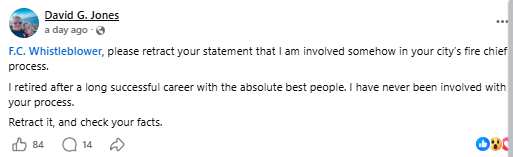
UPDATE: A source told us David Jones out of Addison was a top runner for the job. Frisco Chronicles wrote about it however we have heard directly from David Jones via Facebook who said he is in no way involved in the hiring process for a new Frisco Fire Chief. We removed his name from the front runner paragraph above.
Disclaimer This article is written as opinion, commentary, and personal interpretation based on publicly available records, meeting observations, agenda materials, and information I have heard from community sources. Any statements involving motives, intent, conflicts of interest, contracts, relationships, or behind-the-scenes activity should be understood as alleged, suspected, or opinion unless directly supported by cited public records. Readers are encouraged to review the linked materials, attend public meetings, request records, and form their own conclusions. Nothing in this article should be interpreted as a final statement of fact about any person’s legal conduct, criminal behavior, or ethical violations.
While the search is on for the new Frisco Fire Chief you can be sure that Frisco Firefighters are advocating for a Chief who supports 4 persons staffing and the 48/96 Model. What is the 48/96 model? We asked ourselves the same question we heard them speak about it at citizen’s input.
The Frisco Firefighters Association has been pushing the Frisco Fire Department to move from its current 24/48 schedule to 48/96 schedule. For context, 48/96 means 48 hours on duty followed by 96 hours off which equals essentially two consecutive 24-hour shifts and then four days off.
Meanwhile, City Manager, Wes Pierson has been very upfront he is against the 48/96 model. City Manager, Wes Pierson has been very upfront he is against the 48/96 model and after Fire Fighters talked about it recently at Citizen Input his response this was an HR issue that needed to be discussed privately.
What is the 48/96 Schedule?
Across Texas, fire departments have been moving toward the 48/96 model in recent years. Locally here in DFW McKinney, Richardson, Flower Mound, Lewisville, Carrollton, Denton, Allen, and Grand Prairie all operate on a 48/96 model.
Just this year Mesquite went shifted to the new 48/96 model. Mesquite officials also say the change was overwhelmingly well received, and they have not seen a drop-in service.
Then there is Plano. It is the FWB understanding that Plano is moving in the opposite direction from the traditional schedules. It is transitioning from 24/48 to 24/72, with the transition occurring over several years and additional firefighters being hired to make it possible.
The Frisco Chronicles investigation found evidence that departments like College Station, Sugar Land, Pearland, New Braunfels, Round Rock, Waco, Midland Beaumont, Odessa, Abilene, Brownsville, Klien, San Angelo, DFW Airport, Tyler, McAllen, Longview, Wichita Falls, Woodlands, Bryan, Conroe, Georgetown, Pearland, and Temple also have adopted the 49/96 model.
So, why is Frisco Management so opposed to it?
Models of Proof
College Station is particularly useful for this investigation because it measured the results after implementing 48/96 in November 2024. The city reported an 11.8% decrease in accidents, 28.7% decrease in unscheduled absenteeism, 48.5% increase in training and 93% approval among personnel.
Longview provides another excellent before-and-after example. It had operated 24/48 since 1972, then switched to 48/96 on January 9, 2025, initially as a one-year test. By 2026, its firefighter job posting states that the department is operating on 48/96 model because it helps long term with recruitment.
Should Frisco Switch To the 48/96 Model?
The 48/96 schedule is not simply a scheduling preference. It is a question of what kind of fire department Frisco wants to build for the next generation. A 48/96 schedule would give firefighters 48 hours on duty followed by 96 hours off, creating longer recovery periods and a more predictable work-life balance. For a department asking its firefighters to work one of the most demanding jobs in public service, that matters. Fatigue affects morale, family life, retention and, ultimately, readiness.
Frisco has grown into one of the largest and most sophisticated cities in North Texas. Its fire department should not be stuck treating staffing practices as something that cannot be questioned simply because “that is the way we have always done it.” Apparently, even fire schedules are capable of becoming sacred cows.
The question for city leadership is straightforward: if other departments can successfully operate under a 48/96 model, why shouldn’t Frisco at least seriously evaluate it? There would be legitimate issues to work through. Staffing levels, overtime, coverage, response times, training requirements and budget impacts would all need to be examined. A schedule change should be based on data, not slogans. But Wes Piersons simple refusal to examine the option is just as irresponsible as adopting it without understanding the consequences.
New Fire Chief = Fresh Start
And this is where Frisco’s next fire chief could have an opportunity to make a real difference. A new chief inherits more than trucks, stations and personnel. He or she inherits a department with a culture, a history and firefighters who have spent years watching decisions made above them. The next chief has the opportunity to listen before dictating, to bring firefighters into the conversation and to demonstrate that morale is not merely something mentioned in speeches or employee surveys.
If the 48/96 schedule can improve quality of life, recruitment, retention and morale while maintaining adequate coverage, it deserves a serious look. And if it cannot, firefighters and taxpayers deserve to know exactly why. The next fire chief could make that decision one of the first signs that a new chapter has begun: listen to the people wearing the gear, examine the evidence, and make the decision based on what works best for Frisco.
Wes Piersons Biggest Failure
What Wes Pierson fails to understand is that a strong fire department isn’t built solely with new stations and expensive equipment. It is built by keeping good firefighters, giving them a voice, and making sure they are rested, respected and ready when the alarm sounds. For Frisco, the 48/96 question may be about a schedule. But the bigger question is whether city leadership is willing to rethink the way it does business when the people doing the work tell them there may be a better way.
Wes Pierson has already shut down 4 Person Truck Staffing which the Fire Fighters have been asking for. Both Pierson and several of the current city leaders claimed it would bankrupt the city – yet just this week the City of Celina approved 4-person truck staffing due to the city’s growth. Many North Texas Cities have 4-Person Staffing – yet only Frisco would be affected negatively by it. At least that is what our current YES MAN City Manager, Wes Pierson and several sitting council members want you to believe even though they have NO FIRE SERVICE EXPERIENCE.
For transparency purposes, Frisco Chronicles has never like nor trusted the new City Manager, Wes Pierson. Why? Remember Pierson came to Frisco after serving as the City Manager for the Town of Addison from 2016 to 2020. According to GovSalaries.com his annual wage was $294,102. Residents of Frisco are being asked to trust a man who previously managed “A TOWN” with a population of 17,247 people that covered approximately 4.4 square miles with a growth rate of .3% annually with what is best for Frisco’s future. Compare that to Frisco which covers 69.19 square miles with a tollway dividing the city and has a population of 245,057 and is growing at an annual rate of 3.42%.
Frisco Chronicles firmly believes Wes Pierson has no idea what “A CITY” like Frisco could possibly need and has no experience to rely on in his career history to help him in those situations. That is why good staff over the last two years have left, that is why the HR department has been a disaster. It is clear he was brought here as a “YES MAN” for the former mayor and current council. If he treats City Employees, the way he treats citizens with his nose up in the air and snarky attitude no wonder the exodus is happening.
Disclaimer This article is written as opinion, commentary, and personal interpretation based on publicly available records, meeting observations, agenda materials, and information I have heard from community sources. Any statements involving motives, intent, conflicts of interest, contracts, relationships, or behind-the-scenes activity should be understood as alleged, suspected, or opinion unless directly supported by cited public records. Readers are encouraged to review the linked materials, attend public meetings, request records, and form their own conclusions. Nothing in this article should be interpreted as a final statement of fact about any person’s legal conduct, criminal behavior, or ethical violations.
Read More: 48/96 Work Schedule Presented by: Engineer Todd Marty Firefighter/Operator Tim Swaner Firefighter/Operator Micah Rader. 48/96 Work Schedule. What is the 48/96?. 48 hours on/96 hours off Something different Something progressive. The 48/96 and the Fire Service. https://www.slideserve.com/ronnie/48-96-work-schedule#google_v
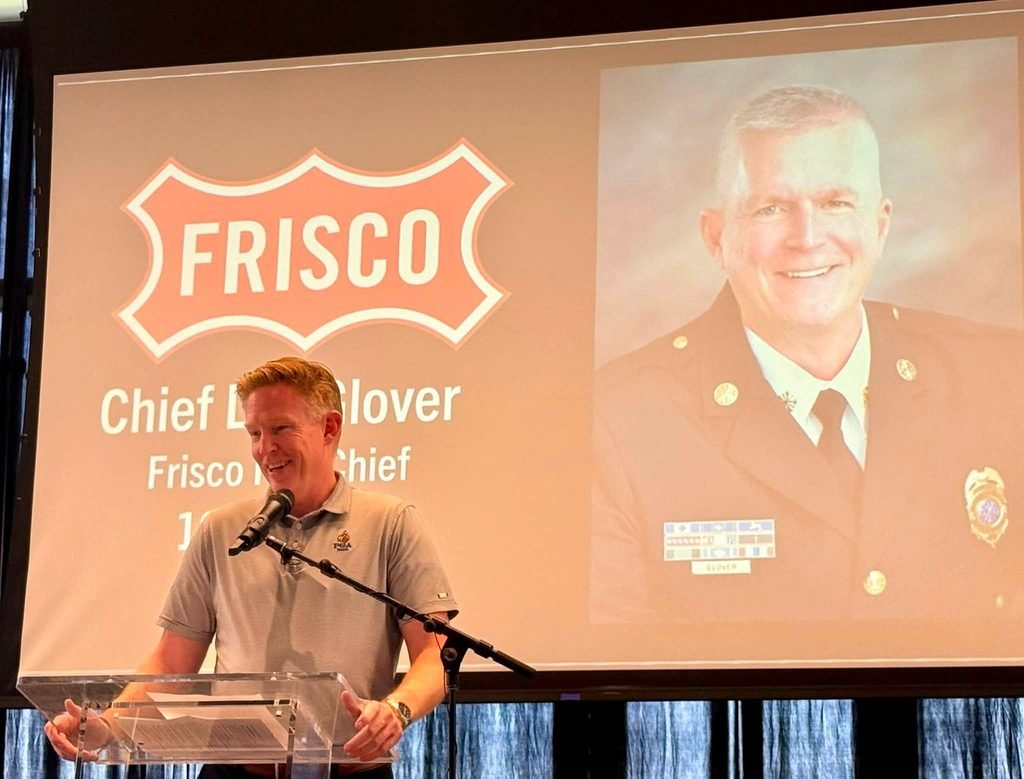
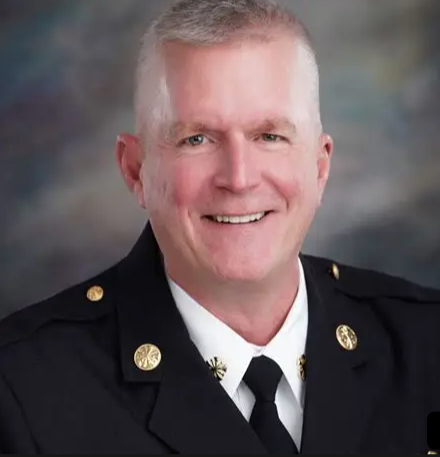
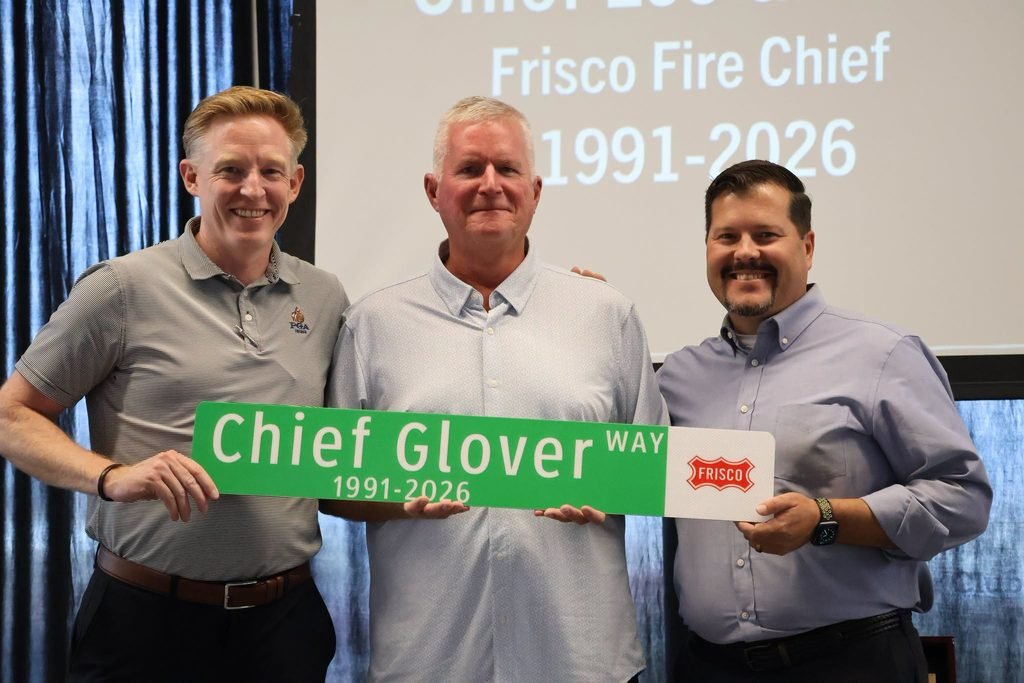
Recently, the City of Frisco announced the retirement of Fire Chief Lee Glover, bringing an end to a 35-year career with the Frisco Fire Department.
According to the City, Glover joined the department in 1991, when Frisco had just seven paid firefighters. He worked his way through the ranks before becoming Interim Fire Chief in September 2022 and being appointed Fire Chief on June 19, 2023. The City of Frisco announced his retirement on April 7, 2026, with his final day scheduled for August 3, 2026.
On the surface, it is the familiar story of a longtime public servant riding off into retirement. But there is considerably more history here. And after more than three decades inside one of Frisco’s most important public-safety departments, there are questions that deserve answers.
Lee Glover Timeline
1991: Joined the Frisco Fire Department.
2011: Frisco conducted an Employee Climate Survey examining conditions within the Fire Department and its leadership.
January 2012: The climate report documented serious concerns regarding morale, trust, intimidation, retaliation and fear within the department. The report also identified concerns involving senior leadership, including then-Assistant Chief Lee Glover.
September 2022: Glover became Interim Fire Chief.
June 19, 2023: City Manager Wes Pierson appointed Glover Fire Chief after a selection process involving five finalists.
April 7, 2026: The City announced Glover’s retirement.
August 3, 2026: Glover’s final day with the City of Frisco
Turn Back Time: The 2011 Climate Report
We have written extensively about the history of the Frisco Fire Department and the concerns raised about its leadership. The 2011 Employee Climate Survey remains particularly important because it was not simply a disgruntled employee complaining about a supervisor. It was a formal examination of the department’s workplace environment.
The report described serious problems involving trust, respect, morale and the relationship between firefighters and department leadership. It characterized the culture as one involving intimidation, retaliation and fear. It also reported that a significant percentage of respondents said they would leave the department if they could.
Our previous reporting noted the report identified Lee Glover as part of the senior leadership structure under then-Chief Mack Borchardt. The question that naturally follows is simple: What changed between 2011 and 2023 that convinced city management that Lee Glover was the right person to lead the department?
That question became particularly relevant when Glover was named Interim Fire Chief in 2022.
The 92.5% Question
When Glover became a finalist for the permanent Fire Chief position in 2023, the Frisco Fire Fighters Association conducted a survey of its membership.
According to the survey previously reported by Frisco Chronicles, 220 of 233 firefighters responded, and 92.5% said they did not want Glover to become the next Fire Chief. The survey also reported that 91.4% did not believe Glover had improved morale or restored trust during his time as Interim Chief.
Despite those numbers, City Manager Wes Pierson selected Glover. At the time, Pierson said Glover’s experience, knowledge and leadership made him the best fit for the department. That decision deserves scrutiny, not because an employee association should automatically determine who runs a municipal department, but because a 92.5% vote against a leadership candidate is an extraordinary number.
So the questions remain:
What did City Manager Wes Pierson know about the survey before selecting Glover?
Why did City Manager Wes Pierson believe the concerns expressed by the firefighters were not sufficient to disqualify Glover?
Did the City conduct any independent investigation into the concerns raised by the firefighters before making the appointment?
Did City Council members know about the survey results before Glover was appointed?
And perhaps most importantly: What did the City of Frisco do to determine whether the problems identified in the 2011 climate report had actually been resolved before putting Glover into the leadership role as Fire Chief?
Fast Forward: May 18, 2026
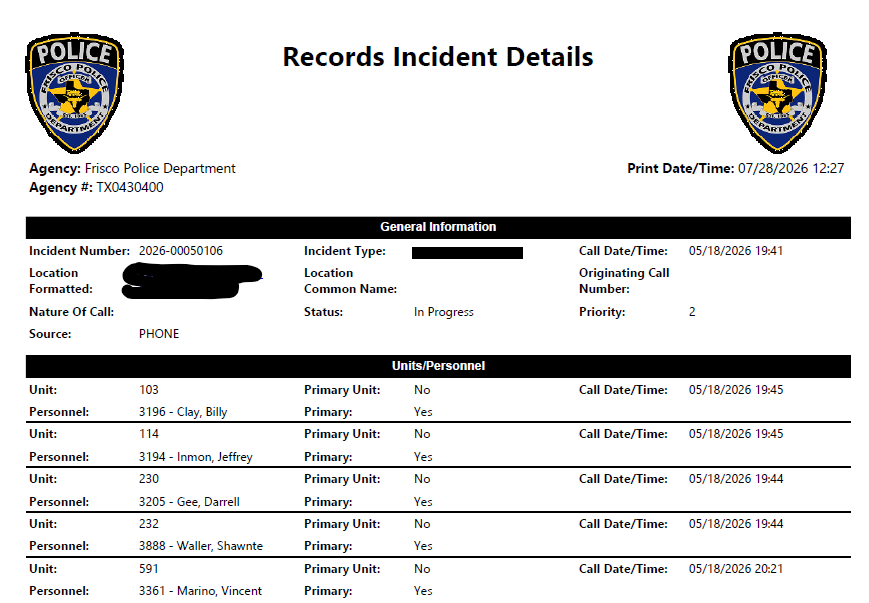
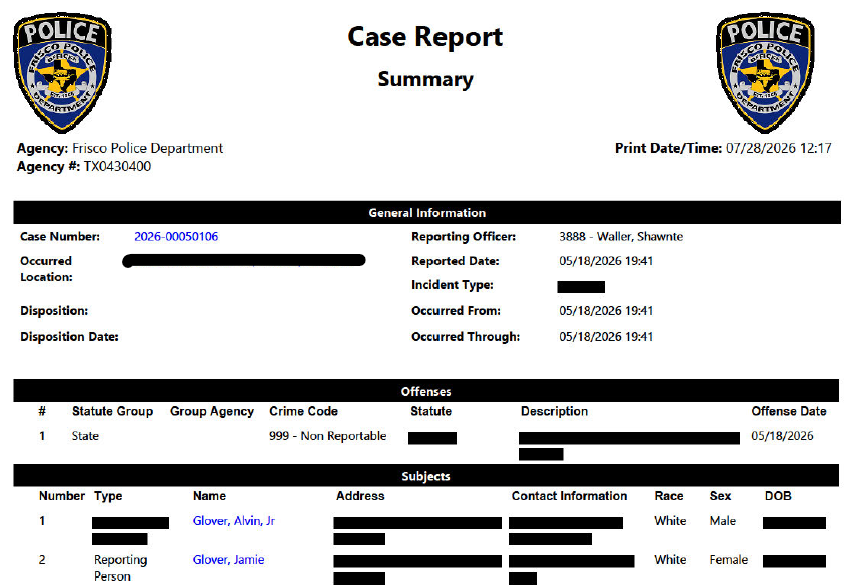
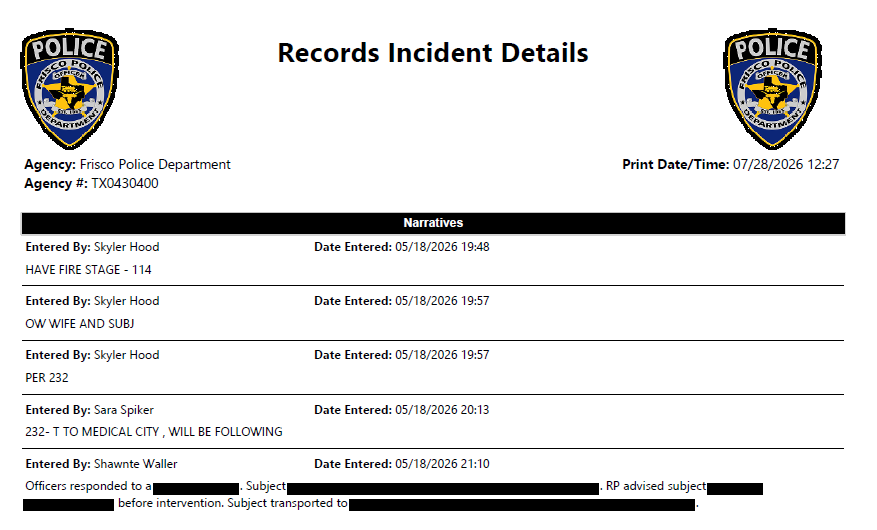
The City announced Glover’s retirement on April 7, 2026. Approximately six weeks later, on May 18, Frisco Police responded to Glover’s residence following a 911 call. We filed a Public Information Request seeking the police records associated with that call and incident.
The records we received were heavily redacted. The Case Report Summary identifies Alvin Glover Jr. as a subject and Jamie Glover as the reporting person.
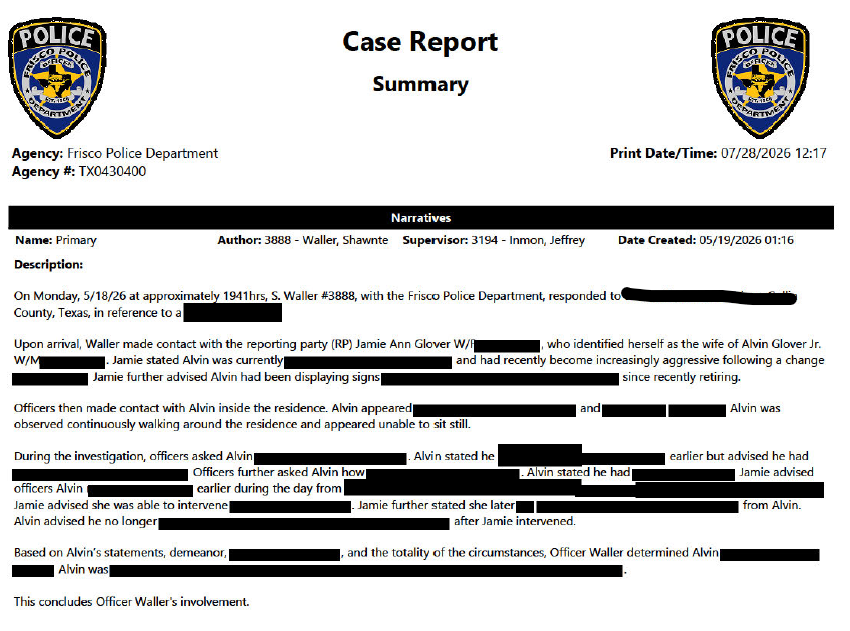
The report states that Frisco police responded to Glover’s residence at approximately 7:41 p.m. on May 18, 2026. According to the report, Jamie Glover identified herself as Alvin Glover Jr.’s wife and told officers that he had recently become increasingly aggressive following a change that is redacted from the report.
The report also states that Jamie reported that Alvin had been displaying certain signs since “recently retiring,” although the specific information is redacted. Officers subsequently made contact with Alvin Glover inside the residence. The remainder of the report contains additional redactions.
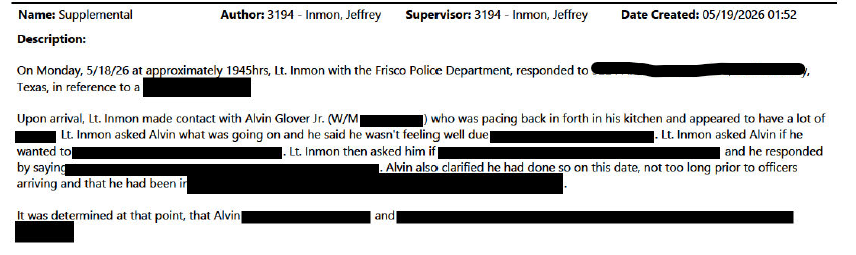
A supplemental report was also included in the records provided to us. There is an important distinction here.
We know a police response occurred. We know the City’s records identify the individuals involved. We know portions of the report describe concerns involving Glover’s behavior.
We do not know everything that happened because significant portions of the records were withheld or redacted. That leaves questions.
What Happened After the 911 Call?
According to sources familiar with the incident, Glover was experiencing a serious personal crisis and was transported to a hospital following the police response.
Sources have also alleged that the incident involved suicidal behavior and that Glover may have had a weapon in his possession before officers arrived. Those allegations have not been independently verified by Frisco Chronicles and should not be treated as established fact without supporting documentation.
We are also told that Glover did not return to his normal duties following the May 18 incident and that his next public appearance connected to the department was associated with his retirement in August.
If that account is accurate, it raises some obvious questions:
What happened between May 18 and August 3? Was Glover placed on leave?
Was he using accrued sick leave, vacation, administrative leave or another form of paid leave?
Was he still designated as Fire Chief during that period? Was he performing any official duties? Was he receiving his regular salary? Who was running the Fire Department during Glover’s absence?
Did the City conduct any internal review? These are not questions about someone’s private medical history. They are questions about the administration of a taxpayer-funded public agency and the use of taxpayer-funded compensation.
Was Glover Treated Differently?
This may be the most important question of all. Firefighters work in an extraordinarily stressful profession. Mental health, trauma, substance abuse, family crises and other personal struggles can affect first responders just as they can affect anyone else.
The City should have policies governing how employees, including department leadership, are treated when they experience a personal or medical crisis.
So we have to ask: Are those policies applied equally to everyone? No. The proof is in the previous pudding.
Are rank-and-file firefighters given the same flexibility, leave options and confidentiality that are available to department leadership? No. The proof is in the previous pudding.
Has the City ever placed another firefighter or senior officer in a similar situation on paid leave while maintaining their position?
What are the City’s policies when a department head is unable to perform the duties of the position? Well history shows they terminated the Assistant Fire Chief Cameron Kraemer who was out on medical leave for PTSD and mental health issues.
Who had authority to designate an acting chief and did they formally appoint an acting Chief after May 18, 2026?
If not, why not? Those questions can and should be answered without disclosing someone’s private medical information.
The Mack Borchardt Connection
There is another piece of this history that cannot simply be ignored. Mack Borchardt served as Frisco’s Fire Chief for decades and later became Special Assistant to the City Manager. The City’s current staff directory still lists Borchardt as Special Assistant to the City Manager and states that he served as Fire Chief from 1981 to 2012.
Borchardt’s transition out of the Fire Chief position has been discussed extensively in connection with the 2011 climate report. He was terminated by the city then rehired by then City Manager George Purefoy (long time good ole boy friendship) who made him a “Fire Consultant Liaison within the City Manager’s office. He received a hefty salary and city vehicle. The 2011 report raised significant concerns about the department’s leadership culture at the time. It also identified concerns regarding the senior leadership structure surrounding Borchardt.
Glover was part of that senior leadership structure. Yet years later, Glover ultimately became the Fire Chief. That creates a legitimate question about whether the City actually addressed the problems identified in 2011 or simply changed the name on the office door.
City Management’s Role
There is another issue that deserves examination. The City knew about the 2011 climate report, knew about the concerns surrounding the department’s previous leadership structure, and knew that 92.5% of responding firefighters surveyed did not want Glover to become Fire Chief. With all that knowledge and information what led City Manager Wes Pierson to reach the opposite conclusion?
The City has said Glover was the best fit for the job. Fine. Then show taxpayers the work. What criteria were used? Who conducted the interviews? Who evaluated the finalists? What were the scoring criteria? What concerns were raised about each finalist?
Who recommended Glover? Were references checked? Were prior complaints or investigations reviewed? Was the Fire Fighters Association survey discussed during the selection process? And did Pierson or anyone else in city management conduct an independent assessment of the concerns raised by members of the department?
These are reasonable questions when the person being selected is going to oversee one of the City’s largest and most important public-safety organizations.
Retirement or Something More?
Now we come back to the original question. Why did Lee Glover retire?
The city announced his retirement on April 7, 2026, nearly four months before his final day. The official announcement described it as the conclusion of a 35-year career and praised the department’s accomplishments during his tenure.
That may be exactly what happened. But the timing of the May 18 police response, followed by questions about Glover’s absence from the department, makes it reasonable for taxpayers to ask whether there was more to the story.
Was the retirement entirely voluntary? Was Glover ever asked to retire?
Was he facing an internal investigation? Was he placed on leave?
Was he medically unable to return to duty? Did he decide that retirement was the best option?
Did city management encourage or negotiate his departure? And were any agreements, benefits, payouts, leave balances or other financial arrangements associated with his retirement?
The Bigger Issue
This story is not really about whether Lee Glover had a personal crisis. If the allegations about the May 18 incident are true, that is a deeply personal matter, and nobody should use another person’s crisis as entertainment. The issue is whether the City of Frisco has one set of rules for ordinary firefighters and another for those occupying the corner office.
That is the issue taxpayers should care about. The Frisco Fire Department has grown enormously since Lee Glover joined in 1991. The city now describes the department as having 265 sworn personnel and 34 civilian employees. That is a massive public-safety operation.
The person sitting in the Fire Chief’s office has enormous responsibility. The public therefore has a legitimate interest in how that position is filled, how leadership problems are handled, how employee complaints are investigated, how leave policies are applied and how taxpayer dollars are spent.
The questions surrounding Lee Glover do not begin with the May 18, 2026 police call. They go back more than a decade. The 2011 climate report raised questions about culture and leadership.
The 2022 appointment of Glover as Interim Chief raised questions about whether those problems had really been resolved. The 2023 appointment of Glover as permanent Chief raised even more questions after the Fire Fighters Association survey reportedly showed overwhelming opposition. And now the circumstances surrounding his final months with the City raise another set of questions.
Maybe there are perfectly reasonable answers to all of them. If there are, the City should provide them. Because transparency should not depend on whether the person involved is a firefighter, a department head, a city manager or anyone else on the public payroll.
Frisco taxpayers deserve to know whether the rules are actually applied equally. And after years of controversy surrounding the Fire Department’s leadership culture, that is not an unreasonable thing to ask. It is the minimum.
What Is Next Next we will address the issues with hiring the new Chief of the Frisco Fire Department. We will examine some relationships and ask why the city is using a new company to do the search. Is Wes Pierson looking for the best candidate or the best candidate who agrees with him on the operations of the department.
This is Pierson’s first time working in a major city. He previously worked in Addison, which is 4 square miles and before that Corpus Christi before their growth boom. The leads us to ask does he have the background to make such a large decision. Sources inside say there is a lot of doubt when it comes to his decision-making process with the Fire Department. Stay Tuned for part two!
Disclaimer: This article is intended to report on matters of public record and public interest. If additional information becomes available this article may be updated accordingly.
This article is written as opinion, commentary, and personal interpretation based on publicly available records, meeting observations, agenda materials, and information we received from community sources. Nothing in this article should be interpreted as a final statement of fact about any person’s legal conduct, criminal behavior, or ethical violations.
Summer is over but the heat still has things percolating in Frisco. It is time to break down some events that happened over the summer.
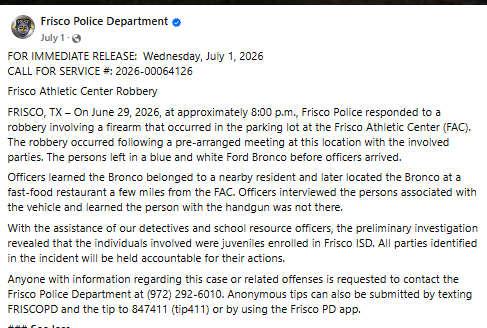
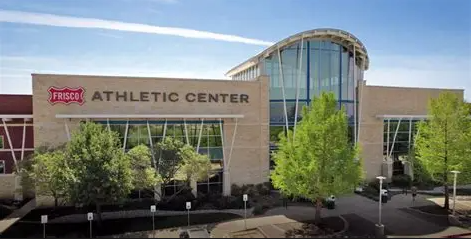
Over the summer you may have seen the post from the Frisco Police Department regarding the Frisco Athletic Center Robbery. It was posted on July 1st and reads “On June 29, 2026, at approximately 8:00 p.m., Frisco Police responded to a robbery involving a firearm that occurred in the parking lot at the Frisco Athletic Center (FAC).”
The post detailed how the robbery occurred following a pre-arranged meeting at the FAC between two parties. One party apparently left in a blue and white Ford Bronco before officers arrived. Officers learned the Bronco belonged to a nearby resident and later located the Bronco at a fast-food restaurant a few miles from the FAC. Officers interviewed the people associated with the vehicle and learned the person with the handgun was not there.
The shocking part is when they announced that with the assistance of detectives and school resource officers, the preliminary investigation revealed that the individuals involved were juveniles enrolled in Frisco ISD. The post closed by saying, “All parties identified in the incident will be held accountable for their actions.”
You can imagine the community’s shock and concern when they learn JUVENILES ENROLLED IN FRISCO ISD were allegedly involved. In my gut something did not add up, and I had several questions.
What was the pre-arranged meeting for? Facebook Marketplace Sale? Drugs?
What fast-food restaurant did they find the Bronco at? There were no posts on social media asking why there is a police presence at a fast-food restaurant parking lot. Frisconians are nosey so there would be a post somewhere.
How did they immediately know it was juveniles and that they were enrolled in Frisco ISD?
We filed an open records request for all documents related to the case and agreed they could redact any information relating to the juveniles involved however they still sent out request to the Texas Attorney General to keep the info from the public. Why?
That was when I got an email from a parent who had several details on the incident because they were picking up someone nearby and when they saw the commotion they listened to the police scanner from 8pm to 8:36pm.
All of the following details are ALLEGED and have not been corroborated due to Frisco PD holding the incident documents from our Public Information Request.
Allegedly the 8PM MEET UP was a drug deal for Oxi! The Oxi dealer was supposedly driving a blue Bronco with a white top. The driver was a black male with an Afro, his passenger a black male with dreads in a red sweatshirt was carrying the oxi. The Bronco pulled up to the planned meeting spot, which happened to be right in front of the FAC which has cameras outside that supposedly captured the entire exchange.
Allegedly the BUYER walked up to the car (passenger seat side) and opened the backpack to pick up the goods and handed over a wad of cash. Supposedly the dealer counted the cash which was short of the agreed amount. A verbal exchange ensued, then the dealer pulls a gun and demands the backpack at gunpoint (ie. Armed robbery).
Supposedly the Bronco then drives off, and the kid (the buyer) goes inside and reports to the FAC staff he was robbed at gunpoint, and it was reported to the police. Duh!
According to the Frisco Chronicles tipster, based on the police scanner, Frisco PD immediately tracked the Bronco with FLOCK cameras and tracked it east on Wade, to south on Ohio, towards 121. It was announced on the police scanner the plates came back to a house on Lily Pad Lane (corner of 380 and 423).
These details made much more sense and are very different than the summary posted by Frisco Police Department. The questions are not going away simply because summer is over.
If the preliminary investigation truly established that juveniles enrolled in Frisco ISD were involved, then the public deserves to know what happened next. Were arrests made? Were charges referred to the Denton County District Attorney? Was the matter handled through the juvenile justice system? Or was this quietly turned over to Frisco ISD and left there?
And perhaps the bigger question is why the public version of the incident appears so thin when the alleged circumstances, if accurate, are anything but ordinary.
A reported armed robbery involving a firearm, alleged narcotics, juveniles, a pre-arranged meeting, surveillance cameras and FLOCK camera tracking is not exactly a minor parking-lot misunderstanding. Yet residents were given a carefully packaged summary and when Frisco Chronicles filed a PIR for the case file and underlying records, Frisco PD sought an Attorney General ruling rather than simply providing the releasable portions with juvenile information redacted.
That raises another question: What exactly is being protected?
To be clear, the allegations provided by our source remain allegations. We have not independently verified the alleged drug transaction, the identities of the people involved, the alleged weapon, or what was captured on surveillance video. That is precisely why public records matter. Journalism should not have to rely on a police scanner, a concerned parent and an anonymous tipster to piece together what happened during an alleged armed robbery in a public parking lot.
And this is where the phrase “all parties identified in the incident will be held accountable” deserves some follow-up. Accountable how? Accountability is not a slogan for a Facebook post. It is a process. It means determining what happened, identifying who was responsible, referring appropriate cases for prosecution, and allowing the public to understand the disposition of a serious incident without exposing protected information about juveniles.
Nobody is asking Frisco PD to publish the names of children. Nobody is asking for protected juvenile records. Frisco Chronicles is asking for the releasable facts.
What happened? What charges, if any, were filed? Was the case referred to the District Attorney? Was anyone arrested or detained? Was Frisco ISD involved? And what happened to the investigation after the initial police response?
Those are reasonable questions for a community to ask.
Frisco has spent years cultivating an image as one of the safest cities in America. There is nothing wrong with being proud of that reputation. But a “safest city” designation should never become a reason to avoid uncomfortable questions. If anything, a city that takes public safety seriously should welcome scrutiny and demonstrate that its system works even when the facts are embarrassing, complicated or inconvenient.
Transparency does not tarnish Frisco’s reputation. Hiding behind the reputation does.
So summer may be over, but this story isn’t. The public deserves the facts, not the polished version. And until those records are released or the appropriate authorities explain what happened to this case, there are still more questions than answers.
That is not accountability. That is unfinished business.
Disclaimer: This article is intended to report on matters of public record and public interest. If additional information becomes available, including the dismissal of charges, acquittal, or other developments, this article may be updated accordingly.
This article is written as opinion, commentary, and personal interpretation based on publicly available records, tipster information, meeting observations, agenda materials, and information we received from community sources. Nothing in this article should be interpreted as a final statement of fact about any person’s legal conduct, criminal behavior, or ethical violations. Reader discretion — and a sense of humor — are advised.
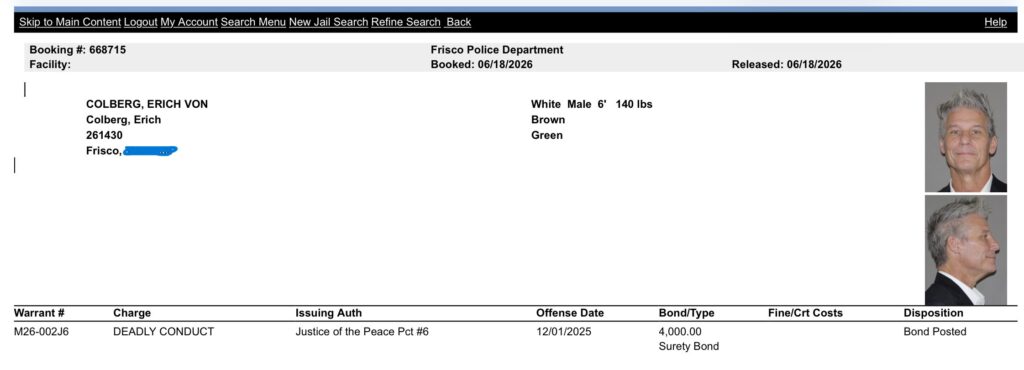
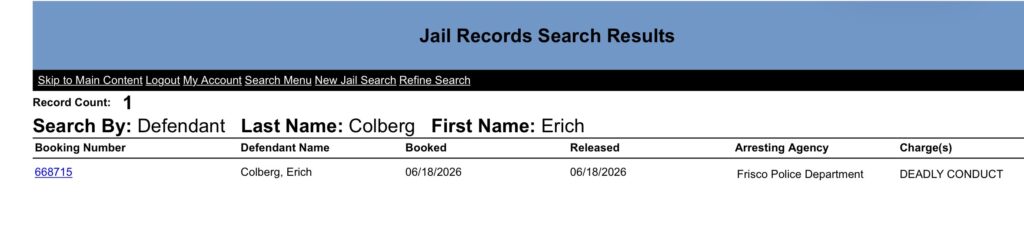
Recently Frisco Chronicles was alerted to an arrest made by the Frisco Police Department on 6/18/2026 involving Erich Colberg (husband of new council woman Brittany Colberg). What do we know about the arrest? Not much. Readers can be assured Frisco Chronicles will report the information honestly and accurately as information becomes available.
Current Information: All we know at this time is Mr. Colberg was booked on 6/18/2026 under the following information:
Booking Date and Release Date: 6/18/2026
Booking Number: 668715
Warrant Number: M26-002J6
Charge: Deadly Conduct
Issuing Auth: Justice of the Peace PCT #6
Offense Date: 12/1/2025
Bond: 4,000.00 (Surety Bond)
Disposition: Bond Posted
Side Note: The information provided by Frisco Chronicles in this article is based on public records, law enforcement records, court filings, and other publicly available sources available at the time of publication. An arrest or criminal charge is an allegation only and is not evidence of guilt.All individuals are presumed innocent unless and until proven guilty in a court of law.
Screenshot
Charge: Deadly Conduct Defined
In Denton County, the offense of Deadly Conduct is defined by Texas law, specifically Texas Penal Code § 22.05. Frisco Chronicles went to ChatGPT to ask what is charge “Deadly Conduct” related to in Texas. This is soley for informational purposes to understand the allegations of the charge. The statute has two primary forms of deadly conduct:
1. Recklessly placing another person in imminent danger of serious bodily injury
This is generally a Class A misdemeanor.
The prosecution must prove that a person recklessly engaged in conduct that placed another in imminent danger of serious bodily injury. Serious bodily injury means an injury creating a substantial risk of death or causing permanent disfigurement or long-term loss of bodily function.
Examples could include:
Driving a vehicle directly at another vehicle or pedestrian.
Intentionally swerving toward another motorist.
Throwing heavy objects at moving vehicles.
Brandishing or pointing a firearm at someone, even if no shot is fired (Texas law presumes recklessness when someone knowingly points a firearm at another person).
2. Knowingly discharging a firearm
This is a Third-Degree Felony.
A person commits felony deadly conduct if they knowingly discharge a firearm:
At or in the direction of another person; or
At a vehicle, building, or habitation while being reckless as to whether it is occupied.
Screenshot
Breaking Down the Law
Can Deadly Conduct arise from a traffic incident?
Yes. While many people associate the offense with firearms, Section 22.05(a) does not require a firearm. In a traffic-related incident, prosecutors may pursue a Deadly Conduct charge if they believe the driver used the vehicle in a reckless manner that placed another person in imminent danger of serious bodily injury.
Examples could include intentionally attempting to ram another vehicle, purposely forcing another vehicle off the roadway, driving head-on toward another vehicle, and aggressive road-rage maneuvers that create an immediate risk of death or serious injury. The vehicle itself can be the instrumentality of the offense if it is used recklessly enough.
What if the incident involved a gun during road rage?
Deadly Conduct is one of the more common charges in Texas road-rage cases where someone points a handgun at another driver, displays a firearm in a threatening manner, fires a shot from a vehicle, or fires toward another vehicle.
Even if no one is struck and no physical injury occurs, the charge may still apply because the offense focuses on creating an imminent danger, not on whether someone was actually hurt.
Frisco Chronicles is just giving context to the charge deadly conduct. It is important to note per public records today; there is nothing that notes Erich Colberg had a weapon on him of any kind or that has anything to do with his charge of Deadly Conduct.
The Arrest
Why an arrest over 6 months later? Based solely on the information on Denton County’s website it suggests that investigators may have developed evidence after the initial incident or presented the case to prosecutors at a later date. Without the offense report, probable cause affidavit, or warrant affidavit, it’s not possible to determine whether the allegation involves reckless operation of a motor vehicle, a firearm, both, or another form of conduct.
Public Information Request
Frisco Chronicles has submitted a PIR for the more information and will let you know what we find out based on records such as an offense report, probable cause affidavit, warrant affidavit, 911 recording, and witness statements. That is the only way to provide the factual basis for the charge, subject to any lawful withholding if the criminal case is still pending.
Statement from Brittany Colberg For Frisco
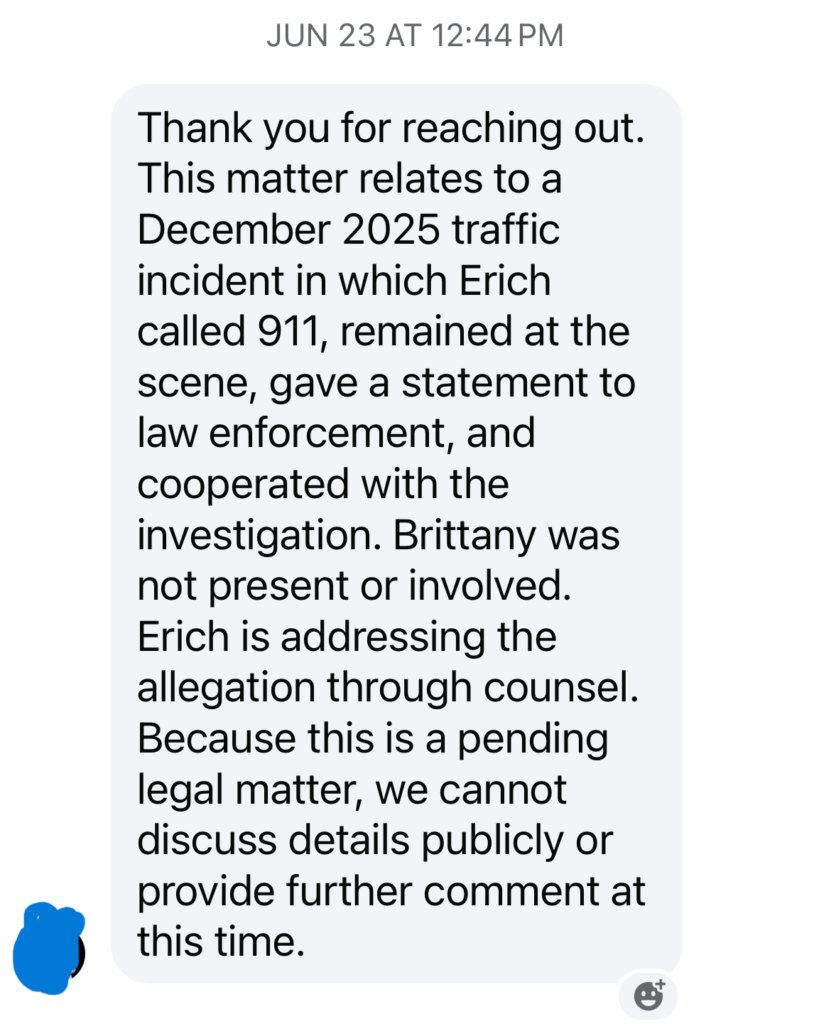
We did reach out to Councilwoman Brittany Colberg via Facebook Messenger last month on June 23rd. The response we received read,
“Thank you for reaching out. This matter relates to a December 2025 traffic incident in which Erich called 911, remained at the scene, gave a statement to law enforcement, and cooperated with the investigation. Brittany was not present or involved. Erich is addressing the allegation through counsel. Because this is a pending legal matter, we cannot discuss details publicly or provide further comment at this time.”
In closing, Frisco Chronicles will follow this case and report any new findings. The charges are allegations only until the case goes to court.
Disclaimer: This article is intended to report on matters of public record and public interest. If additional information becomes available, including the dismissal of charges, acquittal, or other developments, this article may be updated accordingly.
This article is written as opinion, commentary, and personal interpretation based on publicly available records, meeting observations, agenda materials, and information we received from community sources. Nothing in this article should be interpreted as a final statement of fact about any person’s legal conduct, criminal behavior, or ethical violations.
As Frisco heads into Election Day, the questions are no longer about campaign signs or polished mailers. The real story, who is pulling the strings behind the curtain. Every election has an establishment candidate, the one blessed by the insiders, donors, consultants, and political networks that have spent years shaping City Hall. The question voters should ask is simple: who benefits if nothing changes?
Then there is the growing debate over information, polling, and voter perception. Are voters receiving objective facts, or carefully crafted narratives designed to steer them toward a preferred outcome? One factor nobody can ignore is Frisco’s changing demographics. Muslim and Indian voters have become an increasingly significant force in local elections, not because they vote as a monolithic bloc, but because their numbers and civic engagement continue to grow. Candidates who ignore those communities do so at their own peril.
And finally, there is the question many residents continue to discuss: was the FunAsia podcast controversy simply an interview gone sideways, or was it part of a larger political operation to set up a candidate to look like a racist? Let’s jump right in and start spilling the tea.
Mr. Establishment: Mark Hill
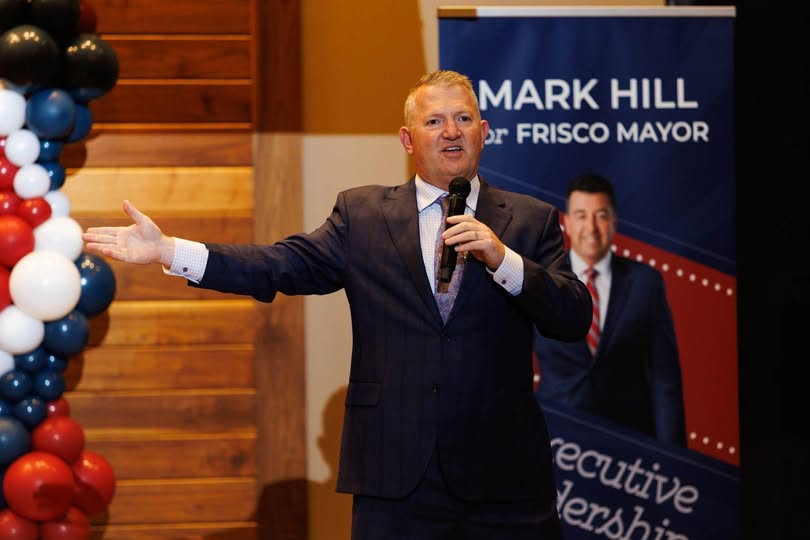
As we said, every campaign cycle has an establishment candidate who is blessed by the insiders, donors, consultants, and has already participated in helping shape city hall. In this runoff Mark Hill is 1000% the Establishment (Cheney 2.0) for the City of Frisco.
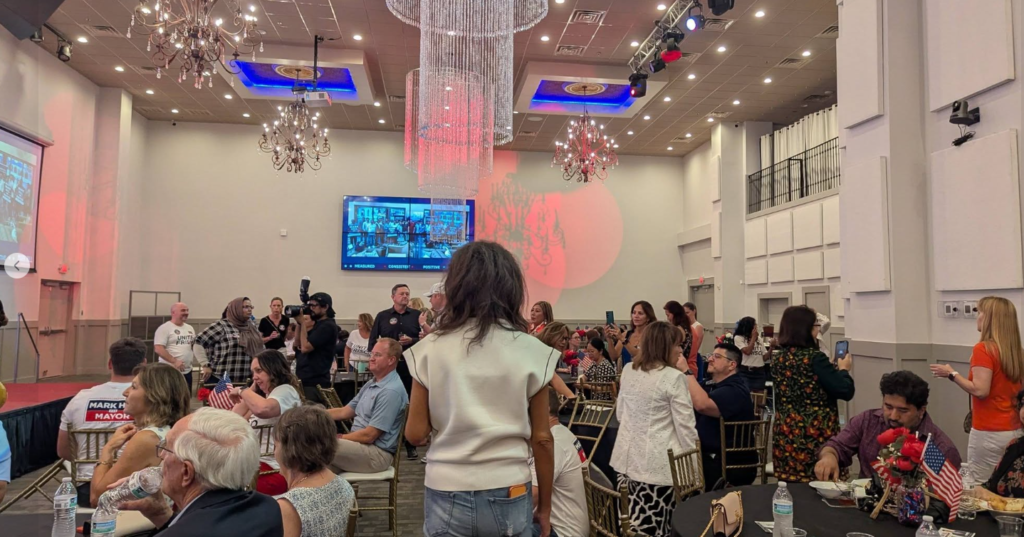
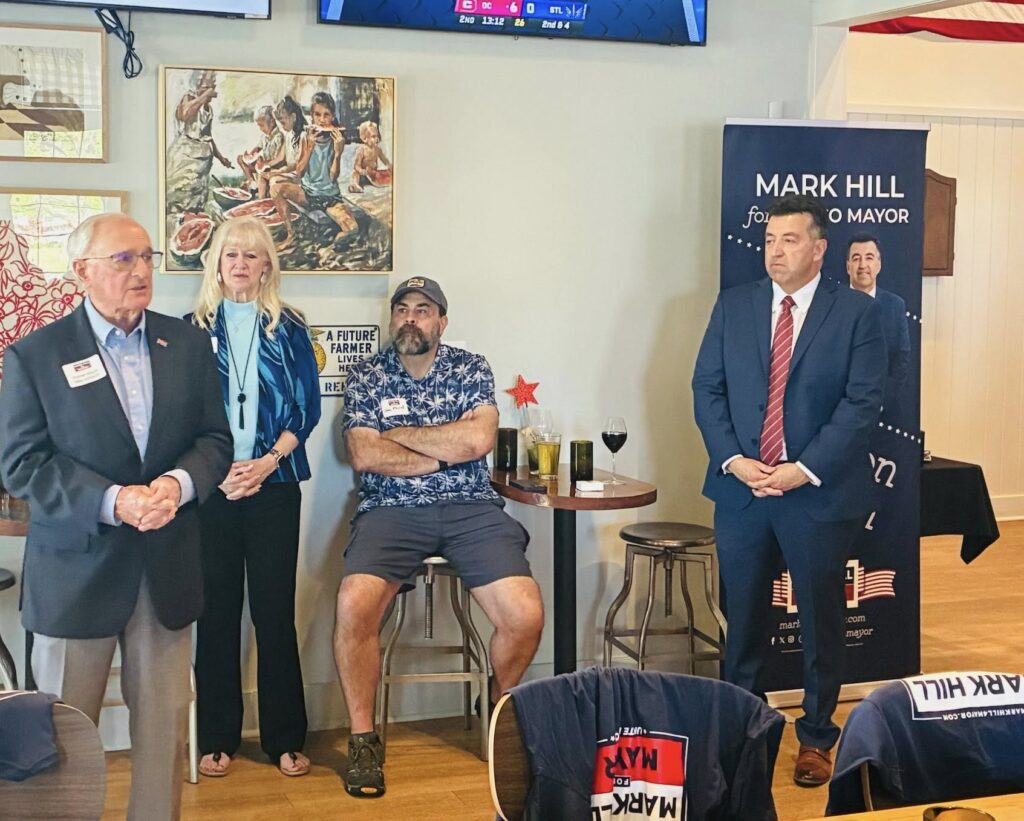
As President of Frisco ISD Board of Trustees, Mark Hill has had a seat at the table for many of these public private partnership deals which have helped shape Frisco. He is already up to speed on what is in some of those fine details they don’t want residents to see. Next, look at his campaign photos, it is a Who’s Who of Frisco Insiders and Establishment.You see their faces in every campaign online like, Tracie Reveal Shipman, Karen Cunningham, Lisa Kirby, Councilwoman Laura Rummel, Councilwoman Ann Anderson, Former Councilwoman Tammy Meinershagen, Jason Young (Developer), Steve Cone (P&Z), and many more. Then there is the campaign social media team made of the alleged town online bullies such as Sean Merrel (currently on planning & zoning), Jake Petras (now in Real Estate), Lance Taylor and the newly minted Jared Tye (Real Estate).
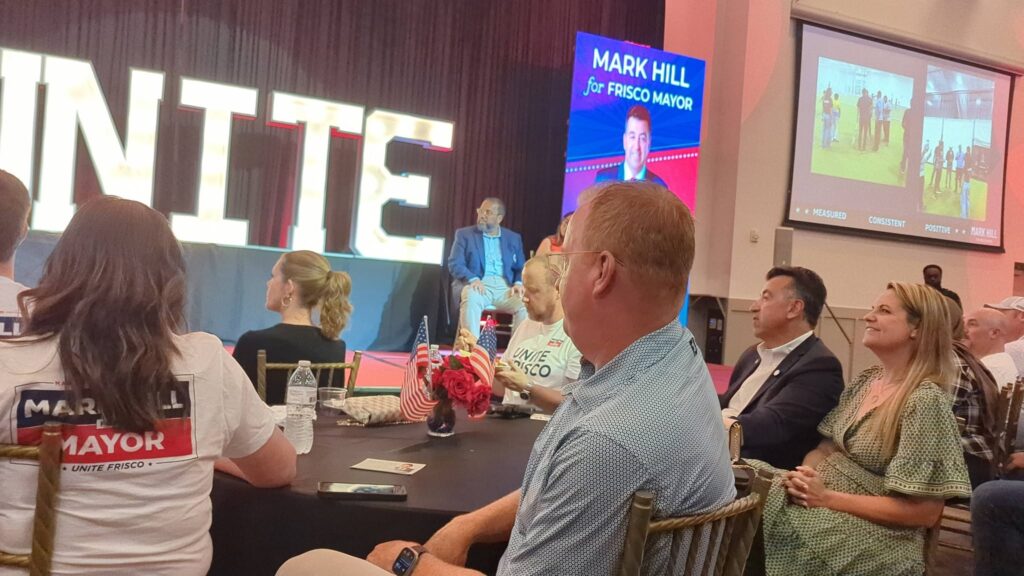
Jeff and Dana Cheney sitting at the Unite Party with Mark Hill and his wife.
After watching several campaigns, one thing the Establishment knows is they cannot put Cheney out front for Hill, because it will automatically polarize a portion of the audience whose vote they are campaigning for. While Jeff Cheney has kept a low profile, his Cheney Cabal aka “The Establishment” has been hard at work around the clock for Mark Hill. Now, you are asking what proof do I have that Cheney is in full support of Mark Hill? It is posted online! Just this week Mr. & Ms. Prom Queen and King – Dana and Jeff Cheney went to Mark Hill’s Unite Frisco event and sat with them at the same table. The room was full of the same powerful friends I jokingly call the top 100 insiders.
In Frisco, the establishment campaign team works overtime to attack the new candidate on the block. They have done year after year, campaign after campaign and will go to any length to win even if it destroys a good person’s reputation. The Establishment campaign must win – everything, and I mean everything rides on it!
The question voters should ask is simple: who benefits if nothing changes?
Fun Asia Podcast – Set up or Real?
What is FunAsia? It is a podcast that became a topic in the Frisco mayoral race after interviewing both Mark Hill and Rod Vilhauer. The podcast is conducted through the South Asian media network known as FunAsia, which operates multiple radio stations, video programming, and podcasts serving the Dallas–Fort Worth South Asian community.
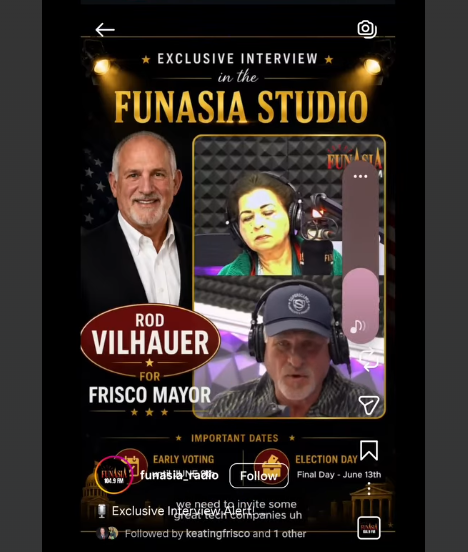
On June 4, FunAsia Radio posted voters could catch Mark Hill “Live On Air” at 9am – so tune in. On June 5, FunAsia Radio posted the Hill and not to far into the interview the host talks about the negative impact outsiders are having at city hall meetings, and that local South Asians don’t feel welcome who live there. She then looked at Mark Hill and said “as Mayor, when you are Mayor Mark Hill, what will you say to residents to make sure everyone feels welcome. What stood out was how she smiled sounded excited and said “when you are Mayor Mark Hill” clearly showing a preferential bias in her reporting. Then look at both images for the interview – Mark Hill’s true images appear in the marketing for the interview.
Now compare Hills interview to the FunAsia interview with Rod Vilhauer, it was very different. Starting with the advertising, the image of Rod Vilhauer is clearly not Rod Vilhauer. If you google his name, there are a ton of photos of the candidate, and it is clear this is an AI created image used in FunAsia’s marketing. Why was Mark Hill’s perfect and Rod Vilhauer clearly manipulated? Pictures of the Real Rod Vilhauer below.
Next the tone of the interview was a little different, and the host never really seem “excited” like she did with Mark so that showed the next clear difference. When the interview comes out, an immediate reaction about comments that appeared to disparage Hispanics where cut and pasted all over social media by Hill supporters. Then Fun Asia announced they removed the interview and put out an apology. Many people never even caught the full interview. If you look today the only thing out there are bits, clips, posted by Hill supporters and they sound manipulated if you watch Rod in the live box.
It is clear FunAsia manipulated his appearance in early marketing, so is it possible this was a set up or manipulated too? Was Hill’s campaign team involved in the setup? It is a fair question. Frisco Chronicles heard from a campaign insider with the Vilhauer team they were shocked the interview had been pulled as they had not even heard it yet. The public fallout surrounding candidate interview, removal, station apology, and has only fueled speculation. The problem, since FunAsia removed the interview so fast, even if they were to repost it now – you can never prove if it was or was not manipulated to make Rod look racists.
Unite Frisco or Manipulate Frisco?
Unite Frisco is about bringing everyone in Frisco together according to Mark Hill, especially the South Asian community. If Mark Hill is about Uniting Frisco – then why is he surrounding himself with certain people who have clearly showed past poor judgement that some may call “racist” to the same South Asian community Hill is trying to court now.
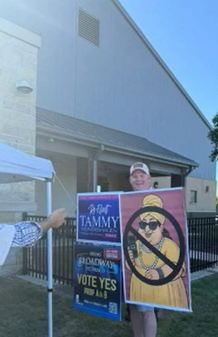
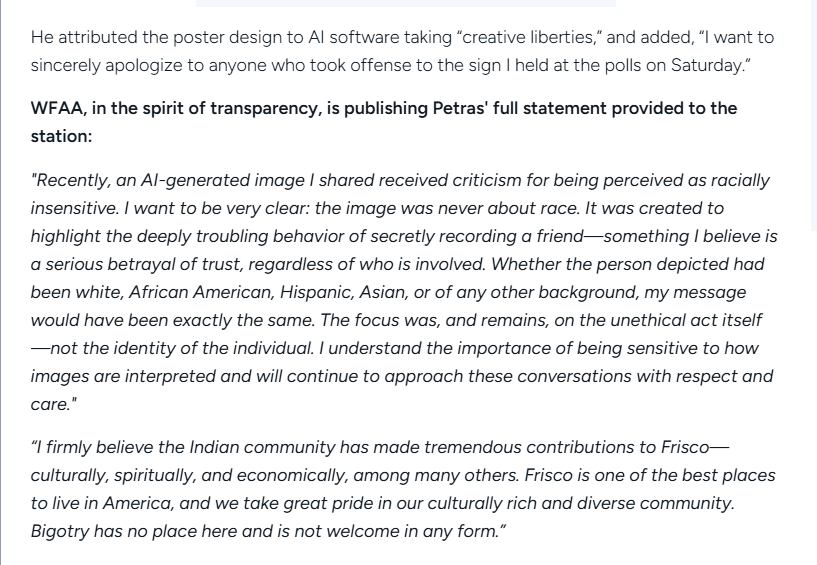
Example #1: Mr. Jake Petras made the news last year for holding up what he claimed was a picture made by AI of a South Asian woman, wearing a turban that clearly looked similar to a candidate that year in the race. Petras told WFAA, Jobin Paniker that he was sincerely sorry to anyone who took offense to the sign,” then went on to say AI took creative liberties when making it.
While many believe Petras and his apology, Frisco Chronicles wants to know where did he got such a large sign printed to have that day at the polls? Something like that takes time and planning. Frisco Chronicles would like to know how is what he did at well-known South Asian Polling Station on election day, any different than alleged statements made by a campaign candidate. Petras wants forgiveness and for it go away but wants to hold Rod Vilhauer to the cross for statements he has already corrected and apologized for. However just hours after his aired Petras posted on a local social media page that several statements where it sounds like doubles down on his decision being a good idea.
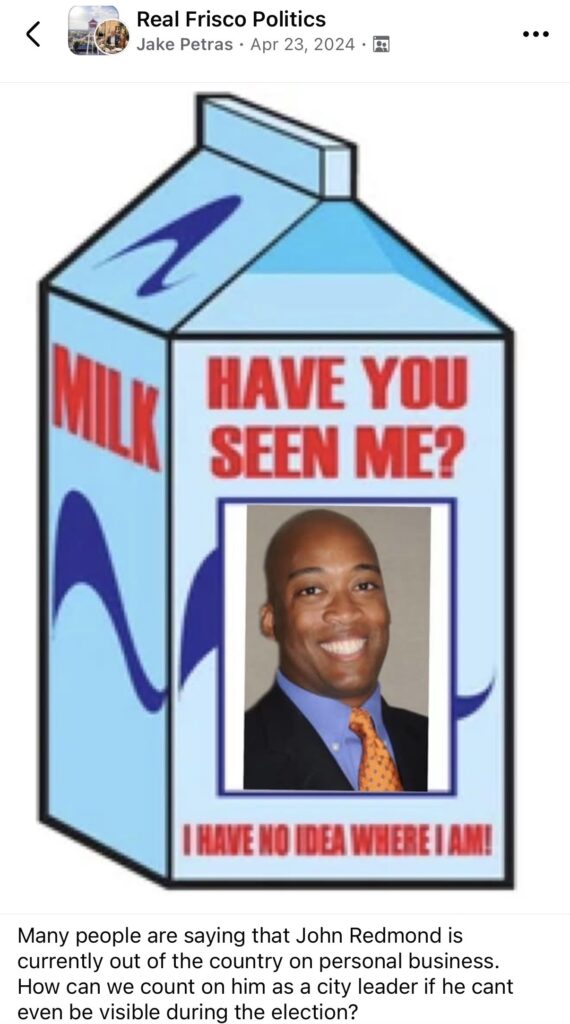
These are not the only questionable decision by Jake Petras. There was the time he put another candidate’s picture on a milk carton – and that candidate happened to be black. Then there was when he wanted to make fun of Jared Elad our Jewish Councilman and use an AI photo with I guess one say enhanced features. They art in interpretive – so do you see a pattern or just some funny art?
ScreenshotScreenshot
Example #2: Tammy Meinershagen
I know a lot of folks criticize the Tammy Tapes and the fact that we took out the second person in the recording to protect their identity, what Tammy said in those tapes still stands. Tammy Meinershagen and only Tammy is responsible for her comments. All the people on the Hill campaign today let her slide by last year after these comments were unveiled and now, she is a huge Mark Hill supporter?
In the recording Tammy Meinershagen can be heard making fun of the number of Indian Festivals, then she goes on to say the Indian Community is living a different world, lastly, she questions if any of the Indians at these events are voters. Listen to Tammy talk about diversity in Frisco by clicking here. In another video she talks about how she had a conversation with Gopal Ponangi where she told him he failed to get the bonds voted through, failed to balance the budget and how that is kind of an issue. She talks about how she asked him how he would do at city council if he couldn’t handle the Frisco ISD BOD. She then said she told Gopal that the citizens don’t have confidence in FISD leadership at that moment, and how his time of Frisco ISD School Board was a failure. Question for Tammy today, if you could not support Gopal last year then how can you support the FISD Boad of Trustees President Mark Hill this year? Are we just going to overlook that now?
To top it off Tammy Meinershagen biggest supporter was caught delivering hateful nasty mailers about South Asian Indian, Burt Thakur running at the time. A local PAC was responsible for them allegedly run by Tracie Reveal Shipman. Both support Mark Hill for Mayor. Read about it by clicking here.
Unite or Manipulate
How can Hill allow certain people to who have displayed South Asian hate be on his team be proud of them as his supporters. For example, at his big Unite Frisco event this week right by his side was disgraced Tammy Tapes Meinershagen. If the community wants to up in arms about what Vilhauer said, then they should hold Meinershagen to the same level of criticism but instead last year they swept it under the run and blamed anyone else they could.
We released the full transcript last year between the two participants to show it was not manipulated. Tammy is responsible for what she said and now she is part of the Mark Hill Unite Team. None of these people in the photo at Mark’s Unite event had any issue with Tammy’s statements last year and blamed us for publishing them, blamed the other participant, but never blamed Tammy Meinershagena sitting councilwoman.
Honestly, it’s embarrassing how easily the Establishment manipulates our South Asian voters. Oh, this man is bad, he is racist – vote for us, donate to us, all the while the campaign is texting fake numbers by a Muslim Inman showing Mark Hill wining to again manipulate to scare South Asian voters.
has said then they should hold Tammy Meinershagen to the same level of criticism because last year she got a pass claiming Frisco Chronicles manipulated her words which clearly the full transcript published shows we did not.
Rod Vilhauer
Then you have Rod Vilhauer who calls himself a man of the people and wants to put Frisco First. Vilhauer has tripped over a few of his comments and apologized publicly for them. Is he a perfect man? No. Has he claimed to be? No. Has he promised to do his best for all Frisco Residents in every corner of this city? Yes.
Let’s just be honest, Rod is not the best at public speaking, and he probably should not do anymore podcasts. But look at his page and the diversity of supporters on it and tell me the one thing every video has in common. He has been a good friend, supportive of their businesses, a leader, at his core is a sincere human being. Looking at his page, it is full of new faces, a new excitement in this city.
Ask yourself why so many attacks across social media groups and pages by Hill voters to paint Rod Vilhauer as a racist? Hill should take inventory of his own camp. That one word, along with the implication of hate will drive voters to be fearful and end up voting for the establishment. Voters stop asking questions and that allows manipulation and fear voting to take over.
Following Rod’s campaign online you see new people getting involved, new faces getting political, regular residents coming forward and standing up for him. The new faces are not “FRISCO INSIDERS” or part of the “FRISCO ESTABLISHMENT” which is refreshing.
What Frisco Chronicles finds refreshing about him is that 1) he admitted he was wrong, 2) he openly apologized for those comments made early on his campaign and 3) he asked for the South Asian, Hindu Indians to forgive him. I respect a man who will stand up, admit his failures, and do the right thing. No one in Hills camp has taken inventory of their mistakes.
Be Sure At The Polls
It is my opinion and only my opinion that Mark Hill is Cheney 2.0 and I want a different direction for our city. Follow the endorsements, follow the money, follow the consultants, and suddenly the picture becomes much clearer. The battle isn’t just between candidates anymore; it’s between competing visions of who gets to influence Frisco’s future. In the age of social media, podcasts, targeted messaging, and selective data points, campaigns can create an illusion of momentum that may or may not reflect reality. Frisco voters deserve to know whether they are seeing authentic community sentiment or a political marketing campaign.
At the same time, many voters are asking whether certain political organizations, advocacy groups, and community influencers are exercising outsized influence behind the scenes. These questions are part of a larger conversation about representation, political power, and who ultimately gets a seat at the table in one of America’s fastest-growing cities.
The public fallout surrounding candidate interviews, removals, apologies, and subsequent appearances has only fueled speculation. Whether voters see it as media bias, political pressure, damage control, or simply a business decision may depend on their perspective. What is certain is that the episode became one of the defining flashpoints of this election season.
Hill has nothing else to attack Rod Vilhauer on other that being unfit for some comments. His followers and voters have been all over social media doing anything and everything to make Rod Vilhauer look like a racist and hateful person. Talk to him if you see him at the polls – it simply is not true. All I have heard from everyone who talks to him is he has been kind and gracious.
Frisco Chronicles believes voters have the right to make the decision that best suits their home and family but the amount of potential vote manipulation that has gone on in this election is incredible. Let’s see if voters figure it out tomorrow.
Disclaimer For Legal Purposes: This article is written as opinion, commentary, and personal interpretation based on publicly available records, meeting observations, agenda materials, and information I have heard from community sources. Any statements involving motives, intent, conflicts of interest, contracts, relationships, or behind-the-scenes activity should be understood as alleged, suspected, or opinion unless directly supported by cited public records. Readers are encouraged to review the linked materials, attend public meetings, request records, and form their own conclusions. Nothing in this article should be interpreted as a final statement of fact about any person’s legal conduct, criminal behavior, or ethical violations.















I went to her to ask for help with an issue my child that was getting nowhere with the school,…
So whatever became of the $17 million dollars that the city council gave the Mayor to beautify a drainage ditch?
At last count, there are 3 different "spa/massage" businesses in the small office park at the northeast corner of John…
I literally just saw this. Yeah, she used to forward everybody’s emails behind their backs.
You're dropping truth bombs! These mom and pop shops are what should be the least of Karen's worries. If they…