In politics, outrage is rarely accidental. It’s often carefully aimed, strategically timed, and—when necessary—conveniently forgotten. That’s what we call Selective Outrage: when politicians and their allies suddenly discover their moral compass, but only when it points at someone outside their circle.
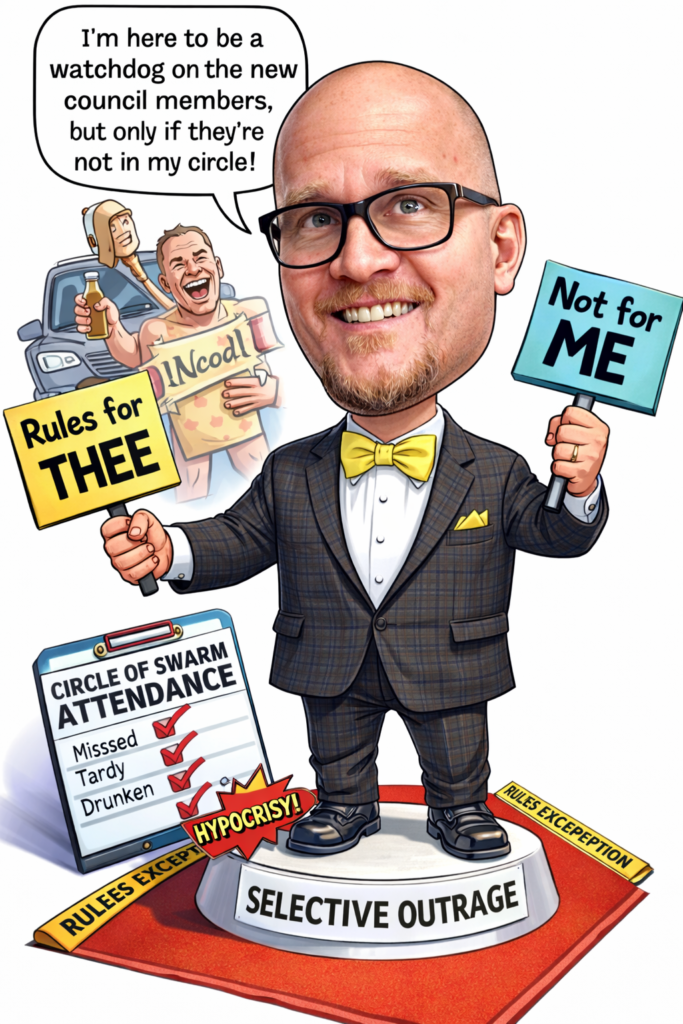
On December 2, 2025, former Frisco councilman Bobblehead Bill Woodard stepped up to the podium during Citizens’ Input with a speech that sounded, at first, like a heartfelt defense of professionalism at City Hall. After all, according to Woodard, during his 20-plus years in Frisco one of the things he was “most proud of” was the professionalism shown by board and council members while serving on the dais.
Touching. Inspiring. Almost nostalgic.
But as the speech unfolded, what residents actually witnessed was less a thoughtful reflection and more what could best be described as an emotional support tantrum wrapped in a watchdog costume. By the time Woodard finished, his concern for the city’s reputation had been carefully aimed at two of the newest council members—members who, coincidentally, are clearly not part of the inner Frisco Swarm circle.
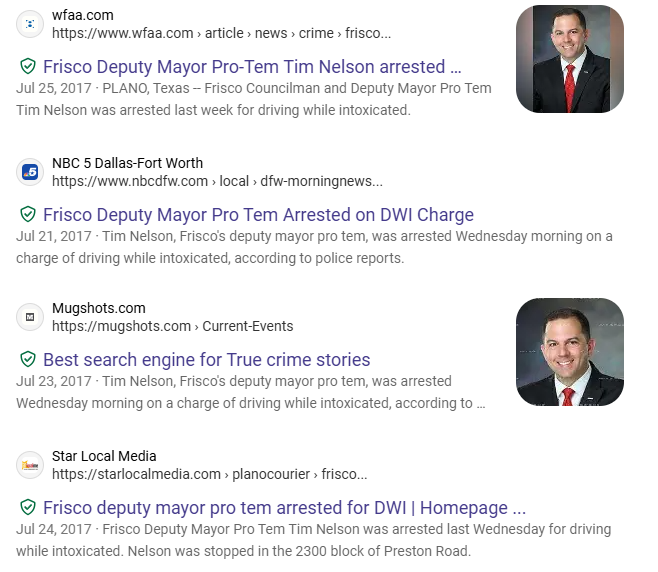
We’ve seen this movie before. In fact, we wrote about it in our earlier blog “Butt-Hurt Politics.” Because here’s the question no one asked from the podium that night: Where was this outrage before? Woodard didn’t rush to the microphone when former Frisco Deputy Mayor Pro Tem Tim Nelson was arrested for alleged drunk driving. There was no impassioned lecture about protecting the city’s reputation then.
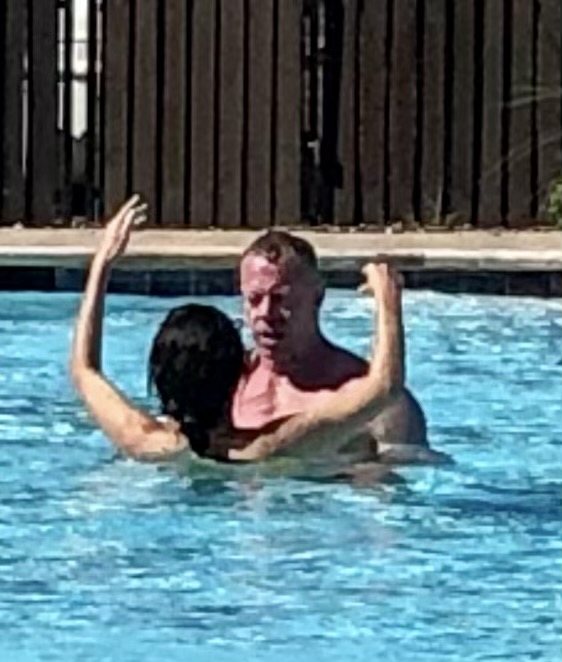
He didn’t sound the professionalism alarm when John “Cheating” Keating was allegedly spotted a few years ago over a Fourth of July weekend at a community pool with a woman (not his wife) who happened to serve on one of the city’s boards.
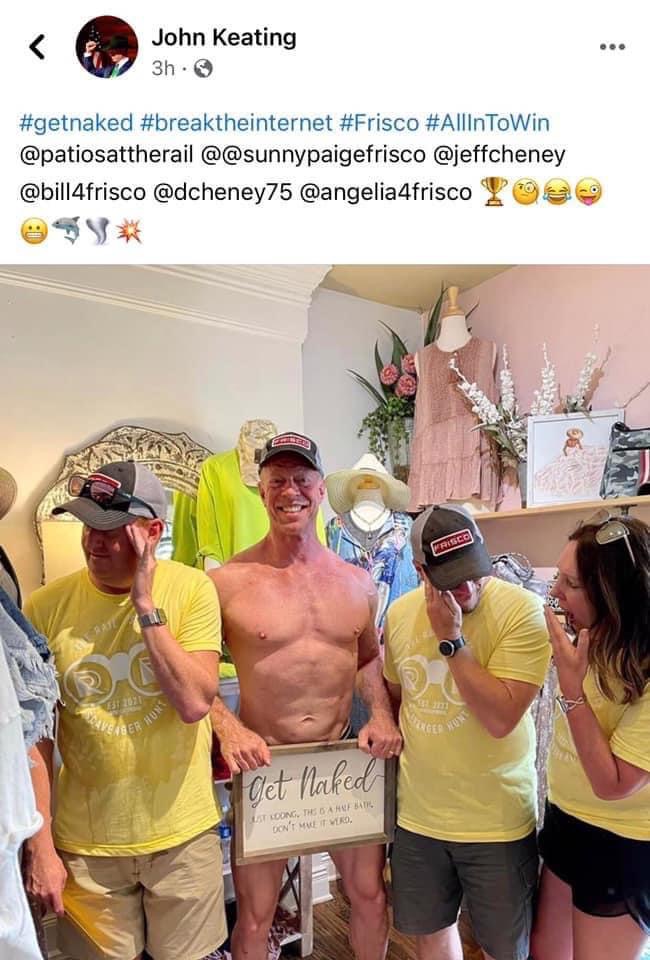
And apparently there was no emergency meeting of the Professionalism Police when Keating once posed holding a sign reading “Get Naked” over his private parts, creating the illusion he was standing there unclothed—while Mayor Jeff Cheney and the First Lady laughed along.
No speeches. No lectures. No watchdog warnings about Frisco’s reputation.
But suddenly, when two new council members stumble, miss a meeting, or crack a joke on the dais, Bobblehead Bill finds his whistle and climbs into the referee tower. That’s not accountability. That’s Selective Outrage.
From his self-appointed pulpit as an anonymous member of the Frisco Swarm, Woodard seems eager to call out mistakes made by newcomers while conveniently overlooking the long list of missteps made by those inside his own political circle. Even more interesting? After hearing Woodard’s lecture on attendance, preparedness, and professionalism, we decided to do something radical: We checked the receipts.
And what we found in the city’s own Governance Board meeting records raises a few questions about whether the standards Woodard preached on December 2 have actually been applied… consistently… fairly…or evenly. Spoiler alert: they haven’t.
But that’s where things get even more interesting. Because if Bobblehead Bill believes showing up late, missing meetings, or leaving early is a threat to the reputation of the City of Frisco… then residents deserve to know whether everyone is being held to the same standard—or just the people outside the Swarm. And that’s exactly what we started digging into.
According to Woodard, missing meetings, arriving late, or leaving early was not just disappointing… it was disrespectful to the citizens of Frisco and damaging to the reputation of the city. Those are strong words. So naturally, we decided to take Woodard’s advice and focus on the facts. If attendance and professionalism are truly the gold standard for serving the public, then it should apply to everyone—past and present. Right?
Let’s Check the Record: Previous Governance Meetings 2022 – 2025
We started by reviewing the Governance Board meeting minutes available through the city website. What we quickly discovered is that the online records are… incomplete.
Still, the minutes that are available tell an interesting story.
Here are a few examples:
June 23, 2022 – Bill Woodard was absent from the Governance Board meeting.
March 15, 2022 – John Keating was absent from the Governance Board meeting.
April 2, 2024 – Bill Woodard left the meeting early.
February 4, 2025 – Angelia Pelham arrived late to the Governance Board meeting.
Now remember Woodard’s speech. His words were clear:
“The citizens of Frisco expect and deserve representatives show up to do the work. On time and prepared.” Fair enough. But if attendance issues are grounds for public lectures at Citizens’ Input, it seems reasonable to ask: Does that standard apply to everyone—or just certain people?
The Curious Case of Missing Minutes of 2026
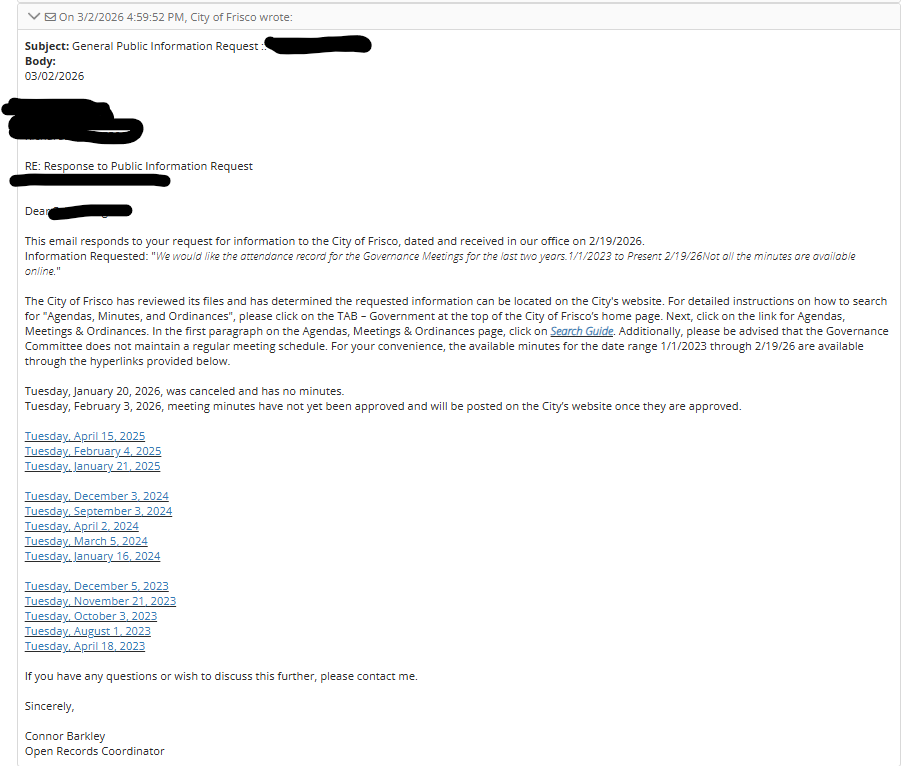
On February 19, 2026, Frisco Chronicles filed a Public Information Request (PIR) asking the City of Frisco for attendance records for Governance Board meetings from January 1, 2023, to the present. We also noted in the PIR that not all meeting minutes appear to be available on the city’s website.
The city responded on March 2, 2026 with a simple explanation:
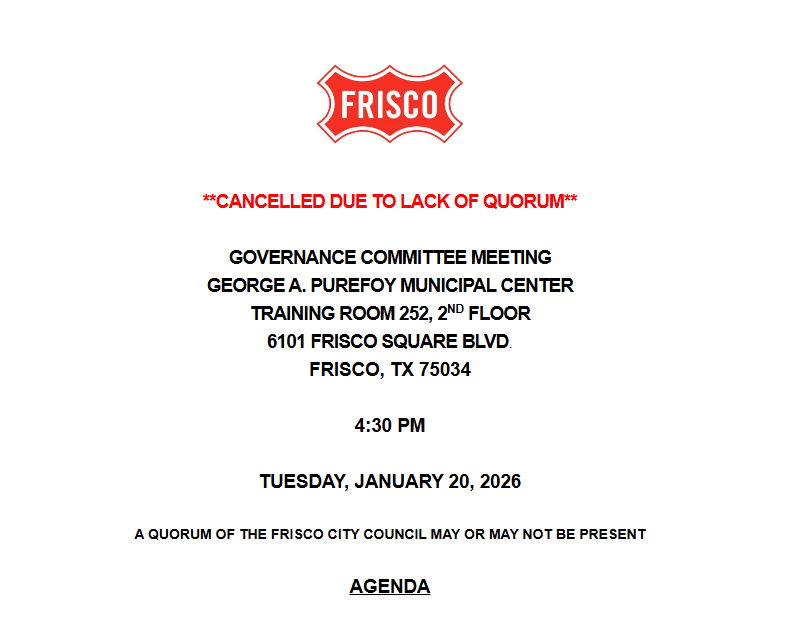
January 20, 2026 meeting shows it was canceled due to lack of quorum. No explanation was provided as the minutes are not posted to the city website.
February 3, 2026, minutes have not yet been approved, so they are not posted.
Then the city closed the request with the status: “Information on Website.”
Things got even more interesting when we looked at the 2026 Governance Board meetings minutes online at the city website.
According to a city insider, the January meeting reportedly lacked quorum because Burt Thakur and Jared Elad misunderstood the meeting date. The next meeting on February 3, a city insider told us the meeting was delayed 20 to 30 minutes because Angelia Pelham arrived late. But since the minutes aren’t publicly posted, residents can’t verify what actually happened. So, we did what any curious citizens would do.
Which raises a simple question: If the minutes exist but just haven’t been approved yet… why not post them with a note that they are subject to approval? Many cities do exactly that in the interest of transparency. But apparently in Frisco, some information moves at the speed of government… while outrage moves at the speed of politics.
The Real Question
Bobblehead Bill Woodard pretends to have an independent point of view and clearly has no issue stepping up to the podium to lecture two new council members about attendance and professionalism. Yet when members of the Frisco Swarm, including himself, miss meetings, arrive late, or leave early, the watchdog appears to take a nap.
No speeches. No Citizens’ Input lectures. No public scolding about the reputation of the city. That’s not accountability.
That’s Selective Outrage.
But Wait… There’s More
After hearing Woodard’s speech about high expectations, we decided to take the research one step further. How many council meetings or work sessions have sitting members council members been late to or been absent from? And, because council members aren’t the only ones expected to show up and do the work we looked into the dozens of boards and commissions, filled with citizen representatives, many of whom were appointed by the same political circle now demanding perfection from others.
The next logical question is simple: Do those appointees meet the same attendance standards? Or does the outrage stop there with just two new council members? That’s exactly what we started digging into next. And what we found might surprise you.
Stay tuned for Part 2: The Attendance Records of City Council and City Boards and Commissions
Disclaimer: This blog includes satire, parody, and comic relief. It contains summarized accounts created solely for humor and commentary. Any resemblance to real events is either coincidental or intentionally satirical. Reader discretion — and a sense of humor — are advised.
For years we have watched our city leaders and city management make rules for thee but not for them. Residents are tired of those on the dais making up their own rules. The final straw was then they allowed a private citizen who was not sworn in as a council member because there was an open recount into closed session. That evening potentially broke so many Texas Open Meetings Act rules and it is time for the pipers to pay the price.
Help us share the petition, spread the word across the community via social media tools to have Frisco Residents, Frisco Business Owners, and Frisco Landowners demand better.
Petition Title: Demand Investigation into Potential Texas Open Meetings Act Violations on February 17 Frisco City Council Meeting
Petition Addressed To:
Greg Willis -Collin County District Attorney
Texas Attorney General’s Office
State Bar Association of Texas
Call To Action: Hold Frisco Officials Accountable for Potential Violations of the Texas Open Meetings Act
On February 17, 2026, the Frisco City Council recessed into an Executive Closed Session under the Texas Open Meetings Act to discuss sensitive legal, personnel, and economic matters. Executive sessions exist for one reason: to allow limited, confidential discussions among authorized officials when the law permits it.
However, during this closed session, Frisco resident Ann Anderson, who recently won a special election by a small margin of votes and was facing an official recount, was reportedly allowed to attend the confidential executive session. At the time Anderson had not been sworn in and taken her oath at a city council meeting in front of the public.
Matters Discussed Per City Agenda include:
A. Section 551.071. Meeting with City Attorney regarding a matter(s) in which the duty of the City Attorney under the Texas Disciplinary Rules of Professional Conduct of the State Bar of Texas conflicts with the Open Meetings Act regarding:
i. Receive legal advice regarding trademark issues.
ii. Receive legal advice regarding proposed interlocal agreement with Collin County, Texas, and other political subdivisions for the use of the Collin County Animal Shelter and related issues.
iii. Receive legal advice regarding JDHQ Hotels LLC v. City of Frisco, Texas in Cause No. 493-07806-2025 pending in the 493rd District Court in Collin County, Texas.
These topics involve sensitive negotiations and legal strategy, which is precisely why the law restricts who may attend such sessions.
B. Section 551.072. To deliberate the purchase, exchange, lease or value of real property located:
i. North of Stonebrook Parkway, west of Preston Road, east of Dallas North Tollway, and south of Eldorado Parkway.
C. Section 551.074. Personnel Matters: Section 551.074 authorizes certain deliberations about officers and employees of the governmental body to be held in executive session:
i. Deliberate the appointment of Mayor Pro-Tem and Deputy Mayor Pro-Tem.
D. Section 551.087. Deliberation regarding commercial or financial information that the City has received from a business prospect or to deliberate the offer of a financial or other incentive to a business prospect.
Why This Investigation Is Necessary
1. Potential Destruction of Attorney-Client Privilege
The closed executive session included legal advice from the City Attorney. Section 551.001 et. seq. Texas Government Code reads “Consultation WITH ATTORNEY – to seek legal advice on pending or contemplated litigation or settlement offers.” The purpose of this provision (Texas Government Code §551.071) is to protect confidential legal advice and attorney-client privilege.
Allowing an unauthorized individual into such a meeting may waive privilege and undermine the legality of the session. It also violates the confidentiality required by the Texas Open Meetings Act.
The presence of an unauthorized individual (Ann Anderson) during legal consultations may invalidate attorney-client privilege, potentially exposing the City of Frisco to legal and financial risk. This raises serious questions regarding the actions of City Attorney Richard Abernathy and whether the integrity of the executive session was compromised.
2. Protection of Public Transparency
The Texas Open Meetings Act exists to ensure public business is conducted openly and lawfully. If the rules governing executive sessions are ignored, the public loses trust that decisions are being made legally and transparently.
3. Pattern of TOMA Concerns
Many Frisco residents have raised concerns about potential TOMA violations over the years. Examples include:
For example, Mayor Jeff Cheney maybe repeatedly violate TOMA when he responds to citizens at length during Citizen’s Input or Public Testimony. Or when the city has prepared a full presentation which is displayed during Citizens Input to try and suppress residents from speaking.
Walking Quorum: That is where members violate, Texas Open Meetings Act (TOMA), Section E which states a violation occurs when there is a series of communications outside a public meeting among members of a governmental body is used to secretly deliberate public business and collectively involves enough members to constitute a quorum. That includes backroom, back-to-back, whisper-to-whisper communications about city business that add up to a quorum. Doesn’t matter if it’s by text, email, smoke signals, or gossip in the golf cart. Section 551.143 spells it out: if you have a walking quorum – you’ve just committed a criminal offense.
We published text messages which showed a potential walking quorum in our blog Walking Quorums and Wobbly Ethics. For years the council has been having discussions about who should be Mayor Pro Tem and Deputy Mayor Pro Tem in private. However, ALL COUNCIL DECISIONS (LIKE MPT / DMPT) HAVE TO BE POSTED AND DISCUSSED IN PUBLIC.
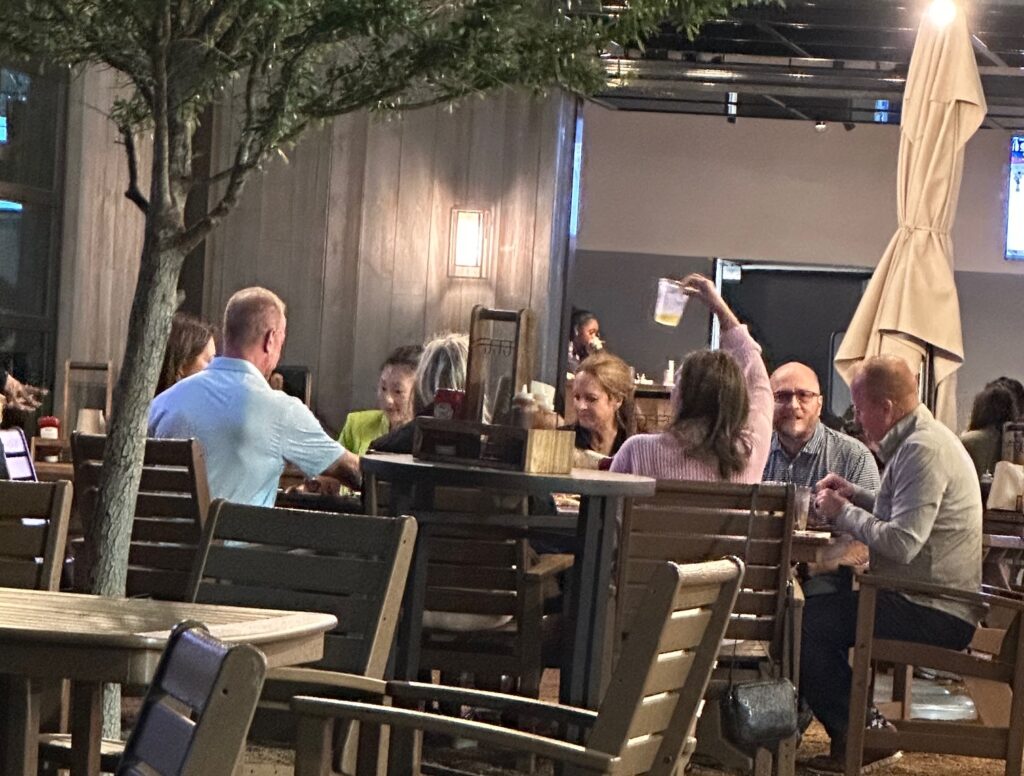
Example: 4 City Council Members Seen Together at PGA
Call To Action:
For this reason, we are calling for an immediate investigation and enforcement of the Texas Open Meetings Act. Relevant Texas Law states, “Under the Texas Open Meetings Act (Texas Government Code Chapter 551), closed meetings are strictly regulated.”
I. Criminal Investigation by Collin County District Attorney’s Office (Greg Willis)
We ask Collin County District Attorney Greg Willis to investigate whether violations of Texas Government Code Chapter 551 occurred during the February 17 executive session. If violations are found, we are asking the Willis to enforce the law and penalties that apply.
II. Attorney General Review
We ask the Texas Attorney General’s Office to determine whether the presence of an unauthorized individual waived confidentiality, and whether documents, recordings, communications, and notes related to the session should now be treated as public records.
III. Professional Conduct Investigation by Texas Bar Association
We ask the State Bar of Texas to investigate whether City Attorney Richard Abernathy violated the Texas Disciplinary Rules of Professional Conduct by allowing a non-authorized individual to attend privileged legal discussions. Ann Anderson’s
Who Should Be Investigated: Any investigation should review the conduct of those present in the executive session, including:
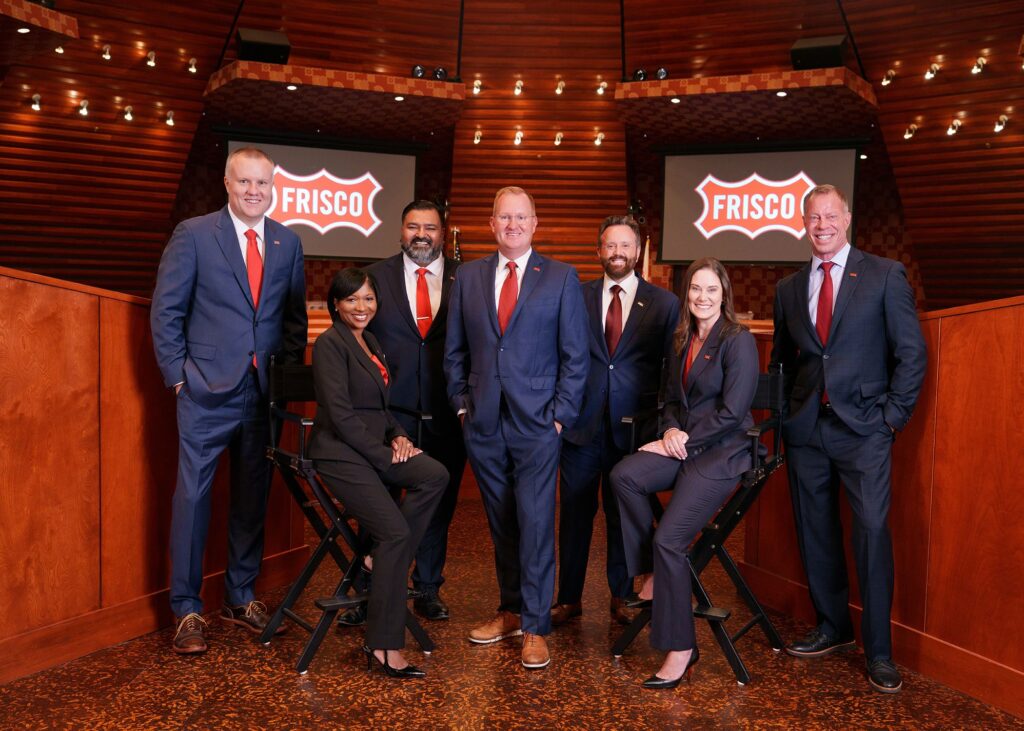
Mayor Jeff Cheney
Mayor Pro-Tem Angelia Pelham
Deputy Mayor Pro-Tem Laura Rummel
Council Member John Keating
Council Member Brian Livingston
Council Member Burt Thakur
Council Member Jared Elad
City Attorney Richard Abernathy
City Manager Wes Pierson
Frisco resident Ann Anderson
In Closing: Sign This Petition
Residents of Frisco deserve a government that follows the law. The Texas Open Meetings Act exists to protect citizens from secret decision-making and backroom politics. If elected officials or city leadership ignore these laws, the public’s trust in local government erodes.
Accountability is not optional. Transparency is not negotiable. The rule of law must apply equally to everyone.
Sign this petition to demand transparency, accountability, and enforcement of the Texas Open Meetings Act.
Disclaimer: This blog includes satire, parody, and comic relief. It contains summarized accounts created solely for humor and commentary. Any resemblance to real events is either coincidental or intentionally satirical. Reader discretion — and a sense of humor — are advised.
After the council ruled on the complaints at the July 2021 council meeting, a resident came forward at the August 3, 2021, council meeting to speak during citizens’ input requesting an independent ethics committee. Mayor Cheney responded to the citizen announcing the Governance Committee would be meeting later that month to review the current ethics policy and the citizen was welcome to attend and speak at that meeting. He then said when it was first put in place that the city attorney told them it could be used as a political weapon against council members. Then Ms. Rouse took the podium and spoke and Mayor Cheney responded to her red faced and with beady little eyes, that the city did not need to hear her complaints because they were not filled out correctly but he insisted they be heard because he wanted them dismissed since they were not factual and ridiculous.
It made us wonder, what do other cities do? The City of Denton has a Board of Ethics which was created in 2018 and their duty is to solely hear ethics complaints filed against city officials. The city website thoroughly details the policy, procedures, and forms. The City of Plano is much like Frisco in how they hear ethics complaints. One interesting thing to note about their Code is Sec 2-109 which states the acceptance of a campaign contribution in excess of $1,000 by any city council member(s) shall create a conflict of interest based on an appearance of impropriety. In a nutshell that means they must recuse themselves from votes that could benefit anyone who gave more than $1,000 to their campaigns. The City of Dallas strengthened its code of ethics policies in 2021 and all complaints go before the Dallas’ Ethics Advisory Commission whose 15 members are appointed by the council. We were surprised to see most cities have the same process as Frisco when it is clear there are major conflicts of interest involved.
Now that you understand the process, and we broke down one of the complaints, it is time to talk about a few reasons why the ethics policy is bogus.
Reason 1: Relationship Conflicts
A conflict of interest occurs when an individual’s interests such as family, friendships, financial or social factors could compromise his or her judgment, actions, or decisions. In this case, several conflicts of interest led to the whole process being bogus.
If one of the fellow council members is indirectly linked to the issue then how could they vote on it? In this case, indirectly, Angelia Pelham was named in the complaint. The mayor campaigned for her, held fundraisers for her just months before the vote, and the alleged allegation in question is related to a post about her. While Angelia is not accused of anything in the ethics complaint, and we don’t believe she had any knowledge of the mayor’s actions or what he planned to post she is indirectly connected to the complaint. One could argue that she could not be impartial and should recuse herself.
To have a council member vote against another council member whom they have served next to for some time and could be friends with smells like shit. The whole thing is questionable and creates an appearance of impropriety.
One of the ethics complaints that evening was against Councilman John Keating for his alleged poor public display of public behavior. For Cheney to vote on Keating and then Keating to vote on Cheney, how is the public supposed to think they don’t have a gentleman’s agreement to not vote against each other? Let’s also take into consideration they are neighbors, literally right next door/across the street from each other in the same cul-de-sac.
Reason 2: Campaign Donations
Did you know that for years those who serve on the council have donated to each other’s campaigns? Some more than others but this is a time-honored tradition based on our review of campaign finance reports.
John Keating over the years has donated $3500 to Mayor Jeff Cheney’s campaign, he also donated 477 dollars to himself, he donated $7000 to Angelia Pelham’s campaign,, $1000 to Bill Woodard’s campaign, and $1500 to Laura Rummel’s campaign. Oh yeah, let’s not also forget Jeff Cheney and John Keating are neighbors (in the same cul-de-sac).
Jeff Cheney along with his wife held a fundraiser for Angelia Pelham that was valued at $1556 bucks according to the campaign finance report as well as he publicly supported her during her election. Dana Cheney also donated 250 dollars to John Keating’s campaign.
Bill Woodard donated $200 to John Keating’s campaign and according to his campaign finance reports he received a $100 donation in 2016 $100 from someone with the last name Abernathy. Is that the same person who serves as the City Attorney? We don’t know but it left us wondering.
Will Sowell donated $450 to Jeff Cheney’s campaign, and $100 to Bill Woodard’s campaign.
Brian Livingston donated $265 to Jeff Cheney’s campaign as a (food expense) and $500 to Laura Rummel’s campaign.
Shona Huffman donated $100 to John Keating’s campaign.
With campaign finance donations going back and forth between candidates, there is no way the council could claim to be impartial. Money flowing between candidates should be an immediate reason for recusal. To one on the outside looking in a donation could be equivalent to a gift. It could also be seen as reciprocal favor where there is an understanding with another person that official action will be rewarded directly or indirectly. Regardless of the amount, a donation should automatically be a reason for recusal.
Reason 3: The City Attorney
You are wondering, what the city attorney has to do with it being bogus? The city attorney works for the city and his goal is to protect the city. That means he advises them of the merit of the complaint and provides a written report describing the nature of the complaint and an assessment of the complaint. What could influence the city attorney in how he does his job or the decisions he makes? You know that thing you call a yearly review – where your company grades you on your performance which ultimately can affect your pay or your employment. The city council and the mayor write the attorney’s yearly review every year. That could influence anyone on how they do their job and the decisions they make.
All residents want is transparency which is important when there is a perceived conflict of interest. Pretend for a moment, everything is above board, and there is no shady shit happening but there is an appearance of wrongdoing, that appearance is just as important as reality in the minds of the public, citizens, and voters.
A resident should not need an attorney to file a complaint against an elected official that was voted into office by the residents. The city should have the City Charter, Code of Conduct, and how-to instructions easily available on the website. It should be easy to obtain all the necessary forms from the city secretary’s office. Calling for a review of the Ethics Policy after complaints were made, gives the appearance of being shady. The city should also consider adopting something similar to Plano, which states a campaign contribution in excess of $1,000 to any city council member(s) shall create a conflict of interest based on an appearance of impropriety. Meaning Jeff Cheney and others on the council would have to recuse themselves from voting on developments where they have received large campaign contributions from those associated with the project. That would be a game-changer rule in Frisco and not one that you would see many on the council voting for anytime soon.
The conflicts mentioned above are glaring red flags and the residents of Frisco should be outraged. We recommend you file your complaints with the Texas Ethics Commission or the Texas Attorney General because it is clear your voice of concern is not welcome in Frisco and that is some shady shit!


I went to her to ask for help with an issue my child that was getting nowhere with the school,…
So whatever became of the $17 million dollars that the city council gave the Mayor to beautify a drainage ditch?
At last count, there are 3 different "spa/massage" businesses in the small office park at the northeast corner of John…
I literally just saw this. Yeah, she used to forward everybody’s emails behind their backs.
You're dropping truth bombs! These mom and pop shops are what should be the least of Karen's worries. If they…