If It’s Such a Great Deal, Why the Peek-a-Boo? The City of Frisco loves to tell residents how transparent they are but it is Crystal clear, like spring water, they don’t want us asking questions about the 2021 decision to open the Employee Health Clinic pushed by former HR Director Sassy Safranek. Transparency for city officials is like one of those novelty shower doors that looks clear until the steam hits and suddenly you can’t see a thing.
Welcome to the fog.
Back in 2021, the City’s Employee Health Clinic wasn’t some sleepy consent-agenda item. It was hotly contested, debated, dissected, and ultimately shoved across the finish line by a rare mayoral tiebreaker vote. Millions of dollars. Long-term projections. Big promises about savings, efficiency, and “doing right by employees.”
Fast-forward to today. Naturally, we thought: Hey, let’s see how that investment is actually doing. You know—basic follow-up … Journalism and Accountability. The stuff transparency is supposedly made of. And the City’s response? NO. NO. NO. (But said politely, on letterhead, with lawyers involved.)
A Simple Question Turns Into a Legal Obstacle Course
On November 12, 2025, Frisco Chronicles filed a Public Information Request (PIR). Nothing exotic. Nothing personal. No medical records. No names. No HIPAA panic.
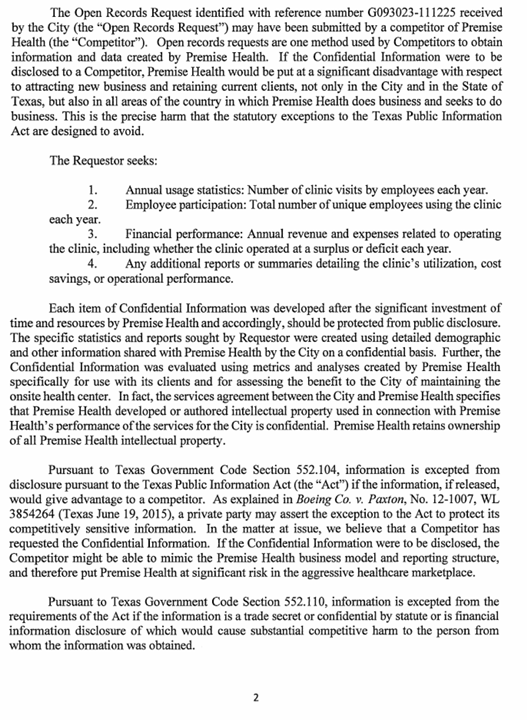
We asked for basic performance data for the City of Frisco Employee Health Clinic over the past five fiscal years (or as available):
Annual number of clinic visits
Number of unique employees using the clinic
Annual operating revenue and expenses
Whether the clinic was running on a surplus or deficit
Any reports detailing utilization, cost savings, or performance
In other words: Is this thing working the way the City told taxpayers it would? Seems reasonable, right? Apparently not.
The Attorney General (Because Why Not?)
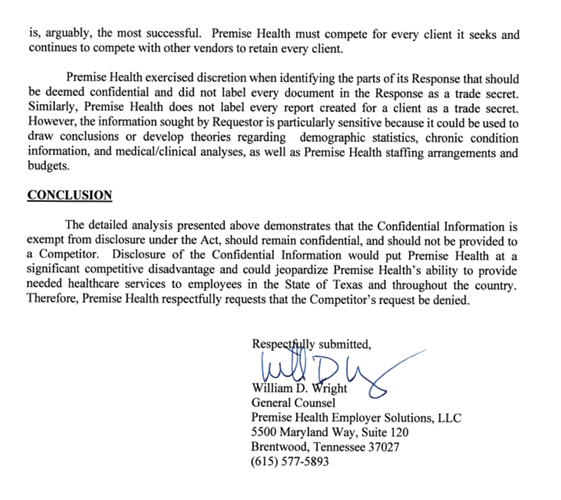
Instead of releasing the data—or even part of it—the City Attorney’s Office punted the request straight to the Texas Attorney General, asking for permission to keep the curtain closed. From their letter:
“Frisco requests that the Texas Attorney General’s Office determine whether Frisco is required to disclose the information.”
Translation: “We’d rather not decide transparency ourselves. Please hold.”
Even more interesting? The City claims it “takes no position” on releasing the information… while simultaneously triggering a process that delays a release of requested documents and invites third parties to object.
That’s like saying: “I’m not stopping you from leaving… I’m just locking the door and hiding the keys.”
Third Parties, Copyrights, and Other Smoke Bombs
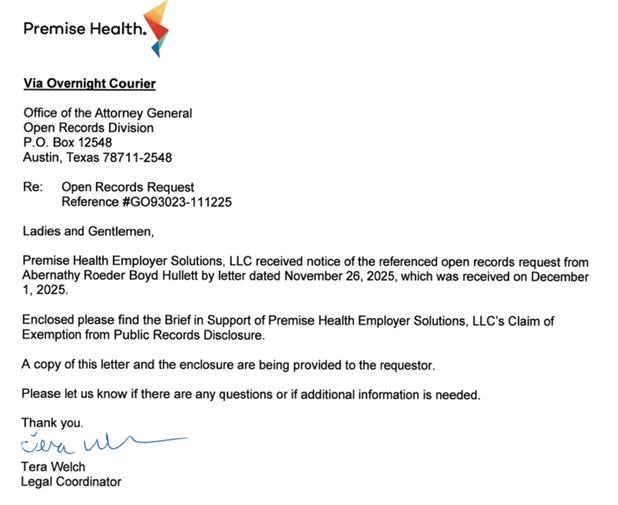
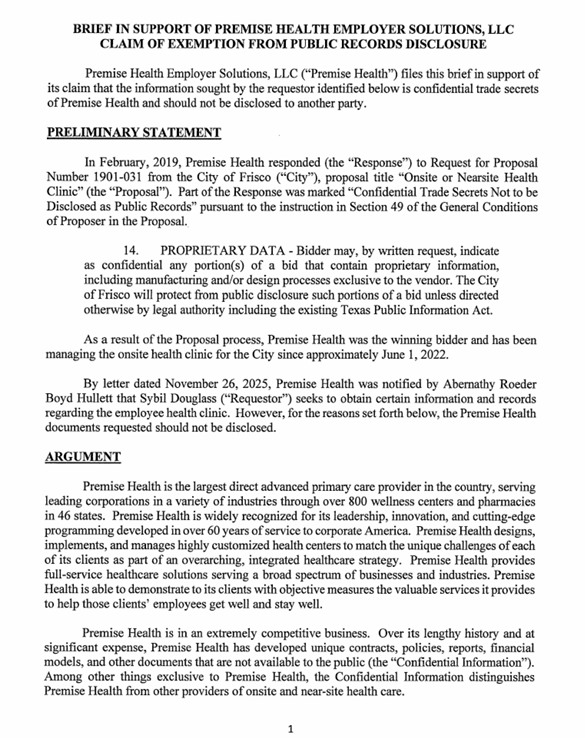
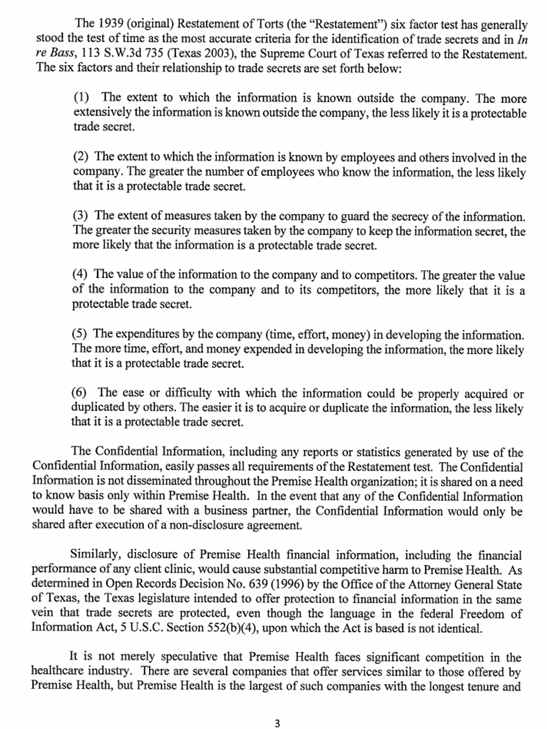
The City also notified Premise Health, the private contractor operating the clinic, giving them the opportunity to argue against disclosure under Section 552.305 of the Texas Public Information Act.
Premise Health, unsurprisingly, filed a brief supporting the City’s request to withhold information. (We’ll publish that response in full—because transparency is apparently contagious when citizens do it.)
The City’s letter also raises the specter of copyright protection, which begs the obvious question: If this is just boring operational data, why the legal gymnastics?
Let’s Rewind: Why This Matters
Back in November–December 2021, City Council members openly worried about low employee utilization, long-term financial losses, and whether the private sector would ever make such an investment.
Deputy Mayor Pro Tem Brian Livingston said at the meeting, “I believe it’ll take us close to eight to nine years—if not longer than a decade—to break even … I don’t believe that the private industry would make that choice.” He continued, “I’m very afraid that the losses will be much larger due to lower utilization that’s planned or expected.”
According to an article in Community Impact the estimated expenses in the clinic’s first year were expected to be over $1.44 million which included salaries, insurance, management and implementation fees and equipment purchases. The clinic’s fifth-year budget is listed at more than $1.31 million. Premise Health projeced that the clinic will operate at a loss in its first three years.
Breaking down the numbers, the clinic required a $173,754 implementation fee, over $6.28 million in salary and management fees in the first five years, and subsidization from the City’s insurance reserve fund.
Despite all that, the deal passed—barely—with Mayor Jeff Cheney casting the deciding vote. Council Members Brian Livingston, Shona Huffman and Dan Stricklin voted against the clinic. And now, four years later, when citizens ask: “So… how’s it going?” The answer is silence, lawyers, and a referral to Austin.
If It’s Saving Money, Show the Receipts
The City’s own website proudly claims the Employee Wellness Center saves taxpayer dollars, reduces insurance costs, and helps recruit and retain top talent. Great! Fantastic! Pop the champagne! So why not release the utilization numbers, cost comparisons and savings analyses?
If the clinic is the fiscal success story we were promised, these records should be the City’s favorite bedtime reading. Instead, we’re told third parties might object, copyright might apply, and the Attorney General must decide.
That’s not transparency. That’s strategic opacity.
The Real Question: What Are We Not Supposed to See?
No one is accusing the clinic of wrongdoing. No one is demanding personal health data. No one is attacking city employees for using a benefit. This is about taxpayer accountability.
When a multi-million-dollar program was controversial from the start, required subsidies, and was justified on future savings …citizens have every right to ask whether those promises materialized. And the City has an obligation to answer without hiding behind contractors and legal process.
Call to Action: This Is Bigger Than One Clinic
Residents of Frisco should not shrug this off. We encourage citizens to:
Write to the City of Frisco, demanding the release of these records
Contact the Texas Attorney General’s Office, urging disclosure under the Public Information Act related to PIR G093023
Remind leadership that “trust us” is not a financial metric
Transparency isn’t a slogan. It’s a practice.
And if the City truly believes this clinic is a win for employees and taxpayers, then sunlight won’t hurt a thing. Unless, of course… there’s something they’d rather keep in the dark.
Disclaimer: This blog includes satire, parody, and comic relief. It contains summarized accounts created solely for humor and commentary. Any resemblance to real events is either coincidental or intentionally satirical. Reader discretion — and a sense of humor — are advised.
After former council member Tracie Reveal Shipman stepped up to the Citizens Input podium to publicly scold two sitting council members over their campaign finance reports, we figured it was a good time to do what Frisco Chronicles does best: pull the thread and see what unravels.
If we’re going to talk aboutethical leadership and transparencywith a straight face, then the microscope shouldn’t only hover over political opponents or convenient targets. Transparency, after all, is not a karaoke song—you don’t get to sing only the parts you like.
So, in the spirit of civic duty, ethical leadership, and good old-fashioned dumpster diving, we decided to take a look at campaign finance compliance across both Frisco ISD trustees and City Council candidates.
Spoiler alert: this trash pile has layers.
The Rules (Because Facts Are Stubborn Things)
Under Texas Election Law, the rules are not optional, vibes-based, or enforced only when politically convenient. Here’s the short version:
Anyone who files a Campaign Treasurer Appointment (Form CTA) must file semiannual campaign finance reports.
This requirement continues even after the election ends, even if the candidate:
Lost
Raised $0
Spent $0
Retired emotionally from politics
The only way out? Cease campaign activity and file a FINAL report.
Straight from Texas Election Code §254.063:
July 15 report (covering Jan 1 – June 30)
January 15 report (covering July 1 – Dec 31)
No report. No “oops.” No “but I meant to.” The law does not care.
Frisco ISD Trustees: Let’s Start There
Public disclosures and election records can be found here:
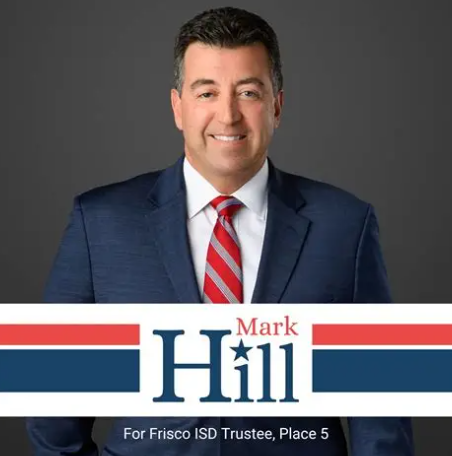
Mark Hill Frisco ISD Board of Trustees – Now Running for Mayor
Not in Compliance
Filed a campaign finance report in January 2024
That report was NOT marked “Final”
Meaning… the reporting requirement continues
Missing Reports:
❌ July 2024
❌ January 2025
❌ July 2025
Even $0 activity requires a filing. The form literally allows you to write “$0” repeatedly. Democracy loves paperwork.
Question for voters: If a candidate can’t follow the most basic campaign finance rules, should they be trusted with the mayor’s office? Asking for a city.
Dynette Davis Frisco ISD Trustee
In Compliance
Filed her July 2025 report which shows $0 contributions and $0 expenditures
Boring? Yes.
Correct? Also yes.
Gold star. No sarcasm required.
Sherrie Salas Frisco ISD Board of Trustees
Not in Compliance
Missing required reports:
❌ January 2025
❌ July 2025
Again, silence is not a filing strategy.
Keith Maddox Frisco ISD Board of Trustees
Not in Compliance
❌ Missing July 2025 report
One report doesn’t sound like much—until you remember compliance isn’t optional.
City Council: Same Rules, Same Problems
Now let’s shift from the school board to City Hall.
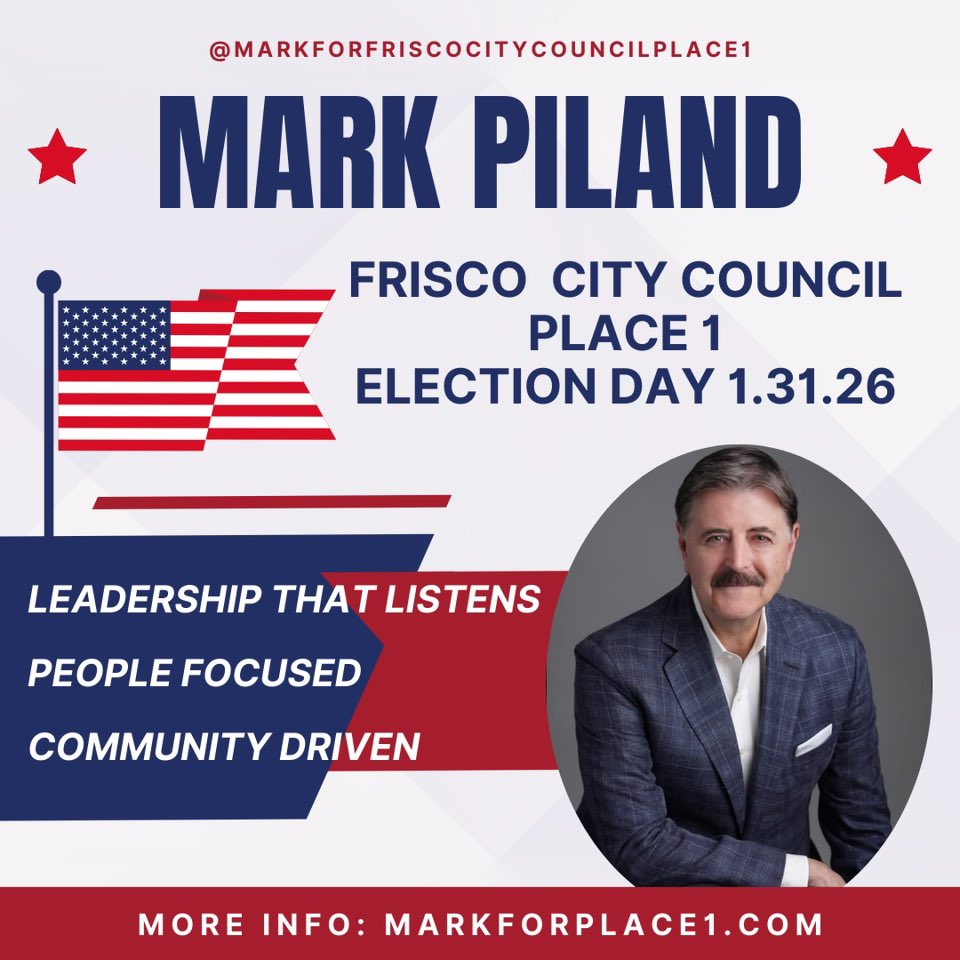
Mark Piland Candidate in the January 31 Special Election
In Compliance
Filed correctly. Reports accounted for. No notes.
Ann Anderson Candidate – City Council
Major Compliance Issues
Filed a Campaign Treasurer Appointment on November 17, 2023
Has filed ZERO campaign finance reports since
That means we’re missing:
❌ June 2024
❌ July 2024
❌ January 2025
❌ July 2025
Per state law, once a treasurer is on file, reports are mandatory until a FINAL report is filed. No reports = not compliant. Full stop.
So… About That Podium Speech
When someone publicly calls out others for ethical lapses, it’s fair to ask:
Has this same scrutiny been applied consistently?
Has the speaker reviewed all campaign finance reports with equal vigor?
Or is ethics enforcement selective—like a traffic cop who only pulls over certain cars?
Transparency is not a weapon. It’s a standard. And standards only work when they apply to everyone.
Final Thought
Campaign finance compliance isn’t complicated. It’s tedious. It’s boring. It’s paperwork-heavy. And that’s exactly why it matters.
Because if a candidate can’t handle the boring rules when no one’s watching, how exactly are they going to handle power when everyone is?
We’ll keep digging. Because someone has to.
Disclaimer: This blog includes satire, parody, and comic relief. It contains summarized accounts created solely for humor and commentary. Any resemblance to real events is either coincidental or intentionally satirical. Reader discretion — and a sense of humor — are advised.
Sec. 254.063. SEMIANNUAL REPORTING SCHEDULE FOR CANDIDATE. (a) A candidate shall file two reports for each year as provided by this section.
(b) The first report shall be filed not later than July 15. The report covers the period beginning January 1, the day the candidate’s campaign treasurer appointment is filed, or the first day after the period covered by the last report required to be filed under this subchapter, as applicable, and continuing through June 30.
(c) The second report shall be filed not later than January 15. The report covers the period beginning July 1, the day the candidate’s campaign treasurer appointment is filed, or the first day after the period covered by the last report required to be filed under this subchapter, as applicable, and continuing through December 31.
Anyone who regularly watches Frisco City Council meetings knows there is choreography involved. Speaker order matters. And more often than not, the Deputy Mayor Pro Tem Laura Rummel saves the most politically charged speaker for last—the closer meant to leave the final impression on viewers and those sitting in the chamber.
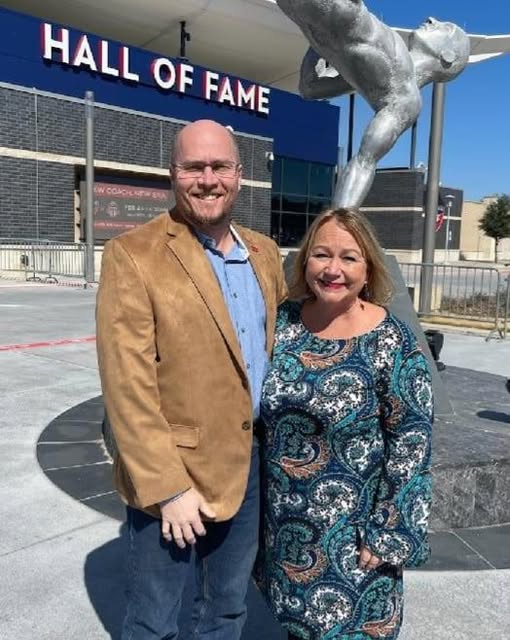
Next up came Tracie Reveal Shipman, who delivered her remarks with the intensity of someone who still has a campaign yard sign in her garage “just in case.” On December 2nd, she stepped to the podium to speak, in her words, “in the spirit of transparency and ethical leadership.” What followed deserves a closer look—because when someone invokes ethics, the facts and consistency matter.
The Résumé as Credibility Shield
Tracie opened with a detailed recount of her credentials:
A 30-year Frisco resident. Two terms on City Council. Selected twice as Mayor Pro Tem by her peers. Appointments to the Comprehensive Advisory Committee, Charter Review Commission, Citizen’s Bond Committee, Visit Frisco, and the Community Development Corporation.
She listed volunteer roles with PTAs, the Heritage Association, Frisco Education Foundation, Scooter Bowl, the Miracle League Turkey Trot, and Leadership Frisco. None of this is in dispute. But credentials are not a substitute for accuracy—and they don’t immunize statements from scrutiny.
An Accidental Admission of Bias
Tracie then made one of the most revealing statements of the night. She acknowledged that she has been involved in at least one local political campaign every year since 1996, and that—upon reflection—she had been on the opposite side of every race run by the current council members.
That matters. It establishes not just experience, but persistent political opposition. And when criticism follows, that context cannot be ignored.
The Cease-and-Desist Narrative
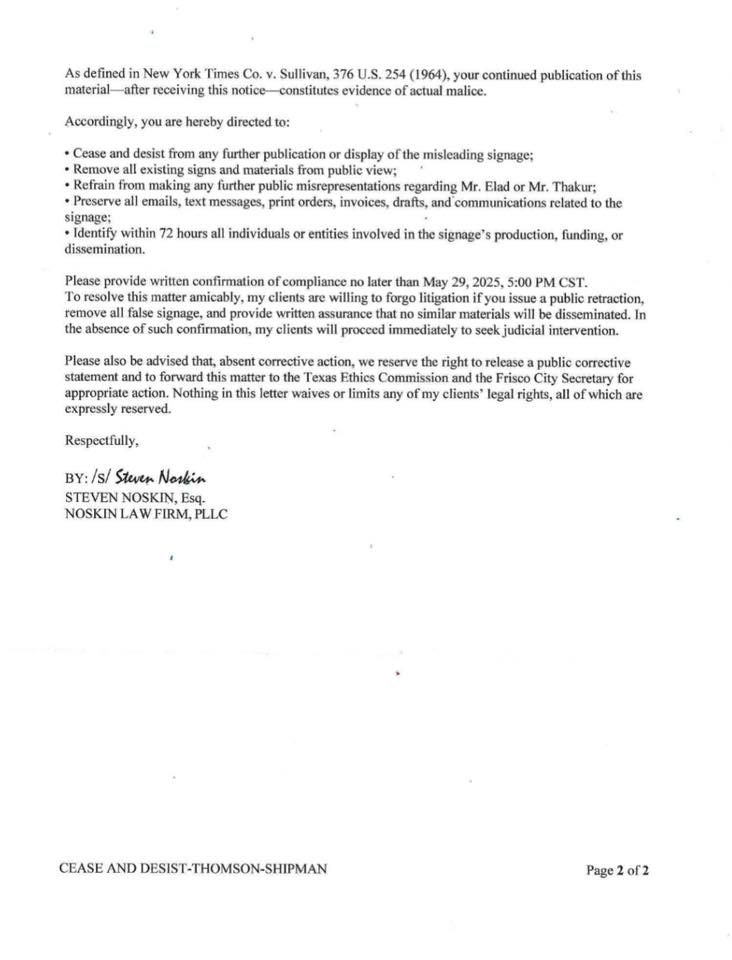
Tracie recounted receiving a Cease & Desist letter dated May 30, 2025, from attorney Steven Noskin, on behalf of council candidates Jared Elad and Burt Thakur, relating to alleged false and misleading campaign advertising connected to the Frisco Firefighters Association.
She stated the allegations were untrue and described engaging in a week-long dispute while out of state, asserting she was prepared to seek sanctions against Mr. Noskin and his clients. According to her remarks, the correspondence ceased the day before the runoff election.
These are her claims, delivered publicly.
Frisco Chronicles has confirmed she was sent a cease and desist which was published on a social media page. Allegedly it is related to the Frisco Porch Pirate who was pushing out information for a PAC that Shipman admits involvement in. Read more about here: Porch Pirates. As for the council meeting roadshow, we have no documentation beyond the letter itself was presented to substantiate the broader allegations made at the podium.
Where the Argument Breaks Down: Campaign Finance Law
The core of Tracie’s speech centered on campaign finance reporting. She asserted that because Mr. Noskin provided legal services related to the cease-and-desist letter, those services “technically should be reflected” in Elad and Thakur’s campaign finance reports—either as legal expenses or in-kind contributions—and she publicly urged them to amend their filings. This is where her argument collapses.
Under Texas campaign finance law, legal services paid personally by a candidate—using non-campaign funds—are not reportable. Likewise, legal services provided independently and not as a political contribution do not automatically constitute an in-kind contribution. Consultation alone does not trigger a reporting requirement. Timing alone does not create a disclosure obligation. And legal representation is not presumed to be a campaign expense absent campaign funds being used.
Transparency does not mean inventing reporting requirements that do not exist.
Free Speech—But Selectively Applied
Tracie framed the cease-and-desist letter as an attempt to “quash” her rights. Yet this framing is difficult to reconcile with her broader political posture. Shipman has openly posted on her social media that she supports the efforts to silence Frisco Chronicles speech.
Free speech cannot be situational. You don’t get to invoke it when convenient and oppose it when critical voices are involved.
A Pattern Worth Questioning
It is also worth noting that Tracie—and others aligned with her—continue to serve on Frisco boards and commissions, roles intended to advise and support city governance. Using Citizen Input to attack sitting council members, question their integrity, and relitigating campaign grievances raises legitimate concerns about conflicts between civic service and political warfare.
That is not transparency. That is not ethical leadership. That is political grievance dressed in ethical language.
A Familiar Warning
Ironically, the most fitting response to Tracie Reveal Shipman’s remarks comes from her closest political ally, Bill Woodard, who recently cautioned others: “Don’t speak of things to which you have no knowledge.”
That advice applies here. Statements made from the podium don’t become facts by repetition. Credentials don’t convert assumptions into law. And transparency demands accuracy—not implication.
But the public record is clear. And selective ethics rarely survive sustained scrutiny.
Let’s Call This What It Was: A Revenge Roadshow
Bill and Tracie’s little duet had all the subtlety of a drunk uncle at Thanksgiving trying to reenact the moon landing.
This wasn’t about City business. This wasn’t about procedures, decorum, or government transparency. This was personal. A double-shot of bitterness served neat.
They’re still mad they lost:
Their preferred candidate, Tammy Meinershagen
Their dream of a taxpayer-funded Performing Arts Center
Their long-held grip on the establishment seat warmers
And—let’s be honest—the fact that Burt and Jared, two unapologetic Republicans, won decisively
They are, in medical terms, butt-hurt. A condition known to flare up when the voters say, “Thanks, but no thanks.”
And now they’re online celebrating their citizens-input rant like it was the Gettysburg Address. Their crowd is cheering them on as if “scold two people publicly” is a constitutional achievement. Please.
The Bottom Line
Frisco deserves grown-ups at the podium. We deserve commentary that cares about the city—not ex-officials turning citizen input into therapy hour. What we saw December 2nd wasn’t courage. It wasn’t leadership. It wasn’t accountability. It was the political equivalent of a participation ribbon taped to a midlife crisis.
And if this is the new standard for public discourse, buckle up, Frisco. The circus is back in town—and the clowns are fighting over who gets to hold the microphone.
Disclaimer: This blog includes satire, parody, and comic relief. It contains summarized accounts created solely for humor and commentary. Any resemblance to real events is either coincidental or intentionally satirical. Reader discretion — and a sense of humor — are advised.
The last few Frisco City Council meetings have been electrifying, to say the least. Truth be told – we are LOVING IT! Between the Mayor staking claim over “his” meetings and the resulting drama on the dais, you could almost sell tickets. But credit where it’s due — it’s been exciting to finally see genuine conversation on the dais happening at City Hall for the first time in years.
The October 21st Showdown
At the October 21 meeting, following the presentation and citizen input on the Animal Holding Facility, Councilmember Burt Thakur began speaking and moved to table the item — citing unanswered questions and wanting to hold a community feedback session. Before he could even finish, Mayor Cheney cut him off, declaring he wasn’t “taking motions yet.” He wanted to “hear from others first.”
Thakur, undeterred, looked to the City Attorney and again tried to make his motion. That’s when the Mayor doubled down:
“I am not taking motions; I am taking comments. I run these meetings like you have been told.”
Cheney then cleared his throat and awkwardly corrected himself, saying “as we have discussed.” But the tone was set — and the message was clear. When it comes to running the show, Mayor Cheney leads with a heavy hand (and perhaps a lead foot). Moments later came the headline-worthy declaration:
“THIS IS MY MEETING!”
Council Questions the Rules — and the Silence is Deafening
At the end of the meeting, Councilmember Brian Livingston asked a simple, reasonable question: What form of governance or parliamentary procedure does the city follow when disputes arise?
The City Attorney’s answer?
“We don’t have one.”
The Mayor quickly followed up, asserting that it’s all governed “by the city charter.”
Livingston pressed the point — noting that with council turnover and growing diversity of thought, it might be wise to establish some formal procedures. Mayor Cheney stood firm:
“There is language in the charter.”
Frisco Chronicles Fact-Checks the Charter
So, we did what any responsible chronicler would do — we went straight to the City Charter.
Section 3.05 — The Mayor: It reads, “The Mayor shall preside at meetings of the City Council and shall be recognized as head of the City government for all ceremonial purposes.” It continues: the Mayor may participate in discussion and may vote only in case of a tie or when required by law. Nowhere does it state the Mayor dictates meeting procedures.
Here’s the kicker: while Section 3.05 gives the Mayor the gavel, it doesn’t say what procedural rules should be followed — not Robert’s Rules, not anything. So, when the City Attorney said there’s “no procedural method of record,” that was spot on.
Translation: It’s Not Your Meeting, Mr. Mayor
Yes, the Mayor presides — but without a formally adopted set of rules, technically, any councilmember can make a motion at any time. Mayor Cheney clearly stated the rules are in the city charter and he is wrong! There is no procedural method of record in the city charter that defines how or who rules on them and who is responsible for enforcing them. It maybe the ceremonial Frisco Way but there is nothing that gives the Mayor the right to call it or control it as “HIS MEETING!”
The Mayor can preside over the agenda but without clarity of what procedural rules you oversee technically a motion can be made by any council member without hearing from all council members. In that case you need to vote to hold the motion to the end of the discussion or vote on it, then move on with more discussion. At least that is how Robert Rules would be applied but again they are not operating by that either. The language in our city charter is standard in Texas city charters. It’s about representation — not authority.
In other words: you don’t get to run the council like your own HOA meeting.
Ceremonial Head ≠ Commander-in-Chief
The Charter calls the Mayor the “Ceremonial Head.” Translation: you cut ribbons, sign proclamations, and smile for photos. That role does not include controlling council debate or deciding who speaks when. It’s representation, not authority.
Who Really Holds the Power?
Section 3.07 — Powers of the City Council states:
“All powers of the city and the determination of all matters of policy shall be vested in the city council.”
“Determination of all matters of policy” means the council as a collective — not the Mayor alone — directs city policy. The Mayor may lead discussions and participate in discussions but has no more policymaking power than any other member, except to break a tie. Power in Frisco, by design, comes from majority decisions, not a single voice.
The power is collective, not individual!
The Missing Rules of Procedure
Section 3.13 — Rules of Procedure says:
“The City Council shall determine its own rules of order and business.”
That’s it. No specific rulebook, no reference to Robert’s Rules of Order. The council — not the Mayor — is supposed to establish those rules together. Until they do, it’s essentially the Wild West of parliamentary procedure in Frisco.
If a dispute arises, there’s no formal method of resolution — meaning “This is MY meeting!” has no legal backing. The Mayor’s authority begins and ends with presiding, not dictating. It was the Mayor who said the rules are in city charter – guess he has to live with there are no rules, which means he has no collective power without those he sits next to.
Final Word
News Flash Mayor Cheney: It is NOT your meeting! The City Charter does not define the procedural rules for conflict resolution which leaves the rules of order undefined. The result is it invites confusion — and, in this case, a power struggle. If Cheney can be questioned or challenged at every corner because as the City Attorney said, “there are not any procedural governance rules.” If Frisco wants to avoid more “electrifying” meetings that play out like reality TV, the council should adopt formal procedures once and for all.
Because until then, Mayor Cheney may claim “It’s my meeting” — but by Charter definition, it’s our city’s meeting and THE ENTIRE COUNCIL RUNS IT!!!
Disclaimer: This blog includes satire, parody, and comic relief. It contains summarized accounts created solely for humor and commentary. Any resemblance to real events is either coincidental or intentionally satirical. Reader discretion — and a sense of humor — are advised.
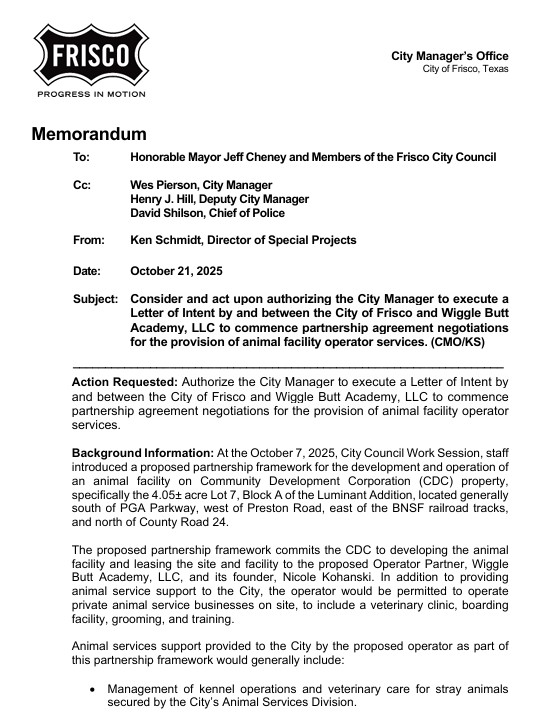
Heading into Tuesday night we took a look at what was on the City Council Agenda. The city just had a work session for the controversial Animal Holding Facility. At the October 7, 2025, City Council Work Session, staff introduced a proposed partnership framework for the development and operation of an animal facility on Community Development Corporation (CDC) property. The proposed partnership framework commits the CDC to developing the animal facility and leasing the site and facility to the proposed Operator Partner, Wiggle Butt Academy, LLC, and its founder, Nicole Kohanski. In addition to providing animal service support to the city, the operator would be permitted to operate private animal service businesses on site, to include a veterinary clinic, boarding facility, grooming, and training.
They City is not taking any time to move forward as the LOI is on the agenda for tomorrow night even after Council Woman Laura Rummel said at this weeks Town Hall the issue would not be revisited until the middle of November. Yet here it is on the agenda for today!
All this when the city has failed to do: A FEASABILITY STUDY, RFQ’S NOW THAT THEY CLAIM TO HAVE THE STRUCTURE AND DESIGN TO POTENTIAL OPERATORS, and ANSWER or RESPOND TO NUMEROUS ANIMAL ADVOCATES THEY EMAILED CITY LEADERSHIP!
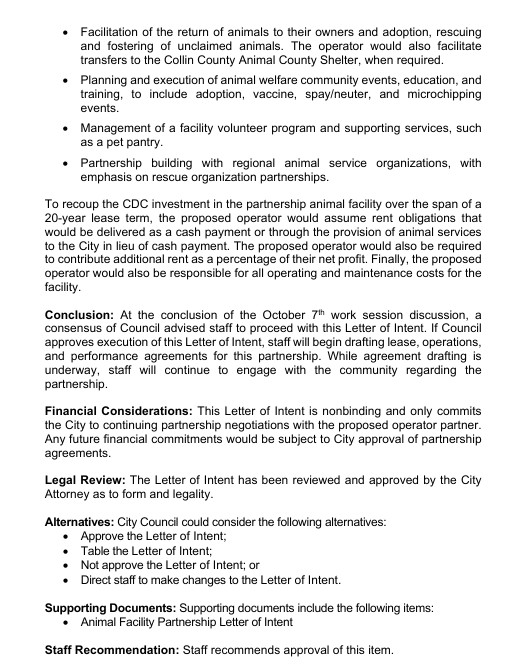
Animal services support provided to the City by the proposed operator as part of this partnership framework would generally include:
• Management of kennel operations and veterinary care for stray animals secured by the City’s Animal Services Division.
• Facilitation of the return of animals to their owners and adoption, rescuing and fostering of unclaimed animals. The operator would also facilitate transfers to the Collin County Animal County Shelter, when required.
• Planning and execution of animal welfare community events, education, and training, to include adoption, vaccine, spay/neuter, and microchipping events.
• Management of a facility volunteer program and supporting services, such as a pet pantry.
• Partnership building with regional animal service organizations, with emphasis on rescue organization partnerships.
However, in the email we received Animal Advocates raised some valid concerns for which they have received no answers for. You can read all of them in our previous blog “Somethings Rotten At The Animal Holding Facility.”
To recoup the CDC investment in the partnership animal facility over the span of a 20-year lease term, the proposed operator would assume rent obligations that would be delivered as a cash payment or through the provision of animal services to the City in lieu of cash payment. The proposed operator would also be required to contribute additional rent as a percentage of their net profit. Finally, the proposed operator would also be responsible for all operating and maintenance costs for the facility.
The conclusion of the memo states, if the Council approves execution of this Letter of Intent, staff will begin drafting lease, operations, and performance agreements for this partnership.
Wait: How can you draft operations and performance agreements when you can’t even address the answers of animal advocates that are directly related to those issues?
The memo continues, while agreement drafting is underway, staff will continue to engage with the community regarding the partnership.
Wait: For Universal you did multiple community town halls and community meetings. For the Performing Arts Center you did the same thing. So why are you not doing that before the LOI to get community feedback. From the emails we have received from advocates you have some very educated advocates from all different backgrounds of shelters, rescues, fosters and yet you are not listening to anyone of them. So the city is saying “WE KNOW MORE THAN YOU, EVEN THOUGH WE HAVE NEVER STEPPED IN A HOLDING FACILITY OR SHELTER?”
The memo ends with, “This Letter of Intent is nonbinding and only commits the City to continuing partnership negotiations with the proposed operator partner. Any future financial commitments would be subject to City approval of partnership agreements.”
Closing Thoughts: When “Nonbinding” Becomes Nonbelievable
So here we are — heading into Tuesday night — and despite all the public frustration, unanswered questions, and promises to “pause and listen,” the City of Frisco seems to be sprinting ahead with its latest pet project (pun intended).
Residents asked for transparency. Advocates asked for answers. Councilwoman Rummel told everyone this issue wouldn’t even come back until mid-November. Yet somehow, faster than a greyhound out of the gate, it’s already back on the agenda for a vote on a Letter of Intent.
And this isn’t just a friendly “let’s think about it” item. That LOI sets the stage for lease terms, operational control, profit-sharing, and a long-term financial partnership — all before the city has completed a feasibility study, issued RFQs, or provided a single clear answer to the citizens and animal experts who have been demanding transparency.
Let’s be honest — Frisco has never been shy about “moving quickly” when certain insiders or interests are involved. But this one smell especially odd.
Why the rush? Why the secrecy? Why the sudden urgency to ink a deal with a private operator on public land when the public hasn’t been heard?
If this is how we do “community engagement” now — by drafting contracts first and asking for input later — maybe it’s time to question who this city really serves. Because right now, it doesn’t look like it’s the residents, the taxpayers, or the animal advocates.
The city says this LOI is “nonbinding.” But we’ve seen that movie before — where “nonbinding” quickly becomes inevitable.
Frisco, it’s time to slow down, listen up, and stop treating transparency like a box to be checked after the ink is dry.
Because when the public’s trust is on the line, “nonbinding” doesn’t mean “no consequences.” REMEMBER THE COUNCIL MEMBERS WHO VOTE YES TO RUSH THE LOI FOR THE HOLDING FACILIYT BECAUSE IN MAY, YOU CAN VOTE THEM OUT! Let’s see if the two newest council members vote inline “just because it’s going to pass” or if they have the backbone to vote no, because they believe a full-service animal hub is what Frisco Residents want.
We’ll be watching too — because this story isn’t over yet.
Disclaimer: This blog includes satire, parody, and comic relief. It contains summarized accounts created solely for humor and commentary. Any resemblance to real events is either coincidental or intentionally satirical. Reader discretion — and a sense of humor — are advised.







I went to her to ask for help with an issue my child that was getting nowhere with the school,…
So whatever became of the $17 million dollars that the city council gave the Mayor to beautify a drainage ditch?
At last count, there are 3 different "spa/massage" businesses in the small office park at the northeast corner of John…
I literally just saw this. Yeah, she used to forward everybody’s emails behind their backs.
You're dropping truth bombs! These mom and pop shops are what should be the least of Karen's worries. If they…