Over the past 15–20 years, bringing “quality jobs” or corporate headquarters to Frisco has been a common campaign theme across many city council and mayoral candidates. As Frisco transitioned from a bedroom suburb into a regional employment center, candidates across political factions have run on platforms tied to economic development, corporate relocations, and high-wage job growth.
For communities like Frisco, smart corporate development isn’t just about landing big company logos—it’s about long-term financial health, balanced growth, and protecting taxpayers. Cities like Frisco have to think carefully about what kind of development they pursue and where it goes.
Mayor Cheney and other city leaders have frequently said Frisco “must pursue” major employers so the city becomes a regional job center instead of a commuter suburb. Cheney has emphasized pursuing large corporations and creating office districts where employees can live, work, and socialize.
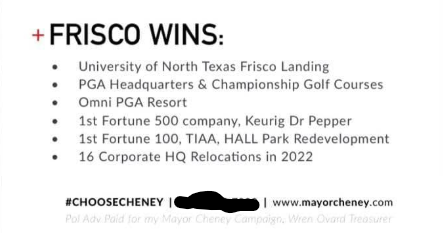
Lifestyle Frisco wrote an article in October 2019 titled “Mayor Jeff Cheney Announces Re-Election Campaign” which centered around Mayor Cheney’s own words. Cheney continues, he was seeking residents votes on May 2, 2020, so he can continue to bring more jobs, expand the tax base, create beautiful neighborhoods, and provide top tier entertainment. He notes that Frisco won our FIRST-EVER Fortune 500 relocation with Keurig Dr Pepper. He continues, the goal is to deepen our Sports City USA brand by adding the National Soccer Hall of Fame, professional lacrosse, and an esports team. His political mailer in 2020 listed his so-called wins. It still does not compare to Plano’s wins that will bring more high paying quality jobs that have a better economic impact to the city.
For years we have listened to candidates and current Council Members talk and campaign about bringing “high-paying primary jobs” to reduce commutes for residents, diversify the city’s tax base, and to support the city’s financial stability. In the most recent special election, we were shocked to learn our newly elected council woman, Ann Anderson stated she was glad that AT&T chose to relocate to Plano. Wait what?
Frisco Chronicles began to question have our city leaders fulfilled their obligations and promises to Frisco residents? Shockingly, no! Residents need to pay attention.
Frisco vs Plano Comparison
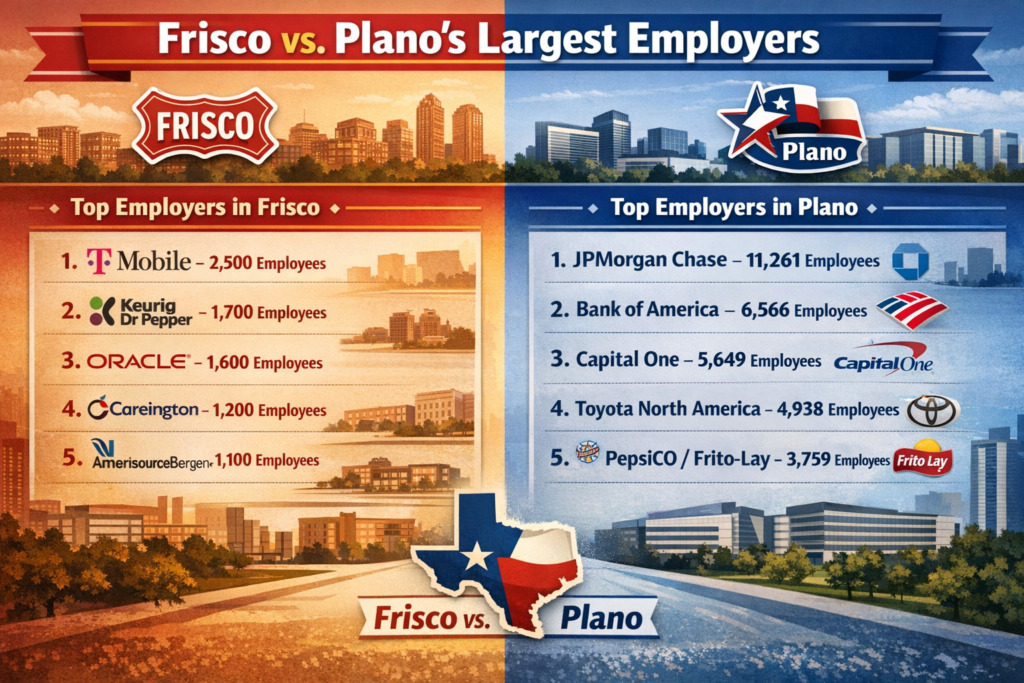
Who is the largest employer in each city?
Frisco: Frisco Indepenent School District – 8,800 employees vs Plano: JP Morgan Chase – 11,261 employees
Frisco vs Plano Economic & Corporate Landscape
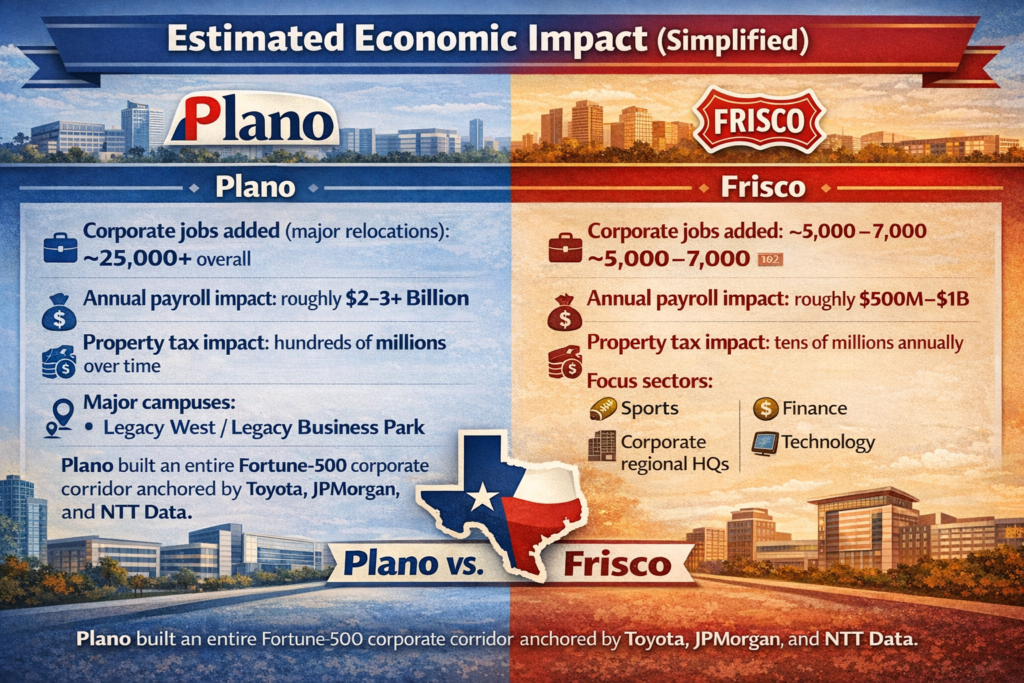
Which city has added the most corporate jobs?
Frisco: 5000 to 7000 vs City of Plano: 25,000+
Which city has had the greatest Economic Impact?
Frisco Annual Payroll Impact: Roughly $500M to $1Billion vs Plano Annual Payroll Impact: Roughly $2 to $3 Billion
Frisco Property Tax Impact: Tens of millions annually vs Plano Property Tax Impact: Hundreds of Millions over time
Frisco
Major employers are a mix of private and public sector. Frisco has attracted some high-profile corporate offices, but its largest employers tend to be public sector or regional service-focused, rather than Fortune 500 headquarters.
The focus has been on building a diversified but smaller-scale corporate base rather than creating a dense Fortune 500 corridor.
There’s evidence of success in certain sectors, but less concentration of high-paying corporate headquarters jobs compared to Plano.
Plano
Plano has built a robust corporate ecosystem, especially along Legacy West/Legacy Business Park, attracting Toyota Financial Services, JPMorgan Chase, NTT Data, Fujitsu/Ericsson, and Capital One.
The city has successfully attracted major Fortune 500 companies which created tens of thousands of corporate jobs and generated billions in annual payroll and hundreds of millions in property taxes.
Plano’s strategy has emphasized large-scale corporate relocation and campus development, which creates a strong economic multiplier effect.
Community Impact Comparison:
Frisco’s Potential Issue: With a large portion of the top employers in the public sector, Frisco’s economic growth may be more sensitive to government budgets, policy changes, and public funding cycles, rather than the stable expansion seen in private corporate headquarters. This could limit long-term job growth and tax base expansion.
Resident Impact Comparison
Plano: Residents benefit from high-paying corporate jobs, a strong tax base that funds public services, and a built-in ecosystem that encourages additional businesses and amenities.
Frisco: While still attracting quality employers and offering amenities, the job base may be narrower in sectors that generate higher wages and broader economic spillover. Public sector dominance among top employers may limit diversity in employment opportunities.
WHO WINS: FRISCO OR PLANO
Plano emerges as the city with a more aggressive, high-impact corporate strategy that directly benefits residents through employment opportunities, payroll tax revenues, and large-scale infrastructure support.
Frisco has been moderately successful in attracting employers but may face long-term challenges due to the nature of its largest employers and a less concentrated corporate corridor.
ELECTION TIME: VOTE WISELY
You constantly here residents in Frisco complain they are tired of growth without infrastructure. Why is that? Because our city leaders have done nothing to reduce our commute to local jobs or bring quality paying jobs to our community. By putting a heavy emphasis on “TOURISM” and “HOSPITALITY” they have created more traffic issues and attracted less quality paying jobs.
A recent big win the city likes to talk about is Universal Kids Resort, which is bound to add to Frisco’s traffic congestion. City leaders are hoping that over the years tourist attractions will bring in enough tax revenue to offset what the corporate relocations could have brought to our community.
A search of the internet for jobs at Universal Kids Resort displays the following available jobs: Lobby Attendant, Quick Service Associate, Dispatcher, Full Time Lead Technician, Lifeguard, Ride Operator Attendant, Wardrobe and Costume Supervisor, and many more. The requirement a HS Diploma or GED, Customer Service Experience. No pay scale offered for any of the positions. Universal offers very few highly paid management positions.
We did find one job for a Senior External Affairs & Corporate Communications Manager which states a bachelor’s degree in political science, Public Relations, Communications, Business Administration or related field is required. It also says at least 7+ years of corporate communications, legislative, government or external affairs experience is required, or equivalent combination of education and experience.
Why is all this important?
Every election the same people stand before us and ask for our vote, and Frisco Residents who are none the wiser continue to just elect the same regime. The result is our leaders have failed to bring quality paying CAREERS to our community. This will affect us down the road when it comes time to paying the big bonds they have asked us to pass over the years.
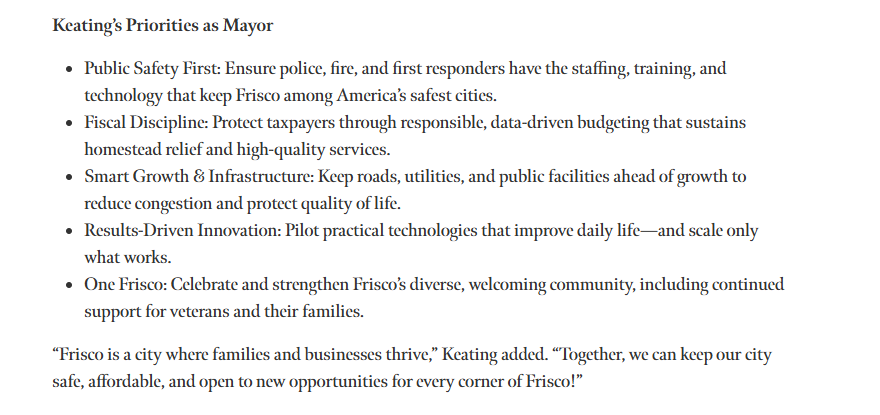
John Keating’s website brags he has served on the council “FOR MORE THAN A DECADE.” Frisco Chronicles is curious if he can name one Corporate Relocation (besides the PGA) that he pushed hard to win that brought high paying quality jobs to Frisco? Keating’s website lists his priorities as Mayor and not one of them directly states the goal to bring high quality CAREERS AND CORPORATIONS that protect taxpayers. He offers the same priorities just re-written that he has failed to complete before in his decade on the dais. Keating’s time is up!
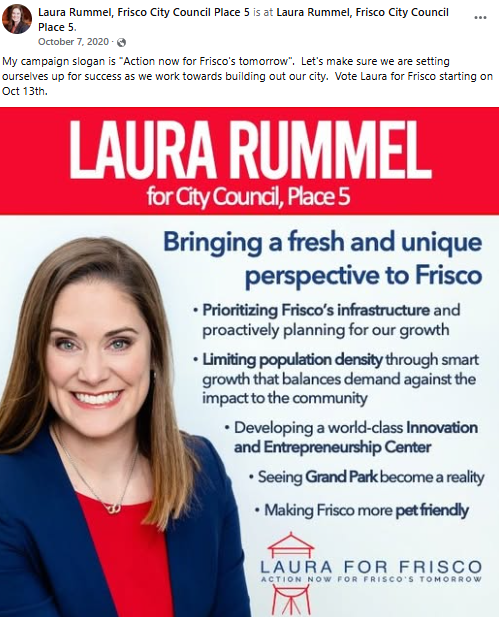
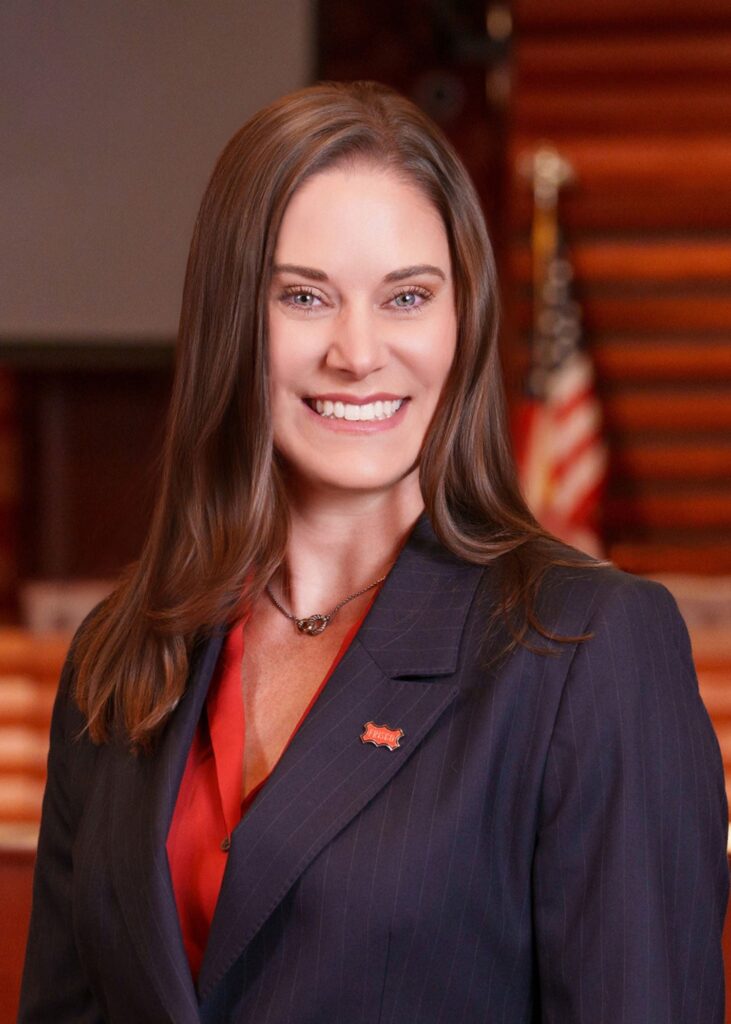
Laura Rummel is back to also ask for your vote! Her website states her priorities include Frisco’s infrastructure, smart growth by asking developers to offer smaller format housing options such as condos, townhomes, zero lot line home alternatives and fuel innovation and entrepreneurship. Her website states, “Start-ups typically provide slow and steady organic growth for the city, as well as bringing high-paying jobs, two attributes I would like to see us continue to recruit here to Frisco.
How will Laura Rummel help Frisco compete with Plano and the economic windfall they are having with corporate relocations? Rummel has had 5+ years on council now and she has no win to call her own! It takes a long time for startups to grow into a Capital One or AT&T and provide an economic impact to residents that we need here.
In closing, when will Frisco Residents say WE HAVE HAD ENOUGH AND WE WANT HIGH PAYING QUALITY JOBS THAT CREATE AN ECONOMIC IMPACT like other surrounding cities. The big wins Frisco claims are great, but they are nothing compared to our neighbor the City of Plano which has built one of the largest corporation corridors in North Texas. Plano employers include major financial institutions, corporate headquarters, tech firms, and large service centers that anchor Plano’s economy and make up a significant share of local jobs. A linear “corporate corridor” lined with major employer logos, emphasizing Plano’s role as a corporate hub
Frisco residents need to ask, “How will we repay the $1 Billion in debt we have?” Frisco leaders have dropped the ball and if you look down the road none of the “WINS” our current leaders like to claim will bring in the billions that major corporate relocations could have. At the last city council meeting you saw them approve a warehouse along the 121 roadway – is that the best use of that land or could it have gone to something else that would have brought in more high-quality paying jobs. Frisco’s future is not as bright as residents would think when it comes to financial stability. The One Billion in debt has to come from somewhere so where will it come from? Get Wise Frisco!
Disclaimer: This blog includes satire, parody, and comic relief. It contains summarized accounts created solely for humor and commentary. Any resemblance to real events is either coincidental or intentionally satirical. Reader discretion — and a sense of humor — are advised.
Largest Employers in Frisco
Employer
Sector
Employees
Frisco ISD
Education
~8,800
Dallas Cowboys
Sports & Entertainment
~2,000
City of Frisco
Government
~1,800
HCL Technologies
Corporate
~1,500
T-Mobile
Corporate
~1,300
Keurig Dr Pepper
Corporate
~1,200
AmerisourceBergen
Healthcare
700+
Baylor Scott & White Health
Healthcare
600+
Collin College
Education
500
Mario Sinacola & Sons
Construction
500
Oracle
Corporate
400
Baylor Medical Center of Frisco
Healthcare
450
Lexipol
Corporate
420
Top Employers in Plano, TX
Plano’s largest employers based on the most recent city and economic data (2025–2026 estimates):
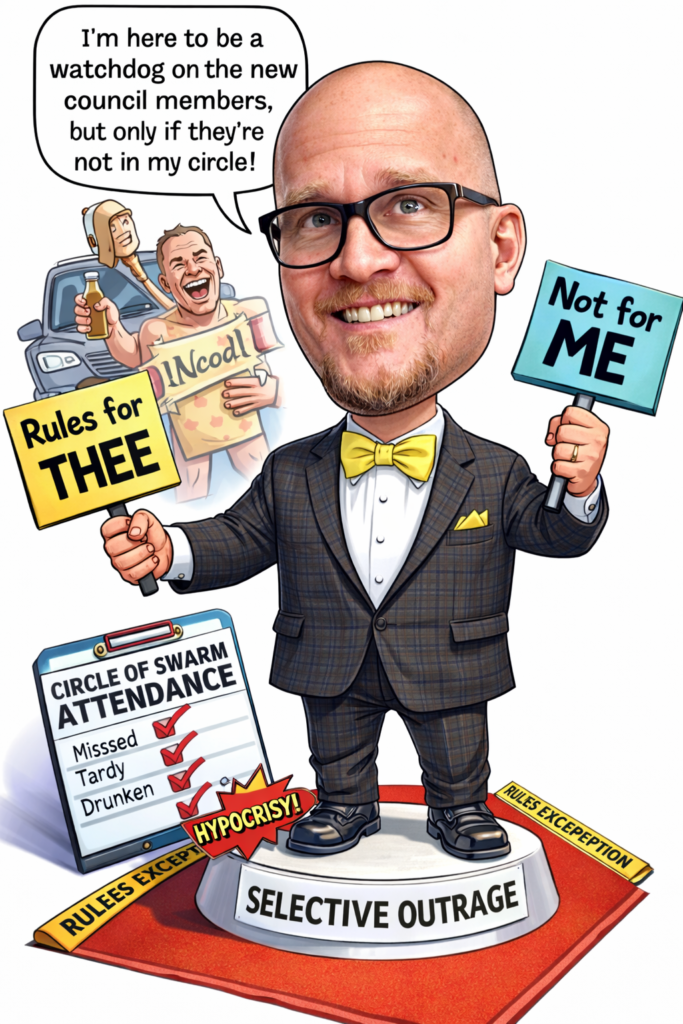
In politics, outrage is rarely accidental. It’s often carefully aimed, strategically timed, and—when necessary—conveniently forgotten. That’s what we call Selective Outrage: when politicians and their allies suddenly discover their moral compass, but only when it points at someone outside their circle.
On December 2, 2025, former Frisco councilman Bobblehead Bill Woodard stepped up to the podium during Citizens’ Input with a speech that sounded, at first, like a heartfelt defense of professionalism at City Hall. After all, according to Woodard, during his 20-plus years in Frisco one of the things he was “most proud of” was the professionalism shown by board and council members while serving on the dais.
Touching. Inspiring. Almost nostalgic.
But as the speech unfolded, what residents actually witnessed was less a thoughtful reflection and more what could best be described as an emotional support tantrum wrapped in a watchdog costume. By the time Woodard finished, his concern for the city’s reputation had been carefully aimed at two of the newest council members—members who, coincidentally, are clearly not part of the inner Frisco Swarm circle.
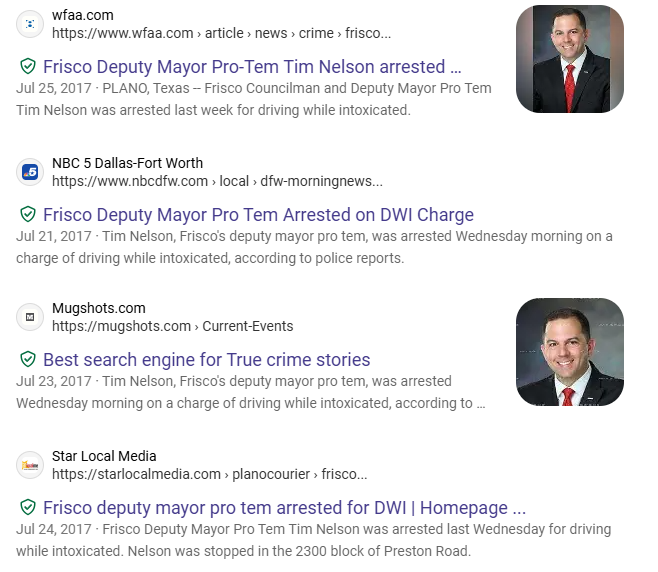
We’ve seen this movie before. In fact, we wrote about it in our earlier blog “Butt-Hurt Politics.” Because here’s the question no one asked from the podium that night: Where was this outrage before? Woodard didn’t rush to the microphone when former Frisco Deputy Mayor Pro Tem Tim Nelson was arrested for alleged drunk driving. There was no impassioned lecture about protecting the city’s reputation then.
He didn’t sound the professionalism alarm when John “Cheating” Keating was allegedly spotted a few years ago over a Fourth of July weekend at a community pool with a woman (not his wife) who happened to serve on one of the city’s boards.
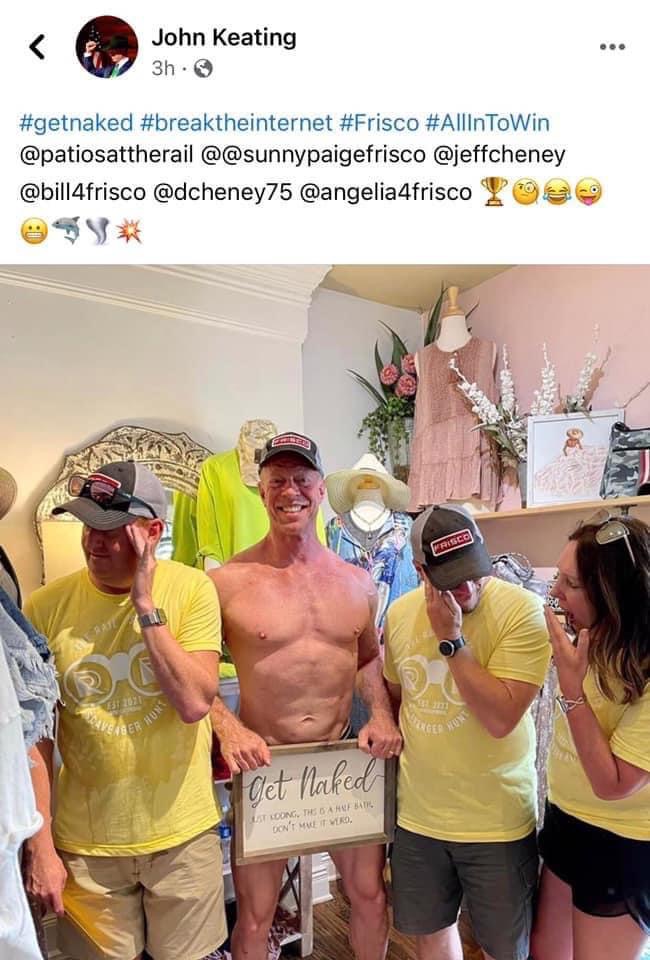
And apparently there was no emergency meeting of the Professionalism Police when Keating once posed holding a sign reading “Get Naked” over his private parts, creating the illusion he was standing there unclothed—while Mayor Jeff Cheney and the First Lady laughed along.
No speeches. No lectures. No watchdog warnings about Frisco’s reputation.
But suddenly, when two new council members stumble, miss a meeting, or crack a joke on the dais, Bobblehead Bill finds his whistle and climbs into the referee tower. That’s not accountability. That’s Selective Outrage.
From his self-appointed pulpit as an anonymous member of the Frisco Swarm, Woodard seems eager to call out mistakes made by newcomers while conveniently overlooking the long list of missteps made by those inside his own political circle. Even more interesting? After hearing Woodard’s lecture on attendance, preparedness, and professionalism, we decided to do something radical: We checked the receipts.
And what we found in the city’s own Governance Board meeting records raises a few questions about whether the standards Woodard preached on December 2 have actually been applied… consistently… fairly…or evenly. Spoiler alert: they haven’t.
But that’s where things get even more interesting. Because if Bobblehead Bill believes showing up late, missing meetings, or leaving early is a threat to the reputation of the City of Frisco… then residents deserve to know whether everyone is being held to the same standard—or just the people outside the Swarm. And that’s exactly what we started digging into.
According to Woodard, missing meetings, arriving late, or leaving early was not just disappointing… it was disrespectful to the citizens of Frisco and damaging to the reputation of the city. Those are strong words. So naturally, we decided to take Woodard’s advice and focus on the facts. If attendance and professionalism are truly the gold standard for serving the public, then it should apply to everyone—past and present. Right?
Let’s Check the Record: Previous Governance Meetings 2022 – 2025
We started by reviewing the Governance Board meeting minutes available through the city website. What we quickly discovered is that the online records are… incomplete.
Still, the minutes that are available tell an interesting story.
Here are a few examples:
June 23, 2022 – Bill Woodard was absent from the Governance Board meeting.
March 15, 2022 – John Keating was absent from the Governance Board meeting.
April 2, 2024 – Bill Woodard left the meeting early.
February 4, 2025 – Angelia Pelham arrived late to the Governance Board meeting.
Now remember Woodard’s speech. His words were clear:
“The citizens of Frisco expect and deserve representatives show up to do the work. On time and prepared.” Fair enough. But if attendance issues are grounds for public lectures at Citizens’ Input, it seems reasonable to ask: Does that standard apply to everyone—or just certain people?
The Curious Case of Missing Minutes of 2026
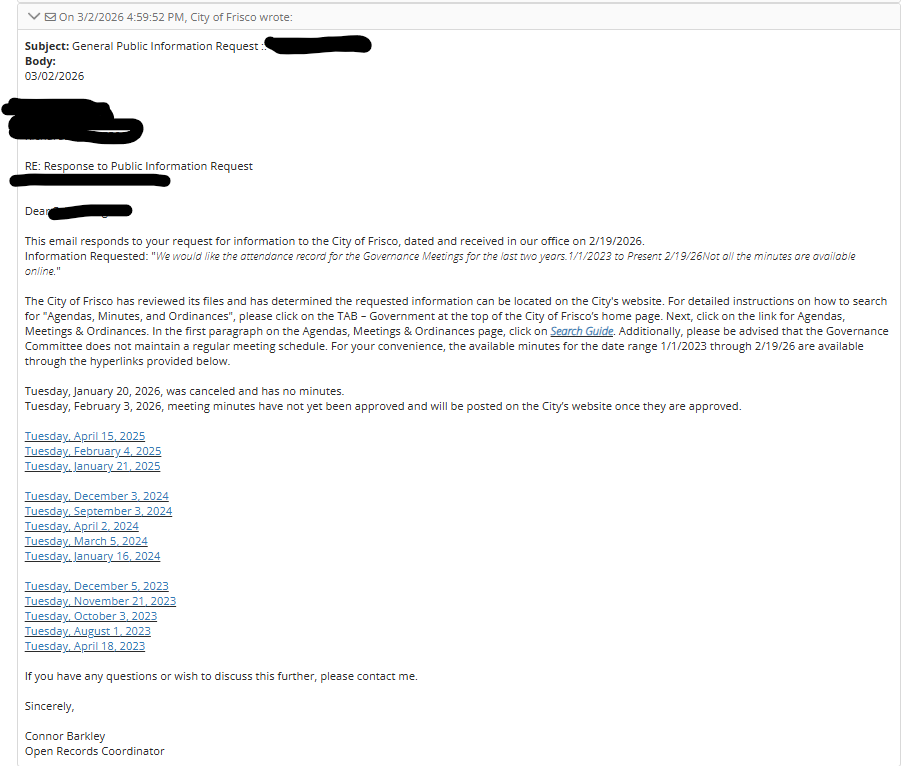
On February 19, 2026, Frisco Chronicles filed a Public Information Request (PIR) asking the City of Frisco for attendance records for Governance Board meetings from January 1, 2023, to the present. We also noted in the PIR that not all meeting minutes appear to be available on the city’s website.
The city responded on March 2, 2026 with a simple explanation:
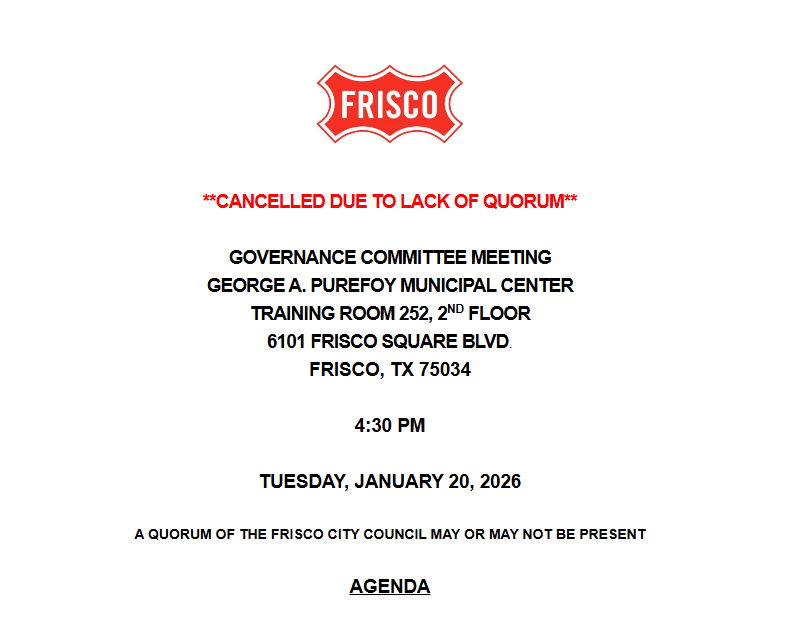
January 20, 2026 meeting shows it was canceled due to lack of quorum. No explanation was provided as the minutes are not posted to the city website.
February 3, 2026, minutes have not yet been approved, so they are not posted.
Then the city closed the request with the status: “Information on Website.”
Things got even more interesting when we looked at the 2026 Governance Board meetings minutes online at the city website.
According to a city insider, the January meeting reportedly lacked quorum because Burt Thakur and Jared Elad misunderstood the meeting date. The next meeting on February 3, a city insider told us the meeting was delayed 20 to 30 minutes because Angelia Pelham arrived late. But since the minutes aren’t publicly posted, residents can’t verify what actually happened. So, we did what any curious citizens would do.
Which raises a simple question: If the minutes exist but just haven’t been approved yet… why not post them with a note that they are subject to approval? Many cities do exactly that in the interest of transparency. But apparently in Frisco, some information moves at the speed of government… while outrage moves at the speed of politics.
The Real Question
Bobblehead Bill Woodard pretends to have an independent point of view and clearly has no issue stepping up to the podium to lecture two new council members about attendance and professionalism. Yet when members of the Frisco Swarm, including himself, miss meetings, arrive late, or leave early, the watchdog appears to take a nap.
No speeches. No Citizens’ Input lectures. No public scolding about the reputation of the city. That’s not accountability.
That’s Selective Outrage.
But Wait… There’s More
After hearing Woodard’s speech about high expectations, we decided to take the research one step further. How many council meetings or work sessions have sitting members council members been late to or been absent from? And, because council members aren’t the only ones expected to show up and do the work we looked into the dozens of boards and commissions, filled with citizen representatives, many of whom were appointed by the same political circle now demanding perfection from others.
The next logical question is simple: Do those appointees meet the same attendance standards? Or does the outrage stop there with just two new council members? That’s exactly what we started digging into next. And what we found might surprise you.
Stay tuned for Part 2: The Attendance Records of City Council and City Boards and Commissions
Disclaimer: This blog includes satire, parody, and comic relief. It contains summarized accounts created solely for humor and commentary. Any resemblance to real events is either coincidental or intentionally satirical. Reader discretion — and a sense of humor — are advised.
The agenda for the February 17thcity work session reads, “Discussion regarding rules of procedure for public testimony / citizen input at City Council meetings, including Ordinance No. 19-10-86.”
Translation? The microphone is under review.
That leaves Frisco Chronicles asking the obvious question: why now? Why would Mayor Jeff Cheney and the Frisco City Council consider changing public testimony (aka citizen input) at City Council Meetings?
Is it because they are tired of hearing from local Palestinian residents?
According to Community Impact, “City attorney Richard Abernathy said council members previously asked him to review their options for changing the public comment policy when there was an issue about the Palestinians.”
Is it because they are tired of being questioned about inappropriate campaign contributions?
Is it because they are tired of hearing from the T-Mobile Whistleblower?
Is it because they are tired of agitators?
Just look at the Community Impact article that quotes Mayor Jeff Cheney as saying, “It has always been where agitators have moved along, but it’s becoming increasingly likely that this is not going away.”
Not going away? That is called civic engagement!
Let’s not forget: those same “agitators” also brought out our Frisco Community & Indian Community who stood at the podium and spoke about why they Frisco and call it home. Funny how public particpation works – when one group speaks, others feel empowered to speak too.
SELECTIVE TOLERANCE IS NOT LEADERSHIP
Point blank: if the motivation for changing citizen input rules is fatigue with certain voices — whether they are Palestinian residents, whistleblowers, critics of campaign donations, so-called agitators, or members of our Indian community — then the problem is not public comment.
The problem is selective tolerance from our Mayor and City Council.
Democracy does not work on a loyalty punch card. You don’t get to pull out the Muslims, Palestinians and Indians at election time and then put a mute button on them afterward. Communities are not props during campaign season and inconveniences during governing season.
Public office requires hearing from people you disagree with. If policy changes are driven by discomfort with who is speaking rather than how meetings are conducted, that erodes trust. And when trust erodes along cultural or political lines, communities understandably perceive bias — whether intentional or not.
Frisco’s strength has always been its diversity of voices: long-time residents, business owners, activists, skeptics, immigrant families, and yes — persistent neighbors worried about dog parks. Silencing or sidelining any segment because their message is inconvenient sends a dangerous signal: you are welcome to vote, donate, and celebrate growth… but not to challenge power. Last I checked … That is not the spirit of the First Amendment. And it is not the Frisco many residents believe in.
Current Citizen’s Input Policy – What’s the Emergency?
Back to the work session, we want to learn more but the minutes for this meeting have not been published on the city website. Without minutes or a video tapped work session, how are residents supposed to have transparency? At least we have Community Impact, who was able to write a full story about the agenda item.
The article reads, “Frisco City Council is considering changing the rules for public input at council meetings. City officials said the move comes after a Feb. 3 meeting where 23 people, including several who were not Frisco residents, spoke about perceived demographic changes in Frisco during the public comment period.”
The current policy allows people who want to speak during citizen input to submit a speaker card at any point during the meeting. They are given five minutes, unless there are 10 or more speakers on the same agenda item which allows them to reduce the time to 3 minutes.
Twenty-three speakers. In one of the fastest-growing cities in Texas. Seems like a drop in the bucket.
Next, we are going to look at the proposed changes being considered by our Mayor and Council.
What could they be?
Who was the 1 council member who voiced concerns for changes?
What is this really about?
Come back for Part 2: Frisco’s “Public Input Problem”
Disclaimer: This blog includes satire, parody, and comic relief. It contains summarized accounts created solely for humor and commentary. Any resemblance to real events is either coincidental or intentionally satirical. Reader discretion — and a sense of humor — are advised.
Back in 2023, one of our earliest blogs focused on the Texas Public Information Act — the law that ensures citizens have access to records showing what their government is doing on their behalf. Transparency is not a courtesy; it is a legal obligation.
Since then, residents regularly contact us with questions about Public Information Requests (PIRs). Sometimes they’re confused by the process. Sometimes they’re overwhelmed by what they receive. And sometimes, they suspect they’re being buried in paperwork rather than given what they actually asked for.
Recently, a resident forwarded several PIR responses and expressed frustration. They felt they were being flooded with documents but not real answers. They hoped we might spot something they missed.
We did!
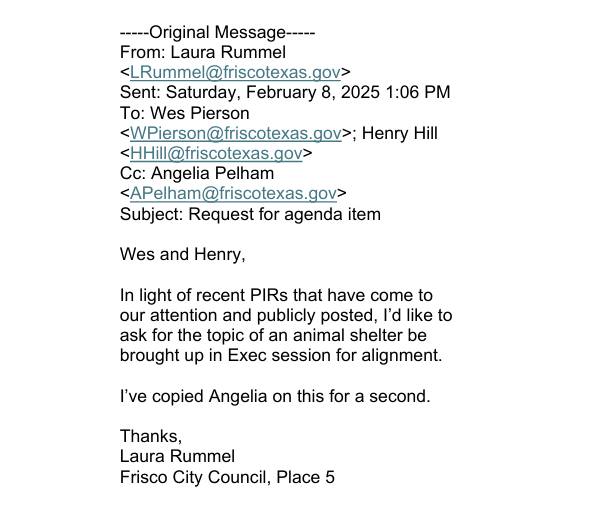
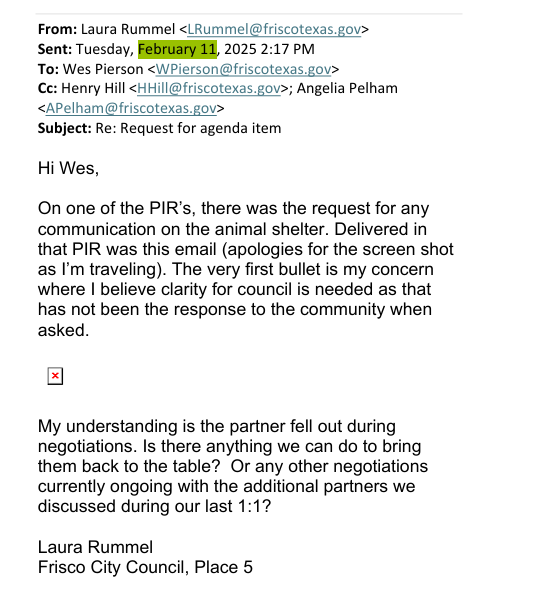
Among the documents was a February 8, 2025 email from Councilwoman Laura Rummell to City Manager Wes Pierson and Assistant City Manager Henry Hill, with Angelia Pelham copied:
“In light of recent PIRs that have come to our attention and publicly posted, I’d like to ask for the topic of an animal shelter be brought up in Executive Session for alignment.”
Let’s pause right there. “In light of recent PIRs…”
Not pending litigation. Not a personnel matter. Not real estate negotiations.
PIRs.
The Pushback
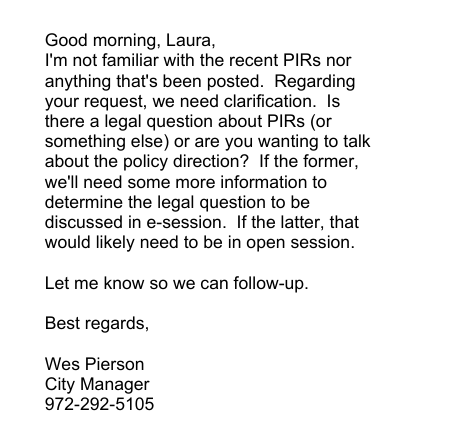
On February 11, 2025, Pierson responded that he was not familiar with the recent PIRs or what had been posted. He asked for clarification: Was there a legal question related to the PIRs? Or was she seeking policy direction?
He stated clearly that if it was policy direction, it would likely need to be discussed in open session.
Avoiding public scrutiny — or reacting to public records requests — is not on that list.
Separately, the Texas Public Information Act governs what records must be released. You do not make something confidential simply by discussing it in executive session. Closed doors do not create confidentiality by magic.
Why Copy Angelia?
Rummell copied Angelia Pelham “for a second.”
A second what? A second vote? A second opinion? A second set of marching orders?
We are not alleging how anyone would vote. But when one council member seeks “alignment” on moving a controversial topic into executive session — particularly in response to public records being released — reasonable citizens are going to ask reasonable questions.
Council members are permitted to discuss city business in limited ways. But deliberating outside public view in ways that circumvent open meeting requirements is exactly what TOMA was designed to prevent.
“Receive legal advice regarding proposed interlocal agreement with Collin County, Texas, and other political subdivisions for the use of the Collin County Animal Shelter and related issues.”
The Animal Shelter and proposed holding facility have been one of the most discussed issues in Frisco over the last several months. Residents have raised concerns at town halls, council meetings, and special sessions. So why is such a heavily debated issue about the Collin County Animal Services ILA headed into executive session?
Legal advice can properly be discussed in closed session. But policy direction? Alignment? Messaging? Those belong on the dais — under the lights — where the public can hear it.
The Consent Agenda Shuffle
Then there’s Item #24 on the Consent Agenda: An annual contract modification for payment to Collin County in the amount of $651,774 — along with rescinding prior council approval from February 3, 2026.
For those unfamiliar, consent agenda items are typically passed in one vote with little to no discussion unless pulled by a council member. A $651,774 contract modification tied to a controversial shelter arrangement seems like the kind of item that deserves public discussion — not a quiet glide path.
This isn’t about whether the city can receive legal advice. It can. This isn’t about whether executive session is ever appropriate. It is.
The question is motive. If executive session is being used as a shield in response to public information requests — if alignment is happening out of view of the public or because documents became public — then that is precisely what TOMA was designed to prevent.
Transparency does not end where discomfort begins.
Spotlight Moment
We have serious concerns and YOU SHOULD TOO!
A councilwoman asking to move a hot-button issue into executive session “in light of recent PIRs.” A city discussing a controversial shelter agreement behind closed doors. A six-figure contract modification sliding onto the consent agenda.
Maybe it’s all perfectly lawful. Maybe it’s all procedural. Maybe it’s all coincidence.
Or maybe Frisco residents are simply asking to see their government operate in the sunlight instead of the shadows.
Laura Rummell has championed this holding facility which many local animal advocates OPPOSE and calling it a Temporary Execution Hold Facility. Rummell’s email states, “the very first bullet is my concern where I believe clarity for the council is needed as that has not been the response to the community.” What response have you all been giving the community? Is this an admission they have been feeding the public one thing when in the background they are either doing something else or have no plan at all?
If everything is above board, then put it above the table. Discuss it openly. Debate it publicly. Vote on it transparently.
Because when public records trigger closed doors, citizens don’t stop asking questions. They start asking better ones like Laura Rummell, what are you hiding?
Links:
The Public Information Act Handbook can be found on the Texas Attorney General’s website and lays out the “how-to” to do open record requests.
Disclaimer: This blog includes satire, parody, and comic relief. It contains summarized accounts created solely for humor and commentary. Any resemblance to real events is either coincidental or intentionally satirical. Reader discretion — and a sense of humor — are advised.
Alright, grab your popcorn —this one has all the makings of a classic Frisco Chronicles feature: money, media, and that familiar scent of roses wafting through the pages of the Dallas Morning News.
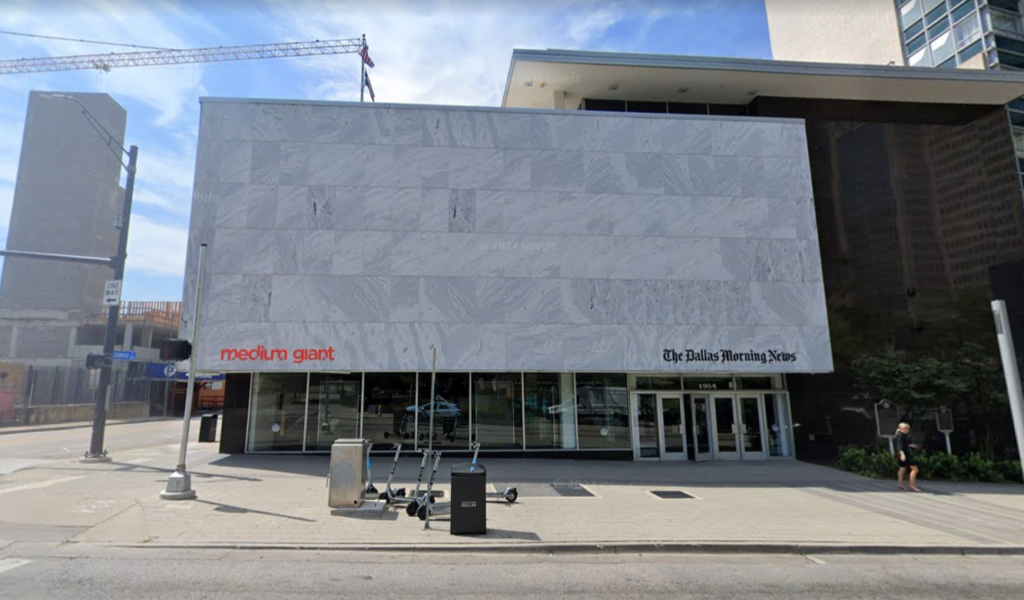
All Good in the Frisco Hood: Brought to You by… Medium Giant?
By now, longtime Frisco residents have noticed a curious phenomenon. Whenever the Dallas Morning News (DMN) writes about Frisco, the city sparkles. Streets are shinier. Leadership is visionary. Problems? What problems? If Frisco had potholes, DMN would probably call them “community engagement craters designed to slow traffic and save lives.”
Which raises the obvious question: why does Frisco always smell like roses in the DMN? Not weeds. Not smoke. Roses.
For years, residents have speculated. Maybe DMN is afraid of being cut off from exclusives. Maybe access journalism is alive and well. Or maybe—just maybe—it’s about the oldest motivator in local government and media alike: Money.
Enter Stage Left: Medium Giant
Here’s where things get interesting. A sharp-eyed reader recently connected a few dots that deserve a closer look. The Frisco Economic Development Corporation (FEDC) has entered into several contracts over the years with a company called Medium Giant.
Whose Medium Giant, you ask?
They’re an “integrated creative marketing agency.” Which is marketing-speak for we make things look good. Even better? Medium Giant just happens to be the sister company of the Dallas Morning News.
Cue the dramatic music. So now the question isn’t why DMN never seems to publish critical reporting on Frisco or its leadership. The question becomes: would they dare?
Follow the Money (Because It Always Tells a Story)
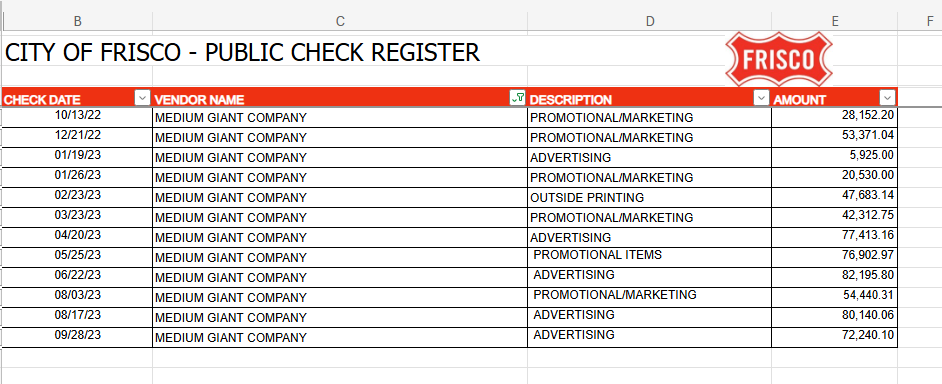
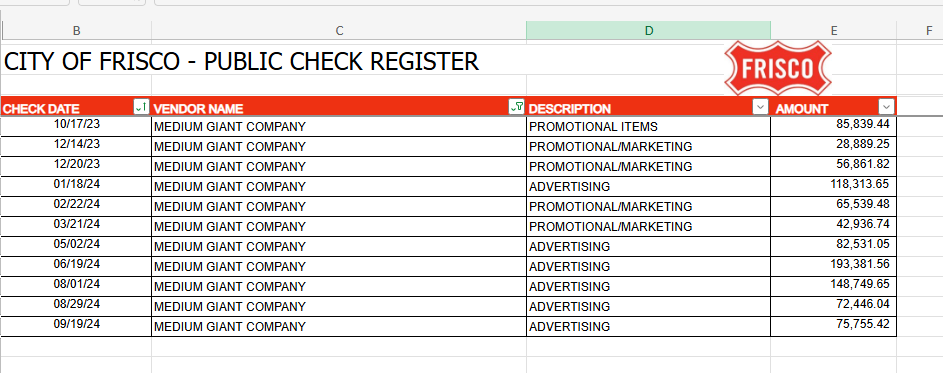
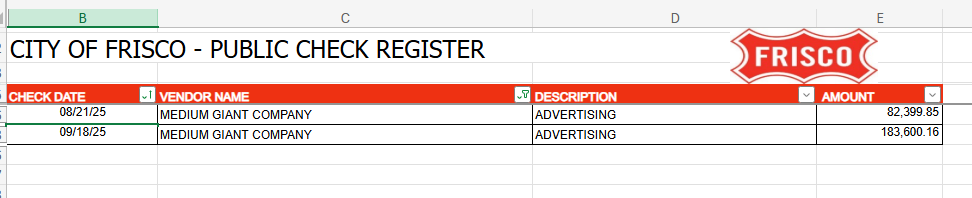
When we reviewed city check registers, we noticed multiple payments over the years made to Medium Giant. Not chump change. Not lunch money. Not “oops, forgot to expense that Uber.”
The total? $2,105,631.76
That’s over two million dollars paid by Frisco entities to a company tied directly to the same organization responsible for shaping Frisco’s public narrative in one of North Texas’ largest newspapers.
Now, we’re not saying this proves corruption. We’re not saying there’s a secret smoky backroom with editors and city staff clinking champagne glasses. We’re not even saying there’s an explicit quid pro quo.
What we are saying is this: If you were the DMN, would you risk torching a relationship connected—directly or indirectly—to a $2 million revenue stream by publishing hard-hitting, unvarnished reporting about Frisco’s leadership, finances, or controversies?
Hit Pieces for Some, Rose Petals for Others
What makes this dynamic even more eyebrow-raising is DMN’s recent track record. The paper has shown it’s perfectly willing to publish aggressive, sometimes glowing-less-than-rose-scented coverage of candidates who fall outside the Frisco inner circle.
Just ask: Jennifer White, Mark Piland, John Redmond
Funny how the gloves come off for political outsiders, but stay neatly folded when it comes to City Hall, current council members, and current city leadership.
Journalism, Marketing, or a Blurred Line?
Let’s be clear: Medium Giant being a marketing firm isn’t inherently wrong. Cities hire marketing agencies all the time. But when the marketing arm and the newsroom live under the same corporate roof, the public has every right to question whether the coverage they’re reading is journalism… or brand management.
Because from where residents sit, the pattern looks less like watchdog reporting and more like: “Frisco: Presented by Medium Giant, distributed by DMN.”
Final Thought
Transparency isn’t just about open records and posted agendas. It’s also about who controls the narrative—and who’s being paid behind the scenes while that narrative is shaped.
Two million dollars isn’t small change. It’s not accidental. And it certainly isn’t irrelevant.
So the next time you read a glowing DMN article telling you everything in Frisco is just peachy, ask yourself: Is this news… or is this advertising with better grammar?
Disclaimer: This blog includes satire, parody, and comic relief. It contains summarized accounts created solely for humor and commentary. Any resemblance to real events is either coincidental or intentionally satirical. Reader discretion — and a sense of humor — are advised.
Misleading behavior in politics doesn’t always arrive with sirens blaring—it usually shows up quietly, tucked inside polished mailers and carefully scripted forum answers that sound just reasonable enough to pass without challenge. When candidates blur facts, cherry-pick endorsements, or present half-truths as full transparency, voters are left making decisions on a manufactured reality.
That’s the real danger: not just that people are misled, but that trust itself erodes, leaving citizens unsure who to believe and democracy vulnerable to manipulation by whoever tells the most convincing story rather than the most honest one.
While both candidates were probably preparing for the SLAN Forum tonight, I was preparing our next blog drop unveiling the misleading behavior happening in this Special Election Campaign.
Ann Anderson’s Campaign Mailer
Wes Pierson, Matthew Sapp, George Purefoy, what do they all have in common? They are quoted on Ann Andersons campaign mailer. We hope she obtained these quotes from public records because if she didn’t that could be problematic.
The quotes from two City of Frisco employees, prompted a simple but critical question: did she ask permission to use those quotes, and more importantly, did City Manager Wes Pierson authorize his words to appear in a political campaign mailer? Because “transparent government” and “borrowing credibility from city staff” don’t usually belong in the same sentence. The quotes are misleading because it makes the public believe that she had permission from these individuals to use their names for political campaigning.
Special Interest Groups
On Anderson’s campaign mailer she claims she is “Accountable only to Frisco Residents – not special interest groups.” At the Frisco Lakes Forum she said she keeps hearing over and over, “You’re one of us, we are so thankful one of us is running, someone who is not intrenched, someone who is a regular person.” Lastly, at the Frisco Chamber Forum she said she is regular citizen who has lived here for 20 years and is highly involved in non-profit organizations and has been on a few boards and commissions for the city. Throughout the forums she has implied she is just a regular ole resident (like you and me), but is that true? No.
Anderson claims she’s just a regular person, yet in the same breath boasts of a “broad understanding of city operations and governance.” That’s not something most everyday residents pick up between HOA meetings and grocery runs. Anderson has been embedded in Frisco’s political inner circle for years—far from an outsider, and nowhere near the political novice she’s selling.
Screenshot
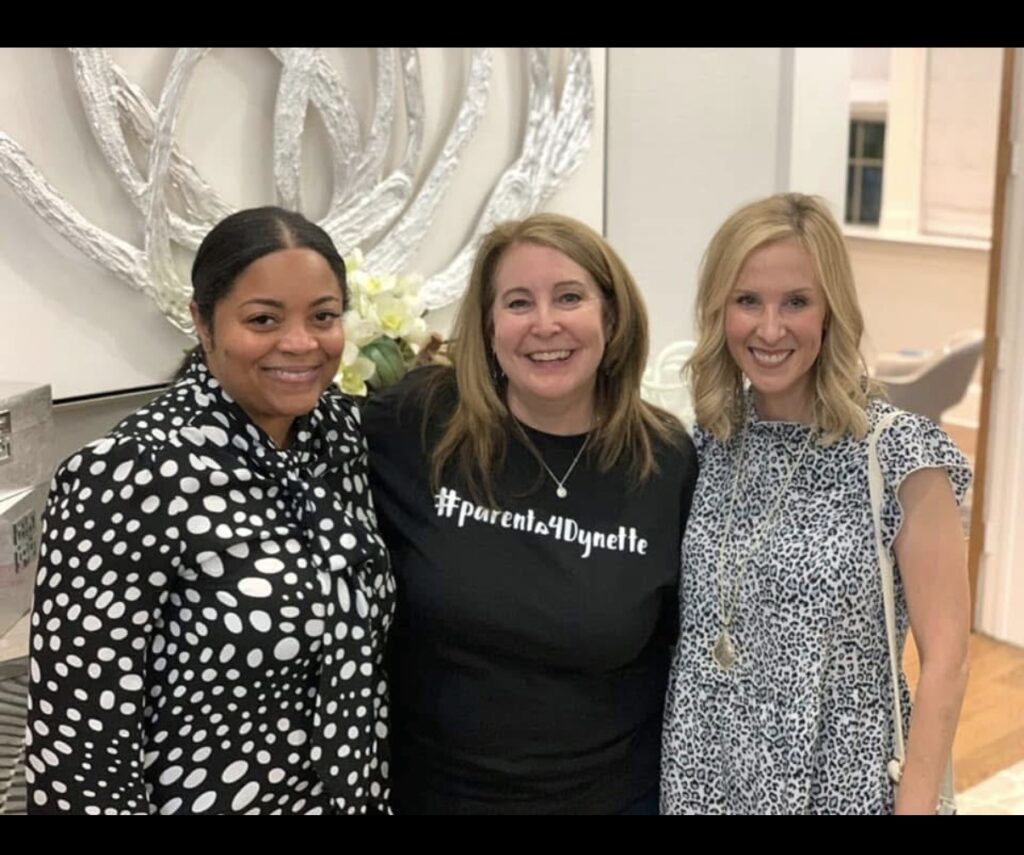
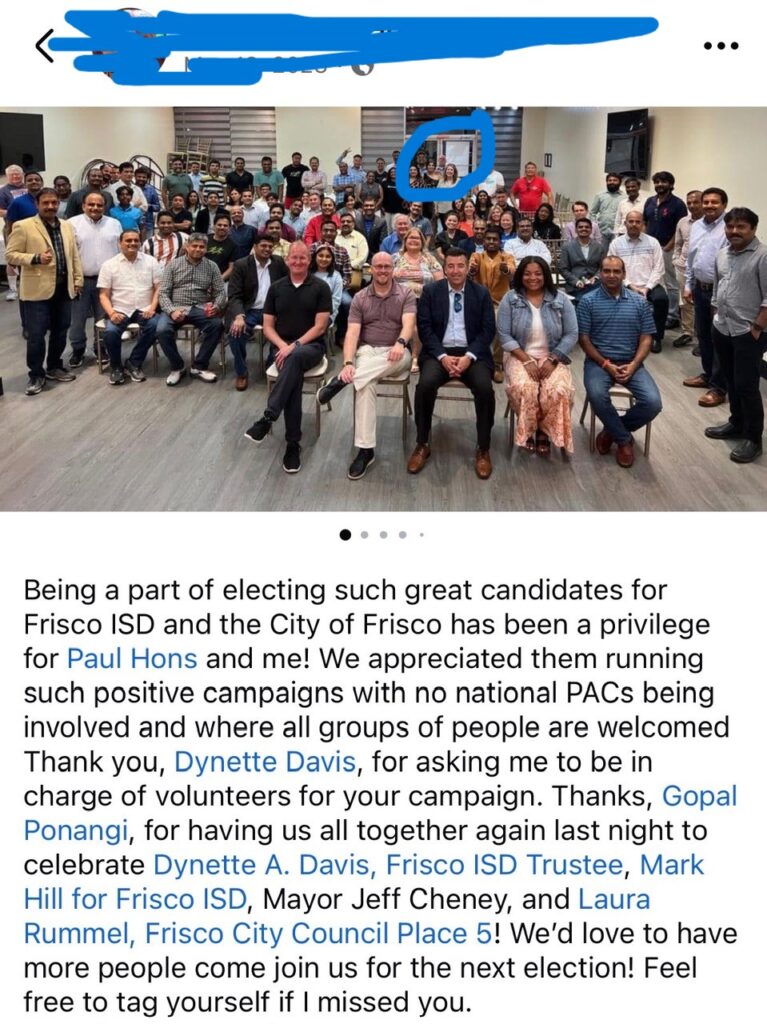
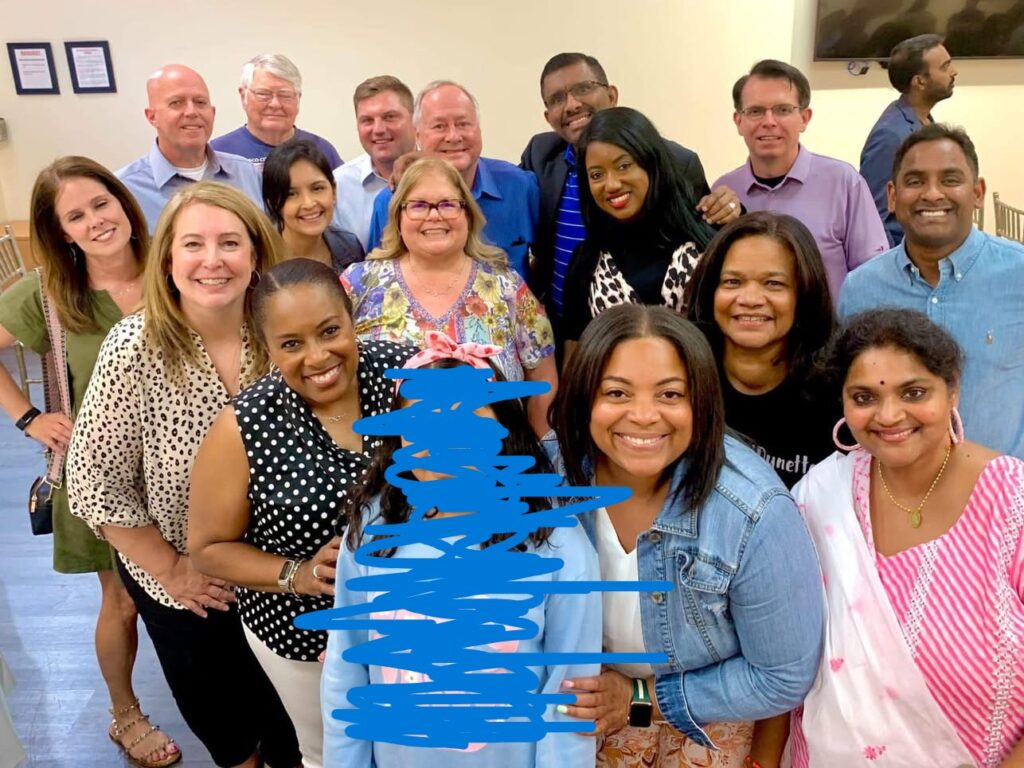
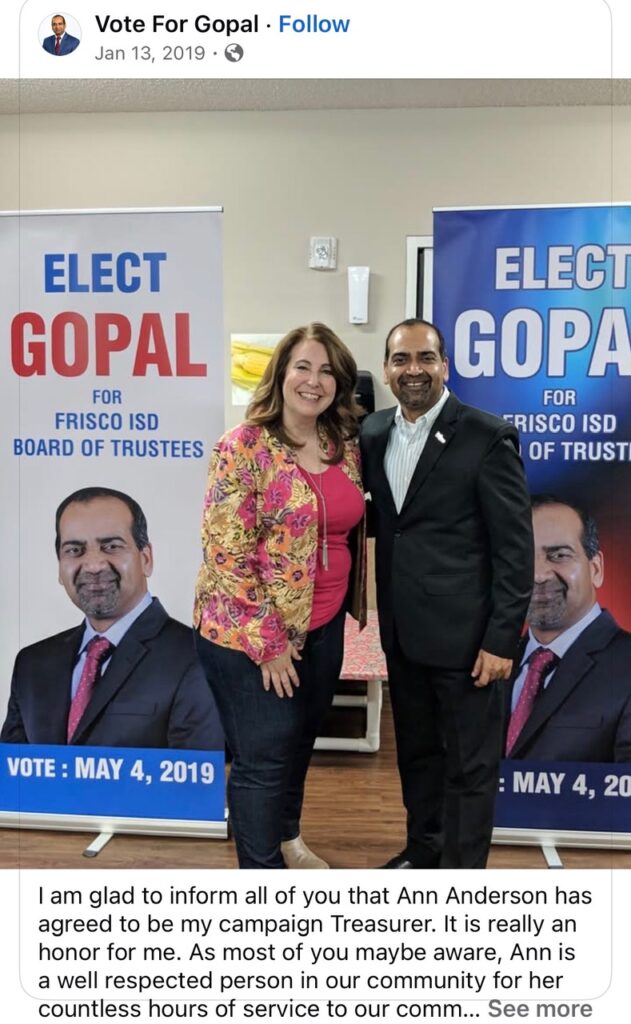
Her political résumé complicates the picture even further. She claims the Republican label, yet previously served as campaign treasurer for Gopal Ponanji, endorsed hard Democrats like Renee Sample and Dynette Davis, and backed current Mayor Jeff Cheney in 2020. That’s deep involvement, long-standing alliances, and a front-row seat to Frisco’s power structure.
While she may not be a part of any official special interest group, she is most definitely part of the Political Inner Circle of Frisco. You know the ones who want to keep the status quo of running this city. The proof was in the forums and who attended. Big names like Mike Simpson (former Mayor), The Cheney’s, John Keating, Laura Rummell, Karen Cunningham, Lisa Kirby, Brad Sharp, David Bickerstaff, Jennifer Achu, and many more all there clapping loudly for Ann Anderson. It was like a high school yearbook of the “popular kids” giggling and laughing and attacking someone who has spent their entire life in public service.
So, before voters buy the “just like you” narrative, it’s time to pause and ask the obvious questions. Because Ann Anderson isn’t an everyday Frisco resident stumbling into politics, she’s part of the inner circle, and Frisco voters deserve honesty about who’s really asking for their vote.
Public Safety
Anderson continues to say Public Safety is important to her and one of her top priorities. If that is the case why has she not dived in to learn more and better understand the ongoing issue with Public Safety and City Management / City Council. Nope, instead she just wants to attack a person who spent 40+ years in public safety and trying to promote a false narrative of the investigation done a few years ago. Online Anderson supporters are talking about the report and unions in post after post and in group after group. They want to talk about how these associations are unions to scare voters and to make them believe Piland supports associations /unions, which is not the case. Clearly at each forum Piland has addressed that he supports the people and when they city turned their back on the public safety employees and would not agree to meet and confer that left them no choice. He clearly said he does not support unions but he does support people especially when we are asking them to risk their lives.
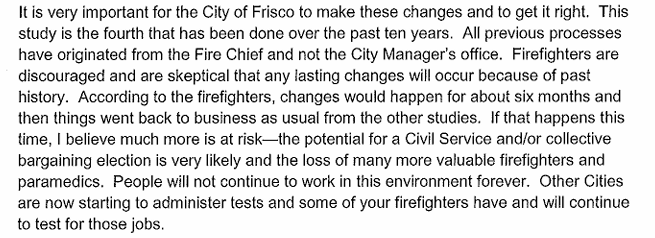
Interestingly the issue of Civil Service and/or Collective Bargaining dates back to 2011, before Mark Piland became Fire Chief in Frisco. The 2011 Climate Report, done by a third party clearly states in the summary and recommendations if change does not happen this time, the auditor believes much more is at risk – the potential for a Civil Service and/or Collective Bargaining election is very likely and the loss of many more valuable firefighters and paramedics. Chief Borchardt and his staff (which included Lee Glover) who is now the CURRENT Fire Chief, management style must change dramatically.
The other thing in this 2011 report is the FD staffs desire for 4 Person Staffing – which clearly shows that is not a new argument for them. They had been calling it out for years, way before Mark Piland came into the picture. In fact, Piland made a good point at one of the forums. He has 10 years of good reviews from city management, and while he was Fire Chief the FD Staff never moved forward with Civil Service or Collective Bargaining. However, after Mark Piland retired, and the city management chose to go back in time and appoint Lee Glover (from the 2011 Climate Report) as Fire Chief that is when the FD has a vote of no confidence for Glover and under Glovers leadership they filed for Civil Service and/or Collective Bargaining. If you are wondering why public safety continues to endorse Mark Piland, it is because he is right for the city council seat.
Republican, Democrat … or does it matter?
Piland is endorsed by both Collin County GOP and Denton County GOP. Ann Anderson made statements at all the forums how the vote for Mark was “preplanned” and “in the bag” which according to our sources in both Collin/Denton GOP’s, was not true. The Denton GOP did rush a meeting to make the endorsement for Mark Piland because while Ann is a Republican she does not live by or stand up for the Republican Values. She has a history of endorsing Hard Democrats for elections and that does not go over well in the conservative Denton County area. As much as we would like to think local politics is non-partisan in today’s world that is simply not true – nothing is nonpartisan.
When it comes to Collin County, we heard the same thing from inside sources, Ann’s previous endorsements and alignments did not go over well and it came down to a vote and Piland won because they felt he was the true Republican who had lived up the values in the Republican Agenda.
We are also told that tonight at the SLAN Forum she continued to defend her relationships with Democrats. What Anderson does not understand is you can have nonpartisan friendships all day long but if you have plans to run for office Republicans are not going to endorse fellow Republicans who openly help elect and endorse Democrats. There is too big of a divide in our world and that is not going to fly. John Keating will probably have a very hard time going for the endorsement for the same reasons.
Business 101
Ann Anderson said she is glad AT&T Headquarter Relocation choose Plano and not Frisco? She was happy we lost a fortune 500 company that the city had worked very hard behind closed doors to get!
At the Chamber Forum she said Frisco “Dodged a Bullet” when they lost Grandscape / Nebraska Furniture Mart and that was “a GOOD BULLET that we dodged” because instead Frisco got the Dallas Cowboys. I am curious if Ann Anderson understands Sales Tax and how it works.
Grandscape (anchored by Nebraska Furniture Mart) and The Star are both huge economic magnets —but based on the tax revenue figures public officials have shared, Grandscape as a retail tax generator likely produces more direct annual sales tax revenue than The Star’s sports/entertainment complex. However, The Star drives a large, long-term economic impact through property value growth, tourism, and related development that isn’t easily captured in one annual number.
In practical terms, Retail sales tax drivers (like NFM/Grandscape) tend to produce easy-to-measure, recurring annual tax revenue — city and county officials are often very excited about them because the checks come in year after year and are predictable.
As for The Star (a sports/entertainment hub) will generate broader economic impact — more jobs, more tourism, and more spillover spending — but the direct annual tax revenue number per year isn’t always as public or as concentrated.
Which one is better? Cities live and die by predictable, repeatable revenue which is sales tax that shows up every month because retail sales happen 365 days a year. When revenue and foot traffic are based on a schedule or a brand’s performance it gets much dicer. That is where Grandscape / NFM wins!
Fact is, if I’m the city treasurer, I want Grandscape. If I’m the mayor cutting ribbons in a tailored suit, I want The Star. But if you are responsible for not raising taxes when the economy hiccups then you better take the furniture store. Every. Single. Time.
Final Curtain – Get out and VOTE!
In the end, Ann Anderson’s own words are what make this so hard to square. She says she wants negative politics out of Frisco. She says voters shouldn’t be boxed in by Republican or Democrat labels. Yet she turns around and sends a hit-style mailer packed with selective framing, questionable quotes, and political drive-bys that do exactly what she claims to oppose. She says public safety comes first, while simultaneously attacking a public safety leader trusted and endorsed by those who put their lives on the line—behavior that feels eerily familiar to a council that happily accepted firefighter endorsements, then turned its back on them once the votes were counted. That’s not reform politics; that’s the same old Frisco playbook with a new cover page.
The bigger question many residents keep asking out loud now: why does this city’s leadership—and its inner kool kids club—seem to hate one man so much that they’ve tried repeatedly to destroy his reputation? Where was the moral outrage over the mayor’s keg party for teens? Where was the pearl-clutching when a council member embarrassed the city at a public pool in an illicit affair, or when signs saying “Get Naked” were laughed off like locker-room humor? Where was the fury when forged documents led to a settlement package fit for royalty? Somehow, silence. Yet for one man, the knives never stop. And maybe that’s why some of us see leadership not in who lands the cleanest punch, but in who takes the hits, stands firm, dusts off the scuff marks, and keeps showing up for the right reason—the residents. If Frisco voters truly want less negativity and more integrity, it may be time to stop listening to slogans and start watching actions.
Early voting has begun and Frisco Chronicles is voting for change in Mark Piland! We are done with the Frisco Playbook.







I went to her to ask for help with an issue my child that was getting nowhere with the school,…
So whatever became of the $17 million dollars that the city council gave the Mayor to beautify a drainage ditch?
At last count, there are 3 different "spa/massage" businesses in the small office park at the northeast corner of John…
I literally just saw this. Yeah, she used to forward everybody’s emails behind their backs.
You're dropping truth bombs! These mom and pop shops are what should be the least of Karen's worries. If they…