Note: We had no intention of discussing the previous legal proceedings and the petitioner in those proceedings, however Bill Woodard left us no choice due to his slanderous accusations that are unfounded and without merit. He opened this can of worms and we will respond to his claims and defend those who have been brought into this for no reason.
If transparency were a sport, the latest post by Bobblehead Bill Woodard aka The Chihuahua would be competing in interpretive gymnastics—lots of movement, impressive flexibility, and just enough flair to make you forget to ask what stuck in the landing.
At first glance, the piece presents itself as a sober “summary of facts” surrounding the Heit/FWB matter. But read a little closer and it starts to feel less like journalism and more like a carefully plated entrée of implication, innuendo, and selective storytelling—served with a garnish of court documents for credibility. That’s not illegal. It’s not even uncommon. But readers should approach with eyes wide open.
Because when a blog post blends verifiable legal proceedings with vivid personal detail, speculation about networks of people, and a one-sided narrative arc, the question isn’t just what is being said, it’s why it’s being said this way, right now.
Before anyone takes this post as gospel, here are a few reasons you shouldn’t. Stop, pause, raise an eyebrow, and rely on your common sense:
Selective storytelling: When one individual is framed as a community pillar and another is reduced to their worst alleged moments, that’s not balance—it’s narrative construction.
Timing: Publishing a so called “fact summary” in the middle of early voting isn’t neutral, it is purposeful to influence votes.
Dressed in Speculation: Create a long list of names and imply they are all connected. Then imply their involvement by framing they “may have been involved” statements to create the appearance of a network when there isn’t one.
Emotional Manipulation of Facts: Include graphic or highly personal details (such as a criminal record from 20+ years ago) to shape reader bias.
Illusion of Transparency: Provide documents to make it appear legit, but the actual interpretation of those documents is not objective or complete. It is one sided by a man with a petty desire to keep control.
None of these means’ readers should ignore the post. It means you should be aware that presentation matters just as much as content, and that motives, like facts, deserve scrutiny.
Readers should be asking themselves, why now? Is it a coincidence that it connects several current candidates for office? Is it a coincidence that it connects anyone who has spoken out against the city or previously run for office to Frisco Chronicles? Is it a coincidence that it every name is a conservative Republicans from Denton, County?
The Answers
Why Now? Power. Frisco Insiders like Bobblehead Bill are losing their relevance. Out with the old, in with the new. They are losing the power they have held to make decisions and without that power what do they have? Nothing.
Coincidence That It Connects to Current Candidates? No!
There’s an old trick in politics—if you can’t win the argument in the present, go rummaging through the past and hope for something, anything, still smells bad enough to distract the room. The Chihuahua’s post leans heavily on that playbook, dressing it up as “transparency” while serving readers a reheated plate of old material filled with speculation and conveniently timed outrage, so you won’t vote for change.
The Chihuahua’s post shows how desperate they are to get you to vote for the status quo like Mark Hill, John Keating, and Laura Rummel. That is how they maintain 4 votes which continues to give them “CONTROL.”
Coincidence that It names anyone who has spoken out against the city. No!
Usually, those strong enough to speak out or question the status quo, are the ones they fear the most. Why? If they present facts, then others start to see the light and ask questions. The goal for them is to stop the questions – just look away -there is nothing to see here.
Conservatives Under Attack
If you’re a conservative in North Texas, your name may already be on a list.
Michael Quinn Sullivan. Thomas Fabry. Carrie de Moor. Rudy de Moor. Erin Anderson. Kelly Karthik. Shona Sowell. Andrew Cucci. Senators Drew Springer and Brent Hagenbuch. Brian Livingston. Dan Stricklin. Michelle Milholland. Mark Eisemann. David Redding. Casey Waits. Millie Rhoades. Stephen John Sullivan. Tony Ortiz. John Stammerich. J. Aiden Gray. Patrick Wamhoff. Melinda Preston. Jennifer White. Cassidy Johnson. Dawn Buckingham. Rick Perry. Greg Abbott. Texas Scorecard. Current Revolt. This is just the beginning!
What do all these names have in common? They are local conservative Republicans. Texas Scorecard and Current Revolt are conservative news sources. And every single one of them was brought up in my first deposition in August 2025 at Clarke Hill law offices in Frisco as well as listed in the petition filed by the Petitioner.
Now tell me—why would the names of so many Republicans come up in a deposition about my little blog, Frisco Chronicles Whistleblower?
I showed up expecting to answer questions about my articles on the Petitioner but instead, they grilled me on every potential republican relationship they think I have, asking the same questions multiple ways to try and trip me up. That’s the game: catch you in a “lie.”
It didn’t matter that I have receipts: website ownership, domain, hosting. They wanted and hoped for a bigger fish. Even though I was nursing a hangover, I answered honestly just like my lawyer told me to. Did they trip me up, yes probably asking the same question 100 different ways over 6 hours. The grand reveal they were hoping for fell short like a bad one-night stand. I get it!
The Twist
Next came the Motion for Contempt and Motion for Sanctions filed by the Petitioners Attorney. Again the motion drags in more names of conservative republicans like Shannon Greer, Andrew Cucci, Thomas Fabry, Brian Livingston, Dan Stricklin, Tony Ortiz, Patrick Wamhoff—and even cites a City Council meeting (Exhibit 28) identifying Melinda Preston (current Denton GOP Chair), David Rettig (Precinct Chair & Mayor elsewhere), Jennifer White (Precinct Chair), Cassidy Johnson (Precinct Chair – Collin County), and more.
One word comes to mind: TARGETED.
At this point they were asking the judge to depose Brian Livingston (current Republican councilman), Dan Stricklin (former councilman), Shannon Greer (Republican precinct chair and animal activist and my own attorney.
The Claims & My Responses
Claim #1: I perjured myself and withheld information the court ordered. Response: False. I answered truthfully like my attorney advised me to.
Claim #2: My attorney is secretly part of the “organization” because of his political affiliations. Response: False. Steve Noskin is my attorney, nothing more.
Yes, my attorney is active in local politics, but to leap from that to “he runs Frisco Whistleblower” is pure fiction, false and libel!
Does this sound targeted to you? The document reads “In light of the fact Steve Noskin is extremely active in politics with a focus on local elections including but not limited to: formerly twice being a political candidate in Frisco; adamantly supporting candidates in each Frisco election; vehemently supporting two candidates who provided information to the Respondent organization; his role as an administrator for Parents of FISD Facebook page and Star Patriots Facebook page; and his active participation in Frisco Conservatives, Star Patriots and Families 4 Frisco PAC, Steve Noskin’s involvement with the Respondent organization is consistent with the Respondent organization’s reason for targeting Petitioner Heit and her Facebook group “Frisco Residents Who Care”
Claim #3: My attorney and Shannon Greer conspired with me to give false testimony. Response: False
Yes, I know Shannon Greer and many other people in this document. Some I know well, others I may have met in passing at an event for a few seconds, and some I don’t know at all. Because she attended a hearing as spectator does not connect to collusion.
Claim #4: I must be running a conspiracy because I use words like “us” and “we” which is plural terminology. Response: False.
Writers, performers, and commentators have been using personas for centuries, and not just to be mysterious or dramatic. It serves real purposes: creative freedom, protection, satire, and sometimes just better storytelling. In journalism and political writing, pseudonyms are often used to separate the message from the messenger—or to avoid backlash. That’s not new; it’s basically how the Federalist Papers were published, under the name “Publius.”
There’s no “secret team of minions” hiding in my closet.
Claim #5: Councilmen Brian Livingston and Dan Stricklin must be involved. Response: False.
Claim #6: I couldn’t explain how I post blogs, so I must be hiding something. Response: False.
After 227+ posts, it’s mechanical. I “just know” how to do it. Like driving to a friend’s house—you know the way but can’t always give perfect step-by-step directions. That doesn’t mean there’s a conspiracy.
Fast Forward to The Chihuahua’s Breaking Blog
Bobblehead Bill adds more names to the list of Republicans being called into question. He tries to expand the web of “CONNECTIONS” by calling out new names in addition to names from the case. What do the new names have in common? They are currently candidates, the spouse of candidates, or supporters of the candidates in the current election for City Council and Frisco ISD.
Conservatives Should Be Outraged & Concerned
Why are Denton GOP leaders, conservative mayor and council members, precinct chairs, and media outlets being dragged into depositions and the Chihuahua’s blog?
The answer is simple, it’s about shutting down free speech, it is about attacking the credibility, integrity and character of the individuals to influence voters and maintain CONTROL. It is about dragging names through the mud and most of all shutting down conservative free speech—in Frisco and Denton County.
They’re mad voters rejected the ISD bond, the Performing Arts Center, and elected two hard Republicans to city council. The welcome mat hasn’t exactly been rolled out for those two, has it? So now the strategy is: smear, intimidate, and silence conservatives and cause voters to pause and rethink about voting for change.
By dragging names through public depositions and blogs, they create the illusion of scandal. That’s the hit job.
The Chihuahua Barked at The Wrong Mailman
When you peel back the dramatics wrapped in legal language to sound authoritative all you have is padded opinion with speculation, insinuation, and a carefully curated list of names of political convenience. It is designed to look like journalism, but it veers into advocacy as the tone shifts from the court case to the individuals. Clearly the Chihuahua’s selective and subtle drop of my “criminal background” is character framing designed to dehumanize me and be inflammatory. It has nothing today with the case he is talking about. Are you the same person today as you were twenty years ago?
Next, he adds guilt by association using narrative stacking. You pile up names, relationships, and suggestions until the reader fills in the gap emotionally. His speculation presented as facts shows he lacks credibility. Did he reach out to me for a comment before writing his blog? No!
At the end of the day use your common sense, is the journalism or revenge reporting?
As for the current legal proceedings we responded to the petitioner’s attorney. Crickets! If the petitioner wants to end this, we can make some adjustments to the blogs, but her attorney needs to confirm to us that it is over, so we don’t interfere with an ongoing legal proceeding. We have written 227+ blogs now, 3 are about the petitioner and 2 mention the petitioner in a paragraph. That is less than .02% of our time spent on the petitioner.
I stand behind every blog I wrote. I have filed Public Information Requests and documented everything I have published through sources. This is not personal for us. We had no intention of making a public statement about the proceedings, but the Chihuahua seem to know a lot about the case that is not public, so we were left no choice but to comment.
Let me say it again: it’s just me. No secret cabal, no Republican plot. Just a blogger behind a keyboard.
Pay Attention Denton County Republicans and Republican Organizations _ You should be alarmed that free speech is being targeted and that you could be next. This is about keeping Frisco blue. VOTE FOR CHANGE! TAKE BACK FRISCO!
For legal purposes I must add this disclaimer: This blog could include satire, parody, and comic relief. It could contain summarized accounts created solely for humor and commentary. Any resemblance to real events is either coincidental or intentionally satirical. Reader discretion — and a sense of humor — are advised.
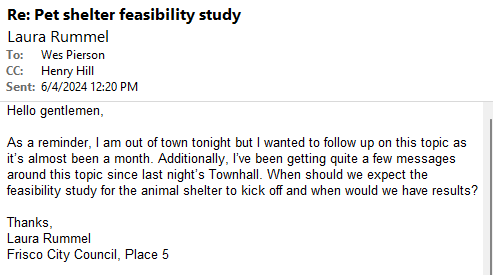
Questions Raised After the Frisco Chamber Forum: A Closer Look at the Animal Shelter Debate
With early voting underway, several residents and animal advocates reached out to me about the recent Chamber Candidate Forum, raising concerns about statements made by Councilwoman Laura Rummel regarding Frisco’s proposed animal services facility.
We reviewed those concerns, along with public records and prior council discussions. What emerges is a series of unanswered questions—and inconsistencies—that voters may want to consider.
A Longstanding Promise, Still Unresolved
For over a decade, residents have pushed for a full-service animal shelter in Frisco. When Laura Rummel first ran for office, animal advocates were among her strongest supporters. Today, many of those same advocates are supporting a new candidate, why?
The Proposal: “Temporary Holding Animal Facility”
The city’s current proposal centers on a $12.5 million temporary holding facility, operated through a public-private partnership.
Originally, animals were expected to stay up to five days at Frisco’s facility before being transferred to Collin County Animal Services (CCAS). But that plan has now changed. Recently the Collin County Commissioners Court announced that Frisco was out at the end of the contract which is November 2028. The Commissioner’s Court has had enough of Frisco Leaders games, delays, and requests for special treatment.
Frisco Chamber Forum: The $2 Million Question
At the forum, Laura Rummel stated “We have been able to figure out how to build a private public partnership that is going to be zero cost additional to the taxpayer. That is very important because when people are saying they want to build a municipal shelter that we own and operate that equates to about $2 million in operating costs every year that we would then have to figure out where that money is coming from.”
However, current city budget data shows:
Total Animal Services budget: ~$1.48 million
Personnel Costs: ~$749,000
The City of Frisco employes 1 Animal Services Supervisor, 1 Senior Animal Control Office (ACO), 6 ACO’s for a total of 8 employees
Even under a private model, the city must still:
Employ Animal Control Officers
Maintain field operations
Transport animals
Those costs do not disappear.
So where does the $2 million figure come from—and what does it include?
The Collin County Curveball
The remainder of the $1.4 million dollar Frisco budget goes to operations. Currently the 2025-2026 costs are $734,948 which reflects the increase due to the Collin County Interlocal Agreement for Animal Services.
Wrench In the Plan: Frisco’s agreement with Collin County Animal Services ends in November 2028.
After Frisco played games with the negotiations, county officials declined to extend a new agreement. The Collin County Commissioners Courts refused Frisco’s “special agreement” and say “Bye, Bye, Bye.” Collin County Commissioners Court told the City of Frisco “were done” and Frisco can go do their own thing.
The Problem:
The city does not yet have a clearly defined long-term plan post-2028
In a recent recording we received (which we will not publish) Laura Rummel can be heard telling residents they will continue to partner with CCAS renting space as needed and that the city may still be able to work out a solution with them. Watch the video of Commissioners Court – there NO, WERE DONE is clear.
“Zero Cost to Taxpayers”?
Laura Rummel said, “We have been able to figure out how to build a private public partnership that is going to be zero additional cost to the taxpayer.” But:
The facility is funded through the Frisco CDC (with sales tax revenue)
Sales tax is still taxpayer money
While property taxes may not increase, residents are still funding the project—just through a different mechanism. Remember they wanted you to agree to use that CDC and EDC funds for the performing arts center too.
Next Laura Rummel said, “The way that we have structured this is that the building itself will be funded by CDC ($12.5 Million) and then the actual ongoing operations is done by a city partner and the partner will get deductions from their rent for city services that are provided. We have the most recent evaluation that we’re looking at the facility has the capacity as built that we might not even need Colin County Animal Shelter anymore.”
The Rent Deduction Model: A Financial Gray Area
Under the proposed partnership:
The operator pays ~$32,000/month in rent
BUT can offset rent by providing services
That raises several questions:
Who determines the value of those services?
Are services billed at market rate—or discounted?
Could rent effectively be reduced to zero?
If so, the financial burden doesn’t disappear, it shifts.
Capacity vs. Reality
At the forum, Laura Rummel suggested that the facility may house animals through adoption, citing a study that shows the average adoption time of 18 days. Two problems with that:
First, City Manager Wes Pierson has been very clear that this is a short-term facility, and they have made no plans for a long-term facility.
Secondly, Rummel is not telling you the full details of the study she quoted regarding the average adoption time. Those same studies show a widespread:
Some dogs: 1–7 days,
Others: 30–50+ days
Outliers: months or even years.
It continues dogs with less desirable traits stayed ~50 days vs ~20 days for others. The “average” hides the fact that some dogs move fast… and others get stuck broader data shows: THE POINT: Averages can obscure outliers.
In Laura’s “Frisco Plan,” what happens to animals that don’t get adopted quickly—especially if the facility was not designed for long-term care?
Other Issues (Not Discussed at the Forum)
A Policy Gap: Owner Surrenders
Chief Shilson has repeatedly said the proposed facility will not accept owner surrenders.
That’s significant because owner surrender is one of the primary reasons residents seek shelter services. Without that option, residents may have limited alternatives. Studies show a resident will dump the animal so that Frisco Animal Services will have to pick it up as a stray.
Process Concerns
Additional concerns raised include no formal Request for Proposal (RFP), no independent feasibility study, and limited transparency around partner selection.
The City of Frisco did 4 to 6 feasibility studies for a performing arts center that over 60% of residents voted no to! They do studies on red lights and traffic patterns. Why not have one for an animal shelter?
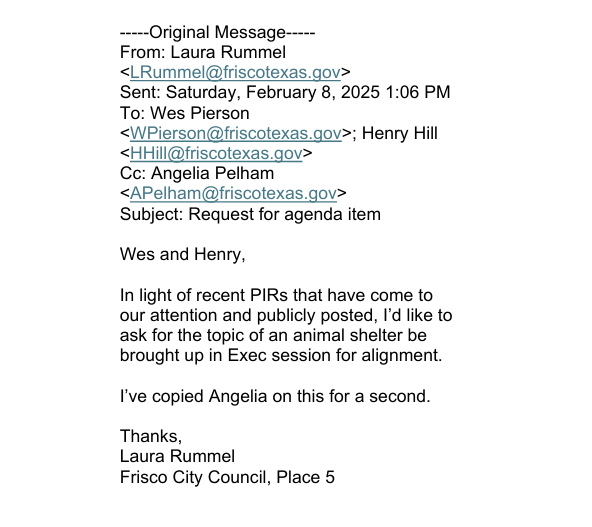
On October 21, 2025, at the Frisco City Council Meeting when discussing the LOI for an animal shelter holding facility, Laura Rummel promised transparency. She pushed for the LOI to be approved without a feasibility study. According to an email between Laura Rummel and city leadership she supported a feasibility study before … what changed?
Remember Laura promised transparency! Yet in 2025 Laura tried to move the discussion of the animal shelter items to executive session? Why? To keep them from the public. Yet she continues to say TRANSPARENCY, I am just wondering what her definition of that is.
Laura Rummel has quoted studies and experts from California. Since when does Texas every rely on data or expertise from California?
Frisco Chronicles has filed several PIR’s for information related to the animal facility and all have been delayed and pushed to Attorney General claiming “confidentiality” so that is not transparency. Animal advocates have also filed PIR’s which are facing the same response. WHERE IS THAT TRANSPARENCY?
The Bigger Picture
This issue goes beyond a single facility. It touches on long-term planning, financial transparency, and public trust.
With key agreements expiring and costs still unclear, voters are left with an important question: Is the current plan a complete solution—or a temporary fix with long-term uncertainties? Why is Laura Rummel pushing this concept through so fast with so many uncertainties? Why did Laura Rummel turn her back on a full-service animal shelter she promised constituents for years? Laura can’t consistently even give the same answer.
Several candidates have come out and said they support a full-service animal shelter and slowing down the process to do it right. Shona Sowell, Rod Vilhauer, Vijay Karthic and Brittnay Colberg all have presented plans and ideas to animal advocates we talked to. Several animal advocates told me they were shocked at how many candidates did not reach out to them knowing the Animal Shelter is a hot topic in this election.
In the meantime, Jeff Cheney is still hoping for his Animal Utopian Society!
Disclaimer: This blog includes satire, parody, and comic relief. It contains summarized accounts created solely for humor and commentary. Any resemblance to real events is either coincidental or intentionally satirical. Reader discretion — and a sense of humor — are advised.
There’s an old saying: if you don’t have the timeline on your side, you better have a good story. And if you don’t have either… well, you write a blog post like the one we just read. Let’s walk through what’s being sold versus what actually holds water.
The Timeline Problem They Hope You Ignore
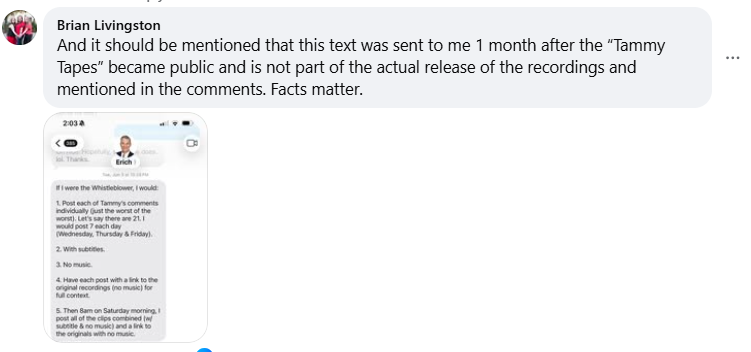
A recent post by a lame blog, leans heavily on the idea that a so-called “bombshell” text ties the Colberg’s to some grand political scheme involving secret recordings used to influence the May 2025 election.
Sounds dramatic. There’s just one problem—it doesn’t line up with reality.
The recordings in question (the now-infamous “Tammy Tapes”) were released on May 3, 2025.
The “smoking gun” text? Dated June 2–4, 2025.
That’s not a minor detail. That’s the entire case falling apart.
You can’t “weaponize” something a month after it’s already been released to the public. That’s not strategy—that’s hindsight dressed up as conspiracy. So right out of the gate, the central premise collapses under its own timeline.
The “Colbergs” Narrative – Built on Sand
The blog tries to create intrigue by emphasizing the message came from “The Colbergs”—plural. A household. A unit. A dramatic flourish meant to imply coordinated action.
But here’s what gets conveniently glossed over: Even by their own referenced commentary, the message traces back to Erich Colberg, not Brittany. No joint plotting. No evidence of collaboration. Just a stretch—one of those reach-across-the-table, nearly-fall-out-of-your-chair stretches—to tie a candidate into something for maximum political effect.
And let’s be honest: if the evidence were that strong, there wouldn’t be a need to play grammatical gymnastics with the word “Colbergs.”
The Court Filing Argument – A Leap Too Far
Another pillar of the dog’s argument is that legal filings to suppress the text somehow equal guilt.
That’s a bold claim—and a dangerous one.
By that logic, anyone who files a motion to limit or challenge evidence in court is automatically admitting wrongdoing. That’s not how the legal system works. Not in Texas. Not anywhere. People file motions for all kinds of reasons: privacy concerns, relevance disputes, procedural issues. It’s called due process, not confession.
Turning routine legal maneuvering into a smoking gun isn’t analysis—it’s narrative-building.
The Missing Connection No One Can Find
Let’s address the elephant in the room: Frisco Chronicles.
Despite the repeated attempts to connect dots, draw lines, and build a web of intrigue, here are the facts:
Frisco Chronicles has never met the Colbergs.
Frisco Chronicles has never communicated with the Colbergs.
The Colbergs had no involvement in the recordings.
Frisco Chronicles operates independently—period.
No shadow network. No backroom coordination. No secret alliance. Just a stubborn refusal to fit into someone else’s storyline.
What This Really Looks Like
When you strip away the dramatic tone, the selective framing, and the carefully chosen wording, what’s left? A post built on:
A timeline that doesn’t work
An association that isn’t proven
A legal argument that overreaches
And a narrative that fills in gaps with assumption
In other words, not a revelation—an attempt.
The Real “Big Truth”
The blog titled their piece “A Little Lie Reveals a Big Truth.” On that, we actually agree—just not in the way they intended.
The “big truth” isn’t about a coordinated political scheme. It’s about how quickly speculation can be dressed up as certainty when there’s an election around the corner. It’s about how a single text—taken out of context, stripped of timing, and stretched to its limits—can be turned into a headline. And maybe most importantly, it’s about relevance.
Because when you can’t match the impact, the reach, or the receipts… sometimes the next best move is to manufacture a moment.
Final Thought
If this is what passes for a “bombshell,” then the bar has dropped somewhere near the basement. Frisco voters deserve facts, not stitched-together narratives that fall apart under basic scrutiny. And if this is the best attempt at keeping up? Well… let’s just say the gap isn’t closing anytime soon.
Lastly, we are still shocked how the dog’s side is more concerned about the exposure of wrongdoing versus if Tammy Meinershagen had done nothing – nothing would have been revealed. She is directly responsible for her actions.
Disclaimer: This blog includes satire, parody, and comic relief. It contains summarized accounts created solely for humor and commentary. Any resemblance to real events is either coincidental or intentionally satirical. Reader discretion — and a sense of humor — are advised.
UPDATE 4/8/26: Per a Facebook Post by Mark Hill For Frisco Mayor he turned in his campaign finance report on time and had the date-stamp to prove it. Hill says the report just had not been uploaded to the city website. We asked him for a copy of the date-stamp in our comment but have yet to receive it. If this is the case, we question how the city secretary who makes an estimated $157,000, made that mistake by not uploading the report. The city is well aware all eyes are on elections and these reports so that is a big error on the cities part.
There’s an old saying: the little things tell you everything.
We looked at the most recent 30-Day Campaign Finance Report for the candidates. The most noticeable problem is that 3 of the candidates did not comply with “STATE LAW” to file their reports. Another candidate turned in their report 4 days late. For the 3 who filed no report, how can residents trust you to run a billion-dollar city budget?
Sreekanth Reddy – Candidate for Place 5
Matthew Chalmers – Candidate for Place 6
Mark Hill – Candidate for Mayor
Rod Vilhauer – Candidate for Mayor (turned in 4 days late)
Let’s be clear—this isn’t complicated. This isn’t obscure. This isn’t optional. If you run for office, you file your campaign finance reports. On time. Every time.
A Pattern, Not a One-Off
While we are upset that these candidates missed the deadline, we are more focused on Mark Hill because he has a pattern of behavior when it comes to his campaign finance reports. This isn’t the first time questions have been raised. In our previous blog, “Who Failed the Campaign Finance Reality Check,” we outlined concerns about missing or non-compliant filings tied to Hill’s campaign activity, including:
July 2024
January 2025
July 2025
Now, here we are again.
The 30-day pre-election report—due April 2nd—has come and gone, and once again, the question lingers:
Where is the report?
The Resume vs. The Reality
Hill’s campaign messaging paints an impressive picture:
Former Frisco ISD Trustee
Experience balancing a billion-dollar budget
Service on economic development committees
Studied finance at Texas A&M
Practicing attorney
That’s a résumé built on fiscal responsibility and governance. Which makes this all the more puzzling.
Because if you understand budgets… If you understand compliance… If you understand finance…
Then you understand deadlines.
So What’s the Problem?
Campaign finance reporting isn’t a suggestion—it’s a legal requirement designed to ensure transparency for voters.
It tells the public:
Who is funding a campaign
Where the money is going
Whether influence is being bought or earned
And yet, voters are left asking:
Why do these reports keep going missing?
Who is responsible—the candidate or the treasurer?
And why hasn’t this been corrected after prior scrutiny?
Yes, a treasurer is listed—Srini Raghavan—but let’s not play bureaucratic hot potato. At the end of the day, the candidate’s name is on the ballot.
Leadership Starts with Accountability
Here’s the uncomfortable truth: Running a city like Frisco requires managing timelines, budgets, and compliance across multiple departments, projects, and stakeholders. If a campaign can’t consistently meet basic state filing requirements…
What does that say about readiness to run a city?
The Bottom Line
This isn’t about paperwork.
It’s about discipline. It’s about transparency. It’s about trust.
Because if you’re asking voters to trust you with hundreds of millions in taxpayer dollars, the bare minimum expectation is this:
You can file a report. You can meet a deadline. You can follow the rules.
Anything less isn’t just an oversight. It’s a warning sign.
Disclaimer: This blog includes satire, parody, and comic relief. It contains summarized accounts created solely for humor and commentary. Any resemblance to real events is either coincidental or intentionally satirical. Reader discretion — and a sense of humor — are advised.

I went to her to ask for help with an issue my child that was getting nowhere with the school,…
So whatever became of the $17 million dollars that the city council gave the Mayor to beautify a drainage ditch?
At last count, there are 3 different "spa/massage" businesses in the small office park at the northeast corner of John…
I literally just saw this. Yeah, she used to forward everybody’s emails behind their backs.
You're dropping truth bombs! These mom and pop shops are what should be the least of Karen's worries. If they…