“Wag the dog” is an idiom describing the act of using a secondary, minor issue or diversion to distract attention from a larger, often damaging crisis. It is most often used in political and media contexts, where leaders allegedly fabricate, amplify, or emphasize a dramatic situation to steer public focus away from bigger scandals.
The Frisco City Council meeting on Tuesday, May 19, 2026, was, in my opinion, one of the biggest political messes in this city’s history. And my mission at Frisco Chronicles is to expose the shady stuff. So, let’s begin.
The Frosting
The public comments portion of the evening reached an all-time high. Everyone was talking about line item #25. The passion in the room was palpable. There were extra police, yelling, swearing, reporters, escorts out, and social media influencers. The tension was raw.
But like many others, I believe most people missed what was sitting in plain sight.
In case you missed it, or are still confused, allegedly this was really about Mayor Jeff Cheney’s Legacy Line Item. In my opinion, he will go down in the history books to save his best work for last. Perfect timing before his pending exit. Played and executed like a true maestro.
Remember this time last year, when the mayor’s cherry-tomato head almost blew right off his shoulders after that horrendous $340 million Performing Arts Center deal failed by voters, along with his cohort Tammy Meinershagen’s re-election? There were too many alleged questions about that deal and who may have benefited from it. In my opinion, Frisco was smart about that one and dodged a bullet.
Well, friends, the deals that allegedly moved forward Tuesday night make last year look like a cheap appetizer. That may also explain Mayor Cheney’s DEFCON 3 behaviors at recent Frisco City Council meetings, when he started getting pushbacks from other council members. More on that soon.
In my opinion, the best way to describe what happened is by comparing the consent agenda to a triple-layer chocolate cake. Everyone got fooled because they were only paying attention to the three visible layers: the Jain temple, the Hindu temple, and the mosque. What I believe many people missed was the ooey-gooey, ever-so-sweet, rich chocolate frosting on top, hiding the rest. That, in my opinion, was the real story.
Before we once again deep-dive into the alleged cabal rabbit hole, let’s not kid ourselves. Open your eyes wide. It is election time, and in my opinion, it is the perfect time to wag the dog and play on voters’ fears while the recipe for the sweet frosting goes unnoticed.
How does an alleged political machine best distract voters? Well, while people were fighting over Islam, Sharia Law, temples, and fear, here is what I believe was really going on underneath the pretty frosting.
The 16 Layers
You missed the other 13 of the 16 development projects. Based on my best guess, this may have represented a development package that roughly ranges between a $750 million to $1 billion dollars.
The Planning and Zoning Commission consent agenda included 16 separate cases totaling more than 300 acres of development across Frisco, which were then sent to Frisco City Council for a vote. Here is a brief overview of what I call the full boxed-up cake deal:
Railhead Phase 1: 8.8 acres with 3 office buildings, 2 retail buildings, and 2 parking garages.
Best Brains Addition Lot 3: 1.7 acres for a childcare center.
Park 25 Block C: 15.6 acres with 2 offices, warehouse, and distribution centers.
Centennial Pediatrics/Islamic Center: 5.8 acres with a place of worship.
Coit & 3537 Addition: 4.4 acres with 3 retail buildings.
FM 423 Lonestar: 14.8 acres with a temple, medical offices, restaurants, a convenience store, and drive-throughs.
Point East Industrial: 44.1 acres with 6 warehouses and distribution buildings.
Lebanon South: 5.7 acres with a temple and community center.
Park 25 Block C: 15.6 acres with 2 offices, warehouse, and distribution centers.
Four Corners Shopping Center: 4.4 acres with 2 hotels.
Grand Park Canal South: 4.8 acres with a childcare facility and restaurant/office space.
Frisco Fire Station No. 8: 4.3 acres with a City of Frisco stealth antenna.
Northeast Community Park: 70.7 acres with a City of Frisco stealth antenna.
Firefly Park Lot 4: 10.9 acres with a parking garage and professional office.
Prosper High School #2: 98.3 acres for a public school, Prosper ISD.
Best Brains Addition Lot 8: 2.3 acres with retail, restaurant, and office uses.
Total: 16 cases and more than 312 acres of Frisco development.
Only 3 of the 16 developments involved religious institutions. The rest included warehouses, hotels, offices, a 98-acre public school, City of Frisco infrastructure, retail, and childcare. In my opinion, this was a treasure chest of Frisco development, not merely a vote on three rubber-banded religious institutions.
That is the cake. Sixteen layers. But the public was only staring at the frosting.
The P&Z Questions
Back when this was approved by P&Z, Chairwoman Brittney Colberg was absent for the vote, and Sean Merrell recused himself. Why? Election-time strategy? A conflict of interest? Something else?
New council member and former P&Z Chairwoman Brittney Colberg currently operate a Title Company. According to publicly available information, the business appears to cater to luxury real estate agents and top producers. Their goal, to help growth-focused real estate professionals’ level up their businesses, strengthen brand reputations, increase market knowledge, become industry leaders, and increase revenue.
Frisco Chronicles must ask, is there a potential down the road for conflict here? If Colberg’s business benefits, directly or indirectly, from any of these deals then the answer could be yes. We have not discovered anything as of now, but we will keep our eyes peeled now that she is elected.
Current P&Z member Sean Merrell, is listed as a licensed professional engineer in Texas for BGE, Inc. He is also the past president of the American Society of Civil Engineers. Frisco Chronicles wondered, does BGE, Inc., have any active applications in Frisco? What about previous contracts with the City of Frisco?
Surprise, surprise … well not really, Frisco Chronicles found what appears to be a warehouse project involving BGE, Inc. This may explain why Sean Merrell recused himself.
The agenda stated: “Consider and act upon adoption of an Ordinance to repeal Ordinance No. 2025-03-16 and grant a Specific Use Permit for an Office/Warehouse/Distribution Center on one lot on 98.1± acres on the north side of SH 121, 1,015± feet west of Independence Parkway. Zoned Highway with a Specific Use Permit for an Office/Warehouse/Distribution Center and Commercial-2. Neighborhood #26. Zoning Case No. SUP25-0009. Applicant: BGE, Inc. (Development Services/JH)” Ordinance 2026-04-34.
Did I mention this was the same warehouse project that Richwoods and Lexington residents were concerned about backing up to their community? That’s right the one that filled Frisco Chambers just a few weeks ago with our Indian neighbors who spoke against the development while our council listened on deaf ears.
The Planning and Zoning Commission reviews and advances development items long before they ever reach City Council. Frisco Chronicles is wondering why were three completely separate projects, at three different locations, with different ownership groups and three different religions, allegedly bundled together under a single consent agenda line item?
I suspect a Christian church would not have been bundled in the same way. Could those projects have been separated and voted on individually? Probably. Was it poor organization? Doubtful, in my opinion. Political strategy? More likely, in my opinion. The epic wag the dog.
Create a distraction while other major development items quietly move forward.
The Council Meeting Moment
Who could see the forest through the trees, when the consent agenda came up? The only questions or pushback appeared to come from Councilmen Burt Thakur and Jared Elad. Both tried to bring up the many other items on the consent agenda that the public was clearly not focused on.
A motion to appeal was made by Councilman Burt Thakur and appeared to be ignored. There was no second motion. Instead, Mayor Cheney appeared to move the discussion into immediate executive session to consult with the city attorney. But why?
There does not appear to be a law requiring consultation with the city attorney to happen in private, away from the eyes and ears of voters and taxpayers. This proves Frisco Chronicles point that there is zero transparency, folks.
Mayor Cheney’s motion immediately received a second, and off they went behind closed doors. Just a guess but what followed behind closed doors may have been a heated discussion about the audacity of a couple of councilmen asking questions and suggesting an appeal. My guess is that the executive session was more of an attitude-adjustment session, the kind your mom gives you when you act up in a store and she walks you outside to the car for an understanding.
Mayor Cheney, in my opinion, was not about to let his alleged Legacy Line Item slip out of his sweaty red hands. Back at the dais, the consent agenda passed 6-0, despite Councilman Burt Thakur appearing not to have agreed with the direction things had gone. Yes, folks, this is what you voted for.
A city council can vote no on almost anything before it. Its primary responsibility is to protect the residents. In my opinion, threats of lawsuits over religious freedom became the wag-the-dog moment, conveniently burrito-wrapped into mega projects most residents were not paying attention to.
It is the opinion of Frisco Chronicles that the PANIC was not only about getting sued over the denial of a mosque but also may have been over the other 13 development deals not going through. Wake up, Frisco … You are being used!
Mayor Cheney does not care about mosques and temples. His track record shows he cares about cash, the deal, the development, and the legacy. This whole situation could not have been more perfectly orchestrated.
Do you really think it was just coincidental that the alleged Legacy Line Item was pushed through during one of Mayor Monopoly Cheney’s final city meetings?
The mayor yelled from the dais, “Stop making this political.” The audience pushed back, “No, you are!”
Councilwoman Angelia Pelham also appeared to join in with similar comments from the dais while defending Mayor Cheney. Ultimately, they were right about one thing: it was not just political. It was about development. The money. The deals. The legacy. The generational wealth. The frosting.
The frosting, folks, is the perfect camouflage for any cake. You really do not know what you are getting until you cut into it. Anything could be lurking under there: cheap angel food cake or the most luxurious and decadent dessert you have ever placed on your taste buds.
In this case, it was a 16-layer cake with top-shelf premier frosting used to camouflage the layers hiding underneath.
The Timing Questions
Conveniently and coincidentally, the appointment of the Mayor Pro Tem and Deputy Mayor Pro Tem was moved until after the elections. Additionally, the replacement of the open P&Z position was also delayed. With a contentious mayoral election happening, I believe they were not going to rock any of those boats until after the election. Just a guess but this was a political move.
Community Chatter Rumor Mill
This section includes rumors, community chatter, and allegations and Frisco Chronicles is not presenting these as proven facts. The reason for including them is because it helps explain the larger pattern that may deserve public scrutiny.
One source told Frisco Chronicles they have heard rumors that Jason Young, who recently won the Universal Liquor business, allegedly is a contender for the open P&Z spot.
Another source told Frisco Chronicles that allegedly, Lori Medina, may become Mark Hill’s new “Chief of Staff” if he wins the election. You may be asking, “Who is Lori Medina and why is she important?” Let’s look at Lori’s resume:
Lobbyist for Wilks Brothers who is building the billion-dollar Fire Fly Development near 380 and DNT
Former Chief of Staff for Mayor Jeff Cheney
Former Business Partner of former Councilwoman Tammy Meinershagen (star of the Tammy Tapes)
Current Campaign Manager or leader in the Mark Hill Campaign
Lori was also allegedly involved in a physical altercation with then-candidate, veteran, and South Asian candidate Burt Thakur
Lastly, Frisco Chronicles heard rumors that Jason Ford, current President of Frisco Economic Development Corporation, may allegedly step down or be forced out. His alleged replacement … Jeff Cheney.
Let’s face it, while all of this is alleged and rumors it does make sense. Greed is never satisfied and everyone knows Cheney does not want to let go of control on the development in Frisco. It is an addiction. Cake is good, and there is never enough cake.
Final Question
So, what was this about? Was it three religious institutions? Was it religious freedom? Was it fear? Was it development? Was it timing? Was it legacy? Was it money?
In my opinion, it was all the above. But the cake metaphor still says it best. The public saw three layers. I believe the real cake was sixteen. And the frosting was the distraction.
Appendix: For Reference Only
Frisco City Council Regular Meeting – Consent Agenda Items 19-25 on Tuesday, 5/19/26
19. Consider and act upon the approval of minutes. (CSO/KM)
A. Consider and act upon the approval of the May 5, 2026, City Council Work Session meeting minutes. (CSO/KM)
B. Consider and act upon the approval of the May 5, 2026, Regular City Council meeting minutes. (CSO/KM)
C. Consider and act upon the approval of the May 12, 2026, Special-Called City Council meeting minutes. (CSO/KM)
20. Consider and act upon authorizing the City Manager to execute an Interlocal Agreement by and between Collin County and the City of Frisco to provide funding for the construction of Dallas Parkway PH5. (Engineering/WJ)
21. Consider and act upon accepting private donations raised by the Leadership Frisco Class XXIX toward the installation of shade structures at Hope Park at Frisco Commons Park. (Play Frisco/JC)
22. Consider and act upon adoption of a Resolution authorizing submittal of a Metropolitan Transportation Plan Policy Bundle, Round 6 application, to the North Central Texas Council of Governments for Transportation Development Credits. (Engineering/MD)
23. Consider and act upon adoption of a Resolution authorizing the submission of the FY25 Comprehensive Opioid, Stimulant, and Substance Use grant application through the Bureau of Justice Assistance by the City Manager or his designee. (Police/LT)
24. Consider and act upon award of Best Value Bid #2603-050, Downtown Garage and Plaza Cleaning Services, to Ambassador Services. (Administrative Services/DF)
25. Consider and act upon whether to direct Staff to submit a written notice of appeal on behalf of the City Council to Development Services, pursuant to Subsection 6.19 of the Zoning Ordinance and/or Section 4.02 of the Subdivision Ordinance, regarding action taken by the Planning and Zoning Commission on any site plan or plat. Any written notice of appeal must be submitted to Development Services. (Development Services)
Disclaimer This article is written as opinion, commentary, and personal interpretation based on publicly available records, meeting observations, agenda materials, and information I have heard from community sources. Any statements involving motives, intent, conflicts of interest, contracts, relationships, or behind-the-scenes activity should be understood as alleged, suspected, or opinion unless directly supported by cited public records. Readers are encouraged to review the linked materials, attend public meetings, request records, and form their own conclusions. Nothing in this article should be interpreted as a final statement of fact about any person’s legal conduct, criminal behavior, or ethical violations.
Frisco Chronicles recently told you that local businessman, Jason Young, obtained a liquor contract allegedly worth millions of dollars with Universal Kids Resort and Universal Kids Theme Park. We published the liquor license on our Facebook page and questioned how Young always seems to appear whenever major opportunities land in Frisco.
Youngs longtime relationship with Mayor Jeff Cheney and current Mayoral candidate (aka his best friend) Mark Hill is hard to miss, as he brags about it on social media. It lends to the other rumblings sent to us that Young has alleged contracts with Toyota for the World Cup (FIFA) games and the ever-coveted PGA Championship events coming to town. One could ask, “Does being the current Mayor’s golf buddy have some benefits?”
It begs the question is nepotism, or favoritism based on relationships, at play in Frisco? Every resident should question when public projects, insider relationships, and massive money collide, why does it make transparency become a treasure map?
Frisco Chronicles would like to know how many other alleged or potential contracts may have been awarded to the same friends of Cheney and other committee members.
What do Public Records and Business Connections Reveal?
Through OpenCorporates you can learn about publicly listed businesses, business interests and more. My research started by creating a list of Jason Young’s business. OpenCorporates lists the following businesses.
Board and Bread LLC lists names include Donny Churchman, manager and Jason Young, agent & manager
The Parlour
Elaine’s Cocktail Kitchen
Alora Hospitality Group LLC lists Donald Churchman as the managing member, Erin Myers as the agent and managing member, and Young as a managing member.
Verona Villa Frisco LP
JYVV LLC, lists Jason Young as the agent and director
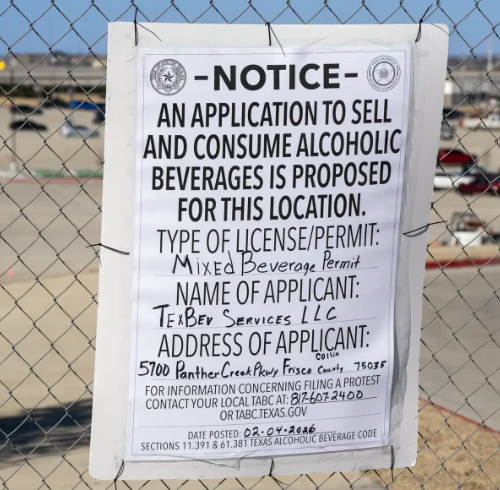
TexBev Services LLC listsJason Young as the manager and United States Corporation Agents, Inc., as the agent
Donny Churchman, Jason Young’s business partner and self-proclaimed “lobbyist for the Building Industry,” appears to have been a smart friend choice for Young. Churchman’s company lists were too long to share here. The question has been asked is his hand in the development of downtown Frisco deserves closer public review. You can mosey on over to OpenCorporates.com for the full breakdown.
Next step, compare the names of the business to the minutes for City of Frisco meetings, boards and commissions. Would we find any connections?
The Grant
The Frisco Community Development Corporation, or FCDC, offers the Rail District Reinvestment Grant Program. Based on the description of the program, it provides matching grants of up to 50% of private investments, with a maximum of $300,000 per project, to property owners and businesses.
The city states the program “aims to enhance the built environment of the Rail District” through partnerships with property owners and businesses. Another document states the overall goal is to enhance the architectural character, economic viability, and pedestrian experience in Frisco’s historic downtown. But what is the primary intent of the grant?
Well, according to the city website the grant’s PRIMARY INTENT is “to improve the architectural character and pedestrian experience of the Rail District through matching grants for building façades, streetscapes, and social spaces like patios and courtyards.”
The Connection: Found In The Agenda Details
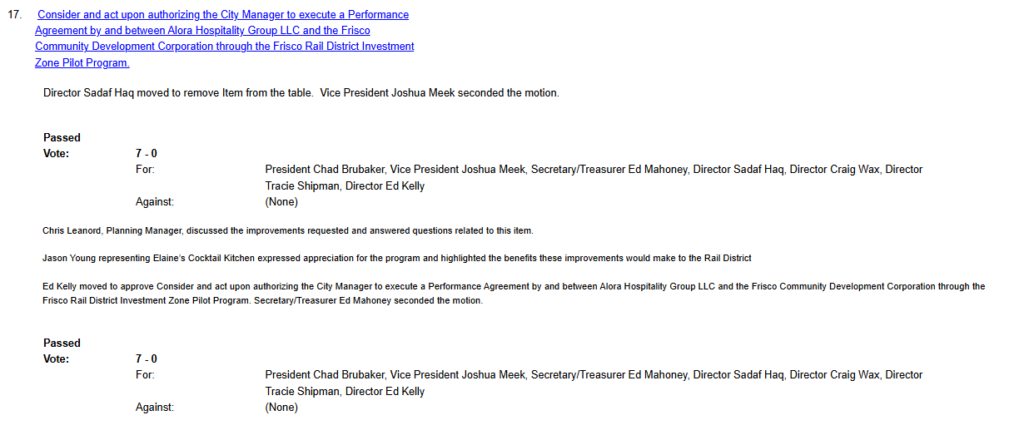
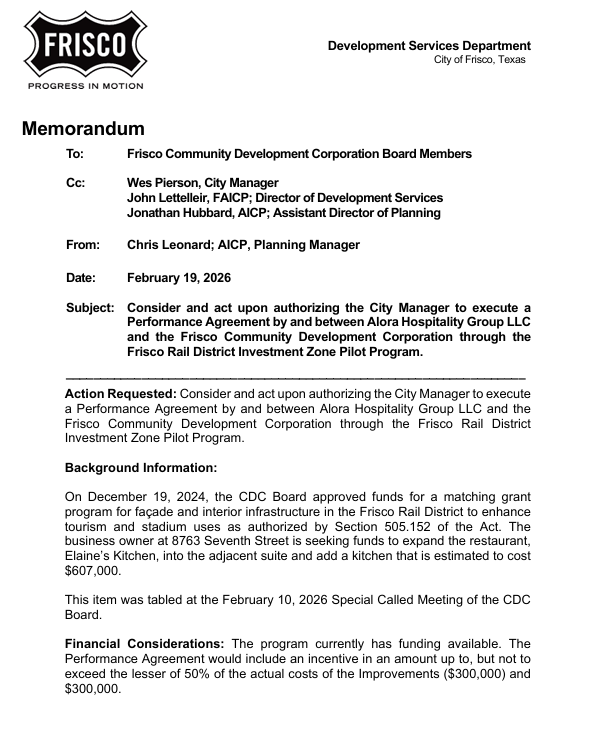
While doing research, comparing Young’s company names to City of Frisco agenda and minutes – we found a connection! Surprise, surprise. Well, not really. The connection is item #16 in the agenda for the Frisco Community Development Corporation on February 19, 2026. It reads,
According to the minutes posted on this city website, Chris Leanord, Planning Manager, discussed the improvements requested and answered questions related to this item. Jason Young representing Elaine’s Cocktail Kitchen expressed appreciation for the program and highlighted the benefits these improvements would make to the Rail District. Ed Kelly moved to approve, and Secretary/Treasurer Ed Mahoney seconded the motion. The item was passed unanimously in a 7 to 0 vote by President Chad Brubaker, Vice President Joshua Meek, Secretary/Treasurer Ed Mahoney, Director Sadaf Haq, Director Craig Wax, Director Tracie Shipman, and Director Ed Kelly.
The Big Question
When downtown restaurants were hurting, falling into debt, and losing their businesses, why did Jason Young’s new business, Elaine’s Kitchen, allegedly receive one of these Frisco CDC $300,000 grants for a kitchen remodel?
Remember the Tier 1 core details of the grant program appear to include:
Eligible improvements: exterior building enhancements, streetscapes, patios, courtyards, interior improvements, and upgrades to building safety systems.
Match structure: reimbursement of up to 50% of approved development expenses after the project is completed.
Target area: restricted to properties located within the designated Old Town Commercial Zoning Boundary/Rail District Grant Zone.
Frisco Chronicles has to ask the qeustion: How does an alleged $300,000 reimbursement from the Frisco CDC for a remodeled kitchen fall under those rules?
Which other merchants in downtown Frisco were able to take part in this program?
Nepotism Running Rampant
Look at the list of names who voted for Jason Young to receive this grant. Then look at his social media and you will see these are not just Frisco CDC Board members but many of them appear to be good friends and political allies of Jason Young.
It leads one to ask, is that not the definition of “conflict of interest” and nepotism?
Imagine that money being used to help suffering merchants instead of allegedly reimbursing Jason Young’s kitchen remodel.
Who is Chef Nick? According to OpenCorporates, Dominic Sean Parks Jr. owns Chef-Nic Catering LLC. He is listed as the Director and Agent.
Frisco Chronicles also received information that Chef Nic, who provides meals and some catering for the city, may allegedly have the Universal Kids contract for his services.
The Famous or Infamous Jake Petras
While we are at it, Jake Petras, former Frisco P&Z commissioner, good buddy, and keyboard warrior of Jeff Cheney, appears to have allegedly cashed in as well. If my memory serves me right, Jake was allegedly down on his luck and facing serious personal financial stress, an impending divorce and that his alleged lover, former Frisco ISD President Renee Archambault, may have been strained at the time.
Jake’s company, LMIF Real Estate, LLC, where he serves as director, appears to have scored big last fall. According to the August 5, 2025 Frisco City Council Agenda Item #33, the applicant LMIF Real Estate, had a request to repeal Ordinance No. 18-10-56 consisting of 80.1+ acres on the southwest corner of Mahard Parkway and University Drive to AMEND the Zoning Ordinance to REZONE the property as Planned Development-271-Office-2/Retail/Residential, and to consider to direct Staff to prepare an Ordinance of the same.
Guess what, it passed 6-0. Could this be another example of nepotism or quid pro quo?
Zoning Case No. Z24-0002. Applicant: LMIF Real Estate, LLC. (Development Services/JH) Reference Links:
Another example of alleged Nepotism maybe the recent “warehouse” deal that upset our Richwoods community. We learned some interesting, alleged connections but we will talk about that in our next blog post – so stay tuned on that.
In Closing
I would like to know how many other contracts may have been awarded to the same friends of Cheney and other committee members. In Frisco, the question is no longer whether favoritism exists — it’s how comfortable city leadership has become with it. When grants, opportunities, and city-backed incentives repeatedly seem to land in the laps of those with the right relationships, the public starts to notice a pattern.
The average business owner filling out paperwork, paying taxes, and trying to compete fairly deserves to know the playing field isn’t tilted toward insiders with direct lines to City Hall. Yet time and time again, residents are left wondering whether qualifications matter less than connections. If you know the mayor, attend the right events, donate to the right campaigns, or move within the right circles, does the red tape suddenly disappear? Do the rules become “flexible”? Does public money somehow become easier to access?
That perception alone is dangerous. Government runs on public trust, and once citizens begin believing there are two sets of rules — one for insiders and one for everyone else — confidence erodes quickly. Transparency becomes theater. Accountability becomes selective. And taxpayers begin asking whether city programs are truly designed to benefit Frisco as a whole… or simply reward the politically connected.
Frisco deserves leadership that serves residents, not networks. Because when special treatment becomes standard operating procedure, it’s no longer economic development — it’s a country club with taxpayer funding. And in Frisco, membership appears to have its privileges.
Disclaimer
This article is written as opinion, commentary, and personal interpretation based on publicly available records, meeting observations, agenda materials, and information gathered from community sources. Any statements involving motives, intent, conflicts of interest, contracts, relationships, or behind-the-scenes activity should be understood as alleged, suspected, or maybe opinion unless directly supported by cited public records. Readers are encouraged to review the linked materials, attend public meetings, request records, and form their own conclusions. Nothing in this article should be interpreted as a final statement of fact about any person’s legal conduct, criminal behavior, or ethical violations.
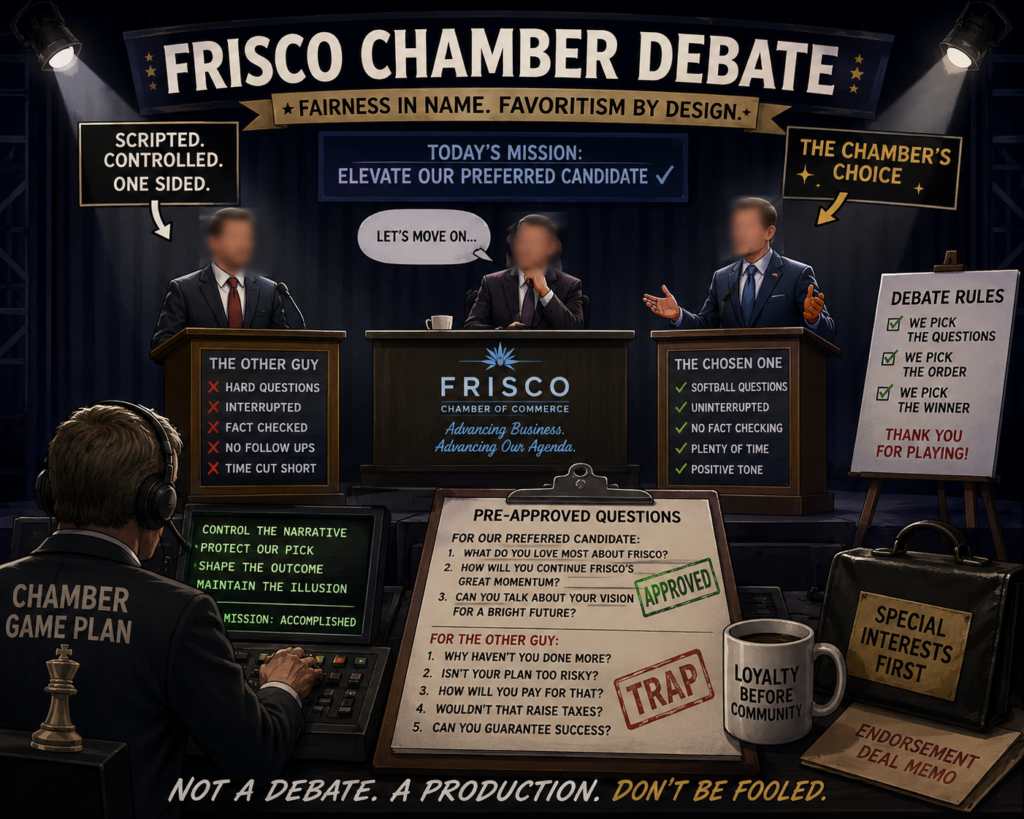
Tonight is the Frisco Chamber Mayoral Runoff Election Candidate Forum at Grace Church located at 5901 Page St near city hall. The Chamber stage lights will glow, the handshakes will flow, and the carefully polished talking points will land right on cue. But longtime Frisco residents have seen this movie before — and unlike Hollywood, the ending is usually written before the curtain rises. Year after year, the Chamber wraps itself in the banner of “community leadership” while quietly signaling which candidate belongs in the club and which one gets left standing outside the velvet rope.
Every year we listen to these debates and every year we have the same feedback sent to us by email.
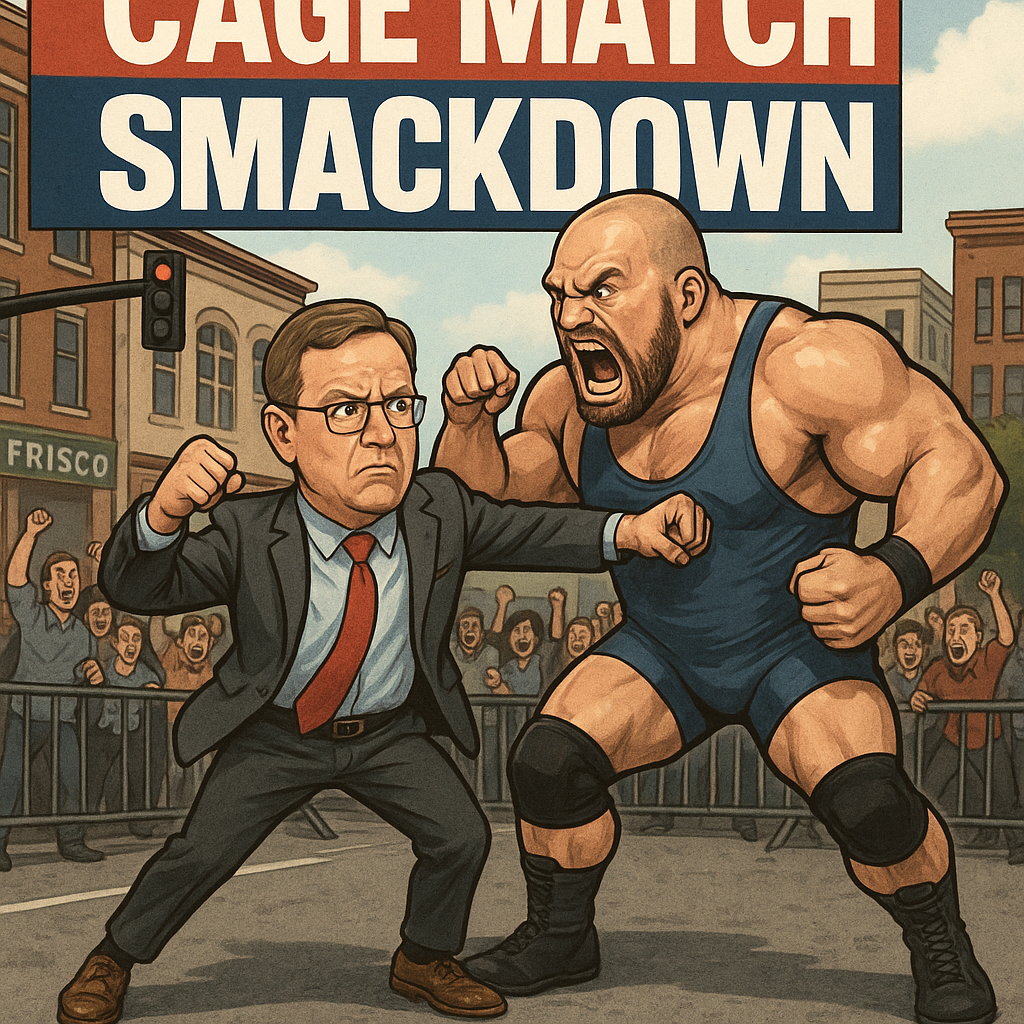
The Cage Match Smackdown
Instead of a debate most of the time the Chamber Forums feel like a coordinated WWE RAW match. If you come expecting civic engagement and balanced moderation, you are about to get body slammed by reality.
Question Controversy
After the last forum we got several emails from residents, and they had strong feelings about the forum’s questions. The complaints included:
Questions are too long.
Not enough time for a candidate to answer the question.
Questions are biased to help the “preferred candidate”
Not clear how to use the challenge
Chamber of Complicity
Most residents want to believe the Chamber is an independent organization and the questions will be fair and balanced, but that is far from reality. In 2024, we wrote about the Election Fix related to the Fire Fighters Association propositions on the ballot. The Chamber allowed Councilman Bill Woodard and representative for the Safety First Frisco PAC ten minutes to speak to residents on why they should VOTE NO to the propositions on the ballot. However, they did not allow the Frisco Firefighters Association to speak, refute, or reply to the statements made by Woodard. This is a forum that goes out residents online via YouTube and the Chambers social media platforms, yet they did not let us hear both sides of an issue. The Frisco Chamber also sent out two email blasts, one in March, and one April of that year before the election to local business and members advocating, they Vote No!
The action they took effectively removed the Chamber as an independent voice on local issues. The bias was clear and showed the Chamber “FIX” was in!
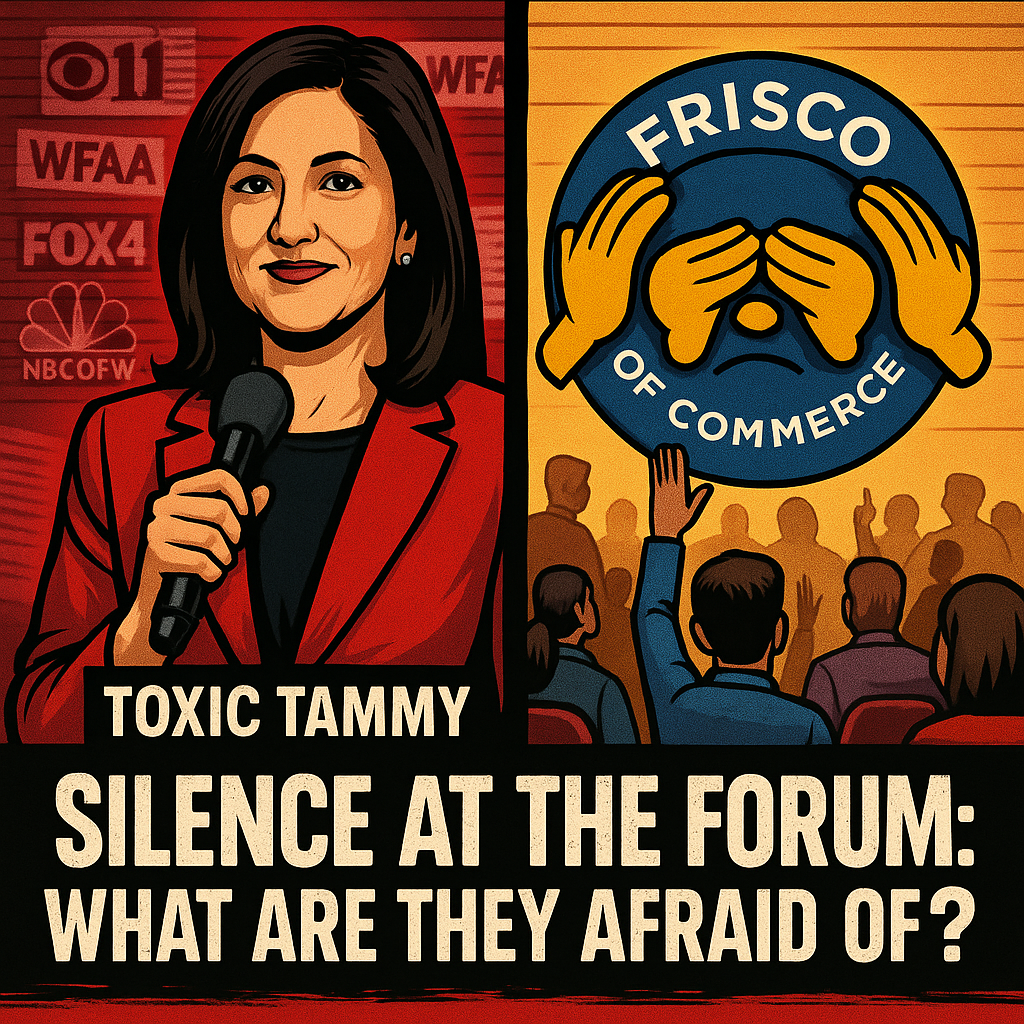
Then in 2025, after the Tammy Tapes were released and made headline news across the DMN, CBS11, WFAA, Fox4 and NBCDFW, one would expect the Chamber to ask Tammy Meinershagen a question about the tapes, but no. While everyone waited on pins and needles for the Chamber Team to ask the big question, they never did. Silence like it never happened.
At the Chamber Forum in 2023, where Mark Piland ran against Mayor Jeff Cheney, the Chamber team specifically asked Mark Piland about a false story that was planted in the DMN by the city to destroy his character just before early voting again. They went as far as asking Piland about a direct quote in the article. The point of this question was to push votes towards Mayor, Jeff Cheney! In fact, the audience booed that night at the question, letting the Chamber know they felt it was unfair and biased.
Again, this is proof the Chamber “FIX” is in, and they are lean towards a preferred candidate. It has happened year after year so if residents are expecting anything different this year, it won’t.
Closing Thoughts
The Chamber stage lights will glow, the handshakes will flow, and the carefully polished talking points will land right on cue. But longtime Frisco residents have seen this movie before — and unlike Hollywood, the ending is usually written before the curtain rises. Year after year, the Chamber wraps itself in the banner of “community leadership” while quietly signaling which candidate belongs in the club and which one gets left standing outside the velvet rope.
By the time the night is over, voters won’t just hear answers from candidates — they’ll see where loyalty truly lies. Watch it closely. Pay attention to who gets protected, who gets interrupted, who gets the softball questions, and who suddenly finds themselves walking into an ambush disguised as “civic engagement.” In Frisco politics, the fix is rarely announced out loud. It’s orchestrated through subtle nods, selective outrage, and a well-connected machine that has perfected the art of appearing neutral while picking favorites behind the curtain.
And if history tells us anything, we should expect at least one underhanded surprise before the final applause. In Frisco, political theaters don’t happen by accident, they are calculated and planned – you’ll see!
Disclaimer: This blog includes satire, parody, and comic relief. It contains summarized accounts created solely for humor and commentary. Any resemblance to real events is either coincidental or intentionally satirical. Reader discretion — and a sense of humor — are advised.
There is a difference between political disagreement and online obsession. In the age of Facebook gladiators, neighborhood watchdog pages, and keyboard constitutional scholars armed with Canva graphics, the line can get blurry fast. But lately, several Frisco residents have been asking a serious question about local physician Dr. Matt Rostami and his increasingly aggressive online commentary aimed at Frisco mayoral candidate Rod Vilhauer.
The concern is not simply that a doctor has political opinions. Doctors are citizens. They vote. They argue. They post memes just like everyone else. Some even discover Facebook Live and suddenly believe they are one podcast microphone away from becoming the next Joe Rogan.
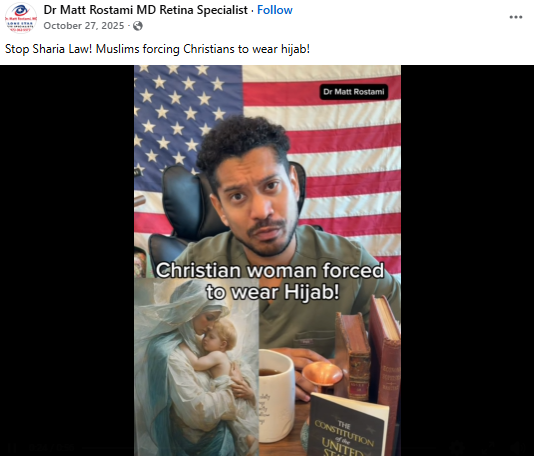
Rostami’s online political presence is not new. Here are just a few posts sent to us by readers.
Video of Dr. Matt Rostami mocking the need to stop Sharia Law and making Christian woman to wear a Hijab. He specifically points out a woman named “Mary” who is holding a baby a reference to the bible. He goes on to say in our country Freedom is showing your butthole and cleavage because sharing is caring.
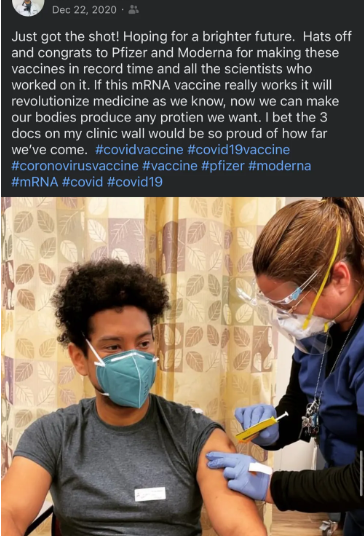
Current Revolt called out Dr. Matt Rostami for being a Democrat in disguise. He claims to be a Republican, but his voting Record says otherwise from what we can tell and Current Revolt called him out about it. We also noticed that he supported the vaccines during Covid which is odd for a Republican.
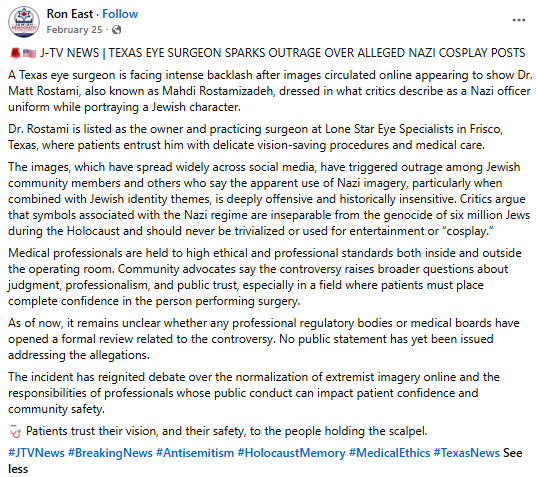
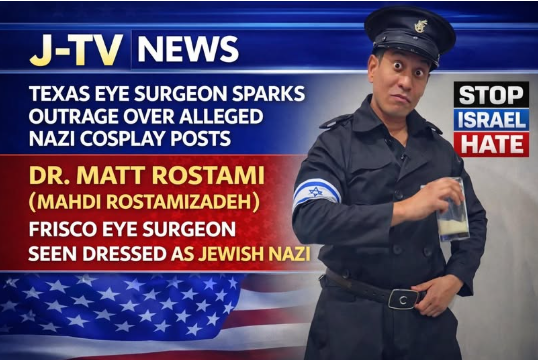
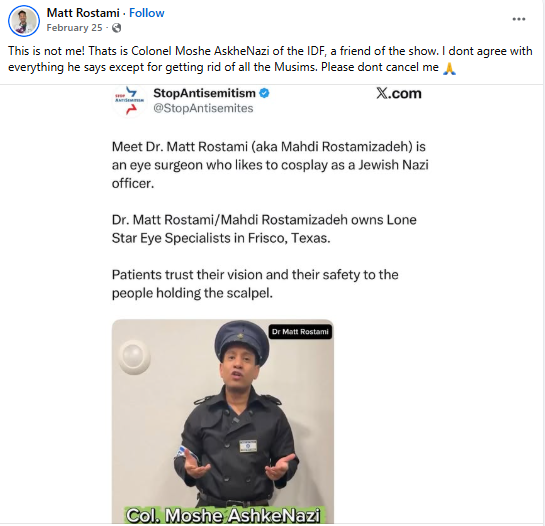
Then there is a post showing Dr. Matt Rostami dressed up in cosplay as a Jewish Nazi Officer. After it was posted he later mocked it, and in the words of Shaggy allegedly said, “it wasn’t me.”
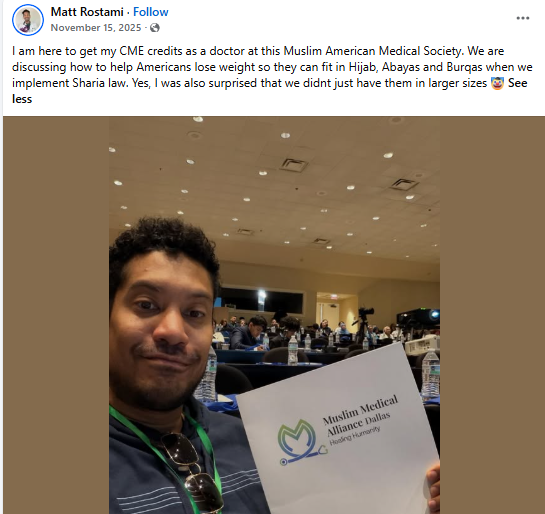
In another post, Rostami holds up a Muslim Medical Alliance folder and mocks obese woman saying “I am here to get my CME credits as a doctor at this Muslim American Medical Society. We are discussing how to help Americans lose weight so they can fit in Hijab, Abayas and Burqas when we implement Sharia law. Yes, I was also surprised that we didn’t just have them in larger sizes (clown face emoji).
The Concern
The concern being raised by residents is whether Dr. Rostami’s online behavior has crossed from political speech into something more concerning: harassment, intimidation, or conduct unbecoming of a licensed physician.
And perhaps the biggest mystery of all: why did it take nearly an entire day to even locate his Texas medical license?
The Name Game
Here is where the story starts feeling less like a medical directory and more like a witness protection subplot from a late-night cable drama.
Most Texans searching the Texas Medical Board database would naturally type in “Matt Rostami.” That search does not easily lead to his medical credentials because “Matt Rostami” is not his legal name.
According to Texas Medical Board records, Dr. Matt Rostami’s legal name is Dr. Mahdi Rostamizaden, and his Texas medical license is listed as #R2723.
To be clear, physicians are not generally required to publicly advertise their license numbers on websites or social media. Texas law typically allows doctors to practice and advertise under a professional name, practice name, DBA, or commonly used name. Nothing illegal there.
Still, some residents found it odd that locating the license information required what felt like a forensic accounting team, three cups of coffee, and the determination of a true-crime podcast listener.
What Does the Texas Medical Board Actually Regulate?
This is where things become important — and nuanced.
The Texas Medical Board does not regulate political beliefs. A physician can support a candidate, oppose a candidate, criticize policy, or post unpopular opinions online. The First Amendment protects a tremendous amount of speech, including speech many people dislike.
Texas law does not create one single “social media behavior statute” for physicians. Instead, physician conduct is regulated through broader standards found in the Texas Occupations Code and Texas Administrative Code involving:
Professional ethics
Dishonorable conduct
Conduct likely to deceive, defraud, or injure the public
Impairment issues
Harassment or threatening behavior
Professional character requirements
The board has previously disciplined physicians over online conduct, including inappropriate Facebook activity and harassment-related behavior. The key legal question is not whether someone is rude, loud, politically charged, or unpopular, but the threshold is evidence.
Not gossip. Not rumors. Not “he seems weird online.” Evidence.
When Does Free Speech Become Harassment?
That is the million-dollar constitutional question.
A physician posting criticism about a political candidate is protected speech. Even harsh criticism usually remains protected. At Frisco Chronicles we know where that line is and we do stand to protect it. The question is should those rules be different for licensed professionals in some categories.
If conduct escalates into targeted harassment, threats, stalking behavior, intimidation, discriminatory conduct, or actions suggesting impaired judgment that could affect patient safety, the equation changes dramatically.
Several Frisco residents who contacted Frisco Chronicles expressed concern that Dr. Rostami’s posts have become increasingly inflammatory and intensely focused on Vilhauer.
One resident wrote:
“The public rhetoric has become increasingly inflammatory.”
Another questioned whether the fixation had crossed into “stalking territory.”
To be very clear, those are serious accusations. We want to make sure folks understand these are opinions — not legal findings.
A skeptical observer might reasonably ask whether the behavior reflects the professional judgment expected from someone entrusted with patient care. But legally speaking, “poor judgment” and “disciplinable impairment” are not the same thing.
That distinction matters.
Because the law does not punish someone simply for acting eccentric online. If it did, half of Facebook would be under federal supervision and Nextdoor would require adult probation officers.
The “Good Professional Character” Standard
Under Texas Occupations Code Chapter 155, physicians are expected to maintain “good professional character.”
Chapter 164 goes further, allowing disciplinary action when a physician is unable to practice medicine safely because of:
illness
drunkenness
excessive use of drugs or chemicals
mental or physical conditions affecting safe practice
Recently, several residents emailed Frisco Chronicles asking whether Dr. Rostami’s online conduct raises concerns about impairment or mental fitness.
To be absolutely clear: there is currently no public evidence proving impairment, substance abuse, or mental incapacity.
However, Texas law does provide mechanisms for investigation if legitimate complaints and probable cause exist.
Under Section 164.053 of the Texas Occupations Code, the Texas Medical Board may request a physician submit to mental or physical examinations if there is probable cause involving professional behavior concerns, substance abuse issues, or mental health conditions affecting safe practice.
If a physician refuses, hearings may follow, during which the physician can present evidence and legal defense.
Again, the standard is not “people on Facebook think he’s acting strange.”
The standard is probable cause backed by evidence.
That is a very high bar — and intentionally so.
Targeting Rod Vilhauer
Perhaps the most comical part of this entire saga is that Dr. Rostami appears to be attacking Rod Vilhauer for a comment made during a podcast that he has later clarified, while Rostami engages in the very same style of online political commentary daily in his regular posts. One day it is “dangerous rhetoric” when Vilhauer speaks bluntly about controversial issues; the next day Rostami is unloading multi-post tirades, inflammatory accusations, taking out political hit pieces in magazines, putting up defamatory road signs, and posting political attacks with the enthusiasm of a late-night cable news host who just discovered espresso. Residents watching this unfold believe Rostami has gone over the line of two people arguing over who is being too loud… through bullhorns. If harsh political speech suddenly qualifies someone as unstable, offensive, or unfit for public discourse, then critics might reasonably ask whether Dr. Rostami’s own Facebook timeline should be entered into evidence as Exhibit A.
Politics, Medicine, and Public Trust
This entire situation raises broader questions that extend beyond one physician or one mayoral race. How much online behavior is too much for professionals entrusted with public safety and public health? Should physicians be held to higher standards in public discourse? At what point does political activism begin damaging public confidence in the medical profession? And perhaps most importantly: in an era where outrage drives clicks, likes, and engagement, are some people simply losing the ability to log off?
The internet has transformed ordinary citizens into full-time broadcasters. Every grievance becomes a livestream. Every disagreement becomes a crusade. Every Facebook thread becomes Gettysburg with emojis. But physicians occupy a unique place in society. Patients trust them with life-altering decisions. That trust depends not only on medical competence, but also on public confidence in their judgment.
The Texas Medical Board understands that balance. That is why it generally avoids policing mere political opinions while still maintaining authority to investigate conduct that may genuinely endanger the public or reflect professional impairment.
For now, Dr. Rostami’s conduct remains largely a matter of public debate — not public discipline.
But one thing is certain: when residents begin asking whether a Doctor’s Facebook feed belongs in a campaign office, a courtroom, or a psychiatric evaluation request, the conversation has already moved far beyond ordinary politics.
For legal purposes we must post this Disclaimer: This blog includes satire, parody, and comic relief. It contains summarized accounts created solely for humor and commentary. Any resemblance to real events is either coincidental or intentionally satirical. Reader discretion — and a sense of humor — are advised.
Frisco Chronicles has no issue questioning city leadership and department leadership because I believe someone must speak for the front-line employees. Why? It is the front-line employees in each department that do the day-to-day work which keeps our city great. Every time I hear from an “insider” it is the same story, different department.
We have heard about nepotism running rampant, leadership involved in sexual affairs, toxic work environments, and much more. The truth is our city needs a good “SPRING CLENAING” in top management and department leaders. Why? To protect our front-line workers who feel the brunt of their failed leadership.
The last two weeks we have received several emails related to City Manager, Wes Pierson. The emails talk about how Pierson leads with hostile and condescending behavior. One email noted he consistently speaks down to staff, direct reports, and his executive team. It went on to say his condescending behavior and communication style undermines the morale across all city departments. Residents have seen this behavior up front and center at city council meetings.
The emails also talk about how employees feared professional retaliation if they file a complaint with HR against department or city leadership. The minute a complaint is filed the city begins actions to end that employee’s employment through any means necessary. That includes making up issues or actions to use against the employee.
We know in a recent meeting with public safety officials he questioned if the Fire Department really needed “ladder trucks” which shows his operational ignorance. Clearly his questioning shows a lack of operational infrastructure needed for basic emergency response. His dismissive attitude towards critical public safety equipment poses a direct threat to our communities welfare.
One email talked about staff development and how Pierson actively blocks the implementation of employee progression and career development. The city constantly changes care development plans to hold employees back.
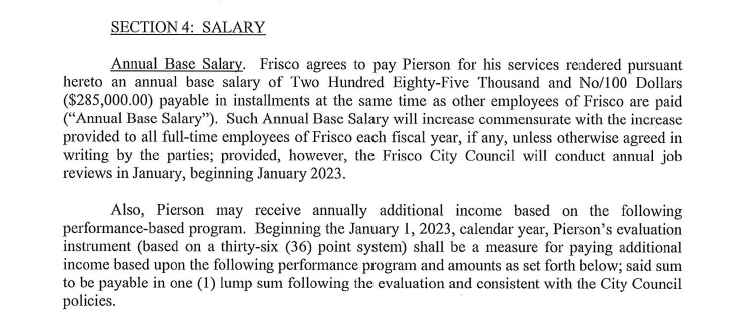
This kind of behavior from one of the highest paid city managers in the nation is unacceptable. There is a severe contrast between his massive compensation package and his refusal to invest in staff progression which behind closed doors is crippling city operations. One email said a third-party investigation into management practices is needed to protect city employees and residents. It is the only way to ensure responsible governance.
When I receive one email I take it as employee frustration, but when I receive 3 in one week from different employees, different departments then it tells me there is an issue at city hall. That issue starts at the top with Wes Pierson as he sets the tone that flows downhill.
Disclaimer: This blog includes satire, parody, and comic relief. It contains summarized accounts created solely for humor and commentary. Any resemblance to real events is either coincidental or intentionally satirical. Reader discretion — and a sense of humor — are advised.

I went to her to ask for help with an issue my child that was getting nowhere with the school,…
So whatever became of the $17 million dollars that the city council gave the Mayor to beautify a drainage ditch?
At last count, there are 3 different "spa/massage" businesses in the small office park at the northeast corner of John…
I literally just saw this. Yeah, she used to forward everybody’s emails behind their backs.
You're dropping truth bombs! These mom and pop shops are what should be the least of Karen's worries. If they…