When Frisco Chronicles began, we had one core mission: to question power, city officials, elections and development deals. Narratives that don’t quite add up. What we never signed up for—and will never tolerate—is racism or cultural hate.
Let me be clear: While I disagree with certain council members. I strongly disagree with some of their decisions, I do not hate them. A difference of opinion, a difference in skin color, a difference in religious beliefs is not dangerous and criticism does not mean we hate someone or wish bad things for them.
What unfolded during citizens’ input at tonight’s Frisco City Council meeting should alarm every resident, regardless of political stripe or which side of the dais you usually sit on. What we witnessed wasn’t accountability—it was fearmongering, and in some cases, outright cultural hostility.
How Did We Get Here?
Two weeks ago, Marc Palasciano—known publicly as the so-called “T‑Mobile Whistleblower”—addressed council during citizens’ input, as he often does. His remarks jumped rapidly between topics: alleged H‑1B visa scams, national layoffs, CEOs selling stock, campaign finance questions involving Mayor Jeff Cheney, and finally, claims of an “Indian invasion.”
He also falsely accused Burt Thakur of using a corrupt consulting firm—an accusation later confirmed to be untrue.
Here’s the problem: these issues were presented as one tangled conspiracy when they are not. H‑1B visa abuse—where it exists—is a national issue handled by federal agencies, not a Frisco City Hall issue. Corporate layoffs and executive stock sales are not municipal policy and have nothing to do with the City of Frisco. Lumping them together and tying them to a specific ethnic community is not civic engagement—it’s narrative manipulation.
Let’s draw a bright line. Questioning your mayor or council about campaign finance reports? Fair game. Asking why donors from outside the city are contributing? Legitimate. But blaming Frisco leadership—or an entire ethnic community—for national immigration issues crosses from oversight into scapegoating.
Fear Has Consequences
The rhetoric from two weeks ago lit a fuse. Tonight, that fuse exploded into the council chamber. We heard heartfelt, measured statements from Indian community leaders—messages rooted in fear, concern, and love for the city they call home. Unfortunately, we also heard remarks that veered into open hostility and cultural resentment.
That is not who Frisco is. And it is certainly not who we should want to become.
Growth Is Not the Enemy—Bad Planning Is
Has Frisco’s Indian population grown over the last 20 years? Absolutely. So has the population of just about everyone else. Frisco is a modern American boomtown—a textbook melting pot. That diversity is not a flaw; it’s one of the city’s greatest strengths. Traffic congestion, infrastructure strain, and overcrowded schools are not the fault of Indian families—or any families moving here. Those issues stem from leadership choices that prioritized splashy development wins over long-term planning. Growth without foresight breeds resentment. Growth with competent governance builds momentum.
Let’s Talk Facts, Not Myths
There is no single, official statistic that says, “X number of people have been arrested for H‑1B visa scams.” Immigration fraud cases are handled across multiple federal agencies and jurisdictions and are usually bundled into broader enforcement data. Could visa fraud occur in Frisco? Sure—just like it could in Plano, Phoenix, or Peoria. Does that mean an entire community or culture is corrupt? Absolutely not.
If you suspect fraud, report it. That’s how a system of laws is supposed to work. What you don’t do is paint thousands of your neighbors with the brush of one allegation.
What the Indian Community Brings to Frisco
A larger Indian population is not a threat to a city. The benefits are real, measurable, and often ignored.
Economic Horsepower
Indian immigrants—particularly since the 1990s—disproportionately work as engineers, physicians, IT professionals, and entrepreneurs. That translates into higher household incomes, higher homeownership rates, and the creation of new businesses: restaurants, clinics, consulting firms, and tech startups. Most importantly, it strengthens the local tax base. Cities with growing Indian populations often see property values stabilize or rise—not decline.
Educational Lift
Indian families place a relentless emphasis on education. Like it or not, this shows up in outcomes: strong PTA involvement, pressure for improved math and science programs, expanded AP offerings, and higher overall school performance that benefits all students—not just Indian students.
Small Business Density
Indian Americans are builders, not just employees. Their businesses revive strip centers, activate underused commercial spaces, and add vitality to local economies.
Civic Stability
Indian immigrants and Indian Americans tend to be law‑abiding, politically moderate, and focused on long‑term settlement. They buy homes. They stay. They invest—in neighborhoods, schools, and community institutions.
Are There Challenges? Of Course.
Cultural clustering can sometimes slow broader integration. That’s not unique to Indians—it’s a universal human behavior. The solution isn’t resentment; it’s engagement. Community events, cross‑cultural dialogue, and leadership that encourages unity instead of division. Bad governance turns growth into anger. Good governance turns it into shared progress.
The Bottom Line
We are not losing Frisco’s identity—we are adding layers to it. These are our neighbors. They are not going anywhere. And frankly, that’s a good thing. I know many Indian families in Frisco. I find them thoughtful, hardworking, respectful, and deeply invested in this city. Like anyone else, they want safety, opportunity, and respect.
And while it may surprise some readers—no, hell has not frozen over—I will give credit where it’s due. Burt Thakur made some amazing points tonight in his speech and Mayor Jeff Cheney’s closing remarks tonight were exactly right. Frisco must remain open, welcoming, and unapologetically inclusive. We teach our children love, not fear. We protect our neighbors, not target them. This is not what we should be teaching our youth.
One speaker said it best when she said diversity is like a quilt. Tons of different fabrics sown together to create a beautiful quilt or art. Diversity isn’t Frisco’s weakness. It’s one of the reasons this city works. Frisco belongs to everyone who calls it home.
Disclaimer: This blog includes satire, parody, and comic relief. It contains summarized accounts created solely for humor and commentary. Any resemblance to real events is either coincidental or intentionally satirical. Reader discretion — and a sense of humor — are advised.
Former City Councilman Bill Woodard announced on his old Bill For Frisco Facebook page a change in a Dec 3, 2025, post. He is now going to become the Frisco Dog watching over everything around town. The post reads “after many months of a social media break, I find myself wanting to provide some thoughts and opinions on a variety of topics, Frisco related. He goes on to say this page won’t be for everyone, that’s ok. It is his take on the goings around town. He makes sure to point out this page is not for anonymous posters or run by an anonymous person.
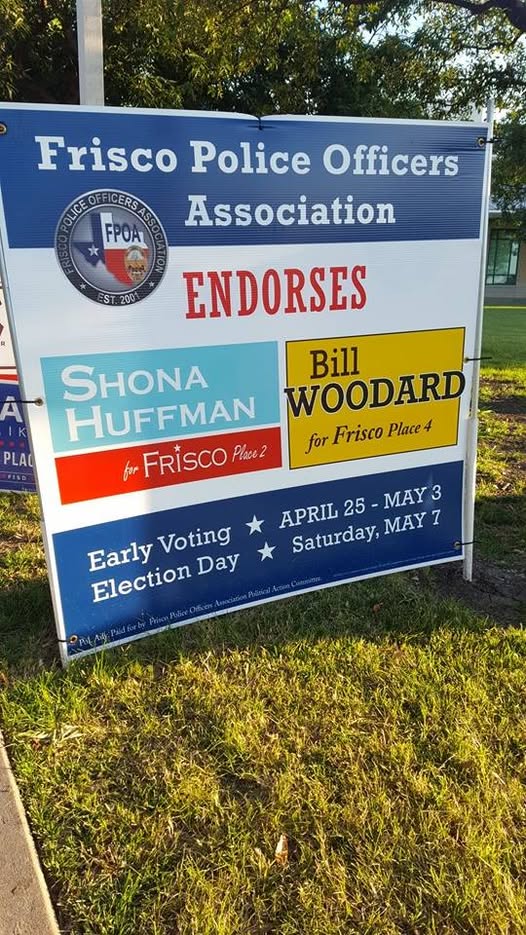
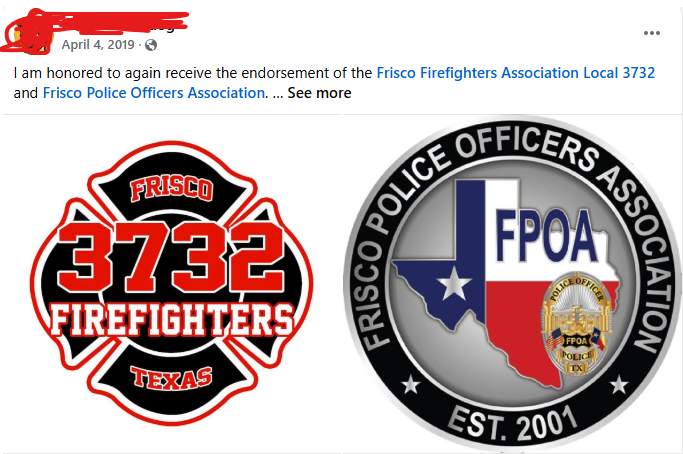
Since the conception of his opinion page he has done nothing but attack the two new council members with his sidekick Tracie Reveal Shipman. In one post from Dec 11, 2025, he goes after Jared and Burt for both accepting an endorsement of the Frisco Fire “Association” which Woodard claims is a union. The post goes on and on in the famous dull Woodard style, but it leaves out one very IMPORTANT THING. WOODARD WAS ENDORSED BY THIS SAME ASSOCIATION.
Why was it not a problem when Woodard accepted the endorsement? Why was it not a problem when his counterparts like Cheney accepted the endorsement? It is only a problem when it is candidates he doesn’t like to get endorsed by the ASSOCIATION. Then the ASSOCATION is a UNION and is BAD!
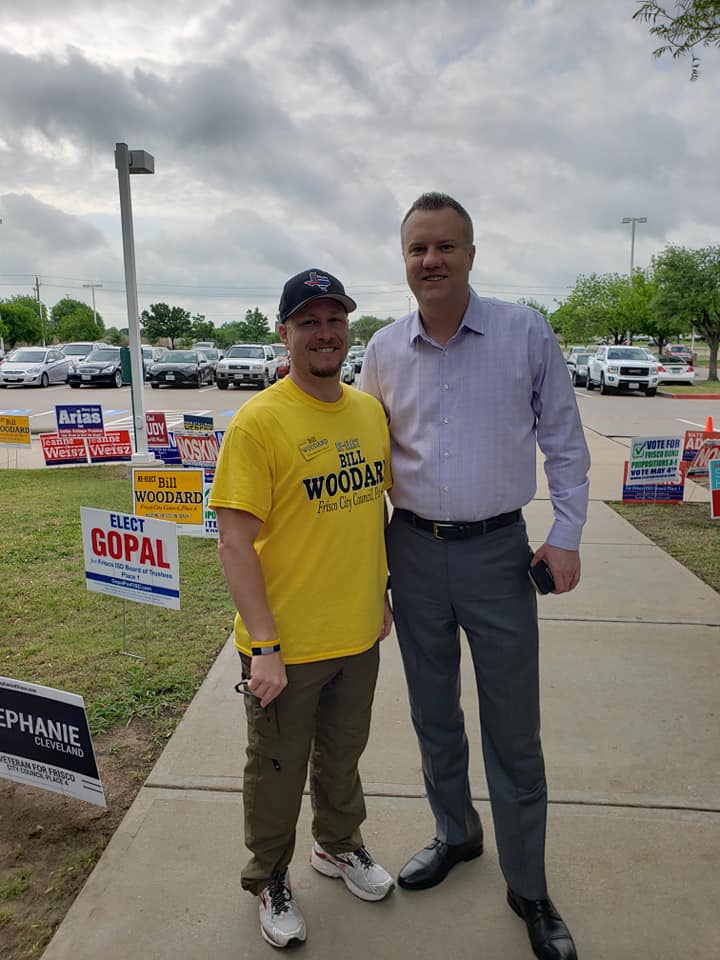
Simply put, it was Woodard’s way of trying to discredit the endorsement by the association that he openly had no issue accepting the same endorsement and money from before (see picture from his page above). He just simply didn’t like who they endorsed this time. It was outside the Frisco Cabel which is a no, no – you don’t cross the Cabel.
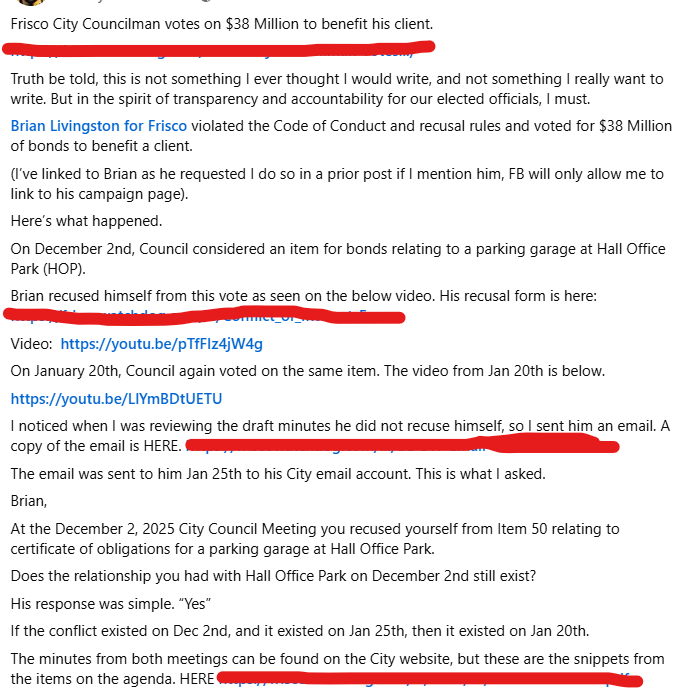
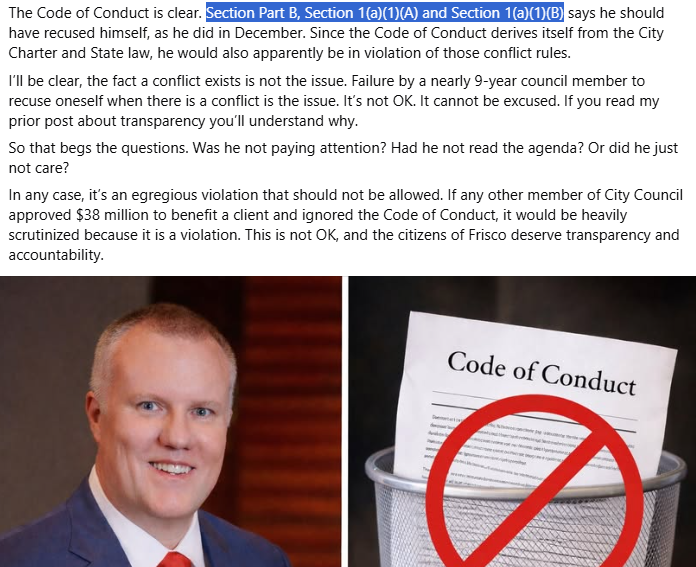
Fast forward to January 31 Bobble Head Bills new blog page writes on an attack on Councilman Brian Livingston accusing him of violating the Code of Conduct, Section Part B, Section 1(a)(1)(A) and Section 1(a)(1)(B) which says he should have recused himself from a specific vote. He calls Livingston’s vote on January 25th an egregious violation.
We reached out to Councilman Livingston via his email and asked him why did he initially recuse himself, was it needed or did he do it out of an abundance of caution?
Then we asked why he did not recuse himself the second time? Mr. Livingston responded to our questions with the following,
“The recent statement published by former City Councilman Bill Woodard stating that I violated the Code of Conduct and/or “recusal rules” related to the recent Frisco City Council votes to provide $38 million in bonds for a parking garage in Hall Office Park is without merit.
After receiving feedback and upon review of my reasoning for my prior recusal, I don’t believe that my recusal related to this subject has at any time ever been legally required. My prior recusal was done only to avoid any appearance of a conflict of interest or impropriety claims.
Furthermore, after reviewing my prior recusal, I don’t believe that any appearance of a conflict of interest or impropriety would exist when looked at by a neutral 3rd party.
I should have realized that Mr. Woodard’s email to me was not an innocent question, but it lacked any question related to a potential concern of a conflict of interest existing.
In hindsight, I wish I would have made a formal statement of my intention and reasoning behind not recusing myself for the second vote and any future votes related to Hall Office Park. I look forward to the opportunity to discuss this if necessary and assure everyone full transparency.”
It is funny because once, Woodard and Livingston were friends. But since Mr. Livingston stepped out to support candidates who were not approved by the Frisco Cabal he is on the outs with the current council and FORMER COUNCIL MEMBER Bobble Head Bill.
Bill The Attack Dog
So here we are. Bill Woodard, no longer on the dais, but still perched high on the porch—barking at passing cars, mailmen, and anyone who dares step outside the Frisco Cabal’s invisible fence. The self-appointed watchdog who insists his blog is about ethics and transparency somehow only finds ethical outrage when the “wrong people” win elections, accept endorsements, or dare to think independently.
Let’s be clear: this isn’t civic education. It’s selective indignation. It’s a greatest-hits remix of grievances, wrapped in long-winded posts that scold residents while conveniently omitting inconvenient facts—like his own past endorsements, votes, and friendships. Transparency, apparently, is only required of others.
What’s most telling is that when facts don’t support the narrative, accusations fill the gap. Councilman Livingston answered questions directly and publicly. Woodard responded not with reflection, but escalation. Because the goal was never clarity—it was control of the narrative.
Frisco doesn’t need another former official lecturing from the sidelines, deciding who is pure enough to govern and who must be publicly shamed. Residents are capable of critical thought. They don’t need Bobble Head Bill translating local government for them like a condescending tour guide.
At Frisco Chronicles, we’ll continue to be the true guard dog and do what watchdogs are actually supposed to do: ask uncomfortable questions, check the receipts, and call out hypocrisy—no matter whose name is on the byline or how long they once sat on the dais.
Stay tuned. The dog may bark, but we’re watching the whole yard.
Disclaimer: This blog includes satire, parody, and comic relief. It contains summarized accounts created solely for humor and commentary. Any resemblance to real events is either coincidental or intentionally satirical. Reader discretion — and a sense of humor — are advised.
Alright, grab your popcorn —this one has all the makings of a classic Frisco Chronicles feature: money, media, and that familiar scent of roses wafting through the pages of the Dallas Morning News.
All Good in the Frisco Hood: Brought to You by… Medium Giant?
By now, longtime Frisco residents have noticed a curious phenomenon. Whenever the Dallas Morning News (DMN) writes about Frisco, the city sparkles. Streets are shinier. Leadership is visionary. Problems? What problems? If Frisco had potholes, DMN would probably call them “community engagement craters designed to slow traffic and save lives.”
Which raises the obvious question: why does Frisco always smell like roses in the DMN? Not weeds. Not smoke. Roses.
For years, residents have speculated. Maybe DMN is afraid of being cut off from exclusives. Maybe access journalism is alive and well. Or maybe—just maybe—it’s about the oldest motivator in local government and media alike: Money.
Enter Stage Left: Medium Giant
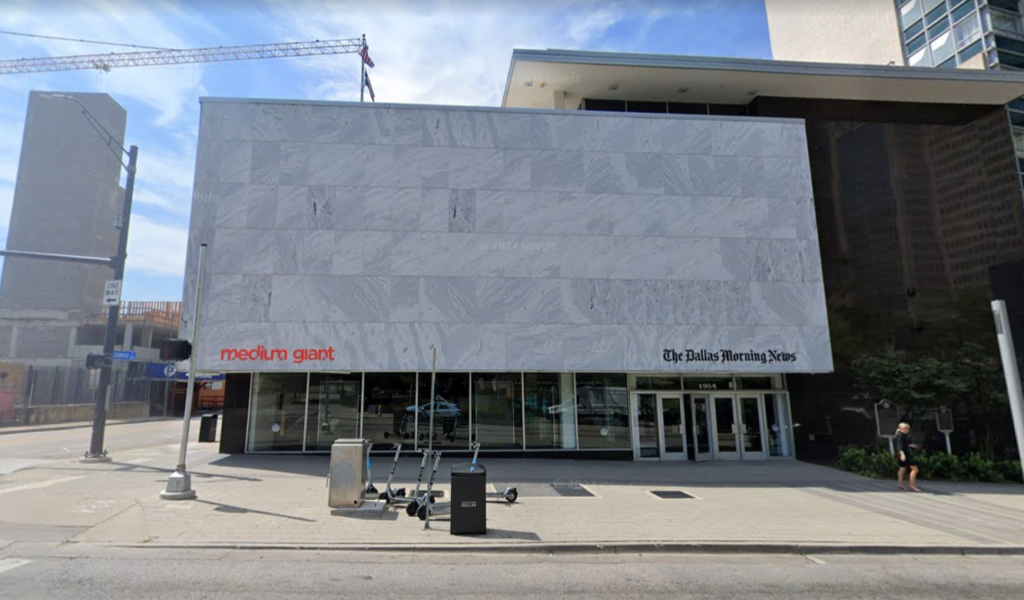
Here’s where things get interesting. A sharp-eyed reader recently connected a few dots that deserve a closer look. The Frisco Economic Development Corporation (FEDC) has entered into several contracts over the years with a company called Medium Giant.
Whose Medium Giant, you ask?
They’re an “integrated creative marketing agency.” Which is marketing-speak for we make things look good. Even better? Medium Giant just happens to be the sister company of the Dallas Morning News.
Cue the dramatic music. So now the question isn’t why DMN never seems to publish critical reporting on Frisco or its leadership. The question becomes: would they dare?
Follow the Money (Because It Always Tells a Story)
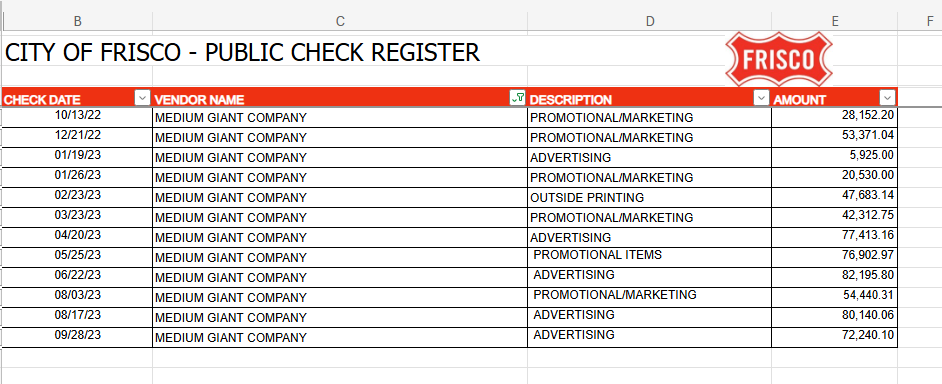
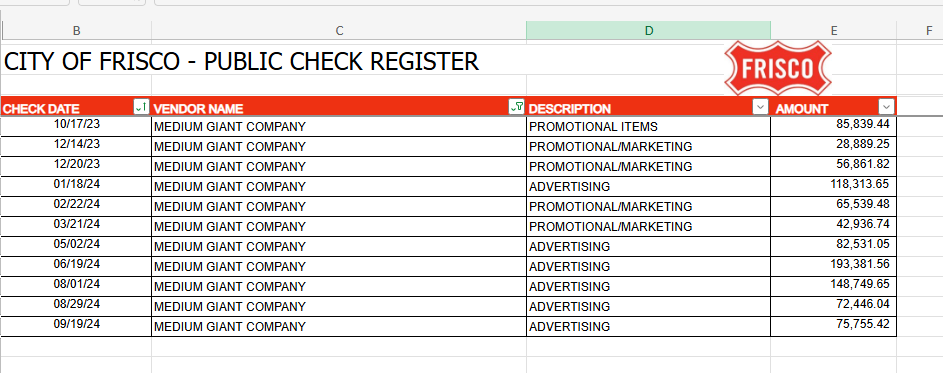
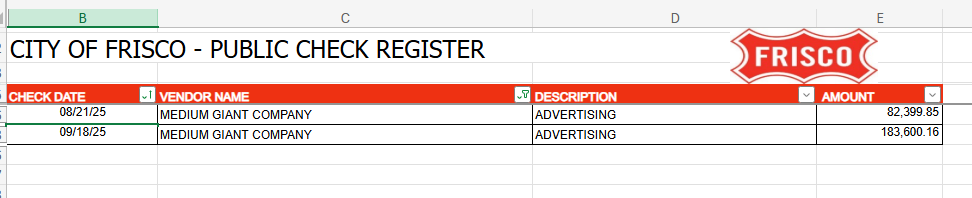
When we reviewed city check registers, we noticed multiple payments over the years made to Medium Giant. Not chump change. Not lunch money. Not “oops, forgot to expense that Uber.”
The total? $2,105,631.76
That’s over two million dollars paid by Frisco entities to a company tied directly to the same organization responsible for shaping Frisco’s public narrative in one of North Texas’ largest newspapers.
Now, we’re not saying this proves corruption. We’re not saying there’s a secret smoky backroom with editors and city staff clinking champagne glasses. We’re not even saying there’s an explicit quid pro quo.
What we are saying is this: If you were the DMN, would you risk torching a relationship connected—directly or indirectly—to a $2 million revenue stream by publishing hard-hitting, unvarnished reporting about Frisco’s leadership, finances, or controversies?
Hit Pieces for Some, Rose Petals for Others
What makes this dynamic even more eyebrow-raising is DMN’s recent track record. The paper has shown it’s perfectly willing to publish aggressive, sometimes glowing-less-than-rose-scented coverage of candidates who fall outside the Frisco inner circle.
Just ask: Jennifer White, Mark Piland, John Redmond
Funny how the gloves come off for political outsiders, but stay neatly folded when it comes to City Hall, current council members, and current city leadership.
Journalism, Marketing, or a Blurred Line?
Let’s be clear: Medium Giant being a marketing firm isn’t inherently wrong. Cities hire marketing agencies all the time. But when the marketing arm and the newsroom live under the same corporate roof, the public has every right to question whether the coverage they’re reading is journalism… or brand management.
Because from where residents sit, the pattern looks less like watchdog reporting and more like: “Frisco: Presented by Medium Giant, distributed by DMN.”
Final Thought
Transparency isn’t just about open records and posted agendas. It’s also about who controls the narrative—and who’s being paid behind the scenes while that narrative is shaped.
Two million dollars isn’t small change. It’s not accidental. And it certainly isn’t irrelevant.
So the next time you read a glowing DMN article telling you everything in Frisco is just peachy, ask yourself: Is this news… or is this advertising with better grammar?
Disclaimer: This blog includes satire, parody, and comic relief. It contains summarized accounts created solely for humor and commentary. Any resemblance to real events is either coincidental or intentionally satirical. Reader discretion — and a sense of humor — are advised.
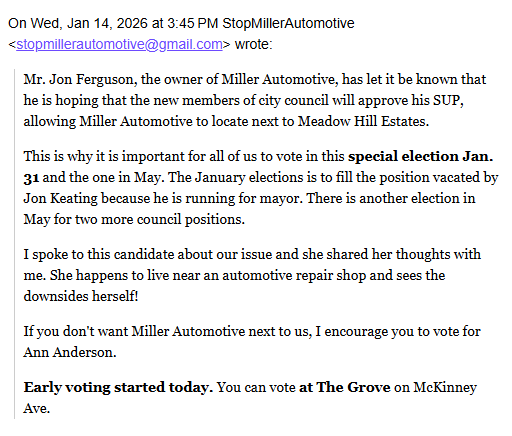
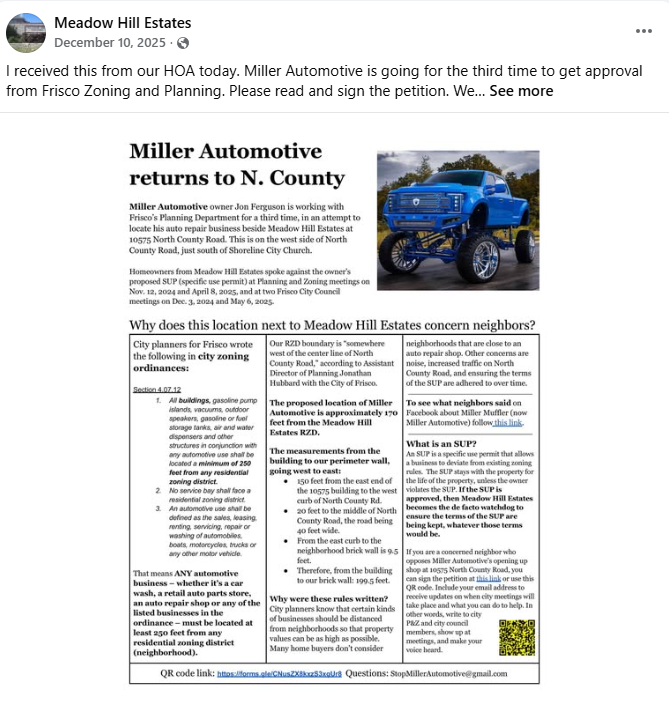
Frisco Chronicles has received multiple complaints from residents of Meadow Hill Estates after an email landed in what appears to be every single email inbox in the community. The message, sent from a Gmail account — StopMillerAutomotive@gmail.com — urged residents to vote in the Frisco Special Election for Ann Anderson.
The writer of the email openly states “I spoke to this candidate about our issue” which is problematic since he never gave the other candidate a chance to share their view on the community’s issue. Based on one conversation with only one candidate you then send an email to your entire community telling them how to VOTE? Did the writer of this email do any research into other projects where citizens objected to something nearby their home and if Ann Anderson supported it.
For example, Universal Kids! Ann Anderson spoke on 2/7/2023 in FAVOR of Universal Studios. She ignored the numerous residents who lived in Cobb Hill and throughout Frisco, that came out and said they did not want a theme park that close to their community because of the noise, traffic and potential crime it could bring. Ask residents today if it has affected their home values in that community and how many Airbnb’s now exist there. She said at the forum the other day we need to be mindful of where we place projects near communities and used the hospital power plant as an example, yet she was in Favor of Universal Kids which is going to have roller coasters looking into people’s backyard! Her words and actions – DON’T MATCH!
That raised an obvious question residents can’t shake: How does a random Gmail account suddenly have the private email addresses of an entire neighborhood?
Not a Guessing Game — It’s a Privacy Issue
Residents aren’t speculating for sport. They’re concerned because there are only a few realistic ways someone could obtain a complete HOA email list:
Through HOA records
Through property management systems
Through board-level access to resident data
Those email addresses are not public information. They are collected for official HOA business, not political campaigning.
From the complaints we received, many residents believe the sender may be a current HOA board member or someone with inside access to HOA records.
The Meadow Hills Estates Facebook Page Raises More Questions
Adding fuel to the fire, residents pointed us to the Meadow Hill Estates Facebook page, which states it is “run by volunteers.” That page has posted about Miller Automotive on December 10, 2025 and several other times throughout the past year.
The overlap between the campaign email content and the Facebook posts has residents asking whether the same individual — or group — is behind both. And if so, how much access do they really have?
HOA Data Is Not Personal Property
Here’s the part that matters most. If a board member obtained residents’ email addresses solely because of their position, those addresses are HOA property, not personal contacts. Using them for anything outside official HOA business — especially electioneering — is widely considered improper and, in many cases, explicitly prohibited.
HOA board members have a fiduciary duty to act in the best interest of the association — not personal political agendas. Using confidential resident data to influence a city election crosses a line that residents say should never be blurry.
Texas Attorney General Complaint Incoming
According to one Meadow Hill Estates resident, a formal complaint is being filed with the Texas Attorney General regarding the use of private HOA data for political purposes. That makes this more than neighborhood drama — it’s a legal and ethical issue.
We Reached Out to 4Sight Property Management
Frisco Chronicles contacted 4Sight Property Management, which oversees Meadow Hill Estates, asking the following: Did your company approve or authorize this email? Do you have rules or policies governing how HOA board members may use resident contact information? What safeguards exist to prevent misuse of confidential HOA data? We are currently awaiting their response and will update readers when one is received.
The Bigger Question
This isn’t about whether someone supports Ann Anderson or opposes Miller Automotive. It’s about trust. Residents trusted their HOA to safeguard their personal information — not turn it into a campaign mailing list. We hope Ann Anderson herself did not know about this email because if she did that it could be problematic also.
Until someone explains who hit “send” and how they had the power to do it, Meadow Hill Estates residents are left wondering whether their HOA is protecting them… or politicking with their privacy.
Stay tuned. Frisco Chronicles will follow this story wherever it leads.
Disclaimer: This blog includes satire, parody, and comic relief. It contains summarized accounts created solely for humor and commentary. Any resemblance to real events is either coincidental or intentionally satirical. Reader discretion — and a sense of humor — are advised.
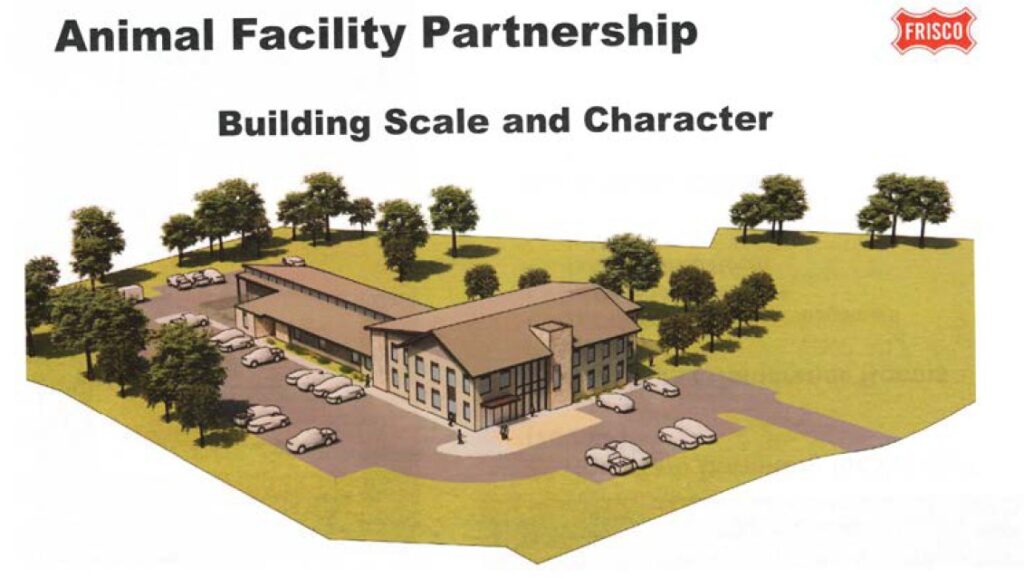
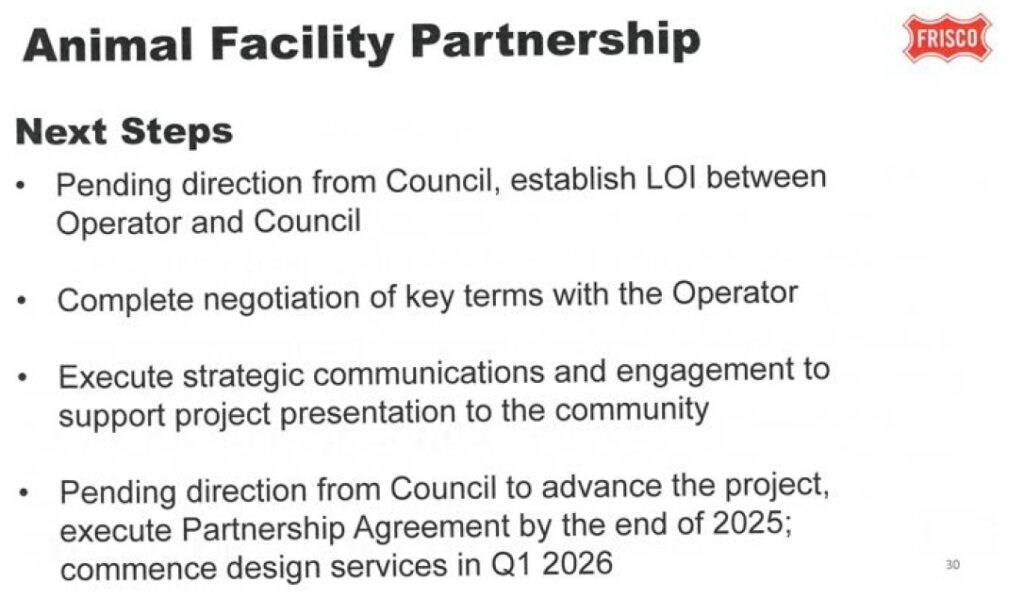
You’ve probably seen the glowing headlines as the local media can’t stop wagging their tails. But behind the news reports that this is GRAND there are Animal Advocates who are growling. From questionable facility operations and designs to compliance and transparency concerns many are asking: Who’s this facility really serving — the animals, or the headlines?
Dana Baird, City of Frisco Communications Director, was right about one thing in her press release “its a first of its kind” but where she was wrong was “in North Texas.” After reading everything sent to us by animal advocates this type of facility with a “private partner” which really means “PRIVATE BUSINESS” has never been done anywhere from our research. Ms. Baird made sure WFAA, her former employer, only reported the “GOOD NEWS” like she usually does.
Yesterday we were cc/d on an email sent to everyone on the City Council, most of the folks in the City Manager’s Office, and almost every news outlet in town (including us). My guess, it won’t be published by any local news outlet because we never anything “bad” published against the city. The email also included several local animal advocates and rescue folks in Frisco.
What was the consensus? They animal welfare folks are growling at the new proposal, and one said to us off the record that “we feel this was thrown up in time for election season and to shut down animal advocates who have been working for years for a full-service animal hub / shelter (not a holding facility).” After reviewing the presentation, we tend to agree! Link for presentation is at the end of this blog!
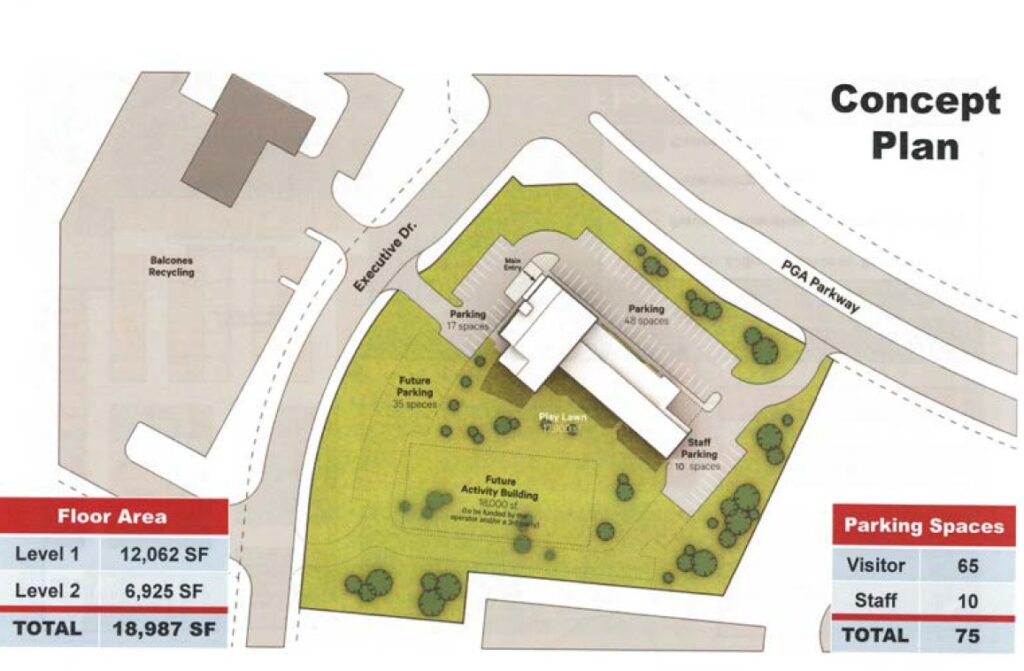
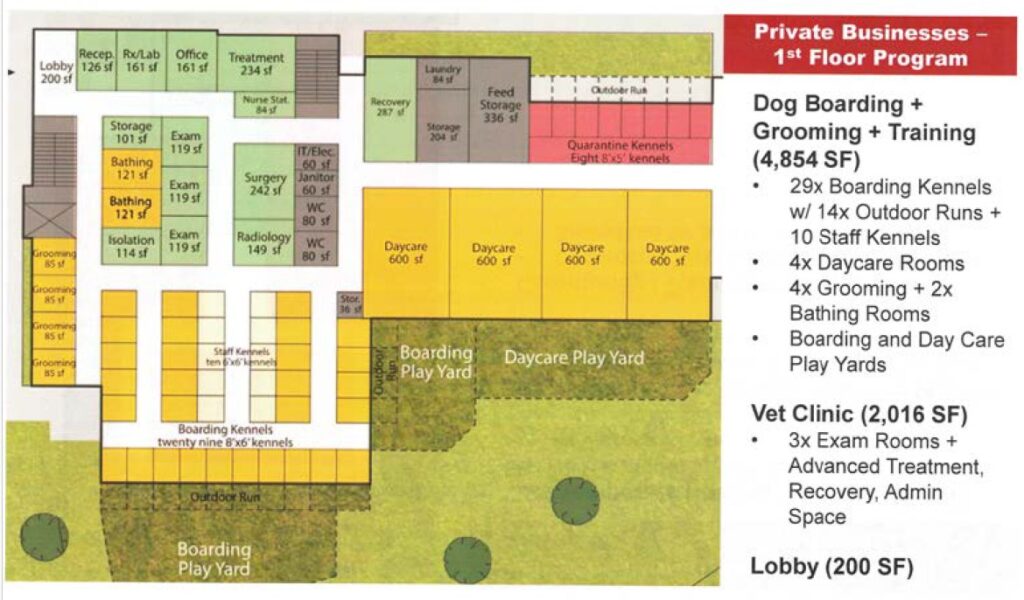
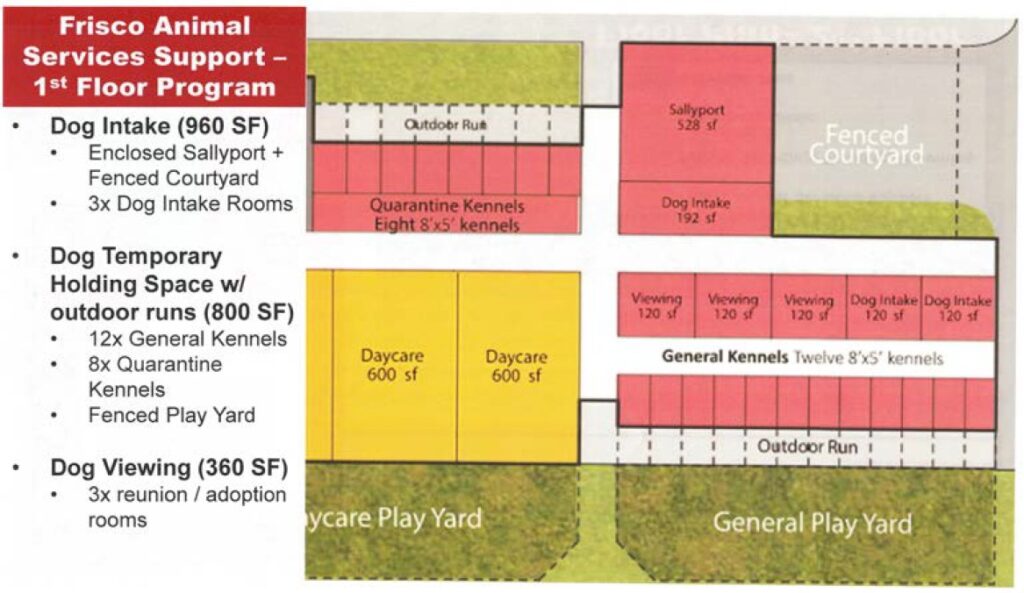
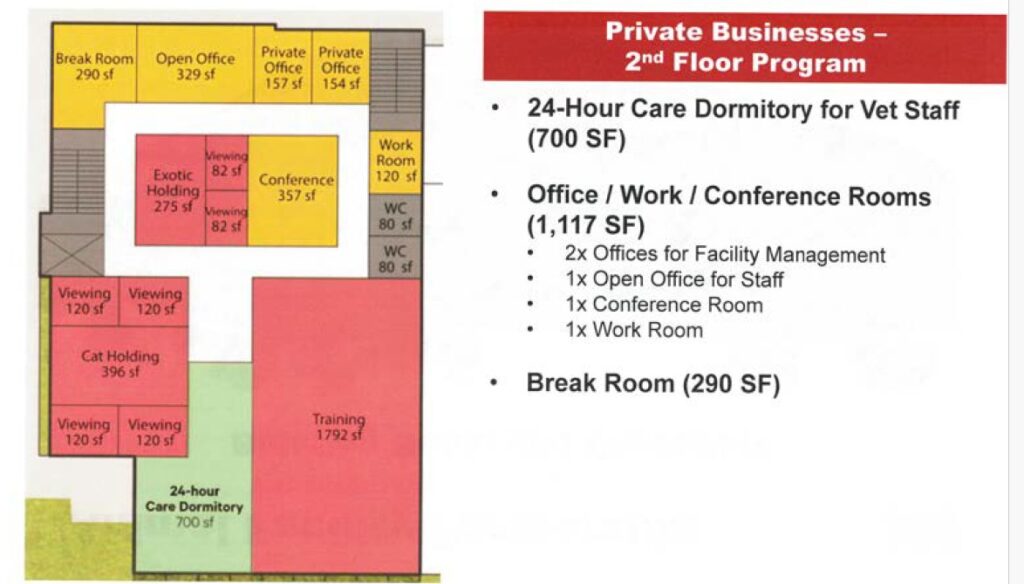
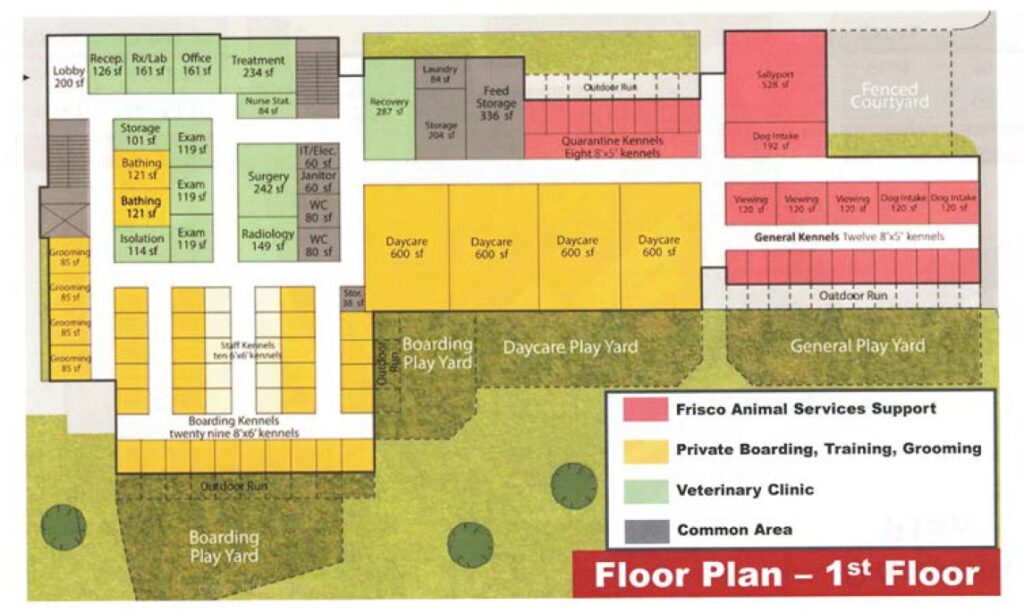
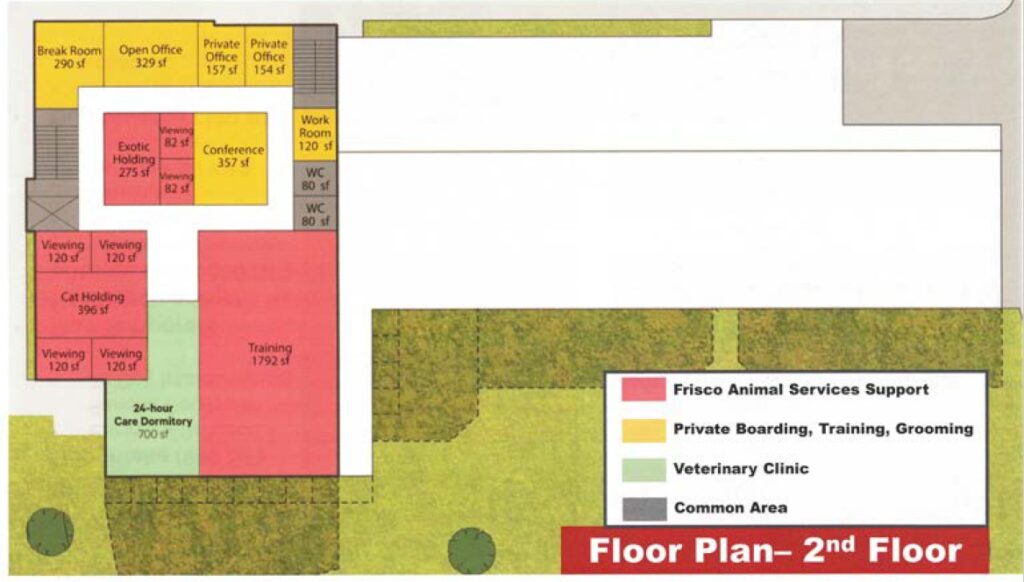
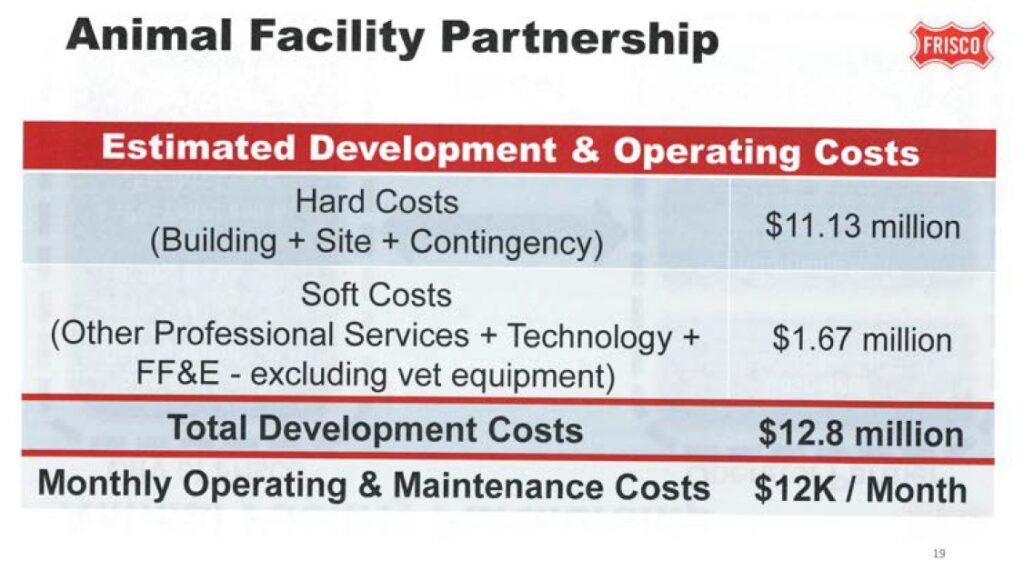
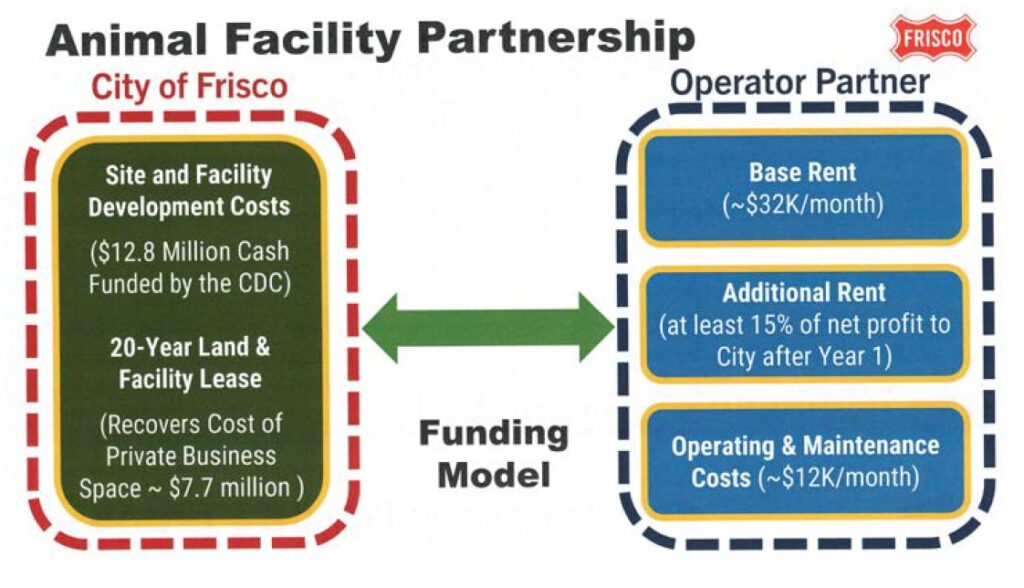
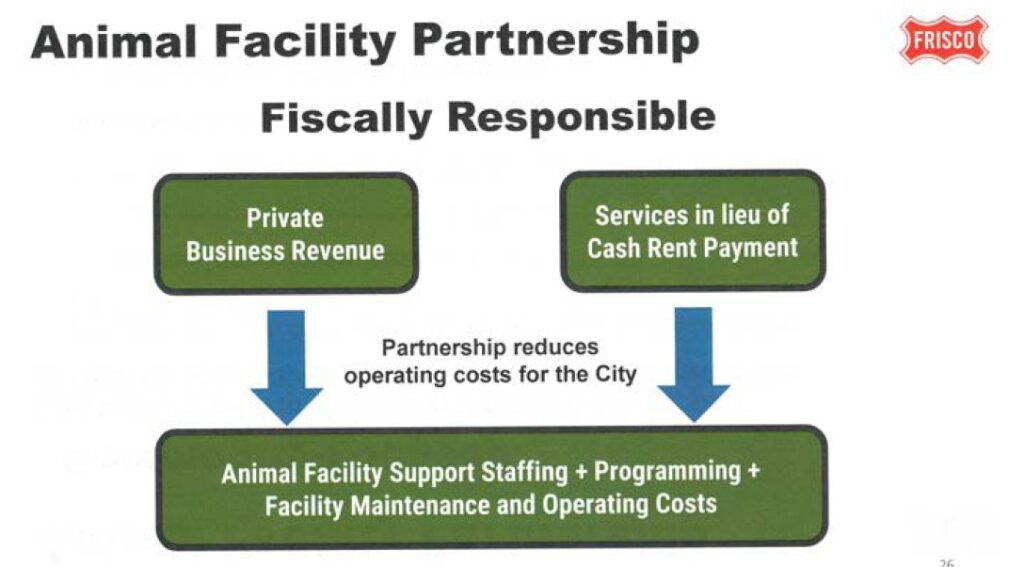
We will publish the letter sent to the city and media in its entirety below. We don’t know much about animal welfare, but we can understand the concerns after reading it. In my opinion, this appears to be a $12 million facility funded by CDC taxpayer money to support a private business. If that is the case, why not fund downtown and #SAVEMAIN? The building will be a two-story structure with a floor plan of 18,987 square feet. How does that break down? The breakdown: 10,769 square feet will be used by the private business, 5,277 square feet belong to the City of Frisco, and 1,100 square feet will be for utility space for both, such as laundry, storage, electrical, and janitorial. The private partnership is with a for-profit business called Wiggle Butts, and they will rent out space to a tenant (veterinarian). The question we have is why they have not held any community sessions or input sessions like they did for Universal Kids or the Performing Arts Center. With to little information and what looks like rushed planning, this looks like a hot mess. After reading the letter, I agree with the Animal Advocates that this has too many potential risks.
Dear Council Members,
This email was put together by several animal advocates who have concerns over the new Animal Holding Facility. While I know this email will be long, I encourage you to read it thoroughly because the liability the city could potentially hold with this model could be costly.
There is a reason animal shelters across the country don’t mix owner owned dogs with stray or adoptable animals. Most public/private partnerships across the United States are done with groups like ASPCA, Humane Society, Best Friends where they run an entire operation for a municipal entity. Why? There is too much liability when you have a “privately owned for profit business operation” within the same facility. The current presented facility violates your own Frisco ordinance today for kennel operations and is a liability to taxpayers who will end up footing the bill in a lawsuit.
Here are the concerns and questions from local animal advocates across Frisco after the recent work session related to the facility operations & design, veterinary services & oversight, financial & contractual concerns, public safety & liability, animal intake & disposition, the relationship with CCAS, staffing & training, legal & regulatory compliance and transparency concerns.
Facility Operation & Design
Two key areas of design in shelters are functionality and public health and safety. Shelters (aka holding facilities) must meet Texas Administrative Code (TAC), Title 25, Part 1, Chapter 169, Subchapter A (Rabies Control) and Health & Safety Code Chapter 826. Functionality or Flow Efficiency is important. A one-way flow design that allows animals to move from intake à medical à adoption/release (or in this case transfer to CCAS) without backtracking to prevent contamination. The current design does not have a “one-way flow” at all!
If Frisco Animal Services drops off a dog via the sallyport it will be moved into the “dog intake” area and then transferred over to the quarantine kennels or general kennels. The hallway space is not self-contained meaning airborne zoonotic diseases can transfer to other animals in that hallway space. Now let’s say one of the stray dogs needs to see the vet and you walk it down the hallway to the “green area” for vet care, that dog could have potentially contaminated that main hallway.
Contagious Diseases (some deadly) such as Parvo, Distemper, Upper Respiratory are transferred by touch, clothes, shoes, or airborne. Even if you have separate HVAC systems in the kennel runs that does not protect “owner owned dogs” that are being paid to be boarded at a private business from contamination in these hallways or walkways. This is a serious liability to the city and the business. It can also have deadly consequences for owned dogs.
Now Wiggle Butt has a dog in boarding, and they move the dog out of the yellow kennels and over to the “daycare” space which is accessed off the same main hallway. What happens? If the stray that was in the hallway before the “owner owned dog” is unvaccinated, carrying a contagious disease it could potentially transfer that to that owner owned dog. Owner owned pets can have not contact AT ALL with strays which is why at shelters they have specific areas for meet and greets or pet introductions. The layout of this facility is a walking liability for taxpayers, residents, Frisco pets, the city and this business.
This leads to the following set of questions because the disease prevention and control aspects of this design are very worrisome.
Has the city conducted a FORMAL FEASIBLITY STUDY? No! Why not?
The city has done this for every other project, including the recent Performing Arts Center.
Why not use a legitimate company like Quorum to do a formal feasibility study because this presentation does not reference best practices in municipal animal care.
Quorum / Shelter Planners of America can give you better demand planning than using arbitrary numbers from Collin County that do not truly represent Frisco’s intake.
Who helped design this model? What professional input did you have?
How was the kennel count determined? No data sets were given, and did you consider the forecast for today vs 10 years from now?
What experts were consulted on the design and functionality of this building? (outside of those who have a vested interest)
While Councilwoman Laura Rummell has stated online that design will have different HVAC systems that does not matter in shared spaces. Please explain in more detail which areas will have separate systems with separate air zones?
Will the HVAC systems be in compliance with the Association of Shelter Veterinarian standards?
Which veterinarian’s (other than those with a vested interest) were consulted for input in this design? Did any of them specialize in shelter medicine?
Will the private partner and its staff be required to take the same certification classes on Zoonotic Disease control that Animal Control Officers are required to take?
What will the cleaning workflow be? Where will cleaning supplies be stored? In the storage room on the main hallway? Will the supplies be used on both sides of the facility?
Will you have separate cleaning equipment and facilities for the “Frisco side” versus the “private business side” to prevent complete contamination by staff from one area to another? For example, will use the same floor mops throughout the facility?
Where will the food bowls be washed and cleaned?
How will the private business / city prevent airborne zoonotic diseases being transferred by clothes, shoes, hands, etc., around the facility to different areas of when they are crossing over areas where you have owner owned dogs?
If you must take a dog from the “Frisco” side to the medical area to see the vet (in green) how will you prevent diseases from being transferred to the staff kennels, daycare and grooming area. They must walk right into it to get the medical portion of the building.
Will used food and water bowls be transported back and forth in the main hallway to the feed storage room after the dogs have used them allowing potential airborne diseases to be released in the main hallway?
For liability reasons we are curious why privately (owner-owned) boarded animals are located directly next to quarantine and adoptable animals that have the risk of disease?
Who was the architect for this project? Do they have any experience in animal shelter designs?
What SOP will be in place and has it been written with the help of experts to confirm sick/healthy animals will be physically separated? Especially from “owner owned dogs” that are in the care of the private business housed in the same facility.
2. Animal Intake & Disposition
What isolation set up will you have for the first 24 hours an animal is in the facility to watch for illness before putting a dog in the “Frisco kennels”?
What types of oversight and reporting methods will this private business have (subject to PIR’s)?
Will the facility spay or neuter these animals before they are transferred to CCAS?
Will animals be vaccinated upon intake or while at Frisco’s facility?
What medical services will be offered to these stray’s before being transferred to CCAS?
What shelter management system will be used for keeping track of records?
How will we prevent non-residents from using the facility and dropping of strays? What will be the method to get those animals back to the proper facilities? What is the method to monitor this?
Will the public be able to drop off strays? At the presentation it was said yes, however WFAA is reporting the public cannot drop off animals to the facility?
Will Frisco Animal Services be the only ones with access to drop off at this facility?
If it must go through Frisco Animal Services, how will after hours strays be handled? Will residents still be able to drop off found dogs after hours at Frisco Emergency ER?
The proposal mentions that animals will be transferred to rescues within 3–5 days. Is it 3 days or 5 days?
Will Collin County count that stray hold period towards the number of days in their stay hold period?
It was mentioned that the private partner will be transferring the animals to Collin County, how is this being accomplished?
If the private partner transfers animals to Collin County will the partner also use the same vehicle to transport owner owned animals to clients? If yes, this allows for the increased potential of cross contamination (without separate vehicles)
Is CCAS on board with private business dropping off strays after the hold periods? Who will be doing the paperwork?
It was mentioned by the private partner they have connections with rescues and plan to move some of the dogs after a stray hold to a rescue. Which Rescue? Have any Rescues committed to that in writing?
Considering that rescues across Texas and the country are already at or beyond capacity and other shelters can’t get them to pull animals we are curious what magic element this private entity must make that happen.
Is the proposed director suggesting these animals be transferred to her own rescue? If so, that raises significant questions about transparency and potential conflicts of interest.
According to the press release you’ll be doing adoptions at the facility (which is fantastic). Why do you need to transfer dogs to CCAS?
After the stray hold is complete, and a dog is kept there for adoption, who will the adoption be through? The City of Frisco, from Wiggle Butt?
Which legal entity will be responsible for the animals while in custody? Does the liability fall on Wiggle Butts or City of Frisco?
If the facility is full and a stray comes in, what is the plan? With no space where will the pet go? Frisco ER, CCAS? Who will you make those decisions with?
Who will be responsible for managing clear intake & stray-hold policies: Exact stray hold period, owner notification plan, microchip scanning, and how/when animals are declared property of shelter/rescue. (Statute requires microchip scanning and gives cities duties.) Is the hold time / stray time the same for microchipped vs. non-microchipped pets?
3. Staffing & Training
Will the training for the staff be different for the private business versus the staff overseeing the “Frisco Animals”
Will there be SOPs for staffing & training standards
Will there be a requirement for minimum staffing ratios and animal-control training? Will the staff working with “Frisco Pet” have to complete the same required Animal Control Officer Certifications as a standard ACO? Who will pay for that training?
Will the Animal Advisory board help oversee this process required by Chapter 823 including independent vets and animal welfare members.
Regarding the proposed facility, what experience does the proposed veterinarian and director have working in or managing municipal shelters?
Has the city talked with any local municipal shelters for feedback?
Have they handled large-scale animal intake and the complex decision making that comes with public shelter operations?
Do either of the operators have certifications and relevant courses taken from the National Animal Care & Control Association?
Without the proper training and knowledge, the facility risks noncompliance and liability issues so who will be responsible for that, the private entity, the city, or both?
4. Veterinary Oversight & Public Services
What kind of veterinary services by law can you offer while a dog is on stray hold?
Who will have that Euthanasia authority? What will the decision matrix be? If no, then will the animals be sent to Collin County for euthanasia?
If EU is conducted, who decides euthanasia, under what standards, and what review/appeal rights exist? How will triage be done during capacity crises? Will the facility have humane euthanasia if needed for an injured animal?
We assume the vet will also be allowed to continue their private practice in the facility (same as Wiggle Butts). Will there be any restrictions to whom they can service in the facility through private practice clients?
Who will be writing the biosecurity & infection control SOPs: Daily cleaning, PPE, isolation protocols, vaccination requirements for boarding clients, staff vaccination/training, disease reporting.
Veterinary oversight and VCPR: Is there a written VCPR for boarding clients (if clients will receive vet care on site)? Who pays for emergency vet care for customers vs strays?
Zoonotic diseases are transmitted through direct contact, aerosol transmission (airborne), and ingestion via food or water bowls. If a stray animal comes out of the kennel and is walked down the hallway to the clinical area of the vet and it has a medical issue that is contagious, are you aware the hallway is not contaminated? Who will clean the whole hallway before any other animal could potentially walk on it in order not to transfer a zoonotic disease or contagious virus from the floor.
That same hallway will be used to walk owner owned animals from their kennels to a boarding / training room along that hallway without it being cleaned they could transfer zoonotic viruses
Public Services
Since the beginning of these discussions, it has been mentioned several times that this facility “may have” services for the public. What services will be available? What cost?
Low-Cost Access for spay & neuter, dental care, set of yearly vaccines including rabies for dogs and cats of all ages, microchipping, parasite prevention, and heartworm testing?
Heartworm Prevention medications?
Wellness Subscription Plans for low-cost annual services over 12 months for budget affordability?
In the presentation the owner of Wiggle Butts mentioned the facility will try to offer services to those who need to surrender in hopes that it will help them be able to keep their dog instead. Some of the suggestions were a food pantry, training, behavioral, etc. Who will be providing the training? What is the cost for this? Will it be low cost or at her current prices of $250 per session (which most people can’t afford).
5. Relationship with Collin County Animal Services (CCAS)
Will Frisco continue its contract with CCAS?
Will the current contract remain in place, or will there be a new contract?
How much is that costing taxpayers on top of the new facility?
What changes will be made to the contract now that Frisco has its own holding facility?
Will it change to a price per animal drop off?
How much will the city of Friso have to contribute to the building of CCAS expansion if we have our own facility? Will that be on top of the $12 million cost for our own facility?
Currently when an animal arrives at Collin County, they have a 7-day stray hold policy.
Will the time an animal spent at the Frisco facility count towards the CCAS stray hold period?
If no, will CCAS then hold the dog another 5 to 7 days under their stray hold policy? (in addition to the Frisco hold time)
Will the dogs or cats that are transferred to CCAS, after the stray hold period at the Frisco facility, be at the top of the list for potential euthanasia since they have already been held for a stray period?
How will CCAS determine what animals are adoptable when transferred over to them since they will have no contact with the animals while in Frisco’s care?
The hold period allows staff at shelters to determine how adoptable a pet can be.
How many animals currently housed at the Collin County Animal Shelter originate from the City of Frisco in a weekly or monthly period?
How many dogs are being dropped off at Frisco emergency clinics or veterinary offices?
Is there a way to determine how many of those animals dropped off are from outside city limits?
According to the presentation No owner surrenders will be accepted at the Frisco Facility and Frisco residents will still have to contact either Animal Services or schedule to take them to Collin County Animal Services, correct?
Do you feel this is a confusing message to residents?
Reality Check: That is a very confusing mixed message to residents. “Go here for A but go here for B or maybe C call Animal Services” The end result will be the same as every other city Residents will dump their dogs in a nice neighborhood hoping they are found and taken to the shelter as a stray. What will it take for the Frisco facility to allow surrenders?
Has Collin County been informed of the future changes and their role in the new set up? How does Collin County feel about this plan? Have they agreed to these changes to be your euthanasia headquarters and surrender headquarters?
Has CCAS agreed to have a private entity transport strays to them (instead of Frisco Animal Services) and do you have a signed agreement on that?
6. Public Safety & Liability
Bite Quarantine
Will you have a designated isolation area for “official quarantine dogs” or will you handle that process through your CCAS relationship?
Who will properly train staff in safe handling techniques and the use of appropriate equipment such as catch poles, muzzles, and protective gear.
What will happen when an animal comes in that is human-aggressive, or a dog or cat with a confirmed bite history?
Volunteers
At the presentation the owner of Wiggle Butts said they hope to have a volunteer program put together soon. Generally, people cannot “volunteer” for a private, for-profit business without pay under federal and Texas labor law, so how will volunteers fit into the equation?
If this facility is run by a private business such as a private kennel, trainer, or boarding business and has unpaid people walking dogs, cleaning kennels, feeding animals, or helping customers — that’s work that generates profit and violates the Fair Labor Standards Act (FLSA). Legally, they must be paid employees or independent contractors (rarely fits).
What is the plan to handle aggressive or dangerous animals that may pose a risk to staff, volunteers, and the public?
If a volunteer is bitten by a stray who will be liable? The City? Wiggle Butt? The animal’s owner since it is on stray hold?
What will the behavioral assessment and process be for strays? Potentially Adoptable Pets? Bite Quarantine Animals?
How does a “fear-free” training approach align with public safety and the legal responsibilities of a municipal facility?
While the “fear free” approach is a positive and compassionate philosophy, it must be applied realistically. Not every animal entering a municipal shelter can be safely rehabilitated or rehomed, and public safety must take precedence over idealism. It can lead to inadequate space, staffing, or resources, often leads to overcrowding, increased stress, and higher disease risk.
Therefore, what will be the balanced approach—combining humane care with practical decision-making to ensure that the shelter fulfills its mission responsibly and sustainably?
This is a complicated, high-risk setup (owner owned animals vs strays) unless the contract and operations are written and run with rock-solid public-health, veterinary, procurement, and liability protections. Who will be responsible for this?
Does this model currently create a substantial liability risk for the City of Frisco and its taxpayers?
7. Legal & Regulatory Compliance
Which legal entity will own the animals while in custody? City or private operator? (This impacts who is allowed to provide medical care under the owner-exemption.)
Which statute will govern each function since you have a private kennel with a city facility?
Shelters operate under the Texas Health & Safety Code Chapter 823 while “Kennels” defined as a facility that boards, trains or handles dogs or cats owned by others for compensation operates under THSC Chapter 824.
Will shelter animals be run under Chapter 823 and boarding clients or under Chapter 824 — and how will conflicts be resolved?
Records & Public Information: Who will maintain the records, where will they be kept, and how will public-records requests be handled? Owners have a right to privacy and now you have a private business with access to resident information which is usually considered confidential.
Consumer protections for paying customers: Will the operator and vet be required to provide written informed consent to private paying customers of the business that the facility will be holding strays that could be unvaccinated, possibly be carrying an infection disease, maybe there on an aggressive quarantine hold, etc.?
Will there be a written notice about how refund/compensation terms if a paying customer dog gets exposed or injured to protect taxpayers from a potential lawsuit.
Who will be responsible for Performance metrics & termination rights: Return-to-owner rate targets, disease outbreak thresholds, audit rights, corrective action, and termination for failure to meet standards.
Will the private partner be subject to PIR’s for city data or details?
Will the city carry its own insurance to protect us from potential lawsuits from this setup? (outside the private contractor’s insurance)
CURRENT CITY OF FRISCO’S ORDINANCE: Defines a kennel as “Any premises wherein any person engages in providing pet care services (except veterinary) for four (4) or more animals, such as boarding, grooming, sitting and training pets, except as prohibited by the City of Frisco’s Comprehensive Zoning Ordinance, as it currently exists or may be amended.”
Veterinary services are excluded from that definition (i.e. if you’re a vet you may have other rules).
The current ordinance requires kennel clients to provide “Proof of current rabies, parvo, distemper and Bordetella vaccinations must be maintained for all dogs, cats and ferrets four (4) months of age” so will the for profit Kennel portion of the business have to disclose to potential paying clients that unvaccinated, pets potentially carrying a zoonotic virus will be contained inside the building?
8. Financial & Contractual Concerns
Does operator have a 10-year history of financial and business credentials?
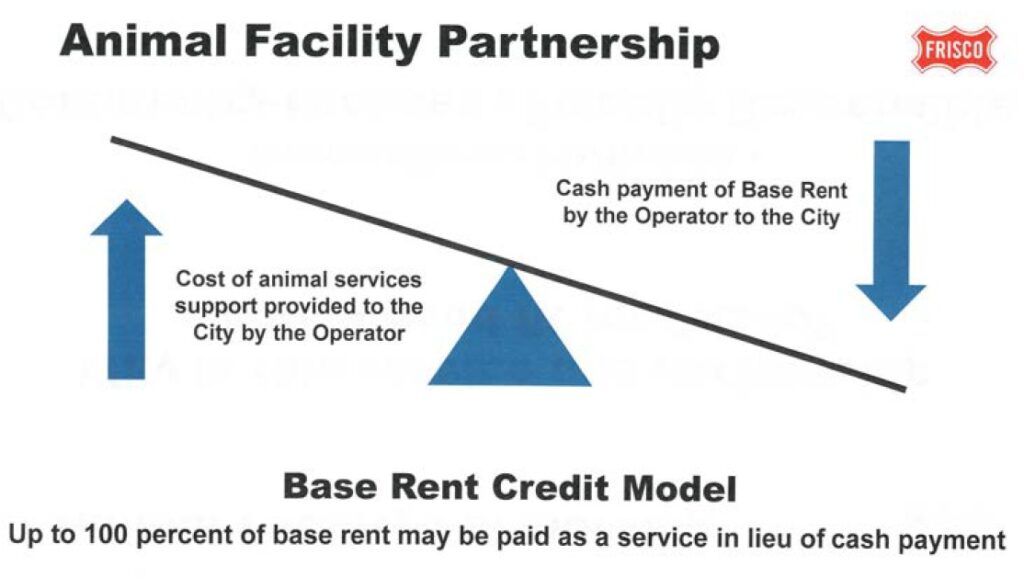
Does the current business currently have a history that shows they can cover the potential monthly cost of over $50k +15% of profits (2nd year)
What is the back up plan if the operator cannot fulfill its obligations?
Will, or has, the city publicly advertised for operators now that they have a business model?
Has there been a Proforma (of Financial Forecast) of Income & Expenses for City
Has there been a Proforma (projection) for services, policy and operational costs and expenses?
Is the private entity positioned to benefit financially or professionally from this proposal through their private businesses? If yes, how?
Furthermore, what is the clear contingency plan if the operation proves unsustainable?
If the director is unable to meet intake demands or financial goals, there must be a backup strategy—such as returning management to municipal control, restructuring the program, or appointing new leadership—to protect both the animals and the community?
What type of Contract language will there be: indemnity / insurance / risk allocation: Minimum insurance amounts, municipality indemnity carve-outs, who pays defense costs, and whether municipal immunity applies. Will the city require the private operator as an additional insured (and vice versa as appropriate).
Procurement transparency: Show how the city selected the vendor, RFQ/RFP documents, competing bids, and legal justification under Local Government Code. Confirm the contract was pro-cured properly.
Will, or has, the city publicly advertised for operators now that they have a business model?
9. Transparency
With the private partner announcement, did the “private partner” have any input or say on this while in her role on the city’s Animal Advisory Board? Is that a conflict of interest?
Will she remain on the Animal Advisory Board in the future? Is this a conflict of interest?
Will employees of the business have access to information on strays and how does this potentially violate privacy issues of residents. What about paying owners privacy?
Procurement transparency: Show how the city selected the vendor, RFQ/RFP documents, competing bids, and legal justification under Local Government Code. Confirm the contract was procured properly.
In conclusion, this Animal Facility Presented is a liability issue all around. Too many variables have not been considered. This puts the city, the business owner, residents and Frisco pets at risk. There is a reason this has not been done before, so what makes Frisco think they can do it better?
For this to move forward it would need to have strict SOP Clauses in the Contract (to protect taxpayer dollars from potential suits)
Customer consumer protections: “Contractor must obtain written informed consent per Chapter 824 for boarding clients, disclose co-location with municipal shelter, fire-safety systems, and emergency plans; refunds/credit policy for exposure incidents.”
Strict physical separation clause: The contractor shall maintain distinct, walled, separately ventilated areas for municipal-custody animals and boarding/training clientele. No shared runs, HVAC, food/water bowls, or grooming equipment. The floor plan should be reworked to have strays nowhere near a potential owner-owned animal.
Biosecurity & outbreak clause: “Contractor will implement DSHS-recommended isolation, cleaning, and cohorting plans; immediate notification to city and mandatory temporary suspension of boarding if an outbreak is suspected.”
VCPR & veterinary authority clause: “All veterinary care for paid clients must be provided under a documented VCPR; shelter animal care will be under the shelter VCPR as required by law. Contractor will not offer paid medical services to owners of boarded animals without expressed written authorization and compliance with TBVME rules
Insurance & indemnity: “Minimum commercial general liability (specify high limits), professional liability for vet services if provided on site, and contractor named as additional insured on city policy. Contractor indemnifies city for contractor negligence; city indemnifies contractors for actions taken under city directives.”
Records & transparency: “Contractor will maintain intake, medical, and disposition records on premises; microchip scans on intake; monthly reporting to city; records available for audit and subject to public information requests.




I went to her to ask for help with an issue my child that was getting nowhere with the school,…
So whatever became of the $17 million dollars that the city council gave the Mayor to beautify a drainage ditch?
At last count, there are 3 different "spa/massage" businesses in the small office park at the northeast corner of John…
I literally just saw this. Yeah, she used to forward everybody’s emails behind their backs.
You're dropping truth bombs! These mom and pop shops are what should be the least of Karen's worries. If they…