Summer is over but the heat still has things percolating in Frisco. It is time to break down some events that happened over the summer.
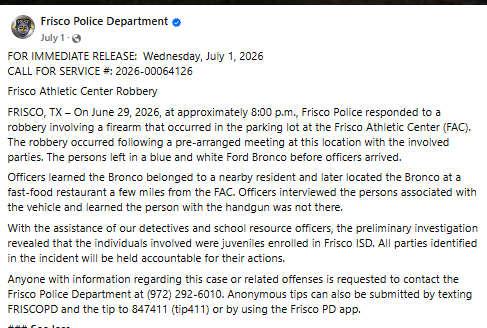
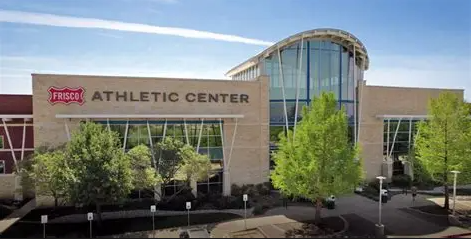
Over the summer you may have seen the post from the Frisco Police Department regarding the Frisco Athletic Center Robbery. It was posted on July 1st and reads “On June 29, 2026, at approximately 8:00 p.m., Frisco Police responded to a robbery involving a firearm that occurred in the parking lot at the Frisco Athletic Center (FAC).”
The post detailed how the robbery occurred following a pre-arranged meeting at the FAC between two parties. One party apparently left in a blue and white Ford Bronco before officers arrived. Officers learned the Bronco belonged to a nearby resident and later located the Bronco at a fast-food restaurant a few miles from the FAC. Officers interviewed the people associated with the vehicle and learned the person with the handgun was not there.
The shocking part is when they announced that with the assistance of detectives and school resource officers, the preliminary investigation revealed that the individuals involved were juveniles enrolled in Frisco ISD. The post closed by saying, “All parties identified in the incident will be held accountable for their actions.”
You can imagine the community’s shock and concern when they learn JUVENILES ENROLLED IN FRISCO ISD were allegedly involved. In my gut something did not add up, and I had several questions.
What was the pre-arranged meeting for? Facebook Marketplace Sale? Drugs?
What fast-food restaurant did they find the Bronco at? There were no posts on social media asking why there is a police presence at a fast-food restaurant parking lot. Frisconians are nosey so there would be a post somewhere.
How did they immediately know it was juveniles and that they were enrolled in Frisco ISD?
We filed an open records request for all documents related to the case and agreed they could redact any information relating to the juveniles involved however they still sent out request to the Texas Attorney General to keep the info from the public. Why?
That was when I got an email from a parent who had several details on the incident because they were picking up someone nearby and when they saw the commotion they listened to the police scanner from 8pm to 8:36pm.
All of the following details are ALLEGED and have not been corroborated due to Frisco PD holding the incident documents from our Public Information Request.
Allegedly the 8PM MEET UP was a drug deal for Oxi! The Oxi dealer was supposedly driving a blue Bronco with a white top. The driver was a black male with an Afro, his passenger a black male with dreads in a red sweatshirt was carrying the oxi. The Bronco pulled up to the planned meeting spot, which happened to be right in front of the FAC which has cameras outside that supposedly captured the entire exchange.
Allegedly the BUYER walked up to the car (passenger seat side) and opened the backpack to pick up the goods and handed over a wad of cash. Supposedly the dealer counted the cash which was short of the agreed amount. A verbal exchange ensued, then the dealer pulls a gun and demands the backpack at gunpoint (ie. Armed robbery).
Supposedly the Bronco then drives off, and the kid (the buyer) goes inside and reports to the FAC staff he was robbed at gunpoint, and it was reported to the police. Duh!
According to the Frisco Chronicles tipster, based on the police scanner, Frisco PD immediately tracked the Bronco with FLOCK cameras and tracked it east on Wade, to south on Ohio, towards 121. It was announced on the police scanner the plates came back to a house on Lily Pad Lane (corner of 380 and 423).
These details made much more sense and are very different than the summary posted by Frisco Police Department. The questions are not going away simply because summer is over.
If the preliminary investigation truly established that juveniles enrolled in Frisco ISD were involved, then the public deserves to know what happened next. Were arrests made? Were charges referred to the Denton County District Attorney? Was the matter handled through the juvenile justice system? Or was this quietly turned over to Frisco ISD and left there?
And perhaps the bigger question is why the public version of the incident appears so thin when the alleged circumstances, if accurate, are anything but ordinary.
A reported armed robbery involving a firearm, alleged narcotics, juveniles, a pre-arranged meeting, surveillance cameras and FLOCK camera tracking is not exactly a minor parking-lot misunderstanding. Yet residents were given a carefully packaged summary and when Frisco Chronicles filed a PIR for the case file and underlying records, Frisco PD sought an Attorney General ruling rather than simply providing the releasable portions with juvenile information redacted.
That raises another question: What exactly is being protected?
To be clear, the allegations provided by our source remain allegations. We have not independently verified the alleged drug transaction, the identities of the people involved, the alleged weapon, or what was captured on surveillance video. That is precisely why public records matter. Journalism should not have to rely on a police scanner, a concerned parent and an anonymous tipster to piece together what happened during an alleged armed robbery in a public parking lot.
And this is where the phrase “all parties identified in the incident will be held accountable” deserves some follow-up. Accountable how? Accountability is not a slogan for a Facebook post. It is a process. It means determining what happened, identifying who was responsible, referring appropriate cases for prosecution, and allowing the public to understand the disposition of a serious incident without exposing protected information about juveniles.
Nobody is asking Frisco PD to publish the names of children. Nobody is asking for protected juvenile records. Frisco Chronicles is asking for the releasable facts.
What happened? What charges, if any, were filed? Was the case referred to the District Attorney? Was anyone arrested or detained? Was Frisco ISD involved? And what happened to the investigation after the initial police response?
Those are reasonable questions for a community to ask.
Frisco has spent years cultivating an image as one of the safest cities in America. There is nothing wrong with being proud of that reputation. But a “safest city” designation should never become a reason to avoid uncomfortable questions. If anything, a city that takes public safety seriously should welcome scrutiny and demonstrate that its system works even when the facts are embarrassing, complicated or inconvenient.
Transparency does not tarnish Frisco’s reputation. Hiding behind the reputation does.
So summer may be over, but this story isn’t. The public deserves the facts, not the polished version. And until those records are released or the appropriate authorities explain what happened to this case, there are still more questions than answers.
That is not accountability. That is unfinished business.
Disclaimer: This article is intended to report on matters of public record and public interest. If additional information becomes available, including the dismissal of charges, acquittal, or other developments, this article may be updated accordingly.
This article is written as opinion, commentary, and personal interpretation based on publicly available records, tipster information, meeting observations, agenda materials, and information we received from community sources. Nothing in this article should be interpreted as a final statement of fact about any person’s legal conduct, criminal behavior, or ethical violations. Reader discretion — and a sense of humor — are advised.
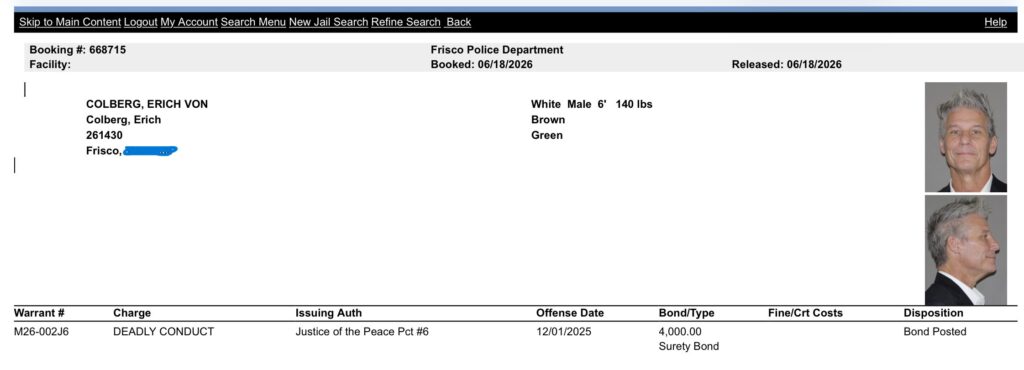
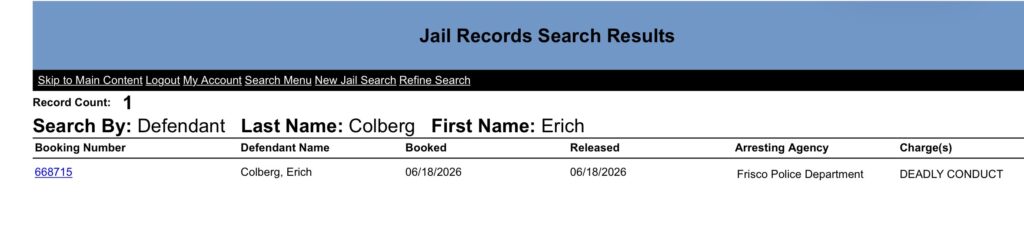
Recently Frisco Chronicles was alerted to an arrest made by the Frisco Police Department on 6/18/2026 involving Erich Colberg (husband of new council woman Brittany Colberg). What do we know about the arrest? Not much. Readers can be assured Frisco Chronicles will report the information honestly and accurately as information becomes available.
Current Information: All we know at this time is Mr. Colberg was booked on 6/18/2026 under the following information:
Booking Date and Release Date: 6/18/2026
Booking Number: 668715
Warrant Number: M26-002J6
Charge: Deadly Conduct
Issuing Auth: Justice of the Peace PCT #6
Offense Date: 12/1/2025
Bond: 4,000.00 (Surety Bond)
Disposition: Bond Posted
Side Note: The information provided by Frisco Chronicles in this article is based on public records, law enforcement records, court filings, and other publicly available sources available at the time of publication. An arrest or criminal charge is an allegation only and is not evidence of guilt.All individuals are presumed innocent unless and until proven guilty in a court of law.
Screenshot
Charge: Deadly Conduct Defined
In Denton County, the offense of Deadly Conduct is defined by Texas law, specifically Texas Penal Code § 22.05. Frisco Chronicles went to ChatGPT to ask what is charge “Deadly Conduct” related to in Texas. This is soley for informational purposes to understand the allegations of the charge. The statute has two primary forms of deadly conduct:
1. Recklessly placing another person in imminent danger of serious bodily injury
This is generally a Class A misdemeanor.
The prosecution must prove that a person recklessly engaged in conduct that placed another in imminent danger of serious bodily injury. Serious bodily injury means an injury creating a substantial risk of death or causing permanent disfigurement or long-term loss of bodily function.
Examples could include:
Driving a vehicle directly at another vehicle or pedestrian.
Intentionally swerving toward another motorist.
Throwing heavy objects at moving vehicles.
Brandishing or pointing a firearm at someone, even if no shot is fired (Texas law presumes recklessness when someone knowingly points a firearm at another person).
2. Knowingly discharging a firearm
This is a Third-Degree Felony.
A person commits felony deadly conduct if they knowingly discharge a firearm:
At or in the direction of another person; or
At a vehicle, building, or habitation while being reckless as to whether it is occupied.
Screenshot
Breaking Down the Law
Can Deadly Conduct arise from a traffic incident?
Yes. While many people associate the offense with firearms, Section 22.05(a) does not require a firearm. In a traffic-related incident, prosecutors may pursue a Deadly Conduct charge if they believe the driver used the vehicle in a reckless manner that placed another person in imminent danger of serious bodily injury.
Examples could include intentionally attempting to ram another vehicle, purposely forcing another vehicle off the roadway, driving head-on toward another vehicle, and aggressive road-rage maneuvers that create an immediate risk of death or serious injury. The vehicle itself can be the instrumentality of the offense if it is used recklessly enough.
What if the incident involved a gun during road rage?
Deadly Conduct is one of the more common charges in Texas road-rage cases where someone points a handgun at another driver, displays a firearm in a threatening manner, fires a shot from a vehicle, or fires toward another vehicle.
Even if no one is struck and no physical injury occurs, the charge may still apply because the offense focuses on creating an imminent danger, not on whether someone was actually hurt.
Frisco Chronicles is just giving context to the charge deadly conduct. It is important to note per public records today; there is nothing that notes Erich Colberg had a weapon on him of any kind or that has anything to do with his charge of Deadly Conduct.
The Arrest
Why an arrest over 6 months later? Based solely on the information on Denton County’s website it suggests that investigators may have developed evidence after the initial incident or presented the case to prosecutors at a later date. Without the offense report, probable cause affidavit, or warrant affidavit, it’s not possible to determine whether the allegation involves reckless operation of a motor vehicle, a firearm, both, or another form of conduct.
Public Information Request
Frisco Chronicles has submitted a PIR for the more information and will let you know what we find out based on records such as an offense report, probable cause affidavit, warrant affidavit, 911 recording, and witness statements. That is the only way to provide the factual basis for the charge, subject to any lawful withholding if the criminal case is still pending.
Statement from Brittany Colberg For Frisco
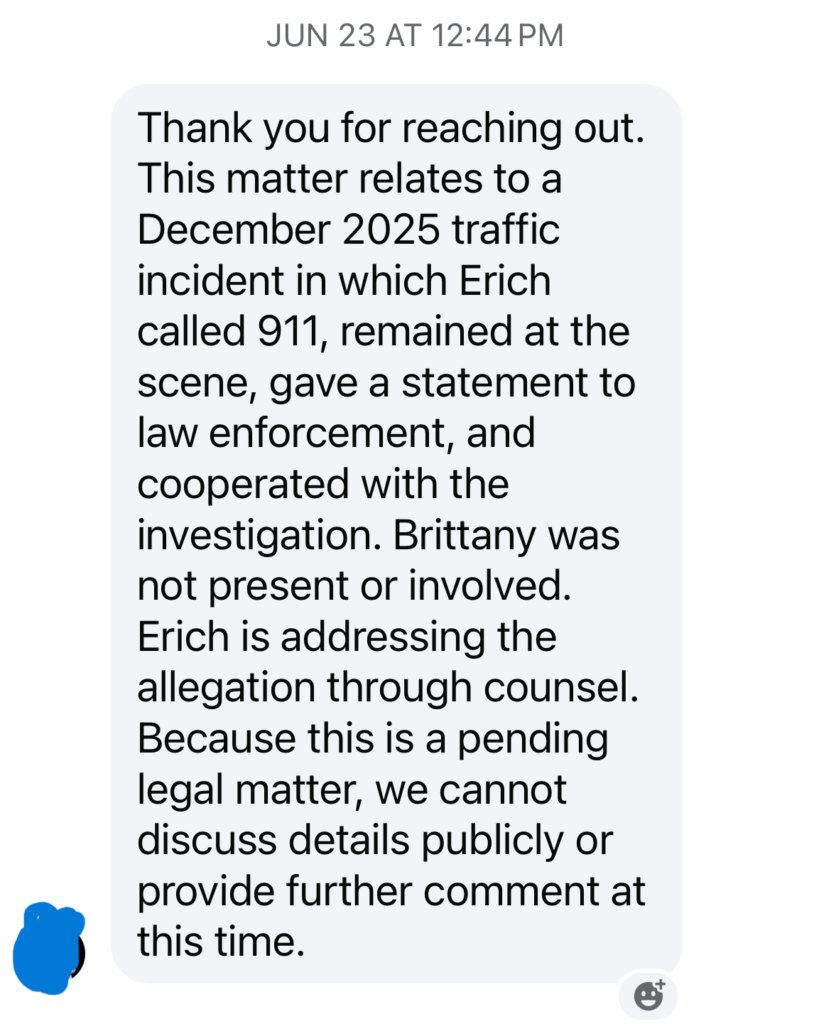
We did reach out to Councilwoman Brittany Colberg via Facebook Messenger last month on June 23rd. The response we received read,
“Thank you for reaching out. This matter relates to a December 2025 traffic incident in which Erich called 911, remained at the scene, gave a statement to law enforcement, and cooperated with the investigation. Brittany was not present or involved. Erich is addressing the allegation through counsel. Because this is a pending legal matter, we cannot discuss details publicly or provide further comment at this time.”
In closing, Frisco Chronicles will follow this case and report any new findings. The charges are allegations only until the case goes to court.
Disclaimer: This article is intended to report on matters of public record and public interest. If additional information becomes available, including the dismissal of charges, acquittal, or other developments, this article may be updated accordingly.
This article is written as opinion, commentary, and personal interpretation based on publicly available records, meeting observations, agenda materials, and information we received from community sources. Nothing in this article should be interpreted as a final statement of fact about any person’s legal conduct, criminal behavior, or ethical violations.
There is a difference between political disagreement and online obsession. In the age of Facebook gladiators, neighborhood watchdog pages, and keyboard constitutional scholars armed with Canva graphics, the line can get blurry fast. But lately, several Frisco residents have been asking a serious question about local physician Dr. Matt Rostami and his increasingly aggressive online commentary aimed at Frisco mayoral candidate Rod Vilhauer.
The concern is not simply that a doctor has political opinions. Doctors are citizens. They vote. They argue. They post memes just like everyone else. Some even discover Facebook Live and suddenly believe they are one podcast microphone away from becoming the next Joe Rogan.
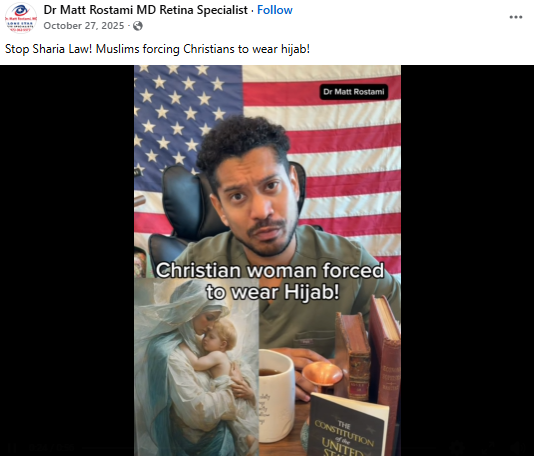
Rostami’s online political presence is not new. Here are just a few posts sent to us by readers.
Video of Dr. Matt Rostami mocking the need to stop Sharia Law and making Christian woman to wear a Hijab. He specifically points out a woman named “Mary” who is holding a baby a reference to the bible. He goes on to say in our country Freedom is showing your butthole and cleavage because sharing is caring.
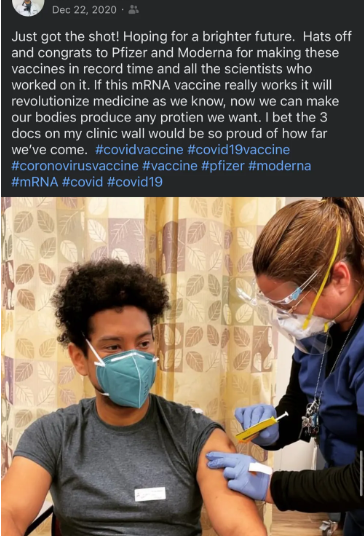
Current Revolt called out Dr. Matt Rostami for being a Democrat in disguise. He claims to be a Republican, but his voting Record says otherwise from what we can tell and Current Revolt called him out about it. We also noticed that he supported the vaccines during Covid which is odd for a Republican.
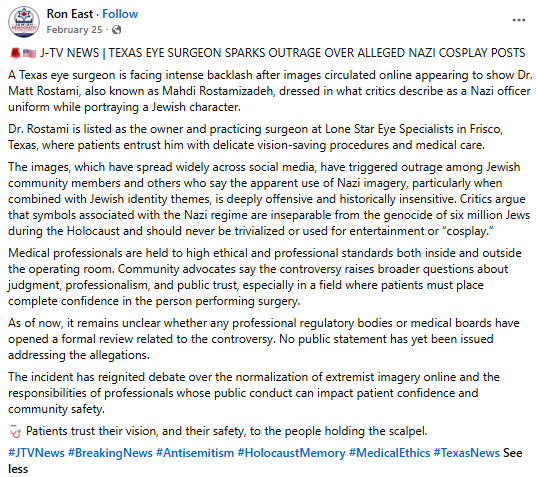
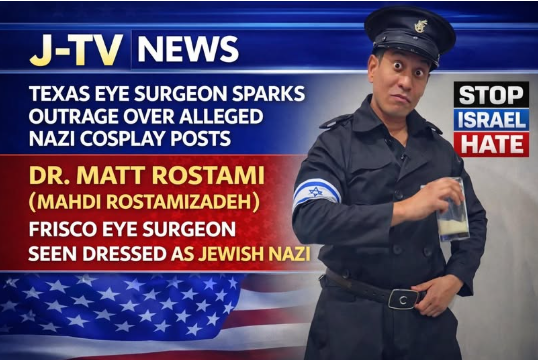
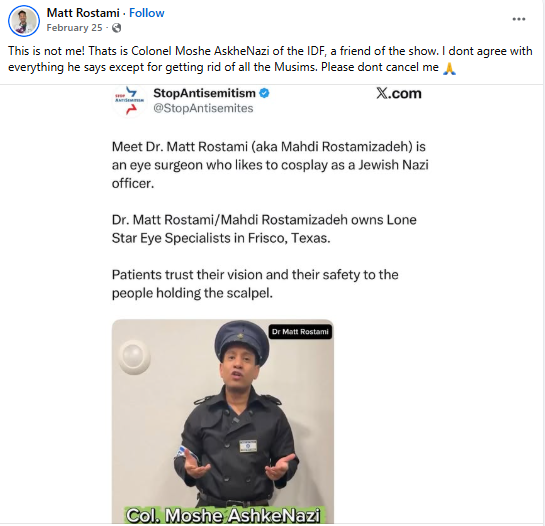
Then there is a post showing Dr. Matt Rostami dressed up in cosplay as a Jewish Nazi Officer. After it was posted he later mocked it, and in the words of Shaggy allegedly said, “it wasn’t me.”
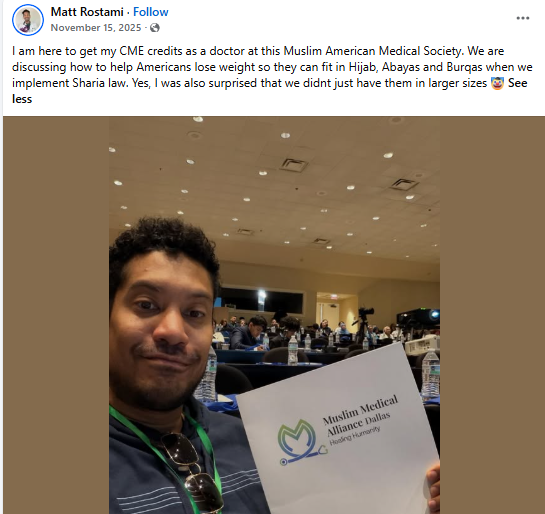
In another post, Rostami holds up a Muslim Medical Alliance folder and mocks obese woman saying “I am here to get my CME credits as a doctor at this Muslim American Medical Society. We are discussing how to help Americans lose weight so they can fit in Hijab, Abayas and Burqas when we implement Sharia law. Yes, I was also surprised that we didn’t just have them in larger sizes (clown face emoji).
The Concern
The concern being raised by residents is whether Dr. Rostami’s online behavior has crossed from political speech into something more concerning: harassment, intimidation, or conduct unbecoming of a licensed physician.
And perhaps the biggest mystery of all: why did it take nearly an entire day to even locate his Texas medical license?
The Name Game
Here is where the story starts feeling less like a medical directory and more like a witness protection subplot from a late-night cable drama.
Most Texans searching the Texas Medical Board database would naturally type in “Matt Rostami.” That search does not easily lead to his medical credentials because “Matt Rostami” is not his legal name.
According to Texas Medical Board records, Dr. Matt Rostami’s legal name is Dr. Mahdi Rostamizaden, and his Texas medical license is listed as #R2723.
To be clear, physicians are not generally required to publicly advertise their license numbers on websites or social media. Texas law typically allows doctors to practice and advertise under a professional name, practice name, DBA, or commonly used name. Nothing illegal there.
Still, some residents found it odd that locating the license information required what felt like a forensic accounting team, three cups of coffee, and the determination of a true-crime podcast listener.
What Does the Texas Medical Board Actually Regulate?
This is where things become important — and nuanced.
The Texas Medical Board does not regulate political beliefs. A physician can support a candidate, oppose a candidate, criticize policy, or post unpopular opinions online. The First Amendment protects a tremendous amount of speech, including speech many people dislike.
Texas law does not create one single “social media behavior statute” for physicians. Instead, physician conduct is regulated through broader standards found in the Texas Occupations Code and Texas Administrative Code involving:
Professional ethics
Dishonorable conduct
Conduct likely to deceive, defraud, or injure the public
Impairment issues
Harassment or threatening behavior
Professional character requirements
The board has previously disciplined physicians over online conduct, including inappropriate Facebook activity and harassment-related behavior. The key legal question is not whether someone is rude, loud, politically charged, or unpopular, but the threshold is evidence.
Not gossip. Not rumors. Not “he seems weird online.” Evidence.
When Does Free Speech Become Harassment?
That is the million-dollar constitutional question.
A physician posting criticism about a political candidate is protected speech. Even harsh criticism usually remains protected. At Frisco Chronicles we know where that line is and we do stand to protect it. The question is should those rules be different for licensed professionals in some categories.
If conduct escalates into targeted harassment, threats, stalking behavior, intimidation, discriminatory conduct, or actions suggesting impaired judgment that could affect patient safety, the equation changes dramatically.
Several Frisco residents who contacted Frisco Chronicles expressed concern that Dr. Rostami’s posts have become increasingly inflammatory and intensely focused on Vilhauer.
One resident wrote:
“The public rhetoric has become increasingly inflammatory.”
Another questioned whether the fixation had crossed into “stalking territory.”
To be very clear, those are serious accusations. We want to make sure folks understand these are opinions — not legal findings.
A skeptical observer might reasonably ask whether the behavior reflects the professional judgment expected from someone entrusted with patient care. But legally speaking, “poor judgment” and “disciplinable impairment” are not the same thing.
That distinction matters.
Because the law does not punish someone simply for acting eccentric online. If it did, half of Facebook would be under federal supervision and Nextdoor would require adult probation officers.
The “Good Professional Character” Standard
Under Texas Occupations Code Chapter 155, physicians are expected to maintain “good professional character.”
Chapter 164 goes further, allowing disciplinary action when a physician is unable to practice medicine safely because of:
illness
drunkenness
excessive use of drugs or chemicals
mental or physical conditions affecting safe practice
Recently, several residents emailed Frisco Chronicles asking whether Dr. Rostami’s online conduct raises concerns about impairment or mental fitness.
To be absolutely clear: there is currently no public evidence proving impairment, substance abuse, or mental incapacity.
However, Texas law does provide mechanisms for investigation if legitimate complaints and probable cause exist.
Under Section 164.053 of the Texas Occupations Code, the Texas Medical Board may request a physician submit to mental or physical examinations if there is probable cause involving professional behavior concerns, substance abuse issues, or mental health conditions affecting safe practice.
If a physician refuses, hearings may follow, during which the physician can present evidence and legal defense.
Again, the standard is not “people on Facebook think he’s acting strange.”
The standard is probable cause backed by evidence.
That is a very high bar — and intentionally so.
Targeting Rod Vilhauer
Perhaps the most comical part of this entire saga is that Dr. Rostami appears to be attacking Rod Vilhauer for a comment made during a podcast that he has later clarified, while Rostami engages in the very same style of online political commentary daily in his regular posts. One day it is “dangerous rhetoric” when Vilhauer speaks bluntly about controversial issues; the next day Rostami is unloading multi-post tirades, inflammatory accusations, taking out political hit pieces in magazines, putting up defamatory road signs, and posting political attacks with the enthusiasm of a late-night cable news host who just discovered espresso. Residents watching this unfold believe Rostami has gone over the line of two people arguing over who is being too loud… through bullhorns. If harsh political speech suddenly qualifies someone as unstable, offensive, or unfit for public discourse, then critics might reasonably ask whether Dr. Rostami’s own Facebook timeline should be entered into evidence as Exhibit A.
Politics, Medicine, and Public Trust
This entire situation raises broader questions that extend beyond one physician or one mayoral race. How much online behavior is too much for professionals entrusted with public safety and public health? Should physicians be held to higher standards in public discourse? At what point does political activism begin damaging public confidence in the medical profession? And perhaps most importantly: in an era where outrage drives clicks, likes, and engagement, are some people simply losing the ability to log off?
The internet has transformed ordinary citizens into full-time broadcasters. Every grievance becomes a livestream. Every disagreement becomes a crusade. Every Facebook thread becomes Gettysburg with emojis. But physicians occupy a unique place in society. Patients trust them with life-altering decisions. That trust depends not only on medical competence, but also on public confidence in their judgment.
The Texas Medical Board understands that balance. That is why it generally avoids policing mere political opinions while still maintaining authority to investigate conduct that may genuinely endanger the public or reflect professional impairment.
For now, Dr. Rostami’s conduct remains largely a matter of public debate — not public discipline.
But one thing is certain: when residents begin asking whether a Doctor’s Facebook feed belongs in a campaign office, a courtroom, or a psychiatric evaluation request, the conversation has already moved far beyond ordinary politics.
For legal purposes we must post this Disclaimer: This blog includes satire, parody, and comic relief. It contains summarized accounts created solely for humor and commentary. Any resemblance to real events is either coincidental or intentionally satirical. Reader discretion — and a sense of humor — are advised.
Frisco Chronicles has no issue questioning city leadership and department leadership because I believe someone must speak for the front-line employees. Why? It is the front-line employees in each department that do the day-to-day work which keeps our city great. Every time I hear from an “insider” it is the same story, different department.
We have heard about nepotism running rampant, leadership involved in sexual affairs, toxic work environments, and much more. The truth is our city needs a good “SPRING CLENAING” in top management and department leaders. Why? To protect our front-line workers who feel the brunt of their failed leadership.
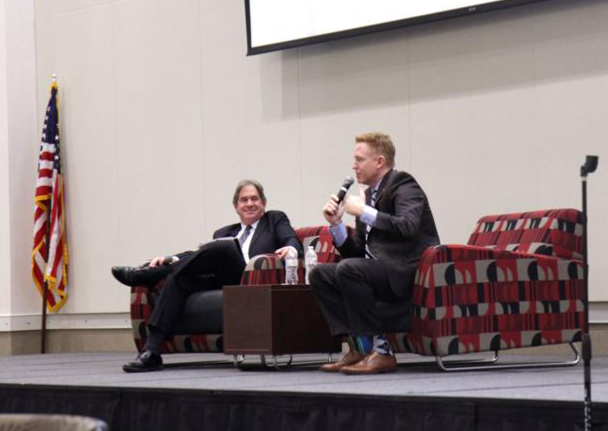
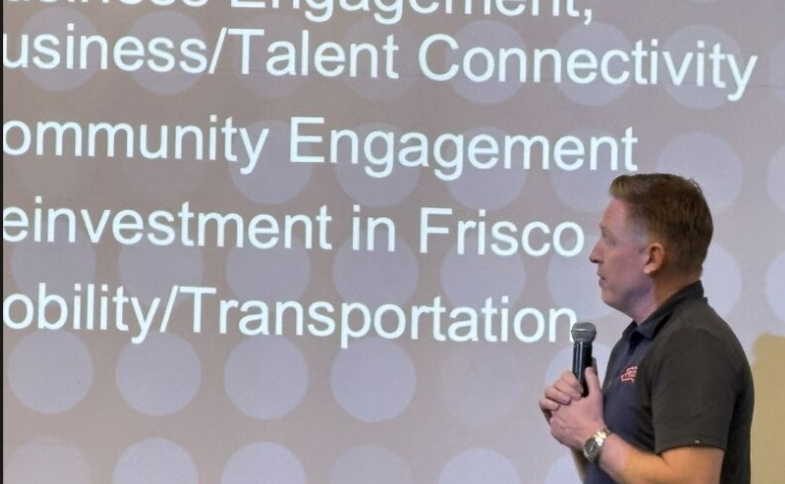
The last two weeks we have received several emails related to City Manager, Wes Pierson. The emails talk about how Pierson leads with hostile and condescending behavior. One email noted he consistently speaks down to staff, direct reports, and his executive team. It went on to say his condescending behavior and communication style undermines the morale across all city departments. Residents have seen this behavior up front and center at city council meetings.
The emails also talk about how employees feared professional retaliation if they file a complaint with HR against department or city leadership. The minute a complaint is filed the city begins actions to end that employee’s employment through any means necessary. That includes making up issues or actions to use against the employee.
We know in a recent meeting with public safety officials he questioned if the Fire Department really needed “ladder trucks” which shows his operational ignorance. Clearly his questioning shows a lack of operational infrastructure needed for basic emergency response. His dismissive attitude towards critical public safety equipment poses a direct threat to our communities welfare.
One email talked about staff development and how Pierson actively blocks the implementation of employee progression and career development. The city constantly changes care development plans to hold employees back.
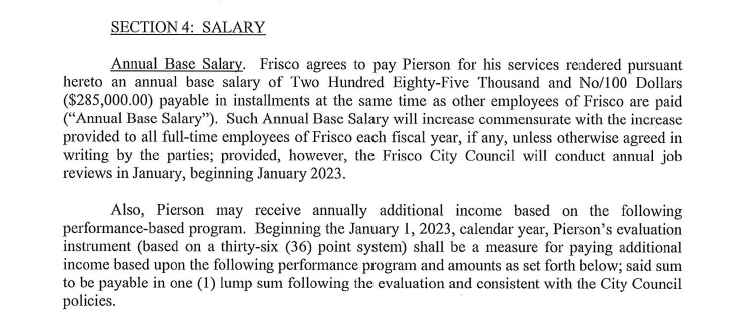
This kind of behavior from one of the highest paid city managers in the nation is unacceptable. There is a severe contrast between his massive compensation package and his refusal to invest in staff progression which behind closed doors is crippling city operations. One email said a third-party investigation into management practices is needed to protect city employees and residents. It is the only way to ensure responsible governance.
When I receive one email I take it as employee frustration, but when I receive 3 in one week from different employees, different departments then it tells me there is an issue at city hall. That issue starts at the top with Wes Pierson as he sets the tone that flows downhill.
Disclaimer: This blog includes satire, parody, and comic relief. It contains summarized accounts created solely for humor and commentary. Any resemblance to real events is either coincidental or intentionally satirical. Reader discretion — and a sense of humor — are advised.
A few years ago, Frisco residents were divided on the idea of an Employee Wellness Center that supposedly would save taxpayer dollars and improve employee health outcomes. At the time, Frisco Chronicles and many residents, raised concerns because the clinic was projected to operate in the red for years before ever breaking even. Funny how “trust the process” always seems to come with a blank check.
So naturally, we decided to follow up.
We filed a Public Information Request asking for basic operational information for the following:
1. Annual Usage Statistics; Number of clinic visits by employees each year.
2. Employee Participation: Total Number of employees using the clinic each year.
3. Financial Performance: Annual revenue and expenses related to operating the clinic, including whether the clinic operates at a surplus or deficit each year.
4. Any additional reports or summaries detailing the clinics’ utilization, cost savings, or operational performance.
Asking for usage numbers, costs, financial performance, and general metrics. Not patient records. Not private medical files. Just the kind of accountability data taxpayers should expect when public money and public partnerships are involved.
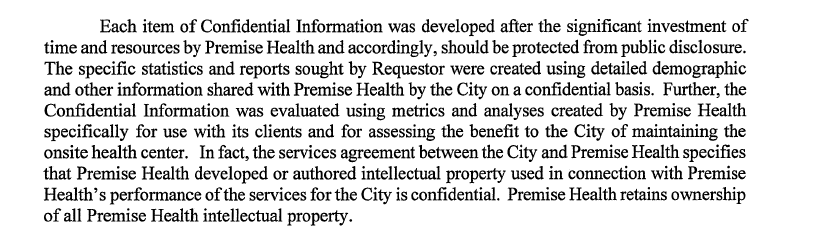
Instead, the City of Frisco is now claiming much of the information is confidential. Premise Health, the private company operating the clinic, also argued the records should be withheld by the public.
That response raises even more questions. The public has the right to know where taxpayer dollars are going.
Since when did taxpayer-funded operations become private just because a corporation is involved? If a city contracts with a private company that operates on taxpayer dollars, then transparency is part of the deal. You don’t get to step into the public arena, collect public money, make promises to taxpayers, and then slam the door shut when someone asks for performance numbers.
Nobody is requesting employee medical files or protected health information. We fully support protecting patient privacy. But there is a massive difference between protecting personal health records and hiding operational data from the taxpayers footing the bill.
The city and Premise Health appear to be blurring that line intentionally.
How many employees use the clinic monthly? How much taxpayer money has been spent? What are the annual operating losses or gains? Has the clinic reduced insurance costs as promised? What metrics are being used to measure success?
Those are not invasive questions. Those are standard accountability questions.
And frankly, if the clinic is performing well, why fight so hard to keep the numbers hidden?
The public has every right to question why officials are circling the wagons over usage statistics and financial data. Transparency should not suddenly disappear because the answers may be politically inconvenient.
Government transparency in Frisco increasingly feels like a game of “public when convenient, private when questioned.” The city loves press conferences, ribbon cuttings, and glossy announcements when launching programs, but when residents ask for follow-up data years later, suddenly everyone discovers the word “confidential.”
Maybe the Employee Wellness Center is a success story. Maybe it’s exactly the financial sinkhole critics warned about years ago. Either way, taxpayers deserve facts, not carefully crafted legal objections designed to keep the public in the dark.
Read our original article and decide for yourself whether this is about protecting privacy — or protecting politics.
Disclaimer: This blog includes satire, parody, and comic relief. It contains summarized accounts created solely for humor and commentary. Any resemblance to real events is either coincidental or intentionally satirical. Reader discretion — and a sense of humor — are advised.



I went to her to ask for help with an issue my child that was getting nowhere with the school,…
So whatever became of the $17 million dollars that the city council gave the Mayor to beautify a drainage ditch?
At last count, there are 3 different "spa/massage" businesses in the small office park at the northeast corner of John…
I literally just saw this. Yeah, she used to forward everybody’s emails behind their backs.
You're dropping truth bombs! These mom and pop shops are what should be the least of Karen's worries. If they…