There’s an old saying: if you don’t have the timeline on your side, you better have a good story. And if you don’t have either… well, you write a blog post like the one we just read. Let’s walk through what’s being sold versus what actually holds water.
The Timeline Problem They Hope You Ignore
A recent post by a lame blog, leans heavily on the idea that a so-called “bombshell” text ties the Colberg’s to some grand political scheme involving secret recordings used to influence the May 2025 election.
Sounds dramatic. There’s just one problem—it doesn’t line up with reality.
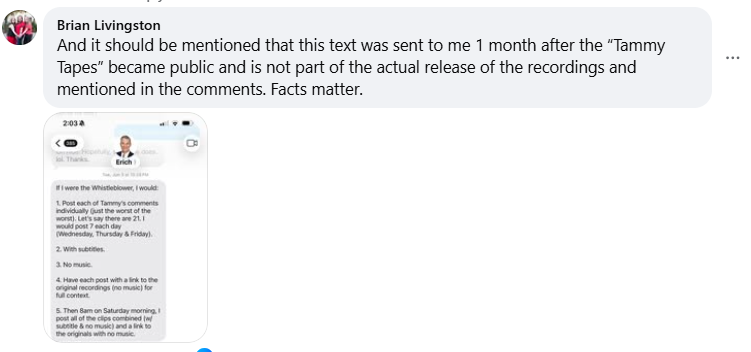
The recordings in question (the now-infamous “Tammy Tapes”) were released on May 3, 2025.
The “smoking gun” text? Dated June 2–4, 2025.
That’s not a minor detail. That’s the entire case falling apart.
You can’t “weaponize” something a month after it’s already been released to the public. That’s not strategy—that’s hindsight dressed up as conspiracy. So right out of the gate, the central premise collapses under its own timeline.
The “Colbergs” Narrative – Built on Sand
The blog tries to create intrigue by emphasizing the message came from “The Colbergs”—plural. A household. A unit. A dramatic flourish meant to imply coordinated action.
But here’s what gets conveniently glossed over: Even by their own referenced commentary, the message traces back to Erich Colberg, not Brittany. No joint plotting. No evidence of collaboration. Just a stretch—one of those reach-across-the-table, nearly-fall-out-of-your-chair stretches—to tie a candidate into something for maximum political effect.
And let’s be honest: if the evidence were that strong, there wouldn’t be a need to play grammatical gymnastics with the word “Colbergs.”
The Court Filing Argument – A Leap Too Far
Another pillar of the dog’s argument is that legal filings to suppress the text somehow equal guilt.
That’s a bold claim—and a dangerous one.
By that logic, anyone who files a motion to limit or challenge evidence in court is automatically admitting wrongdoing. That’s not how the legal system works. Not in Texas. Not anywhere. People file motions for all kinds of reasons: privacy concerns, relevance disputes, procedural issues. It’s called due process, not confession.
Turning routine legal maneuvering into a smoking gun isn’t analysis—it’s narrative-building.
The Missing Connection No One Can Find
Let’s address the elephant in the room: Frisco Chronicles.
Despite the repeated attempts to connect dots, draw lines, and build a web of intrigue, here are the facts:
Frisco Chronicles has never met the Colbergs.
Frisco Chronicles has never communicated with the Colbergs.
The Colbergs had no involvement in the recordings.
Frisco Chronicles operates independently—period.
No shadow network. No backroom coordination. No secret alliance. Just a stubborn refusal to fit into someone else’s storyline.
What This Really Looks Like
When you strip away the dramatic tone, the selective framing, and the carefully chosen wording, what’s left? A post built on:
A timeline that doesn’t work
An association that isn’t proven
A legal argument that overreaches
And a narrative that fills in gaps with assumption
In other words, not a revelation—an attempt.
The Real “Big Truth”
The blog titled their piece “A Little Lie Reveals a Big Truth.” On that, we actually agree—just not in the way they intended.
The “big truth” isn’t about a coordinated political scheme. It’s about how quickly speculation can be dressed up as certainty when there’s an election around the corner. It’s about how a single text—taken out of context, stripped of timing, and stretched to its limits—can be turned into a headline. And maybe most importantly, it’s about relevance.
Because when you can’t match the impact, the reach, or the receipts… sometimes the next best move is to manufacture a moment.
Final Thought
If this is what passes for a “bombshell,” then the bar has dropped somewhere near the basement. Frisco voters deserve facts, not stitched-together narratives that fall apart under basic scrutiny. And if this is the best attempt at keeping up? Well… let’s just say the gap isn’t closing anytime soon.
Lastly, we are still shocked how the dog’s side is more concerned about the exposure of wrongdoing versus if Tammy Meinershagen had done nothing – nothing would have been revealed. She is directly responsible for her actions.
Disclaimer: This blog includes satire, parody, and comic relief. It contains summarized accounts created solely for humor and commentary. Any resemblance to real events is either coincidental or intentionally satirical. Reader discretion — and a sense of humor — are advised.
UPDATE 4/8/26: Per a Facebook Post by Mark Hill For Frisco Mayor he turned in his campaign finance report on time and had the date-stamp to prove it. Hill says the report just had not been uploaded to the city website. We asked him for a copy of the date-stamp in our comment but have yet to receive it. If this is the case, we question how the city secretary who makes an estimated $157,000, made that mistake by not uploading the report. The city is well aware all eyes are on elections and these reports so that is a big error on the cities part.
There’s an old saying: the little things tell you everything.
We looked at the most recent 30-Day Campaign Finance Report for the candidates. The most noticeable problem is that 3 of the candidates did not comply with “STATE LAW” to file their reports. Another candidate turned in their report 4 days late. For the 3 who filed no report, how can residents trust you to run a billion-dollar city budget?
Sreekanth Reddy – Candidate for Place 5
Matthew Chalmers – Candidate for Place 6
Mark Hill – Candidate for Mayor
Rod Vilhauer – Candidate for Mayor (turned in 4 days late)
Let’s be clear—this isn’t complicated. This isn’t obscure. This isn’t optional. If you run for office, you file your campaign finance reports. On time. Every time.
A Pattern, Not a One-Off
While we are upset that these candidates missed the deadline, we are more focused on Mark Hill because he has a pattern of behavior when it comes to his campaign finance reports. This isn’t the first time questions have been raised. In our previous blog, “Who Failed the Campaign Finance Reality Check,” we outlined concerns about missing or non-compliant filings tied to Hill’s campaign activity, including:
July 2024
January 2025
July 2025
Now, here we are again.
The 30-day pre-election report—due April 2nd—has come and gone, and once again, the question lingers:
Where is the report?
The Resume vs. The Reality
Hill’s campaign messaging paints an impressive picture:
Former Frisco ISD Trustee
Experience balancing a billion-dollar budget
Service on economic development committees
Studied finance at Texas A&M
Practicing attorney
That’s a résumé built on fiscal responsibility and governance. Which makes this all the more puzzling.
Because if you understand budgets… If you understand compliance… If you understand finance…
Then you understand deadlines.
So What’s the Problem?
Campaign finance reporting isn’t a suggestion—it’s a legal requirement designed to ensure transparency for voters.
It tells the public:
Who is funding a campaign
Where the money is going
Whether influence is being bought or earned
And yet, voters are left asking:
Why do these reports keep going missing?
Who is responsible—the candidate or the treasurer?
And why hasn’t this been corrected after prior scrutiny?
Yes, a treasurer is listed—Srini Raghavan—but let’s not play bureaucratic hot potato. At the end of the day, the candidate’s name is on the ballot.
Leadership Starts with Accountability
Here’s the uncomfortable truth: Running a city like Frisco requires managing timelines, budgets, and compliance across multiple departments, projects, and stakeholders. If a campaign can’t consistently meet basic state filing requirements…
What does that say about readiness to run a city?
The Bottom Line
This isn’t about paperwork.
It’s about discipline. It’s about transparency. It’s about trust.
Because if you’re asking voters to trust you with hundreds of millions in taxpayer dollars, the bare minimum expectation is this:
You can file a report. You can meet a deadline. You can follow the rules.
Anything less isn’t just an oversight. It’s a warning sign.
Disclaimer: This blog includes satire, parody, and comic relief. It contains summarized accounts created solely for humor and commentary. Any resemblance to real events is either coincidental or intentionally satirical. Reader discretion — and a sense of humor — are advised.
Frisco Chronicles filed numerous PIRs related to the Utility Billing Department today. A full copy of the requests can be found at the bottom of this blog. The reason for filing these PIRs, is because over the last year we have had several anonymous tips of alleged allegations or infractions. Due to the accusations, Frisco Chronicles is requesting more details.
The department is run April Spann – Revenue Collections Manager, and according to OpenGovPay her annual salary in 2024 was $139,363. We also heard that Angela Dowd or Dowell from HR recently moved over to the department even though she has no experience and is paid exceptionally well also.
Allegation #1: Millions of Gallons of Water are “NOT ACCOUNTED FOR”
If this is true, how would the city bill for that water? Who would they bill? Is this the real reason in 2025 the City of Frisco recommended raising our water / sewer rates? Was this an attempt to bill or make up for the lost revenue in millions of gallons of water? Is this why there was a panic and opposition to any upgrades to the Utility Billing system?
In September of 2025, city staff recommended a 9% increase to water rates and a 15% increase to sewer rates to cover increased operational costs. Fees for environmental services such as recycling will increase by $1 for residents and 5% for businesses. Storm water rates are also set to increase by 20% which became effective January 1, 2026.
Why the Increase? Brett Petersen (budget strategic planning manager) explained that the North Texas Municipal Water District’s capital needs and regional debt service are driving a portion of the increases. Staff cited proposed FY26 utility adjustments are necessary to support planned expansions at the Panther Creek and Stewart Creek wastewater treatment plants and new transmission costs. He also noted the proposed addition of 7.5 full-time equivalents (FTE) to the utility fund and about $590,000 in new and replacement capital.
Allegation #2: Recently an “INVESTIGATION” was done into the staff leadership of that department.
Allegedly the entire staff within the department was interviewed for the investigation. Accusations include management not knowing how to run the department, being a bully, and possibly being racist towards staff and customers. Allegedly the department has very high turnover because the manager drives employees away. There is also a preference for only hiring black employees over hiring the most qualified candidate. Other allegations include when customers asked for a payment plan or were at risk of being cut off, she would overturn judgements for black customers only. Finally, there is a lack of experience, items not being recorded or accounted for, and no training for employees.
The Result: Allegedly after the investigation was closed the Billing Supervisor and Assistant Revenue Manager were fired. At that time, Angela Dowd or Dowell from Human Resources, who has no experience, was transferred over to the Utility Department to be the Assistant Manager in Revenue Collections even though she had zero experience or qualifications. Why? Allegedly it was to protect her from being fired in HR.
Same Story, Different Department
The highest salary for a city employee in 2025 was $469,030. The average salary for city employees in 2025 was $72,002, which is 4% lower than the USA average but 28% higher than the Texas state average. The median salary for city employees in 2025 was $66,551, which is 28.2% higher than the Texas state median.
That means the salary range for city employees typically falls between $20,481 and $113,856. The top 10% of highest-earning employees have salaries ranging from $143,765 to $469,030. Those are some good salaries, and most employees don’t leave a high paying job without reason. In this economy, it is not easy to find jobs with some of those salary ranges.
We have reported issues in several departments across the city in the last few years including the Fire Department, Human Resources, Public Works and now Utilities. Why do similar accusations keep coming up repeatedly just in different departments? If you have a problem with one person, chances are it’s them (not you). If you have a problem with several people, all the time then you need to stop and look in the mirror because the problem is most likely you!
The City of Frisco has the same problems (just a little different in nature) in each department. Problems from bad leadership, preferential treatment, retaliation, intimidation, racism, and sexual affairs. How many investigations has this city done in the last 5 years into city departments. It seems to me quite a few and that can only mean there is a lack of leadership and management across the city. All of this, and it does not even include the alleged issue into the Meter Change Out Program. Where will it end? We will report back whatever we learn from the recently filed PIRs. However, we expect the city will try to delay and send the request to the Attorney General just like they did with the Employee Health Clinic. Transparency at its best!
Get Out & Vote
We are about to elect a New Mayor, and two new city council members. This is important because we need really people in this city who will hire a city manager who can take care of these issues and create a work environment our employees deserve. Pay attention to these candidates running for office and do your research! It is vital to our city employees and residents that change happens.
Disclaimer: This blog includes satire, parody, and comic relief. It contains summarized accounts created solely for humor and commentary. Any resemblance to real events is either coincidental or intentionally satirical. Reader discretion — and a sense of humor — are advised.
Copy of Frisco PIR’s Filed April 4, 2026
Pursuant to the Texas Public Information Act, I am requesting access to and/or copies of the following records related to the Utility Billing Department and Revenue Collections Division: Internal Investigations Any and all records, reports, findings, summaries, or communications related to investigations conducted within the Utility Billing / Revenue Collections Division within the past 3 years. This includes complaints, interview notes, conclusions, and any disciplinary recommendations or actions taken. Personnel Actions Records reflecting terminations, resignations, retirements, or reassignments of employees within the Utility Billing / Revenue Collections Division during the past 3 years, including but not limited to supervisors and management-level staff. Documents explaining the reasons for such personnel actions, where available. Organizational Structure & Hiring Current and past organizational charts for the Utility Billing / Revenue Collections Division. Job descriptions, qualifications, and hiring criteria for management positions within the division. Records related to recent hiring decisions for supervisory or management roles (last 5 years). Customer Account Policies & Enforcement Policies and procedures governing utility disconnections, payment plans, and account adjustments. Any internal audits, reviews, or reports evaluating how these policies are applied. Aggregate data (no personal identifiers needed) showing approval/denial rates for payment plans or disconnection decisions over the past 3 years. Employee Complaints / Workplace Environment Records of formal employee complaints, grievances, or HR reports related to workplace conduct, management practices, or department leadership within the Utility Billing / Revenue Collections Division. Any employee climate surveys or internal assessments conducted in the past 3 years. Communications Emails or internal communications among department leadership, HR, and executive staff referencing: Department performance Employee concerns Investigations or complaints (Limit to the past 3 years to reduce scope if needed.)
Alright, grab your popcorn —this one has all the makings of a classic Frisco Chronicles feature: money, media, and that familiar scent of roses wafting through the pages of the Dallas Morning News.
All Good in the Frisco Hood: Brought to You by… Medium Giant?
By now, longtime Frisco residents have noticed a curious phenomenon. Whenever the Dallas Morning News (DMN) writes about Frisco, the city sparkles. Streets are shinier. Leadership is visionary. Problems? What problems? If Frisco had potholes, DMN would probably call them “community engagement craters designed to slow traffic and save lives.”
Which raises the obvious question: why does Frisco always smell like roses in the DMN? Not weeds. Not smoke. Roses.
For years, residents have speculated. Maybe DMN is afraid of being cut off from exclusives. Maybe access journalism is alive and well. Or maybe—just maybe—it’s about the oldest motivator in local government and media alike: Money.
Enter Stage Left: Medium Giant
Here’s where things get interesting. A sharp-eyed reader recently connected a few dots that deserve a closer look. The Frisco Economic Development Corporation (FEDC) has entered into several contracts over the years with a company called Medium Giant.
Whose Medium Giant, you ask?
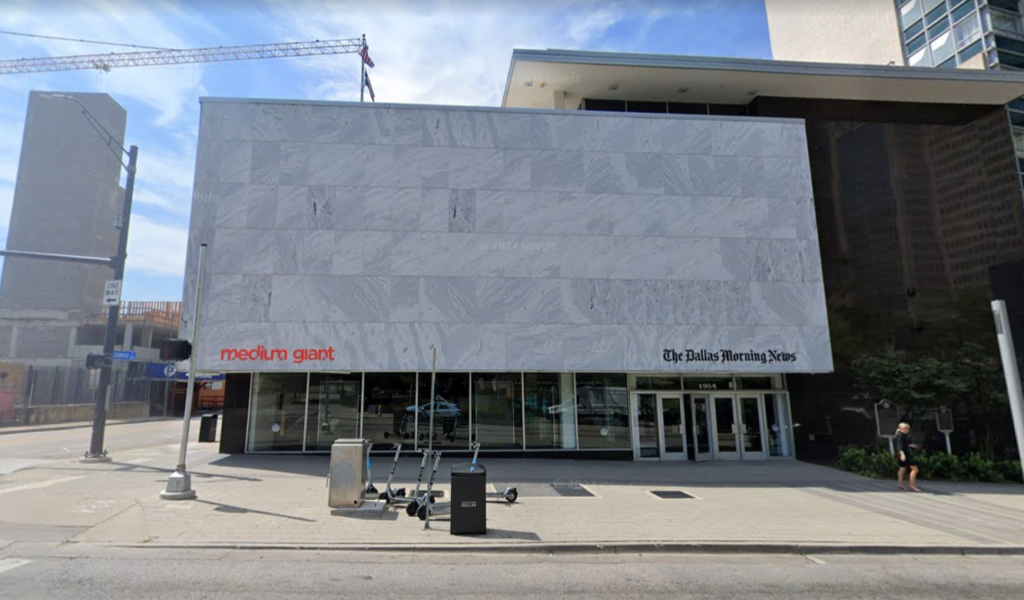
They’re an “integrated creative marketing agency.” Which is marketing-speak for we make things look good. Even better? Medium Giant just happens to be the sister company of the Dallas Morning News.
Cue the dramatic music. So now the question isn’t why DMN never seems to publish critical reporting on Frisco or its leadership. The question becomes: would they dare?
Follow the Money (Because It Always Tells a Story)
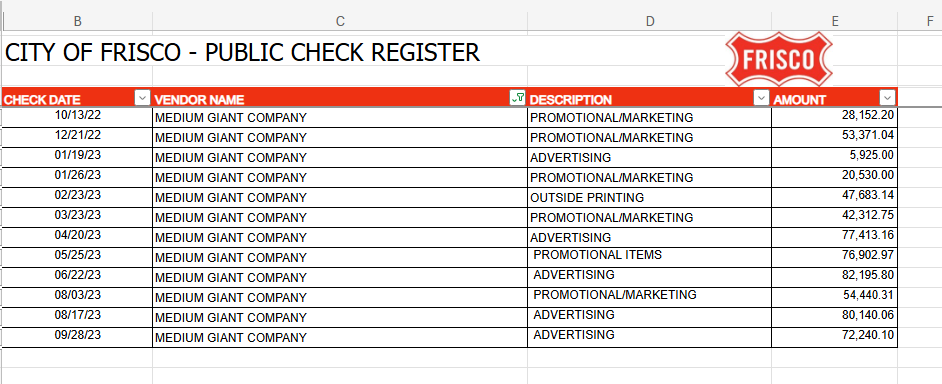
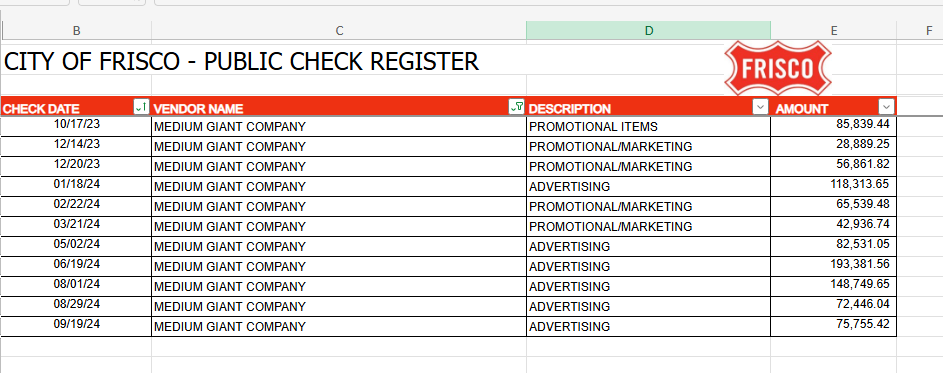
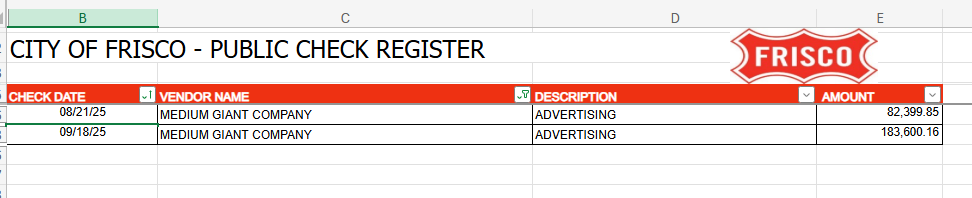
When we reviewed city check registers, we noticed multiple payments over the years made to Medium Giant. Not chump change. Not lunch money. Not “oops, forgot to expense that Uber.”
The total? $2,105,631.76
That’s over two million dollars paid by Frisco entities to a company tied directly to the same organization responsible for shaping Frisco’s public narrative in one of North Texas’ largest newspapers.
Now, we’re not saying this proves corruption. We’re not saying there’s a secret smoky backroom with editors and city staff clinking champagne glasses. We’re not even saying there’s an explicit quid pro quo.
What we are saying is this: If you were the DMN, would you risk torching a relationship connected—directly or indirectly—to a $2 million revenue stream by publishing hard-hitting, unvarnished reporting about Frisco’s leadership, finances, or controversies?
Hit Pieces for Some, Rose Petals for Others
What makes this dynamic even more eyebrow-raising is DMN’s recent track record. The paper has shown it’s perfectly willing to publish aggressive, sometimes glowing-less-than-rose-scented coverage of candidates who fall outside the Frisco inner circle.
Just ask: Jennifer White, Mark Piland, John Redmond
Funny how the gloves come off for political outsiders, but stay neatly folded when it comes to City Hall, current council members, and current city leadership.
Journalism, Marketing, or a Blurred Line?
Let’s be clear: Medium Giant being a marketing firm isn’t inherently wrong. Cities hire marketing agencies all the time. But when the marketing arm and the newsroom live under the same corporate roof, the public has every right to question whether the coverage they’re reading is journalism… or brand management.
Because from where residents sit, the pattern looks less like watchdog reporting and more like: “Frisco: Presented by Medium Giant, distributed by DMN.”
Final Thought
Transparency isn’t just about open records and posted agendas. It’s also about who controls the narrative—and who’s being paid behind the scenes while that narrative is shaped.
Two million dollars isn’t small change. It’s not accidental. And it certainly isn’t irrelevant.
So the next time you read a glowing DMN article telling you everything in Frisco is just peachy, ask yourself: Is this news… or is this advertising with better grammar?
Disclaimer: This blog includes satire, parody, and comic relief. It contains summarized accounts created solely for humor and commentary. Any resemblance to real events is either coincidental or intentionally satirical. Reader discretion — and a sense of humor — are advised.
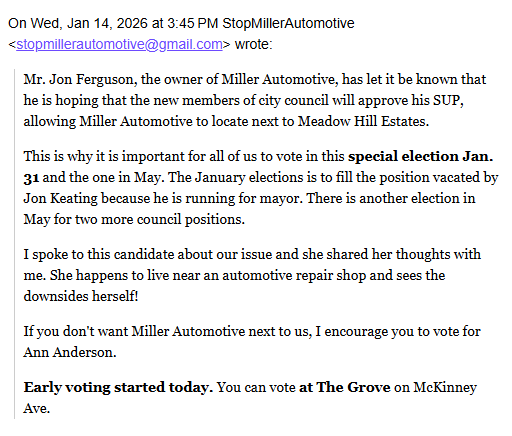
Frisco Chronicles has received multiple complaints from residents of Meadow Hill Estates after an email landed in what appears to be every single email inbox in the community. The message, sent from a Gmail account — StopMillerAutomotive@gmail.com — urged residents to vote in the Frisco Special Election for Ann Anderson.
The writer of the email openly states “I spoke to this candidate about our issue” which is problematic since he never gave the other candidate a chance to share their view on the community’s issue. Based on one conversation with only one candidate you then send an email to your entire community telling them how to VOTE? Did the writer of this email do any research into other projects where citizens objected to something nearby their home and if Ann Anderson supported it.
For example, Universal Kids! Ann Anderson spoke on 2/7/2023 in FAVOR of Universal Studios. She ignored the numerous residents who lived in Cobb Hill and throughout Frisco, that came out and said they did not want a theme park that close to their community because of the noise, traffic and potential crime it could bring. Ask residents today if it has affected their home values in that community and how many Airbnb’s now exist there. She said at the forum the other day we need to be mindful of where we place projects near communities and used the hospital power plant as an example, yet she was in Favor of Universal Kids which is going to have roller coasters looking into people’s backyard! Her words and actions – DON’T MATCH!
That raised an obvious question residents can’t shake: How does a random Gmail account suddenly have the private email addresses of an entire neighborhood?
Not a Guessing Game — It’s a Privacy Issue
Residents aren’t speculating for sport. They’re concerned because there are only a few realistic ways someone could obtain a complete HOA email list:
Through HOA records
Through property management systems
Through board-level access to resident data
Those email addresses are not public information. They are collected for official HOA business, not political campaigning.
From the complaints we received, many residents believe the sender may be a current HOA board member or someone with inside access to HOA records.
The Meadow Hills Estates Facebook Page Raises More Questions
Adding fuel to the fire, residents pointed us to the Meadow Hill Estates Facebook page, which states it is “run by volunteers.” That page has posted about Miller Automotive on December 10, 2025 and several other times throughout the past year.
The overlap between the campaign email content and the Facebook posts has residents asking whether the same individual — or group — is behind both. And if so, how much access do they really have?
HOA Data Is Not Personal Property
Here’s the part that matters most. If a board member obtained residents’ email addresses solely because of their position, those addresses are HOA property, not personal contacts. Using them for anything outside official HOA business — especially electioneering — is widely considered improper and, in many cases, explicitly prohibited.
HOA board members have a fiduciary duty to act in the best interest of the association — not personal political agendas. Using confidential resident data to influence a city election crosses a line that residents say should never be blurry.
Texas Attorney General Complaint Incoming
According to one Meadow Hill Estates resident, a formal complaint is being filed with the Texas Attorney General regarding the use of private HOA data for political purposes. That makes this more than neighborhood drama — it’s a legal and ethical issue.
We Reached Out to 4Sight Property Management
Frisco Chronicles contacted 4Sight Property Management, which oversees Meadow Hill Estates, asking the following: Did your company approve or authorize this email? Do you have rules or policies governing how HOA board members may use resident contact information? What safeguards exist to prevent misuse of confidential HOA data? We are currently awaiting their response and will update readers when one is received.
The Bigger Question
This isn’t about whether someone supports Ann Anderson or opposes Miller Automotive. It’s about trust. Residents trusted their HOA to safeguard their personal information — not turn it into a campaign mailing list. We hope Ann Anderson herself did not know about this email because if she did that it could be problematic also.
Until someone explains who hit “send” and how they had the power to do it, Meadow Hill Estates residents are left wondering whether their HOA is protecting them… or politicking with their privacy.
Stay tuned. Frisco Chronicles will follow this story wherever it leads.
Disclaimer: This blog includes satire, parody, and comic relief. It contains summarized accounts created solely for humor and commentary. Any resemblance to real events is either coincidental or intentionally satirical. Reader discretion — and a sense of humor — are advised.




I went to her to ask for help with an issue my child that was getting nowhere with the school,…
So whatever became of the $17 million dollars that the city council gave the Mayor to beautify a drainage ditch?
At last count, there are 3 different "spa/massage" businesses in the small office park at the northeast corner of John…
I literally just saw this. Yeah, she used to forward everybody’s emails behind their backs.
You're dropping truth bombs! These mom and pop shops are what should be the least of Karen's worries. If they…