On Tuesday, February 17, 2026, something curious happened at Frisco City Hall. According to a tipster who attended the meeting, while waiting in the reception area they observed Brian Livingston and Ann Anderson step off the elevator after closed session together and walk into Council Chambers prior to the meeting. Which raises a very simple question:
Did Ann Anderson attend the Executive Session?
And if she did — was that appropriate under Texas law? Let’s walk through it calmly. Facts first. Opinions later.
The Legal Framework: Texas Open Meetings Act (TOMA)
In Texas, closed meetings are governed by the Texas Open Meetings Act otherwise known as TOMA.
Executive sessions are permitted only for specific reasons — legal advice, personnel matters, real estate negotiations, and similar narrow categories. Attorney consultations fall under § 551.071.
Who May Attend Executive Session?
Sworn-in members of the governing body
The city attorney
Staff whose presence is necessary
Individuals whose participation is necessary to the subject being discussed
Notice a key word there: necessary.
Was Ann Anderson a Member of the Council?
That is the critical question.
The election was canvassed at a special meeting on 2/10/26.
A recount request was filed and accepted.
The City delayed the swearing-in pending the recount.
Therefore, on February 17, she had not taken the oath of office.
Under Texas law, an elected official becomes a member of the governing body only after qualification for office — which includes taking the oath. Until that oath is administered, a person is generally considered a private citizen. The law does not automatically grant access to someone who is merely a “candidate” or “apparent winner.”
So, the question becomes: If she had not been sworn in, on what legal basis could she attend executive session?
The Frisco City Charter
The Frisco City Charteris the foundational legal document that creates the city’s government and spells out how it operates, what powers it has, how officials are elected, how meetings are run, and what limits exist on authority.
Section 5.05, “Taking of Office” states:
Each newly elected person shall be inducted into office at the first regular meeting following the official canvass.
At such meeting the oath shall be administered in accordance with the Charter.
Was the election finalized? No, because an official recount was filed and accepted by the city. In fact, Angelia Pelham had to come in and certify the request. A recount does not automatically invalidate the canvass — it just re-examines the totals. But if the city intentionally delayed the swearing-in pending the recount (which the city did), then she technically remains a private citizen until the swearing-in.
That distinction matters.
The “Unauthorized Person” Question
The Candidate’s Status: Until a candidate is officially declared the winner and sworn in, they are legally a member of the public. The Texas Attorney General has repeatedly opined that a governmental body may not admit “selected members of the public” to an executive session (Op. No. GA-0511).
Attorney-client privilege during executive session depends on confidentiality. If a non-member — meaning someone not yet sworn in — is present during a § 551.071 consultation, does that risk waiving privilege?
As established in the 2026 Open Meetings Act Handbook, the presence of an unauthorized third party (Ann Anderson) during a § 551.071 consultation destroys the confidentiality required for the attorney-client privilege. The Texas Attorney General Opinion GA-0511 makes clear that a governmental body may not admit “selected members of the public” to executive session.
If that candidate is in the room while the City Attorney gives advice on a lawsuit or a contract, it is possible that the entire discussion becomes discoverable. Opposing counsel in that lawsuit can depose the candidate and the council members about exactly what was said.
Waiver of Attorney-Client Privilege
This is the biggest “red flag” for a City Attorney. Supposedly, for the attorney-client privilege to remain intact, the communication must stay between the client (the city, as represented by the Council) and the lawyer.
• The Potential Risk: If an outside third party (the candidate) is present, the privilege is waived.
• The Potential Consequence: Opposing counsel in a lawsuit or a citizen filing a Public Information Act (PIA) request could argue that the entire discussion is now “discoverable” because it was shared with a third party.
Potential Penalties (The “Rule Violations”)
Criminal Liability: Under § 551.144, a member of a governmental body commits a Class B misdemeanor if they knowingly call, aid, or participate in a closed meeting that is not permitted by law. READ THAT AGAIN
The “Aiding and Assisting” Rule: The leading guidance on this comes from Texas Attorney General Opinion JC-0307. It clarifies that a person who is not a member of the governmental body can indeed be charged with a criminal violation of TOMA under the Texas Penal Code’s “Law of Parties.” The logic behind that is if a non-member (an unseated candidate) “acting with intent, aids or assists” a member who is knowingly violating the Act, they are just as criminally liable as the official. Does that mean Anderson commit a crime?
Civil Voiding: Any action taken or decided upon based on that illegal executive session could be declared void by a court (§ 551.141).
Frisco Charter Compliance: The Frisco City Charter requires the Council to follow state law. A violation of TOMA is, by extension, a violation of the city’s own governing rules.
Are there any exceptions? The only way a candidate could legally attend is if the Council determines their presence is necessary to the matter under discussion and their interests are not adverse to the city’s (AG Op. No. JC-0375). For example, if the candidate was a witness to a specific incident being discussed, they might be brought in to provide facts, but they should generally be excused once the legal deliberation begins. Observation: “Watching” to get a head start on the job does not count as “necessary” under Texas law.
The City Attorney Professional Responsibility & Risk
The State Bar Factor: Supposedly, if a City Attorney allows an unseated candidate into an executive session, they are effectively failing to protect the “privilege” of their actual client (the City). This could be a violation of the Texas Disciplinary Rules of Professional Conduct (specifically Rule 1.01 regarding competent representation and Rule 1.05 regarding confidentiality).
Reporting Criminal Violations (The District Attorney): Since knowingly participating in an illegal closed meeting is a Class B misdemeanor in Texas, the primary enforcement authority is the local District Attorney (DA). That means Frisco Residents should demand that the Collin County District Attorney look into this issue! Most Frisco City Council meetings take place at City Hall in Collin County. Write your Collin County District Attorney and demand they investigate and file a complaint for them to look at this. The more residents they hear from the better.
We were curious, what would the Texas Attorney General think about all this. Well, from what we could find, the OAG has been very consistent: Until a candidate is sworn in, they are legally a member of the public. The OAG has built a “three-pillar” framework that makes admitting an unsworn candidate to an executive session, especially in a contested race—a high-stakes legal gamble for the City Council.
1. The “No Selected Public” Rule (GA-0511): One of the most cited opinions on this is GA-0511 (2007). It poses the question: Can a governmental body let some members of the public in while keeping others out?
The Verdict: No. The OAG concluded that a governmental body may not admit “selected members of the public” to a meeting closed under the Texas Open Meetings Act (TOMA).
The Application: Since an unsworn candidate has no official status, admitting them is effectively admitting a “selected member of the public.” This violates the core intent of the Act.
2. The “Necessity and Adverse Interest” Test (JC-0375): Opinion JC-0375 (2001) sets the bar for when a non-member can be in the room. For a third party to attend, two conditions must be met:
1. Their presence must be necessary in relation to the matter under discussion (e.g., they have specific facts).
2. Their interests must not be adverse to the governmental body.
The Conflict: In a contested race, an unsworn candidate almost certainly fails the “adverse interest” test. If the legal advice involves election procedures, ballot disputes, or city liabilities, that candidate has a personal interest that is distinct from (and potentially adverse to) the City’s official interests.
3. The Criminal Liability Hook (JC-0307): Opinion JC-0307 (2000) should be the one that keeps City Attorneys up at night. It clarifies that non-members can be charged with a criminal violation of TOMA.
Lasty, if a candidate knows the session is illegal and participates anyway, or if the City Attorney “aids or assists” the council in holding this illegal session, they can be prosecuted under the Texas Penal Code’s “Law of Parties.
In A Nutshell – Potential Consequences (If Improper)
If an executive session includes someone not legally permitted confidentiality could be challenged. Discussions could become discoverable in litigation. Any action based on that discussion could be subject to challenge under § 551.141. § 551.144 provides criminal penalties for knowingly participating in an unlawful closed meeting.
Again — these are statutory realities, not blog hyperbole.
The Questions Are Simple
If Ann Anderson was not yet sworn in:
Was she considered a “member” under TOMA?
Was her presence formally deemed “necessary”?
Was that determination documented?
Did the City Attorney advise that her presence would not jeopardize privilege?
If the election was still under recount, did that create a potential adverse-interest problem?
Residents deserve clarity.
JDHQ HOTELS LLC Lawsuit…
The city is currently involved in litigation with JDHQ Hotels LLC. If legal advice about active litigation was discussed during executive session, and if an unauthorized individual was present, could opposing counsel raise questions about privilege?
It is not unreasonable to ask.
Closing Thoughts
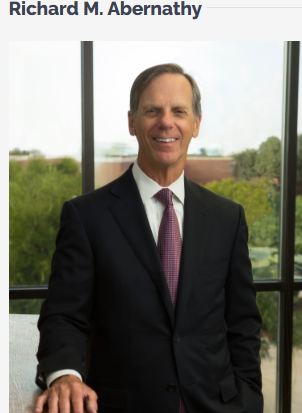
In conclusion, did they all know they could be breaking the law? Did any of them question if Ann Anderson should be engaged in closed session? We are filing PIR’s now for more information. In the meantime, Frisco Residents should be up in arms! The arrogance of the City Council, The Mayor, The City Attorney and City Manager it displayed at Tuesday’s council meeting was on a level never seen before. Should John Keating, who has spent 18+ years in local government, have known better? He is asking to be your next Mayor so shouldn’t he understand TOMA better than anyone as he is the longest sitting person on that dais? Angelia Pelham, Mayor Pro Tem and Laura Rummell, Deputy Mayor Pro Tem should have known better, or they should not have the label Mayor Pro Tem and Deputy Mayor Pro Tem. Should we re-elect Laura Rummell when her actions potentially put the city at risk. Should the city hire a new City Attorney? One might expect or think that Richard Abernathy, our current city attorney, should have stopped what happened at Tuesday’s closed session before the city council meeting.
The city leadership continues to break the rules, and they act as if they just don’t care! They throw it in the face of residents daily! In the three years I have done this blog, I thought I had seen everything. Truly nothing has angered me more than the blatant disrespect to the election process, oath of office process, and to the TOMA rules and Texas Law that each person in that meeting committed Tuesday night.
We would also like full disclosure to anything in that meeting and we plan to file a PIR for it and fight it all the way to the Texas Attorney General’s Office. Based on Texas Law and previous OAG opinions – I think we will win!
This is not about personalities. It is about process. It is about whether the oath of office matters. It is about whether executive session rules apply evenly — or flex depending on convenience. If the City delayed the swearing-in pending recount, then by its own action it recognized that the office had not yet been assumed. So which is it?
Was she a private citizen?
Or was she functioning as a council member?
Because under Texas law, you cannot be both! If everything was done properly, the City should have no issue explaining.
We are not alleging wrongdoing. We are asking for clarity. And in government, clarity should never require a Public Information Request to obtain.
Disclaimer: This blog includes satire, parody, and comic relief. It contains summarized accounts created solely for humor and commentary. Any resemblance to real events is either coincidental or intentionally satirical. Reader discretion — and a sense of humor — are advised.
Back in 2023, one of our earliest blogs focused on the Texas Public Information Act — the law that ensures citizens have access to records showing what their government is doing on their behalf. Transparency is not a courtesy; it is a legal obligation.
Since then, residents regularly contact us with questions about Public Information Requests (PIRs). Sometimes they’re confused by the process. Sometimes they’re overwhelmed by what they receive. And sometimes, they suspect they’re being buried in paperwork rather than given what they actually asked for.
Recently, a resident forwarded several PIR responses and expressed frustration. They felt they were being flooded with documents but not real answers. They hoped we might spot something they missed.
We did!
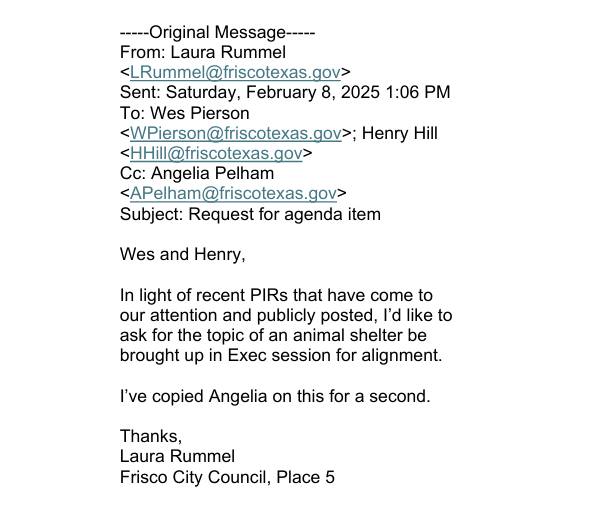
Among the documents was a February 8, 2025 email from Councilwoman Laura Rummell to City Manager Wes Pierson and Assistant City Manager Henry Hill, with Angelia Pelham copied:
“In light of recent PIRs that have come to our attention and publicly posted, I’d like to ask for the topic of an animal shelter be brought up in Executive Session for alignment.”
Let’s pause right there. “In light of recent PIRs…”
Not pending litigation. Not a personnel matter. Not real estate negotiations.
PIRs.
The Pushback
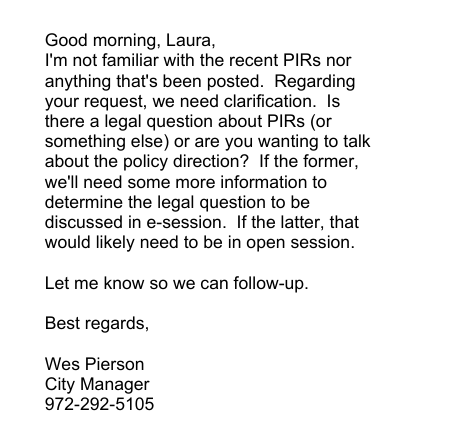
On February 11, 2025, Pierson responded that he was not familiar with the recent PIRs or what had been posted. He asked for clarification: Was there a legal question related to the PIRs? Or was she seeking policy direction?
He stated clearly that if it was policy direction, it would likely need to be discussed in open session.
Avoiding public scrutiny — or reacting to public records requests — is not on that list.
Separately, the Texas Public Information Act governs what records must be released. You do not make something confidential simply by discussing it in executive session. Closed doors do not create confidentiality by magic.
Why Copy Angelia?
Rummell copied Angelia Pelham “for a second.”
A second what? A second vote? A second opinion? A second set of marching orders?
We are not alleging how anyone would vote. But when one council member seeks “alignment” on moving a controversial topic into executive session — particularly in response to public records being released — reasonable citizens are going to ask reasonable questions.
Council members are permitted to discuss city business in limited ways. But deliberating outside public view in ways that circumvent open meeting requirements is exactly what TOMA was designed to prevent.
“Receive legal advice regarding proposed interlocal agreement with Collin County, Texas, and other political subdivisions for the use of the Collin County Animal Shelter and related issues.”
The Animal Shelter and proposed holding facility have been one of the most discussed issues in Frisco over the last several months. Residents have raised concerns at town halls, council meetings, and special sessions. So why is such a heavily debated issue about the Collin County Animal Services ILA headed into executive session?
Legal advice can properly be discussed in closed session. But policy direction? Alignment? Messaging? Those belong on the dais — under the lights — where the public can hear it.
The Consent Agenda Shuffle
Then there’s Item #24 on the Consent Agenda: An annual contract modification for payment to Collin County in the amount of $651,774 — along with rescinding prior council approval from February 3, 2026.
For those unfamiliar, consent agenda items are typically passed in one vote with little to no discussion unless pulled by a council member. A $651,774 contract modification tied to a controversial shelter arrangement seems like the kind of item that deserves public discussion — not a quiet glide path.
This isn’t about whether the city can receive legal advice. It can. This isn’t about whether executive session is ever appropriate. It is.
The question is motive. If executive session is being used as a shield in response to public information requests — if alignment is happening out of view of the public or because documents became public — then that is precisely what TOMA was designed to prevent.
Transparency does not end where discomfort begins.
Spotlight Moment
We have serious concerns and YOU SHOULD TOO!
A councilwoman asking to move a hot-button issue into executive session “in light of recent PIRs.” A city discussing a controversial shelter agreement behind closed doors. A six-figure contract modification sliding onto the consent agenda.
Maybe it’s all perfectly lawful. Maybe it’s all procedural. Maybe it’s all coincidence.
Or maybe Frisco residents are simply asking to see their government operate in the sunlight instead of the shadows.
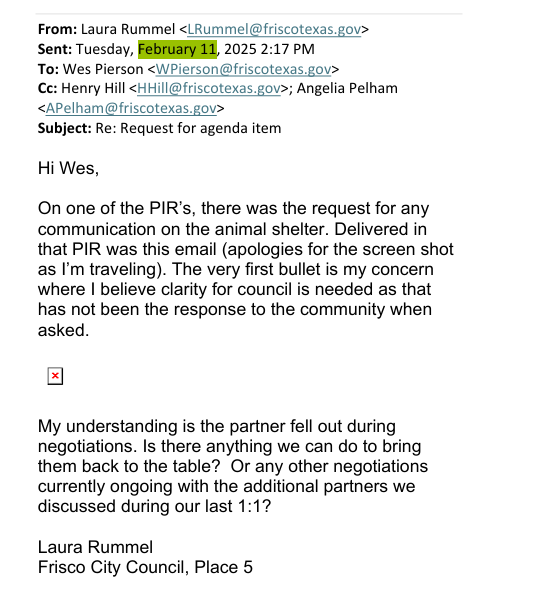
Laura Rummell has championed this holding facility which many local animal advocates OPPOSE and calling it a Temporary Execution Hold Facility. Rummell’s email states, “the very first bullet is my concern where I believe clarity for the council is needed as that has not been the response to the community.” What response have you all been giving the community? Is this an admission they have been feeding the public one thing when in the background they are either doing something else or have no plan at all?
If everything is above board, then put it above the table. Discuss it openly. Debate it publicly. Vote on it transparently.
Because when public records trigger closed doors, citizens don’t stop asking questions. They start asking better ones like Laura Rummell, what are you hiding?
Links:
The Public Information Act Handbook can be found on the Texas Attorney General’s website and lays out the “how-to” to do open record requests.
Disclaimer: This blog includes satire, parody, and comic relief. It contains summarized accounts created solely for humor and commentary. Any resemblance to real events is either coincidental or intentionally satirical. Reader discretion — and a sense of humor — are advised.
Alright, grab your popcorn —this one has all the makings of a classic Frisco Chronicles feature: money, media, and that familiar scent of roses wafting through the pages of the Dallas Morning News.
All Good in the Frisco Hood: Brought to You by… Medium Giant?
By now, longtime Frisco residents have noticed a curious phenomenon. Whenever the Dallas Morning News (DMN) writes about Frisco, the city sparkles. Streets are shinier. Leadership is visionary. Problems? What problems? If Frisco had potholes, DMN would probably call them “community engagement craters designed to slow traffic and save lives.”
Which raises the obvious question: why does Frisco always smell like roses in the DMN? Not weeds. Not smoke. Roses.
For years, residents have speculated. Maybe DMN is afraid of being cut off from exclusives. Maybe access journalism is alive and well. Or maybe—just maybe—it’s about the oldest motivator in local government and media alike: Money.
Enter Stage Left: Medium Giant
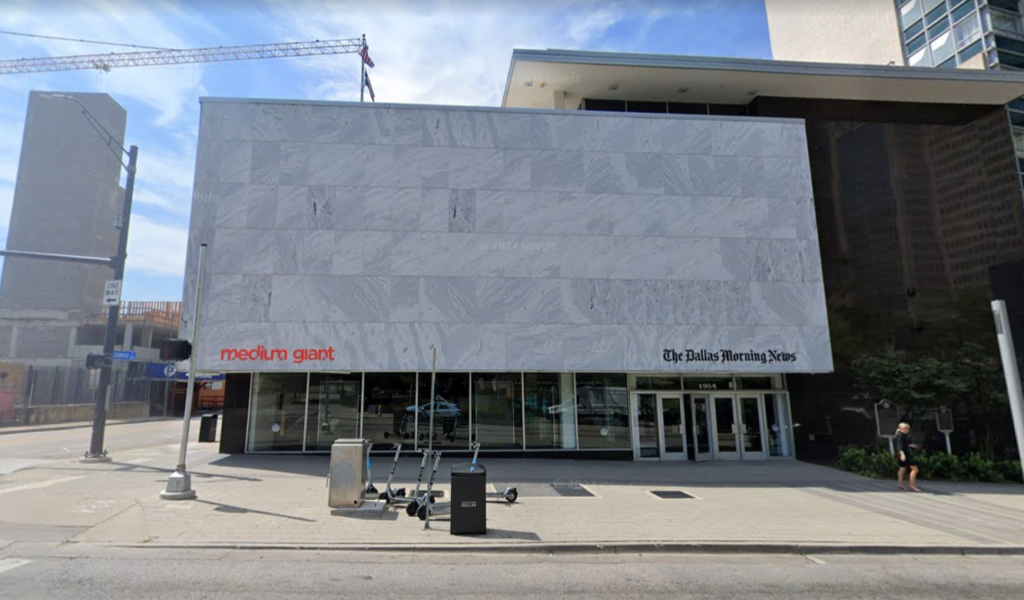
Here’s where things get interesting. A sharp-eyed reader recently connected a few dots that deserve a closer look. The Frisco Economic Development Corporation (FEDC) has entered into several contracts over the years with a company called Medium Giant.
Whose Medium Giant, you ask?
They’re an “integrated creative marketing agency.” Which is marketing-speak for we make things look good. Even better? Medium Giant just happens to be the sister company of the Dallas Morning News.
Cue the dramatic music. So now the question isn’t why DMN never seems to publish critical reporting on Frisco or its leadership. The question becomes: would they dare?
Follow the Money (Because It Always Tells a Story)
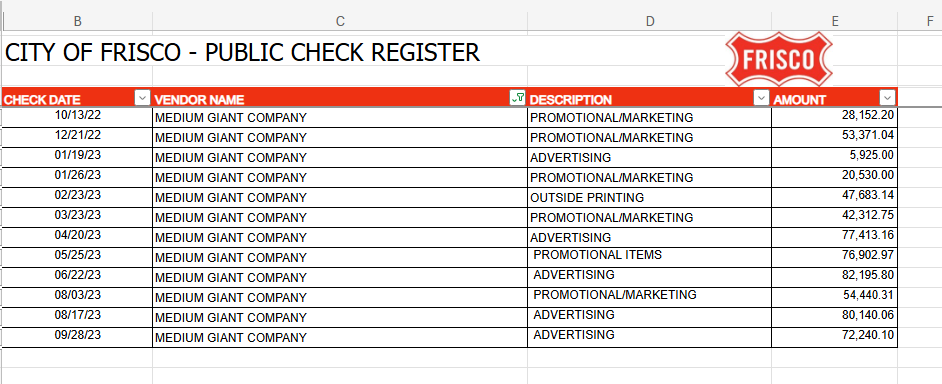
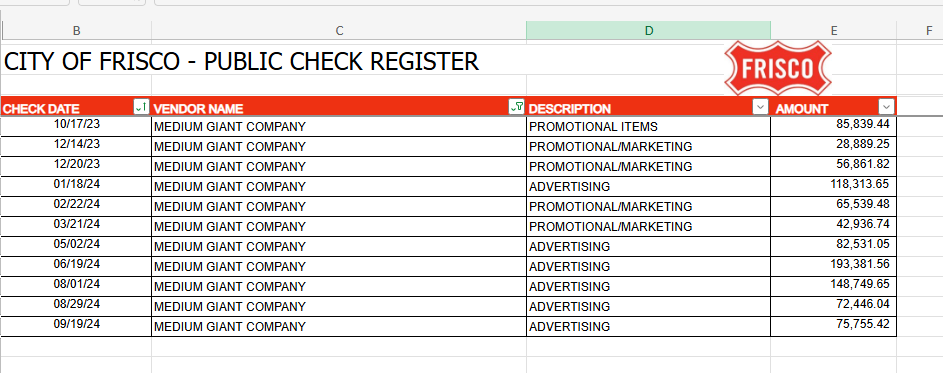
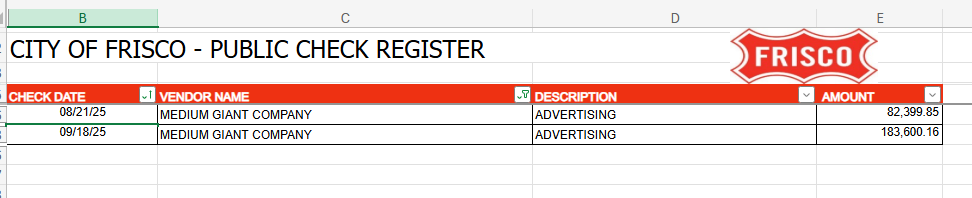
When we reviewed city check registers, we noticed multiple payments over the years made to Medium Giant. Not chump change. Not lunch money. Not “oops, forgot to expense that Uber.”
The total? $2,105,631.76
That’s over two million dollars paid by Frisco entities to a company tied directly to the same organization responsible for shaping Frisco’s public narrative in one of North Texas’ largest newspapers.
Now, we’re not saying this proves corruption. We’re not saying there’s a secret smoky backroom with editors and city staff clinking champagne glasses. We’re not even saying there’s an explicit quid pro quo.
What we are saying is this: If you were the DMN, would you risk torching a relationship connected—directly or indirectly—to a $2 million revenue stream by publishing hard-hitting, unvarnished reporting about Frisco’s leadership, finances, or controversies?
Hit Pieces for Some, Rose Petals for Others
What makes this dynamic even more eyebrow-raising is DMN’s recent track record. The paper has shown it’s perfectly willing to publish aggressive, sometimes glowing-less-than-rose-scented coverage of candidates who fall outside the Frisco inner circle.
Just ask: Jennifer White, Mark Piland, John Redmond
Funny how the gloves come off for political outsiders, but stay neatly folded when it comes to City Hall, current council members, and current city leadership.
Journalism, Marketing, or a Blurred Line?
Let’s be clear: Medium Giant being a marketing firm isn’t inherently wrong. Cities hire marketing agencies all the time. But when the marketing arm and the newsroom live under the same corporate roof, the public has every right to question whether the coverage they’re reading is journalism… or brand management.
Because from where residents sit, the pattern looks less like watchdog reporting and more like: “Frisco: Presented by Medium Giant, distributed by DMN.”
Final Thought
Transparency isn’t just about open records and posted agendas. It’s also about who controls the narrative—and who’s being paid behind the scenes while that narrative is shaped.
Two million dollars isn’t small change. It’s not accidental. And it certainly isn’t irrelevant.
So the next time you read a glowing DMN article telling you everything in Frisco is just peachy, ask yourself: Is this news… or is this advertising with better grammar?
Disclaimer: This blog includes satire, parody, and comic relief. It contains summarized accounts created solely for humor and commentary. Any resemblance to real events is either coincidental or intentionally satirical. Reader discretion — and a sense of humor — are advised.
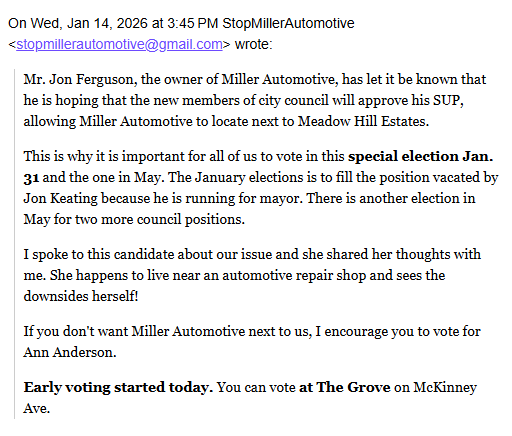
Frisco Chronicles has received multiple complaints from residents of Meadow Hill Estates after an email landed in what appears to be every single email inbox in the community. The message, sent from a Gmail account — StopMillerAutomotive@gmail.com — urged residents to vote in the Frisco Special Election for Ann Anderson.
The writer of the email openly states “I spoke to this candidate about our issue” which is problematic since he never gave the other candidate a chance to share their view on the community’s issue. Based on one conversation with only one candidate you then send an email to your entire community telling them how to VOTE? Did the writer of this email do any research into other projects where citizens objected to something nearby their home and if Ann Anderson supported it.
For example, Universal Kids! Ann Anderson spoke on 2/7/2023 in FAVOR of Universal Studios. She ignored the numerous residents who lived in Cobb Hill and throughout Frisco, that came out and said they did not want a theme park that close to their community because of the noise, traffic and potential crime it could bring. Ask residents today if it has affected their home values in that community and how many Airbnb’s now exist there. She said at the forum the other day we need to be mindful of where we place projects near communities and used the hospital power plant as an example, yet she was in Favor of Universal Kids which is going to have roller coasters looking into people’s backyard! Her words and actions – DON’T MATCH!
That raised an obvious question residents can’t shake: How does a random Gmail account suddenly have the private email addresses of an entire neighborhood?
Not a Guessing Game — It’s a Privacy Issue
Residents aren’t speculating for sport. They’re concerned because there are only a few realistic ways someone could obtain a complete HOA email list:
Through HOA records
Through property management systems
Through board-level access to resident data
Those email addresses are not public information. They are collected for official HOA business, not political campaigning.
From the complaints we received, many residents believe the sender may be a current HOA board member or someone with inside access to HOA records.
The Meadow Hills Estates Facebook Page Raises More Questions
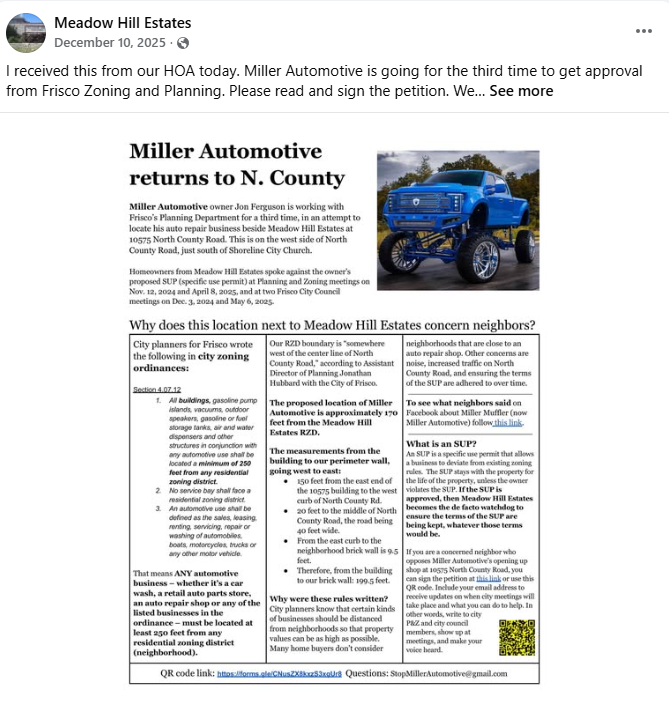
Adding fuel to the fire, residents pointed us to the Meadow Hill Estates Facebook page, which states it is “run by volunteers.” That page has posted about Miller Automotive on December 10, 2025 and several other times throughout the past year.
The overlap between the campaign email content and the Facebook posts has residents asking whether the same individual — or group — is behind both. And if so, how much access do they really have?
HOA Data Is Not Personal Property
Here’s the part that matters most. If a board member obtained residents’ email addresses solely because of their position, those addresses are HOA property, not personal contacts. Using them for anything outside official HOA business — especially electioneering — is widely considered improper and, in many cases, explicitly prohibited.
HOA board members have a fiduciary duty to act in the best interest of the association — not personal political agendas. Using confidential resident data to influence a city election crosses a line that residents say should never be blurry.
Texas Attorney General Complaint Incoming
According to one Meadow Hill Estates resident, a formal complaint is being filed with the Texas Attorney General regarding the use of private HOA data for political purposes. That makes this more than neighborhood drama — it’s a legal and ethical issue.
We Reached Out to 4Sight Property Management
Frisco Chronicles contacted 4Sight Property Management, which oversees Meadow Hill Estates, asking the following: Did your company approve or authorize this email? Do you have rules or policies governing how HOA board members may use resident contact information? What safeguards exist to prevent misuse of confidential HOA data? We are currently awaiting their response and will update readers when one is received.
The Bigger Question
This isn’t about whether someone supports Ann Anderson or opposes Miller Automotive. It’s about trust. Residents trusted their HOA to safeguard their personal information — not turn it into a campaign mailing list. We hope Ann Anderson herself did not know about this email because if she did that it could be problematic also.
Until someone explains who hit “send” and how they had the power to do it, Meadow Hill Estates residents are left wondering whether their HOA is protecting them… or politicking with their privacy.
Stay tuned. Frisco Chronicles will follow this story wherever it leads.
Disclaimer: This blog includes satire, parody, and comic relief. It contains summarized accounts created solely for humor and commentary. Any resemblance to real events is either coincidental or intentionally satirical. Reader discretion — and a sense of humor — are advised.
In our last blog, we looked at Mayor Cheney “in his own words.” And one thing became painfully clear: residents and business owners have more questions than answers. We pointed out that our very own Mayor somehow became the “Official Realtor” of the Rail District and proudly used this in his marketing. Not sure how that happened? Neither are we. Seems like a convenient title to slap on it when you’re the guy with the gavel and the guy with the yard signs. But here’s the question that really matters today:
Who’s knocking on Main Street’s doors right now?
Not the shoppers looking for a boutique candle. Not the residents grabbing tacos or a cup of coffee. Not the neighbors wanting to support local businesses. Are businesses in The Rail District getting visits from investors, developers, and opportunists? Folks who see dollar signs where you see memories. They’re not coming with a smile and a handshake — they’re coming with contracts and cash offers. Are property owners being pressured to sell?
Are these small businesses — the ones who fought through COVID shutdowns, construction dust, and skyrocketing rents — now staring down the possibility of being bought out, flipped, and priced out. Let’s call it what it is: cashing in on a revitalized downtown.
We received this email, which left us with numerous questions. It takes a lot for businesses in Frisco to reach out, because many fear retaliation for speaking up. We commend Randy for speaking up and after reading his email, we are alarmed! We are publishing the entire contents as we received it.
Dear Whistleblower,
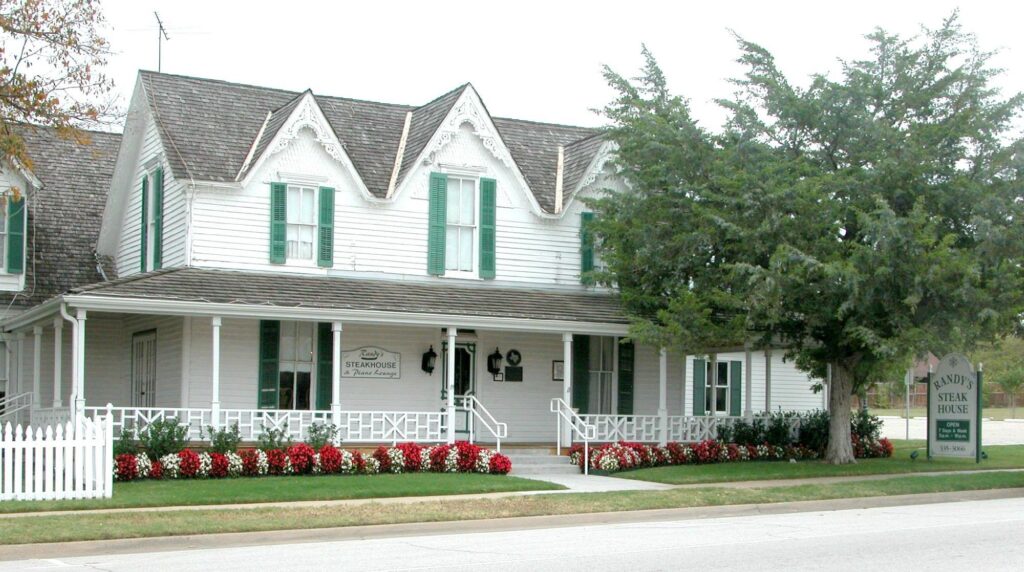
My name is Randy Burks, and I own Randy’s Steakhouse in downtown Frisco. Someone suggested I reach out to you regarding an experience I had that raises serious concerns.
Recently, I attended a meeting between Frisco city staff and downtown merchants about the ongoing Main Street construction. During the meeting, one merchant stated that 14 businesses had already closed due to the project. A city staff member laughed and asked whether those businesses closed because of the construction or because they were “bad operators.”
At that moment, no one in the room knew that I was facing severe financial difficulties—bouncing checks, draining my wife’s and my savings, and borrowing from family just to keep the doors open after 32 years in business. I stood up and told the group that Randy’s Steakhouse maintains 4.7 stars on OpenTable and 4.4 stars on Google, ranking among the top restaurants not only in Frisco but across the Metroplex. I asked if they thought I was a “bad operator.” It was humiliating to be forced to share personal financial struggles in front of both city staff and fellow merchants.
Other merchants then spoke up, saying their businesses were down 60–65% due to the construction. Just a few hours later, I received a text message from Jason Young asking if I was interested in selling my restaurant. While I’ve always been open to retirement discussions at a fair price, the timing felt far from coincidental.
We arranged to meet at 8:30 PM that evening, though he did not arrive until 9:00. He brought with him a man he introduced as Mark Hill, an attorney who he claimed worked with the CDC. Instead of discussing a purchase, Jason asked personal questions about my wife and daughter, while Mark Hill walked around the restaurant taking photos. After a while, I excused myself, angry that my time had been wasted.
The next day, Jason texted me an offer of $2 million for my restaurant. I replied that I would not sell for less than $4 million. Since then, I have heard—but cannot confirm—that his restaurant group includes investors such as Mayor Cheney and Donny Churchman.
I feel compelled to share this because of the sequence of events—the city staff’s dismissive remarks, Jason Young’s immediate outreach, and the potential involvement of city leadership—raises serious concerns of conflict of interest.
Thank you for taking the time to read this. I am prepared to provide additional details, messages, or documentation if helpful.
Sincerely,
Randy Burks
Randy’s Steakhouse
“Déjà Vu: Same Block, Different Spin”
While many love to believe we are biased here at Frisco Chronicles, we do try to be fair! We reached out to Jason Young with some of our questions, and he quickly responded. His comments are intertwined with our questions below.
1. What city staff member would laugh when a merchant says 14 businesses have closed already due to this project and after laughing ask if the business closed due to construction or because they were “bad operators?” We talked to a source inside that meeting, and allegedly that staff member was Ben Brezina, Assistant City Manager. Currently, we have no confirmation from the city Brezina was the staffer with the horrible attitude.
2. The timing of Jason Young’s text message to Randy Burks – is it strategic? Is it coincidental? Hours after Randy pours his heart out at a city meeting, another local business owner who happens to also be a developer is reaching out. Just based on the optics, it doesn’t look good, in fact it looks bad, and it also feels very dirty in our opinion.
We asked Jason Young this question and Jason replied, “I’m not sure what you mean by city meeting or circumstances or timing. I reached out to him because my friend had recently finished restoring a property in Downtown (city) and was looking for a new project. We also are looking at a similar historic home opportunity in Downtown (city) as a potential bed and breakfast, event venue or restaurant. I have projects in Downtown (city) and (city) as well. Our focus is on old downtowns in North Texas. **Anywhere there was a city name, we removed it**
3. Mark Hill? Mark Hill who is a Frisco ISD Board Member? Mark Hill who is a member of the City of Frisco CDC Board? Why was Mark Hill allegedly taking photos of Randy Burks’ property? Is Mark Hill the attorney of record for Jason Young’s business? We go back to one word every time … OPTICS!!! The way Randy describes it, it looks bad, it feels dirty, and you can’t blame him for asking the questions or for feeling the way he does. It does not feel random! It does not feel organic!
We asked Jason Young, when you went to visit Randy steakhouse, you brought with you Mark Hill. Is he your attorney of record? Because the optics of it look as if someone from the EDC or CDC board came to scope out of business. Why would Mark Hill attend the meeting.
Young replied, “The day I visited Randy I by happenstance was with Mark. I told him I was gonna go visit Randy and invited him to come with me to grab a burger at the bar while we chatted which we did. I’ve known Randy for 20 years, used to go weekly to eat from like 2004-2010 until I started dating my wife and she said no more lol. Randy and I served on Frisco Convention and Bureau Board together. I hadn’t seen him in 8 years or so and Mark and I ate at the bar and caught up with Randy. He shared some health concerns, and he gave me a tour of his kitchen.
4. The 2-million-dollar text? Why would you text someone an offer for their business? Why not pick up the phone or send an email with the offer? To us, after reading Randy’s letter, it felt like a fishing expedition on Young’s part, which made us wonder what he would use that intel for? Again, that is how we FELT, there is no evidence that it was a fishing expedition. Given how we felt, we can fully understand why Randy is questioning the sequence of events and potential conflicts of interest. The OPTICS don’t look good.
In talking to Jason Young he stated, “It was simply a text question asking if he would be interested in selling to which he responded yes. So, I went and chatted with him for a few hours. The next day we had a text exchange about a value which we didn’t agree on and he said no hard feelings. It was very brief. No ill intent, just a question.”
5. Three Empires Brewing
After reading the letter our natural reaction was to dig deeper. In that quest, we heard Jason Young may have also invested in Three Empires Brewing on Main Street. What we find interesting about that potential investment, is the owners of TEB back on September 4, 2024, went before city council during citizens input to tell the council the construction is taking a toll on their small family-owned business which they had put their life savings into.
In our conversation with Jason Young, we asked him if he had made offers to any other downtown businesses. Young replied, “In Sept of 2024, I made an investment in a minority percentage of Three Empires Brewing. In early July 2025, I had a brief conversation with Randy regarding the Steakhouse. In late August, another RD business approached me about potentially replacing one of its partners and I declined.”
We expressed our concern about the optics to Jason Young and flat out asked him if he has any business dealings with Mayor Cheney or Jeff Cheney Real Estate Mogul. Young replied, “I have no business dealings with Jeff. He is not at all and never has been an investor of mine.”
In The End: We are just Dazed & Confused
We go back to THE OPTICS … it does not look good! To a “Regular Ole Joe,” it comes across as if a downtown business is in trouble due to the impacts of the construction. That business then goes before the city council during citizens’ input and asks for help to stop the bleeding from the construction. Next thing you know, Jason Young is reaching out to say hi! Oh, and wants to know if you are interested in selling or need an investor for your business. It doesn’t sound good, does it?
We mentioned to Jason Young in our communication that he is a respected member of our community, and he is an influencer on social media; what he says carries weight with many people. In the past, he has been strong in defending the city and council members. Unfortunately, that does not help the optics of this situation.
Randy Burks has every right to question the sequence of events because it does not feel like this meeting happened organically. Unfortunately, that is the optics of the situation. We have reported both sides and it is up to residents to determine what they believe is the truth.
For us here at Frisco Chronicles, after Mayor Cheney’s remarks today on his Facebook page, it does not feel like this is about “progress” or “vibrancy” — it feels like it is about control. We believe there are potentially more players trying to buy up Main Street, lot by lot, brick by brick? That leaves us wondering, who gets to decide what Frisco’s history is worth, and at what price? Only time will tell …
For Residents: Get Out! Go Downtown! Shop Frisco First! #SAVEMAIN
To be blunt: Shop, Eat Frisco First! If you do, you could be saving one of these businesses from having to open their doors to an investor or developer. By shopping and eating FRISCO FIRST, you are saving Main Street’s soul from being put on the negotiating table. #SaveMain isn’t just a slogan. It’s a warning. Because once the doors close and the deals are done, Main Street won’t look like Main Street anymore. It’ll look like somebody’s investment portfolio.
For more information visit SaveMain’s website: click here
For more information on The Rail District: click here
Disclaimer: The information presented in this blog post is based on publicly available records and sources believed to be accurate at the time of publication. Frisco Chronicles and its authors do not guarantee the completeness or reliability of this information and cannot be held responsible for any errors, omissions, or outcomes resulting from its use. All individuals are presumed innocent until proven guilty in a court of law. This content is provided for informational and commentary purposes only and should not be construed as legal, professional, or personal advice.











I went to her to ask for help with an issue my child that was getting nowhere with the school,…
So whatever became of the $17 million dollars that the city council gave the Mayor to beautify a drainage ditch?
At last count, there are 3 different "spa/massage" businesses in the small office park at the northeast corner of John…
I literally just saw this. Yeah, she used to forward everybody’s emails behind their backs.
You're dropping truth bombs! These mom and pop shops are what should be the least of Karen's worries. If they…