While most Frisco residents are busy working, raising families, paying bills, sitting in traffic, and trying to enjoy the city they call home, there is plenty happening around town, behind the scenes at City Hall and throughout Frisco that deserves a little more attention.
Some headlines make the news. Some barely get noticed. Others seem to quietly slip past the public while decisions are being made, money is being spent, policies are being changed, and elected officials are busy doing what elected officials do best: hoping nobody asks too many questions. Well, we have questions.
It is time to look at the latest headlines. to decisions that deserve a closer look, Frisco Chronicles is rounding up the stories you may have seen, the stories you may have missed, and the ones that deserve a little more digging. So, grab your coffee, catch up, and ask yourself: Did I know about that? And if I didn’t, why not?
City of Frisco: Changes the Rules for Citizen’s Input
Back in June of this year, the City Council for the City of Frisco, led by Mayor Mark Hill, eliminated Public Input at City Council meetings. Frisco Chronicles finds it interesting that the Mark Hill who ran on unifying Frisco is actually lead the discussion to change public input and reduce the amount of time citizens could speak to their elected officials. From that point on, taxpayers could only provide input on posted agenda items. Recently the Facebook Page Frisco Public Input for Non Agenda Items questioned if the rules have been applied evenly to the speakers who do make it to the podium.
For example, at a September City Council meeting, Item 29 on the agenda was related to FY2027 Budget. Enter Dan Elmer who discussed budget-related matters for less than a minute then spent his time praising Councilwoman Ann Anderson for her responsiveness, taking his calls, and considering his questions.
Next Retired Fire Chief, Mark Piland took to the podium and discussed the budget process, public hearings, proposed cuts, firefighter staffing and potential funding solutions. His comments were interrupted by Mayor Mark Hill who directed him to remain on topic. According to Frisco Public Input for Non-Agenda Items, Piland responded that he was discussing the budget before continuing with firefighter staffing budget ideas.
That same evening Dan Elmer was appointed to the Frisco Housing Authority Board. The appointment alone does not establish anything improver occurred, but it does raise questions.
Are positive comments about Council members treated the same as criticism?
Are detailed budget concerns given the same flexibility as personal anecdotes?
What specific standard determines when someone must return to the agenda topic?
Shouldn’t every resident have the same opportunity to be heard, regardless of who they are or what perspective they bring?
Now fast forward to November and at last week’s city council meeting the discussion of Public Input was back on the agenda. The Frisco Insider headline reads “Frisco Plans to Bring Back Public Comments” and the Frisco.com Facebook pages led with “Public Comments Back in Frisco” but both headlines are misleading. It is not until you open the articles that they tell you how they plan to bring them back with some “MAJOR CHANGES!”
𝗪𝗵𝗲𝗻 𝗡𝗼𝗻-𝗮𝗴𝗲𝗻𝗱𝗮 𝗦𝗽𝗲𝗮𝗸𝗲𝗿𝘀 𝗔𝗿𝗲 𝗛𝗲𝗮𝗿𝗱: BEFORE: Before consent and regular agenda items
PROPOSED: At the END of the meeting
𝗦𝗽𝗲𝗮𝗸𝗲𝗿 𝗥𝗲𝗴𝗶𝘀𝘁𝗿𝗮𝘁𝗶𝗼𝗻: BEFORE: Fill out a speaker card at the meeting
PROPOSED: Register by NOON on the day of the meeting
𝗟𝗮𝘀𝘁-𝗠𝗶𝗻𝘂𝘁𝗲 𝗦𝗶𝗴𝗻𝘂𝗽: BEFORE: Accepted, even during meetings PROPOSED: Not permitted
𝗧𝗿𝗶𝗮𝗹 𝗣𝗲𝗿𝗶𝗼𝗱: BEFORE: None PROPOSED: Six months
𝗔𝗗𝗗𝗜𝗧𝗜𝗢𝗡𝗔𝗟 𝗥𝗨𝗟𝗘𝗦 𝗗𝗜𝗦𝗖𝗨𝗦𝗦𝗘𝗗
That’s not all folks! If more than 10 speakers register on the same agenda item, the five-minute speaking limit would be reduced to four minutes. A 30-minute overall public comment cap was discussed, but no consensus was reached. A formal City Council vote is anticipated in January 2027. Until then, these changes are PROPOSED and not yet official.
Is this Good, Bad or Indifferent?
What is good about this? Nothing. It allows the City Council to hear less from TAX PAYING CITIZENS who have actual concerns. Residents are being punished for a few out of towners who chose to abuse the public input time.
What makes this bad? Everything. It prevents sensitive discussions on controversial decisions. Taxpayers already complain they email council members and get no response or reply and now they can not go to city council meetings to request their attention on items they are avoiding. It simply allows no flexibility! What if you can’t get to city hall the day before by noon? You are simply screwed and don’t get to speak.
Our council members only care to do ribbon cuttings, ground breakings, photo opportunities and celebrations – instead of the job they were elected to do which is govern. Now they want to say thanks for the vote, and you voice no longer matters until the next time I run for office.
Frisco Chronicles believes every single Frisco Taxpayer should take note of this vote. DO NOT VOTE TO REELECT ANY COUNCIL MEMBER OR MAYOR WHO VOTES FOR THESE PROPOSED RULES. They will vote on this in January of 2027!
Elections are in May of 2027.
Angelia Pelham is not running again leaving her seat open. Ann Anderson does plan to run again for re-election after her short 5-month stint on the council. If she votes YES to changing Citizens Input / Public Input in any way then Taxpayers get ready to VOTE NO ON HER RE-ELECTION and send her home! Why? That seat belongs to the public you chose to cut off from the podium. Bring back citizens input as it has been for years and don’t punish the residents for some stupid out of towners who used our podium to light up their social justice issues.
Disclaimer This article is written as opinion, commentary, and personal interpretation based on publicly available records, meeting observations, agenda materials, and information heard from community sources. Any statements involving motives, intent, conflicts of interest, contracts, relationships, or behind-the-scenes activity should be understood as alleged, suspected, or opinion unless directly supported by cited public records. Readers are encouraged to review any linked materials, attend public meetings, request records, and form their own conclusions. Nothing in this article should be interpreted as a final statement of fact about any person’s legal conduct, criminal behavior, or ethical violations.
A complaint against a sitting council member, a public records request sent to the Attorney General, and a former councilman questioning who should vote on the ethics process. Now Frisco Chronicles is asking whether the same scrutiny should be applied to the people raising the allegations.
Frisco residents have heard plenty about ethics, accountability, and transparency over the years. A couple years ago, after ethics complaints against city council members prompted public concern about elected officials judging their own colleagues, the City of Frisco undertook a review of its Code of Ethics. The result was Ordinance No. 2022-07-26, which established the city’s current Code of Conduct and its complaint review process.
The stated goal was straightforward: restore public confidence in the integrity, independence, and impartiality of city government.
But here we are in October 2026, and Frisco Chronicles has questions about how that process works, who gets to participate, what the public is allowed to see, and whether the rules are being applied consistently. This story begins with Agenda Item 39 at the October 6, 2026, Frisco City Council meeting. It does not end there.
October 6, 2026: An Ethics Complaint Takes Center Stage
But the public discussion suggested there was more behind the item than an ordinary administrative approval. After Mayor Mark Hill opened the floor for public comment, former Councilman William “Bill” Woodard approached the podium. According to the meeting discussion, Woodard said the item was on the agenda because someone sitting on the dais had a complaint filed against them.
Woodard then directed his attention toward Councilman Burt Thakur, asking whether Thakur intended to remove himself from the dais for the vote. The exchange raised an obvious question: Was a sitting council member the subject of a complaint, and would that council member participate in approving the attorneys who could review it?
City Attorney Abernathy subsequently presented the three attorneys proposed for the list. Before the vote, he specifically addressed whether Thakur needed to recuse himself and said he did not believe recusal was necessary, indicating that he had confirmed his position with another attorney.
The council then approved the item. The October 6 agenda packet identifies the three proposed reviewing attorneys as Brenda McDonald, Lance Vanzant, and Richard Hayes. Under Section 2-342, the City Manager selects the reviewing attorney from the council-approved list.
That is an important distinction. Approving the list is not the same as deciding the merits of a complaint, and the October 6 vote should not be characterized as a vote to find Thakur guilty or innocent of anything. Nevertheless, Woodard’s public comments brought the question of an alleged complaint into the spotlight. Frisco Chronicles decided to find out what the complaint actually alleged.
The Public Records Request: Why Send the Complaint to the Attorney General?
Frisco Chronicles submitted a Public Information Request to the City Secretary seeking a complete copy of the complaint William Woodard allegedly filed against Burt Thakur. The city’s response was that the records would be submitted to the Texas Attorney General, with the city asserting attorney-client privilege as a basis for withholding the requested information.
That response raises questions. Section 2-342 of Frisco’s Code of Conduct establishes the reviewing attorney process. Part E, Section 3 requires a complaint to identify the official accused, state the facts and evidence supporting the allegations, identify the rules allegedly violated to the extent possible, and be sworn under oath in the form of an affidavit based on personal knowledge.
The same section states that documents relating to a complaint will be maintained by the City Secretary in accordance with applicable records-retention laws and other applicable laws. The Code of Conduct does not, by itself, establish that every complaint must automatically be released in full. Nor does the fact that a complaint was submitted to the city automatically resolve every question about privilege or confidentiality.
But it does raise a legitimate question: What specific legal basis allows the city to withhold the original complaint, and does that basis apply to the entire document or only particular portions?
A complaint authored and submitted by a private individual is not automatically transformed into a privileged communication simply because it is delivered to a government office. If the City Manager discussed it with the City Attorney that maybe privileged but it does not make the complaint itself privileged. At the same time, a document may contain information protected by law, or portions of it may become subject to a legitimate privilege claim depending on the circumstances and a city can redact that information from the request. The city should be able to identify the applicable legal exception and explain why it covers the records being withheld.
While the original complaint was not public, when disgruntled Former Counciilman Bill Woodard took to the podium during CITIZENS INPUT to gloat and call out a current sitting council member on public record, he made it public. The public should not have to guess what happened behind the scenes.
Frisco Chronicles will continue to examine the city’s position and the Attorney General review. Until that process is resolved, we will not represent the complaint as having been proven or assume that the city’s privilege claim is either valid or invalid.
What Is the Allegation Against Thakur?
Frisco Chronicles contacted one of our sources inside City Hall who might be familiar with the matter. Based on that communication, we understand that Woodard allegedly filed a complaint concerning Councilman Burt Thakur. The reported allegation concerns Part B, Section 2(b)(4) of the Frisco Code of Conduct, titled “Unfair Advancement of Private Interests.”
The provision states that, in matters relating to real property before City Council, the Planning and Zoning Commission, or the Board of Adjustment, a member with a financial interest in property within 200 feet of the matter must disclose that interest by filing a statement with the City Secretary. The member may speak on the item and must then leave the dais or the area where the other voting members are seated. Applicable state conflict-of-interest laws must also be followed. The provision broadly includes land matters such as zoning, preliminary and final plats, site plans, permit requests, variances, and similar requests for city approval involving real property.
In plain English, the allegation reportedly concerns whether Thakur participated in a city decision involving a business or property matter while having a financial interest in nearby property that triggered the disclosure and recusal requirements. That is an allegation, not a finding.
Recently Ann Anderson has been quoted saying we are new and all learning together. Is it possible Thakur also in his first term did not understand fully the new code of conduct.
Frisco Chronicles has not independently reviewed the underlying complaint, established the property ownership involved, or confirmed the distance between the relevant properties. Those details matter and we could confirm them if we had a copy of the complaint, but the city is trying to hide that. Until the complaint and underlying records are available, readers should not assume that a violation occurred.Nothing has been proven at this point. The complaint must be evaluated on the evidence, not on personalities or political loyalties.
The Question Woodard May Not Have Expected: What About Northwest Community Park?
If the purpose of an ethics complaint is to enforce the city’s rules fairly, those rules must be examined consistently, regardless of who files the complaint or who is accused. That brings us to Northwest Community Park, a major public investment that Woodard discussed, advocated for, and voted on during his tenure on council. Frisco Chronicles reviewed a compilation of City Council meeting records covering the park’s planning and development from 2021 through 2025.
The records show that Woodard was involved in discussions about the park’s design, including the extensive bicycle trail system. They also document his participation in votes concerning professional services, project bids, construction contracts, and other park-related expenditures.
The question is not whether a council member is allowed to advocate for a public park. Of course, council members can represent residents, discuss recreational needs, and vote on public projects. The question is whether a council member’s own financial interests require disclosure or recusal under the applicable rules.
Frisco Chronicles understands that Woodard owns property approximately 1.1 miles or less from Northwest Community Park. That distance is based on information supplied for this investigation and has not been independently verified through property records and mapping. If accurate, the reported distance is significantly greater than 200 feet.
That matters because the 200-foot provision cannot simply be stretched to cover any property within walking distance of a park. The relevant legal test must be applied to the actual property, the particular matter before council, and the official’s financial interest.
Still, the broader question deserves scrutiny: Did the development of Northwest Community Park have a foreseeable, special economic effect on property Woodard owns? And were there any other facts that could have triggered disclosure or recusal requirements?
Those questions cannot be answered merely by pointing to a map.
A $40 Million Park and a Council Member Who Advocated for Its Trails
Northwest Community Park became the subject of extensive council discussion as Frisco worked through the design, cost, and construction of the project. The records show that Woodard expressed a strong interest in the park’s cycling facilities.
At a work session on March 2, 2021, work session, he told the design team that existing users of the area preferred a design with greater potential for natural-surface bike trails. The design term indicated it would meet with Woodard to better understand cyclists’ needs. What existing users was Woodard referring to? Himself?
At an October 2021 discussion, city staff described the park’s goal of providing a trail system for beginners and advanced riders alike. On February 20, 2024, Woodard raised concerns about trails he considered disjointed and too narrow. He also asked the design team to reconsider certain features and reiterated his desire for consultation with experienced users of existing bike trails. Again, is that existing user, himself?
Those are documented examples of Woodard’s participation in the park’s design discussions. The records also show his involvement in project votes:
December 6, 2022: Woodard participated in approval of an amendment to the professional services agreement for Northwest Community Park and Frisco on the Green.
December 5, 2023: He seconded a motion approving a consent-agenda package that included rejection of the park’s construction bids after bids came in higher than expected.
November 5, 2024: As Mayor Pro Tem, Woodard moved to award the construction contract for Northwest Community Park. The motion passed 5-0 among the members voting, with Council Member John Keating recused.
November 19, 2024: Woodard participated in approval of a consent-agenda package that included the construction contract for the park’s bike facility.
February 4, 2025: He moved to approve a consent-agenda package that included additional professional services for the project.
March 18, 2025: He moved to approve a consent-agenda package that included a relocation payment associated with Northwest Community Park.
The December 5, 2023, work-session discussion included an option to increase the park’s construction budget to $40 million through additional Community Development Corporation funding. Council ultimately chose to modify the plans and use CDC funding to move the project forward. The records establish that Woodard participated in discussions and votes. They do not establish that his participation was improper, but again, it does raise the question if Woodard had self-interests in this specific park.
Would Woodard Benefit from the Park?
A large public park can make a surrounding area more attractive to potential homebuyers. Trails, recreational amenities, green space, and improved public access can influence how people perceive a neighborhood.
That does not mean every nearby property owner receives a measurable financial benefit, nor does it establish that an official has a disqualifying financial interest under the Code of Conduct. Frisco Chronicles is asking a narrower question: Did Woodard’s property have a particular financial interest that required disclosure or recusal when the park came before council?
The city’s 200-foot rule is not a blanket prohibition on voting for parks, roads, trails, or other public improvements near one’s residence. If the allegation against Thakur is based on the 200-foot provision, the same provision should be read accurately when examining Woodard’s record. Frisco Chronicles would like to know the difference.
Does Cycling Advocacy Create a Conflict of Interest?
Woodard’s advocacy for cycling facilities is well documented in the meeting records. The park’s plans included a variety of bicycle trails and other cycling-oriented amenities. The project also incorporated broader public features, including open space, playgrounds, a dog park, and educational and recreational facilities. Woodard’s interest in cycling and his participation in cycling groups, as described to Frisco Chronicles, may explain why he was vocal about the park’s trail design.
Woodard was very outspoken on this project unlike other projects and that maybe because of his own personal recreational interest or possible financial interest in real property.
Is This About Ethics, Politics, or a Personal Dispute?
Woodard’s decision to raise the complaint issue publicly at the October 6 meeting invites questions about his intentions. His comments placed Thakur’s participation in the attorney-list vote under a public spotlight before the complaint’s merits had been established. Frisco Chronicles also understands that Woodard has publicly criticized Thakur on several other occasions, using the Citizen Input as his bully pulpit.
That history may be relevant to understanding the political context. Where does Woodard’s public criticism arise from: policy disagreements, genuine ethical concerns, political rivalries, or some combination of factors?
The city’s own Code of Conduct recognizes that the timing and publicity surrounding a complaint, the relationship between complainant and respondent, and evidence of the complainant’s motives can be relevant when evaluating whether a complaint may be frivolous. There is a legitimate public-interest question about whether a complaint is being pursued in good faith. The answer should come from the evidence and the established process, not from assumptions about someone’s personality or political ambitions.
Is Woodard pursuing a legitimate concern about compliance with the Code of Conduct? Does he have evidence supporting the allegation? Has he applied the same standard to his own actions? Or has a political disagreement become part of the backdrop to the complaint?
Those questions deserve answers, but Frisco Chronicles will not claim to know Woodard’s motives without evidence.
What About Race? Frisco Chronicles hates to go here but could this be about race? Thakur is the only South Asian (Indian) member of the Frisco City Council. There has been a heightened sense of scrutiny regarding our South Asian community lately in online media and at city council meetings. Frisco Chronicles would like to point out that Frisco is open to all and that treatment has been and continues to be unfair to our good neighbors. That does not stop us from asking could Race be a factor or relevant to what drove Woodard to harass Thakur at Citizens Input several times now. Frisco Chronicles has not established evidence that race played a role in the complaint, and we will not suggest otherwise simply because two officials have a history of public disagreement. It just seems with the current state of tension in Frisco an obvious question to ask.
The Bigger Problem: Who Holds the Ethics Process Accountable?
The public concern that helped drive the 2022 Code of Conduct review has not disappeared: What happens when the people responsible for reviewing an ethics complaint are colleagues of the person accused?
Frisco’s current process attempts to address that concern by requiring a list of three independent private attorneys, with the reviewing attorney selected by the City Manager by lot. The reviewing attorney must meet specified qualifications and cannot be a city council member, city employee, elected public official, or candidate for elected office.
The process also provides for an initial assessment by the reviewing attorney. A complaint may be dismissed on specified grounds, including untimeliness, lack of coverage under the Code, failure to satisfy filing requirements, or facts that would not constitute a violation even if taken as true. A complaint not dismissed at that stage may be referred to council for further review.
The structure provides an independent legal review at an important stage. It does not eliminate every question about transparency, public confidence, or the council’s remaining role.
The public should be able to understand who reviews a complaint, how the reviewer is selected, what standards apply, and what findings are ultimately made. It should also be able to distinguish between a complaint being filed, a complaint being referred for further review, and a proven violation. Those are three different things.
If the city wants residents to trust the process, it must explain the process clearly and disclose the information the law allows it to disclose.
Questions Frisco Chronicles Wants Answered
The records and circumstances surrounding the October 6 meeting leave several questions that deserve documented answers:
1. Will the city release a copy of the complaint and supporting documentation.
2. Which specific council agenda item is at issue in this complaint, and what properties were allegedly within the relevant 200-foot distance?
3. What safeguards ensure that an ethics complaint is evaluated on its merits rather than on political alliances or personal disputes?
Final Thoughts: One Standard, Applied to Everyone
Frisco’s Code of Conduct was adopted to promote public confidence in the integrity, independence, and impartiality of city government. That purpose cannot be fulfilled if residents are left to speculate about complaints, if legal exceptions are invoked without a clear public explanation, or if ethical standards appear to be applied differently depending on who is involved.
Woodard has every right to file a complaint if he believes a city official violated the rules. Thakur has every right to a fair process in which allegations are tested against evidence rather than treated as established facts. And taxpayers have every right to ask whether the rules are being applied consistently.
Frisco does not need an ethics code that exists only to be quoted when someone wants to challenge a political opponent. It needs one that is applied consistently, reviewed fairly, and explained openly. If the rules apply to Burt Thakur, they must apply to Bill Woodard. If they apply to Bill Woodard, they must apply to every other official. And if the city expects residents to trust its ethics process, it must give them every piece of information the law allows them to see.
That is not a personal attack. It is the minimum standard of public accountability. Frisco Chronicles has submitted a response to the Texas AG on why this should be public record. Lastly, Mayor Mark Hill needs to take some accountability. It is our opinion, Hill allowed a former councilman to use Citizen Input for his own personal vendetta and if that is the case, it’s shameful.
Frisco Chronicles will continue to follow the complaint, the city’s response to the public records request, and any evidence that clarifies whether the same standards have been applied consistently. Because ethics should never depend on whose name appears on the complaint.
Disclaimer This article is written as opinion, commentary, and personal interpretation based on publicly available records, meeting observations, agenda materials, and information heard from community sources. Any statements involving motives, intent, conflicts of interest, contracts, relationships, or behind-the-scenes activity should be understood as alleged, suspected, or opinion unless directly supported by cited public records. Readers are encouraged to review any linked materials, attend public meetings, request records, and form their own conclusions. Nothing in this article should be interpreted as a final statement of fact about any person’s legal conduct, criminal behavior, or ethical violations.
Frisco Chronicles recently filed a few PIR’s and surprise, surprise the city has sent them all to the Attorney General for a ruling. The City of Frisco cannot have it both ways. City officials cannot stand before residents and promote transparency while repeatedly routing public information requests through the Texas Attorney General for a ruling on whether requested records must be released. When this happens, residents are left waiting, taxpayers are left wondering, and legitimate questions about what their government is doing remain unanswered.
PIR: Fire Station 9 – Mold Issues
Recently we were alerted by a city insider that Fire Station 9 which was recently constructed, have mold, moisture and mildew issues. We filed two separate PIRs for records concerning the construction of the station and the plans to remediate the mold. We also asked about any “temporary housing” needed and the costs of that since our Fire Fighters should not be sleeping in a mold infested fire station.
We paid for the PIR – $212.94
We paid $151.56 for the second one!
Then we get a letter from ARBH (Abernathy Roeder Boyd Hullett) Lawfirm telling us they have sent it to the Attorney General claiming Client Privilege and Homeland Security Act – claiming we are asking for access codes and passwords which is totally not true. They are also claiming that information relating to competition or bidding could provide and advantage to a competitor.
Just a reminder, TAXPAYER MONEY is being used to build and construct and now they don’t want to show us the bids and reasons for their decision.
What is the city hiding? The fact that we have Fire Fighters in a moldy station that TAXPAYERS just paid for? The fact that we have Fire Fighters sleeping in mold which is dangerous? What are they hiding? If you were going to fight our PIRs then why did you charge us almost $400.00 for the information?
PIR: Woodard Complaint
Recently Former Councilman Bill Woodard filed an ethics complaint against current councilman Burt Thakur. We filed a copy of the complaint, and they sent it to the Attorney General. Now the city is claiming Attorney-Client Privilege. They can withhold that and release a copy of the complaint and what was in the complaint but instead of being transparent they are now trying to claim OH IT IS A SECRET.
PIR: FIRE CHIEF RECRUITMENT
We filed a PIR over a month ago for copies of all public records relating to recruitment, executive search, evaluation, interviewing, selection and hiring process for the position of Fire Chief for the City of Frisco, including the search conducted by any outside recruitment or executive-search firm. We also requested a copy of each Applicant: Resumes/CVs. Cover letters. Candidate profiles.
The city is claiming the information we are asking for (1) contains highly intimate facts about employees’ affairs (i.e. personal financial, medical, family and/or related information) such that its release would be highly objectionable to a reasonable person, and (2) is of no legitimate concern to the public.
We have no issue with the city withholding what is allowed by law. We are not asking for an applicant’s financial, medical history or family information. The excuse the city uses has no legitimate concern to the public would be true if the Fire Fighters issues had not been so public the last few years. One of their biggest concerns has been leadership so it makes it very relevant.
Is what we wrote in our article Fire Chief Search – The Fix Is In true? I mean why would the city go to this extent to hide a resume unless there are no resumes, no search firm, and a process they allegedly may have circumvented?
Transparency Isn’t a Slogan. It’s an Obligation.
To be clear, the Texas Public Information Act allows governmental bodies to seek an Attorney General’s decision when they believe an exception to disclosure may apply. That process is legal. But the fact that a government can seek to withhold information does not mean residents should stop asking why. Which exceptions are being claimed? What specific harm would disclosure cause? Are these requests genuinely necessary to protect confidential information, or are they making public access to government records more difficult than it needs to be? Those are fair questions, and Frisco residents deserve answers.
The responsibility for transparency does not rest solely with city staff or the legal department. The mayor and City Council are the elected officials entrusted with overseeing city government and representing the people who pay the bills. They should be asking how often record requests are being referred to the Attorney General, how much taxpayer money is being spent on those disputes, which categories of records are repeatedly challenged, and whether the city’s approach is consistent with its public promises of openness.
If transparency is a priority, why isn’t the City Council demanding a clear accounting of the city’s public-information practices?
Residents should not have to fight their way through layers of legal review just to understand how their government operates. Public records belong to the public, subject to the legitimate exceptions established by law. Transparency should be the starting point, not a public relations slogan trotted out when convenient.
And here is the bigger problem: every time the city seeks to withhold records, the public is left to wonder what officials are so determined to protect from disclosure. That question alone does not prove wrongdoing, and a referral to the Attorney General does not automatically mean information is being improperly suppressed. But repeated referrals, particularly when they involve matters of substantial public interest, deserve scrutiny rather than blind acceptance.
Mayor and City Council, the question is simple: How can you credibly claim to lead a transparent government if residents continually have to challenge the government’s willingness to release public information?
Frisco Chronicles is not asking for special treatment, it is about accountability, access to public records, and a government that understands whom it serves. The city works for its residents, not the other way around.
In the May 2027 Election, ask candidates what Transparency means to them? Will they support putting meetings on camera for residents to see the recording? Will they push for the more records that are requested to be released. Transparency is not measured by how often elected officials use the word. It is measured by what they disclose, what they explain, and whether they welcome public scrutiny even when the questions are uncomfortable.
Lastly, who recommends a request go to the AG? If the City Attorney makes that decision, then we need to ask if that is a conflict of interest. The law firm makes more money off the city taxpayers for each one they recommend being sent to the AG. Why would the attorney’s office not push for everything to go to the AG’s for a ruling.
If Frisco’s government has nothing to hide, then it should have no reason to fear legitimate public scrutiny. The residents deserve a government that proves its commitment to transparency through its actions, not merely one that advertises it.
Disclaimer This article is written as opinion, commentary, and personal interpretation based on publicly available records, meeting observations, agenda materials, and information heard from community sources. Any statements involving motives, intent, conflicts of interest, contracts, relationships, or behind-the-scenes activity should be understood as alleged, suspected, or opinion unless directly supported by cited public records. Readers are encouraged to review any linked materials, attend public meetings, request records, and form their own conclusions. Nothing in this article should be interpreted as a final statement of fact about any person’s legal conduct, criminal behavior, or ethical violations.
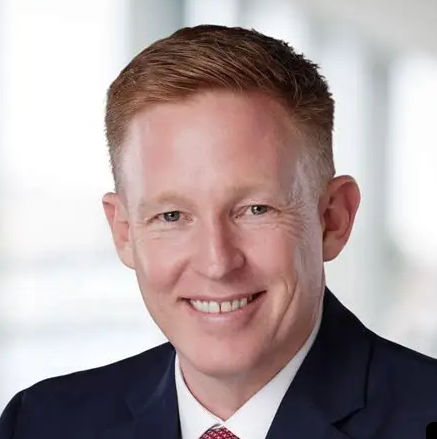
When Frisco City Manager Wes Pierson’s compensation reportedly climbed from $285,000 to $469,000, Frisco Chronicles decided it was time to stop looking at the headline number and start reading the fine print. What do taxpayers get for that price tag? We’re taking a deep dive into Pierson’s employment contracts, examining not only his salary increases but also the additional benefits, financial perks, and protections built into his agreement. What happens if the city decides to terminate his employment? What does his termination clause require taxpayers to pay? And what provisions might have significant financial consequences that residents have never been told about?
Public service comes with public accountability. When taxpayer dollars fund an executive compensation package of this magnitude, residents deserve more than a number buried in a budget. They deserve to know what was negotiated, what changed, and who approved it. Because when it comes to spending taxpayer money, the fine print matters.
Pierson’s Original Employment Contract – June 2022
The original contract from June 2022 reveals considerably more than a $285,000 annual salary. It establishes performance-based compensation, a substantial vehicle allowance, generous personal leave, retirement and deferred-compensation benefits, relocation assistance, and a potential 12-month severance payment if the city terminates its employment under the circumstances described in the agreement.
Breakdown Original Annual Base Salary: $285,000
Annual Vehicle Allowance: $15,600
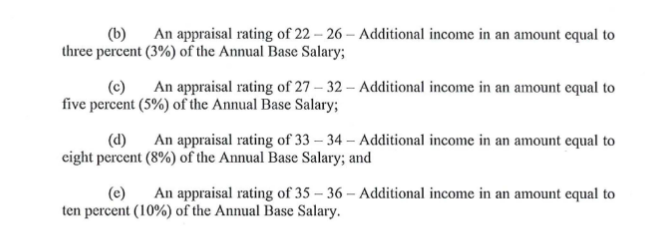
Maximum Annual Performance Bonus: $28,500
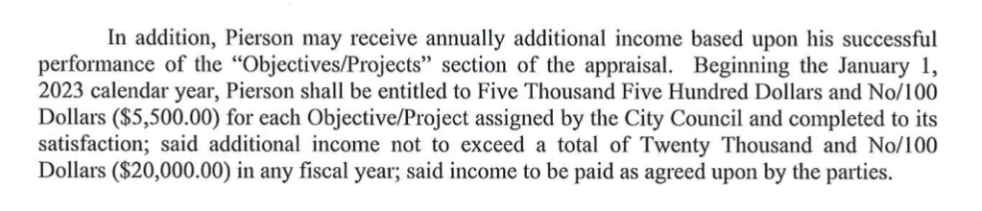
Maximum Objectives/Projects Payments: $20,000
Potential annual cash compensation under the original terms, assuming maximum performance and project payments: $349,100
NOTE: Calculated as $285,000 base salary + $15,600 vehicle allowance + $28,500 performance bonus + $20,000 project payments. This number excludes retirement contributions, insurance, other benefits and any subsequent contract changes.
Performance Bonuses, Objectives/Projects Payments
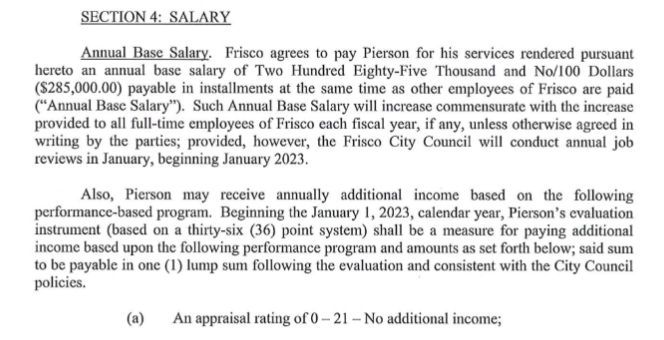
Section 4 of Wes Pierson’s contract establishes an annual performance-based income program beginning January 1, 2023. Pierson’s evaluation instrument uses a 36-point scoring system.
It is important to point out that Mayor and City Council are responsible for evaluating City Manager, Wes Pierson’s performance. That means Pierson has every reason to do what the council wants versus what is right by taxpayers. The contract also provides additional payments for objectives/projects assigned by the City Council that are completed to the council’s satisfaction.
Frisco Chronicles would like to know what type of projects qualified for additional compensation? Again, it is important to note the judge, and jury is the council, which means Pierson has 28,500 reasons to do what the council wants versus what is right by taxpayers.
Other Benefits
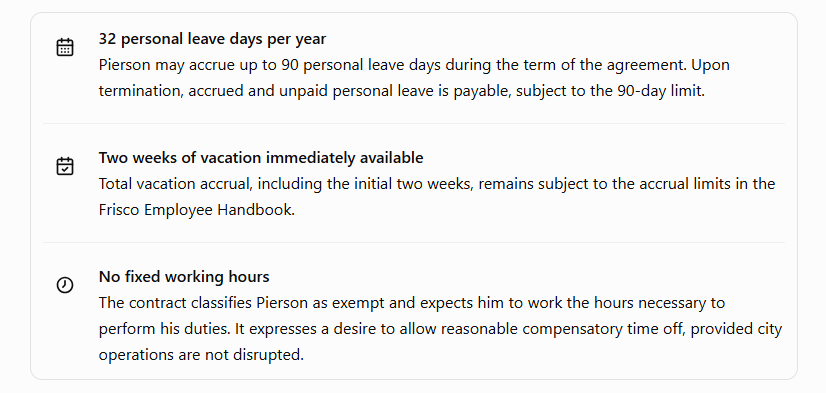
Other highlights of Wes Pierson’s contract include 32 Personal Leave Days Per Year and upon termination, Pierson can receive payment of accrued personal leave days up to 90 days per year. He also has two weeks’ vacation.
The agreement separately references accrued, unpaid personal leave, vacation and sick leave in its termination provisions and the precise payout calculation for each.
Section 5 states he has a vehicle allowance of up to $15,600 per year paid in equal installments which works out to be about $1300 per month. Frisco Chronicles would like to know if there are any separate reimbursements for travel or mileage?
Sections 9 and 10 contain additional benefits that are easy to overlook when looking only at salary. The city agrees to budget and pay reasonable costs for Pierson’s membership in International City/County Management Association, Texas City Management Association, North Texas City Management Association, Two additional civic clubs or professional organizations.
The city also agrees to budget and pay reasonable professional-development and official-travel expenses, including eligible conferences, courses, institutes and seminars. Official travel and professional-development expenses are subject to City Council review and approval as specified in the contract.
One provision deserves particular attention: Frisco agrees to pay the air travel and subsistence expenses of Pierson’s spouse to attend one annual event sponsored by the International City/County Management Association.
Section 11 requires Frisco to provide and pay the premiums for hospitalization, surgical and comprehensive medical insurance for Pierson, his wife, and his dependent children under age 26 who are claimed as dependent.
Section 12 states Pierson also has the Texas Municipal Retirement System (TMRS) which the city contributes annually to. The contract states that this contribution is additional to his salary and is paid in equal quarterly installments, beginning October 31, 2022, or as otherwise agreed by the parties. It also states that the contribution expires immediately if the agreement and employment are terminated pursuant to Section 3.
Section 14 requires Pierson to become a Frisco resident within 24 months of his start date and remain a resident during his tenure. The city also agrees to reimburse necessary and reasonable expenses associated with finding and purchasing a home and moving Pierson’s family and belongings not to exceed $15,000.
Termination or Voluntary Resignation
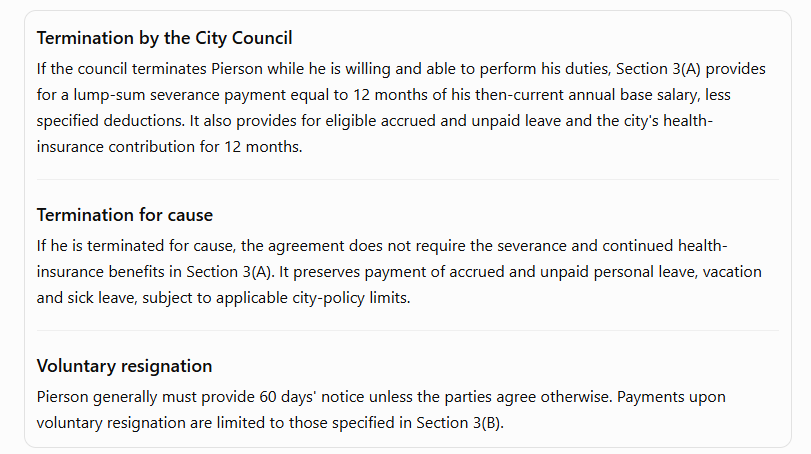
Section 3 establishes different outcomes depending on how employment ends. For example, if the city terminates Pierson, Section 3A provides him with a lump-sum severance payment equal to 12 months of his current annual base salary and 12 months of the city’s health insurance contribution.
Wait, what? We are paying him 1 full year of compensation and free health care for a year if we FIRE HIM? How does that benefit Taxpayers?
First Amended Employment Contract – March 2025
March 4, 2025, First Amended Employment Agreement between the City of Frisco and City Manager Wes Pierson is not simply a new salary agreement. It changes some important financial protection while leaving most of his day-to-day benefits intact.
The most significant changeis in the termination provisions: the amended agreement expressly adds one year of car allowance to the benefits payable if the City Council terminates Pierson while he is willing and able to perform his duties. It also clarifies that the amended terms take effect March 4, 2025.
Important Contract Changes:
Performance Bonus: The amended salary section omits that performance-payment program.
Project/objective payments: In the March 2025 contract there is no equivalent project-payment provision that appears in the amended salary section.
Severance: In addition to the original contract that had 12 months of then-current base salary, eligible accrued leave, and 12 months of health-insurance contributions, the new contract adds payment equal to one year of car allowance.
Relocation Assistance: Removed from new contract
Second Amended Employment Contract – August 2025
The Second Amended Employment Agreement dated August 19, 2025, fills an important gap in the contract. The first change is to his Salary, and his relocation benefit is removed since Pierson now lives within the city. One of the most consequential provisions is the termination package.
Salary Changes
In the second amended employment contract the Performance Pay and Projects and Objective Pay disappear. The March 2025 amended agreement’s Section 4 contains the base salary and annual salary-increase language but does not reproduce either of these additional compensation programs.
Severance Becomes More Valuable
If the City Council terminates Pierson while he is willing and able to perform his duties, the agreement calls for a lump sum payment in the amount of 12 months of his then-current base salary, all eligible accrued leave, payment equal to one year of car allowance, and 12 months of the City’s health-insurance contribution.
Yes, you are reading that right! If the City of Frisco terminates the City Manager, TAXPAYERS will pay the price. For example, if he were terminated tomorrow – the city would have to pay him $400,000+ dollars just in a lump sum salary payment plus an additional 15,600 car allowance, all eligible accrued vacation, leave and personal days, and 12 months of his health insurance coverage. That could be well over ½ million dollars taxpayers are on the hook for!
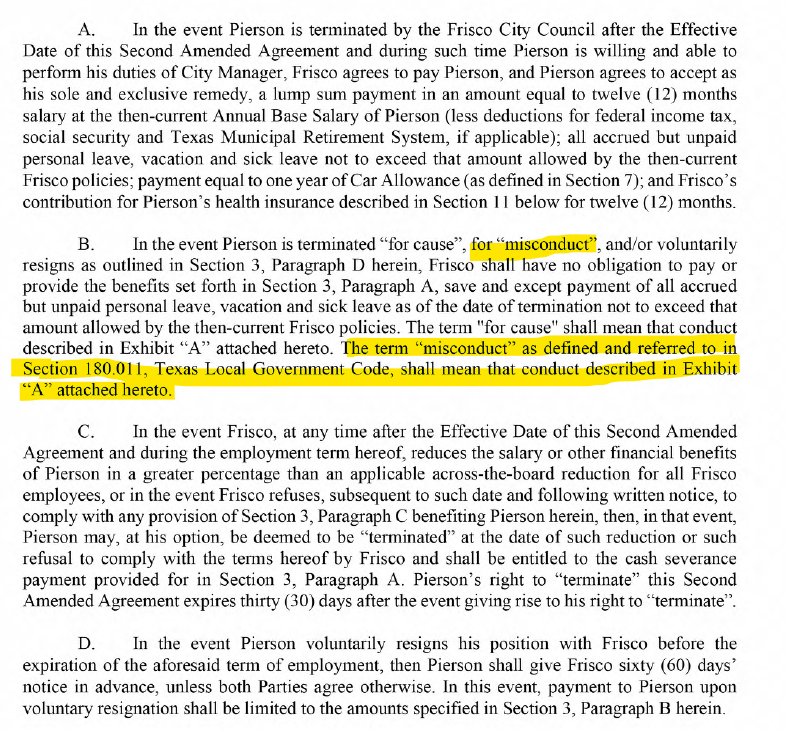
In Section B of the Termination Clause the words for “MISCONDUCT” was added into the language.
Under Section B, if the city terminates Pierson for cause, conduct and/or voluntarily resigns then the city does not have to pay 1-year salary. Taxpayers are still on the hook for all accrued but unpaid personal leave, vacation, sick leave allowed in the current Frisco policies.
The agreement also preserves a potential severance entitlement if the City reduces his salary or other financial benefits by a greater percentage than an across-the-board reduction for all Frisco employees, subject to the contract’s conditions and 30-day deadline.
In Closing: The Fine Print Is the Point
Wes Pierson’s employment contracts tell a much bigger story than a city manager’s salary climbing from $285,000 to a reported $469,000. They reveal a compensation package shaped by amendments, benefits, retirement contributions, leave provisions, and termination protections that deserve public scrutiny.
To be clear, employment contracts are not inherently improper, and severance provisions are not unusual for executive positions. The question is whether the terms negotiated on behalf of Frisco taxpayers are reasonable, necessary, and in the public interest.
Perhaps the most important question concerns accountability. The City Council is responsible for evaluating the city manager, determining his compensation, and making decisions about his continued employment. When the same council controls his performance evaluations and potential bonuses, residents have every reason to demand transparency about how those decisions are made and what standards are applied.
Then there is the termination clause. If Pierson were terminated under circumstances that trigger the contractual severance provisions, Frisco could face a substantial financial obligation beyond his regular salary. The final cost would depend on his salary at the time, eligible accrued leave, the applicable vehicle allowance, and the city’s health-insurance contribution. Taxpayers deserve a clear accounting of that potential liability before the city ever has to write the check.
Frisco Chronicles is not suggesting that a contractual benefit proves wrongdoing. We are asking whether the people paying for those benefits have been given enough information to judge the deal for themselves. A $469,000 compensation package is not just a personnel matter. It is a public expenditure. Every amendment matters. Every benefit has a cost. Every decision made behind a negotiation table deserves scrutiny when public money is involved.
Frisco residents should not have to piece together an executive’s compensation package one contract at a time to understand what their government has agreed to pay. The City Council negotiated the terms. The city manager receives the benefits. And Frisco taxpayers help foot the bill.
So here is the question that remains: Who is looking out for the taxpayers when the city negotiates its own leadership’s compensation?
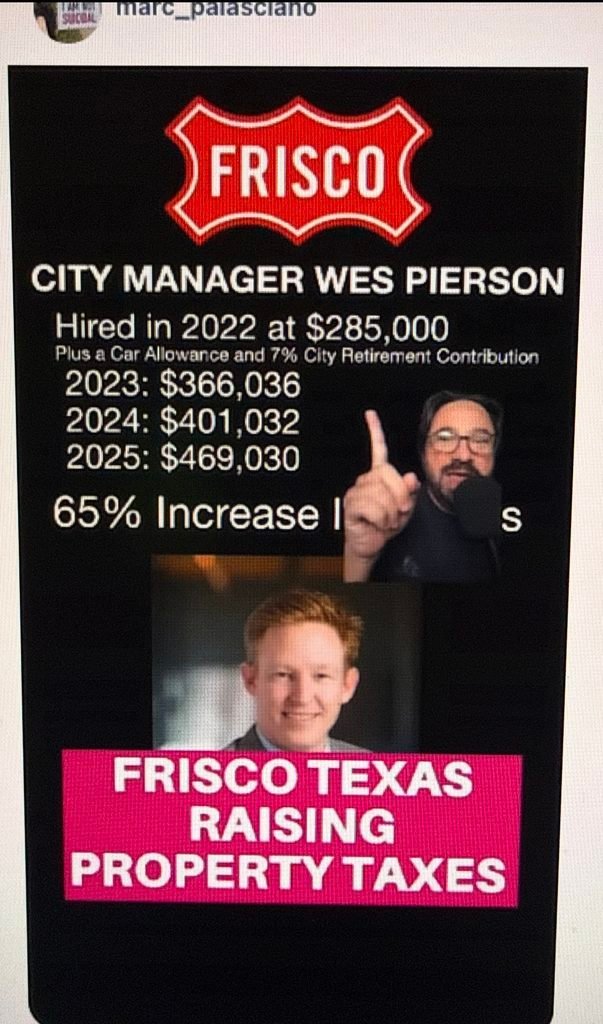
Earlier this summer, Mark Palasciano, former T-Mobile employee, social media activist and self-described “whistleblower” took aim at the salary of Wes Pierson, City Manager for the City of Frisco. Why? At the time the new Mayor and City Council were considering raising property taxes. Palasciano questioned the tax increase and what justification the city could have for the 65% salary increase City Manager Wes Pierson has received since starting office in 2022. Palasciano claimed that when Wes Pierson was hired in 2022 at starting salary of $285,000. He said after several increases his 2026 salary was at $469,000.
Screenshot
Frisco Chronicles wanted to verify these claims, so we filed a public information request with the city. We requested pay increases, annual reviews/evaluations and employee contracts. Is Pierson the ½ million dollar man like Palasciano claimed? Frisco Chronicles confirmed the following pay increases:
A review of some websites like GovSalaries.com shows Pierson makes $469,030 which is 70% higher than the average salary for this position. OpenGovePay.com reports Wes Pierson also earned $469,030 in 2025 and they obtained that from public payroll data from the City of Frisco. The website also states, “From 2024 to 2025, Wesley Pierson’s salary increased by 17% ($67,998). Over the full recorded period from 2022 to 2025, the salary increased by approximately 212% ($318,634), representing an average annual growth of 46.10%.
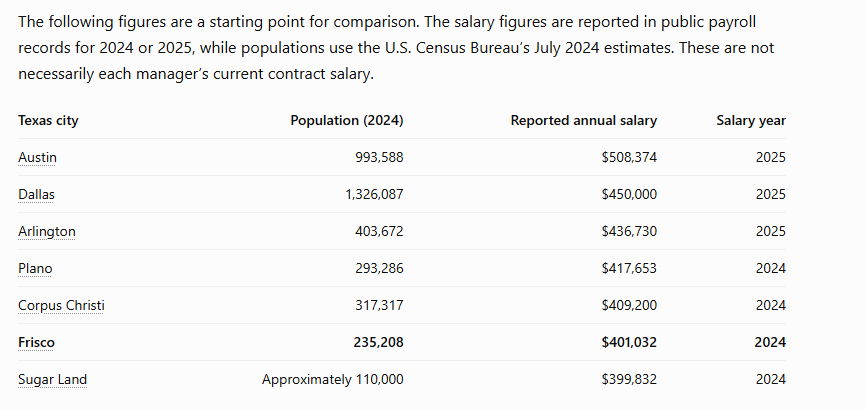
The information provided raised questions like, what are the annual salaries of other city managers in Texas cities? As of 2026, Frisco, Texas has an estimated population of about 249,511 according to the city’s official demographic report, with other sources citing figures in the mid‑245,000s.
Pierson’s Priorities
There is another question the Council needs to answer: If the City Council is responsible for conducting the city manager’s annual performance reviews and determining his compensation, how can taxpayers be assured that the city manager’s priorities are always aligned with the public interest rather than the interests of the elected officials who control his pay? The public deserves to know what criteria are used in those reviews, whether measurable performance standards exist, and whether the results are made available to residents. When the same officials who depend on the city manager to carry out their priorities also determine their raises, it is fair to ask what safeguards exist to ensure independent judgment and accountability. And it raises an uncomfortable question: Has the compensation structure created an incentive for the city manager to keep Council members happy rather than push back when their decisions may not serve taxpayers? Pierson’s willingness to accommodate Council priorities may have perfectly legitimate explanations, but residents should not have to guess whether financial incentives play a role. If his compensation depends, in part, on evaluations by the very people whose wishes he is expected to implement, the public deserves transparency about how that arrangement protects the interests of the people footing the bill.
When Taxpayers Get the Bill, Who Holds City Hall Accountable?
When residents face higher taxes, they are expected to adjust their household budgets. When city expenses rise, taxpayers are told the money is necessary to maintain services and meet the demands of growth. Frisco residents are being asked to shoulder the cost of running a growing city. Property taxes, rising expenses, and the cost of public services are real concerns for homeowners trying to keep up. While the City Council may not have raised taxes this year, residents will see the increase somewhere and you can bet that is your public utility bill.
Yet one question deserves a direct answer from City Hall: How can the City Council justify asking taxpayers for more money while the city manager’s compensation has reportedly increased by 65% in just four years?
This is not about attacking one employee. It is about examining the decisions of the elected officials who approve the contracts, authorizing the spending, and ultimately answer to the people paying the bills. Wes Pierson’s compensation deserves scrutiny, because public money demands public accountability. Austin and Dallas operate much larger cities, with substantially larger populations and complex municipal responsibilities.
A potential 65% increase over four years is not a minor adjustment. The public deserves a transparent explanation of how it was calculated, what drove the increases, and how the Council can justify their decision. Frisco has grown into a major city. Growth brings legitimate demands on city management, but it also brings greater responsibility to spend public money carefully. The Council cannot reasonably demand that residents accept higher costs without being prepared to explain its own spending decisions.
So here are the questions Frisco taxpayers deserve answered: What benefits and additional compensation are included? How does his total package compare with those of managers in similarly sized Texas cities? Why should residents be expected to accept higher tax burdens without a clear accounting of executive compensation? What performance benchmarks justified Pierson’s pay increases? Were they tied to measurable improvements in city services, budget management, economic development, or taxpayer value? Did the Council conduct independent compensation comparisons with similarly sized Texas cities? More importantly, who is holding the Council accountable for the decisions it makes with other people’s money?
Transparency is not a favor City Hall grants residents. It is a basic obligation of public service. The Council controls the contracts. The Council approves the compensation. And the Council must answer for the choices it makes. Frisco taxpayers should not have to wonder whether fiscal restraint applies to everyone except the people running City Hall.
Disclaimer This article is written as opinion, commentary, and personal interpretation based on publicly available records, meeting observations, agenda materials, and informationheard from community sources. Any statements involving motives, intent, conflicts of interest, contracts, relationships, or behind-the-scenes activity should be understood as alleged, suspected, or opinion unless directly supported by cited public records. Readers are encouraged to review any linked materials, attend public meetings, request records, and form their own conclusions. Nothing in this article should be interpreted as a final statement of fact about any person’s legal conduct, criminal behavior, or ethical violations.








I went to her to ask for help with an issue my child that was getting nowhere with the school,…
So whatever became of the $17 million dollars that the city council gave the Mayor to beautify a drainage ditch?
At last count, there are 3 different "spa/massage" businesses in the small office park at the northeast corner of John…
I literally just saw this. Yeah, she used to forward everybody’s emails behind their backs.
You're dropping truth bombs! These mom and pop shops are what should be the least of Karen's worries. If they…