A complaint against a sitting council member, a public records request sent to the Attorney General, and a former councilman questioning who should vote on the ethics process. Now Frisco Chronicles is asking whether the same scrutiny should be applied to the people raising the allegations.
Frisco residents have heard plenty about ethics, accountability, and transparency over the years. A couple years ago, after ethics complaints against city council members prompted public concern about elected officials judging their own colleagues, the City of Frisco undertook a review of its Code of Ethics. The result was Ordinance No. 2022-07-26, which established the city’s current Code of Conduct and its complaint review process.
The stated goal was straightforward: restore public confidence in the integrity, independence, and impartiality of city government.
But here we are in October 2026, and Frisco Chronicles has questions about how that process works, who gets to participate, what the public is allowed to see, and whether the rules are being applied consistently. This story begins with Agenda Item 39 at the October 6, 2026, Frisco City Council meeting. It does not end there.
October 6, 2026: An Ethics Complaint Takes Center Stage
But the public discussion suggested there was more behind the item than an ordinary administrative approval. After Mayor Mark Hill opened the floor for public comment, former Councilman William “Bill” Woodard approached the podium. According to the meeting discussion, Woodard said the item was on the agenda because someone sitting on the dais had a complaint filed against them.
Woodard then directed his attention toward Councilman Burt Thakur, asking whether Thakur intended to remove himself from the dais for the vote. The exchange raised an obvious question: Was a sitting council member the subject of a complaint, and would that council member participate in approving the attorneys who could review it?
City Attorney Abernathy subsequently presented the three attorneys proposed for the list. Before the vote, he specifically addressed whether Thakur needed to recuse himself and said he did not believe recusal was necessary, indicating that he had confirmed his position with another attorney.
The council then approved the item. The October 6 agenda packet identifies the three proposed reviewing attorneys as Brenda McDonald, Lance Vanzant, and Richard Hayes. Under Section 2-342, the City Manager selects the reviewing attorney from the council-approved list.
That is an important distinction. Approving the list is not the same as deciding the merits of a complaint, and the October 6 vote should not be characterized as a vote to find Thakur guilty or innocent of anything. Nevertheless, Woodard’s public comments brought the question of an alleged complaint into the spotlight. Frisco Chronicles decided to find out what the complaint actually alleged.
The Public Records Request: Why Send the Complaint to the Attorney General?
Frisco Chronicles submitted a Public Information Request to the City Secretary seeking a complete copy of the complaint William Woodard allegedly filed against Burt Thakur. The city’s response was that the records would be submitted to the Texas Attorney General, with the city asserting attorney-client privilege as a basis for withholding the requested information.
That response raises questions. Section 2-342 of Frisco’s Code of Conduct establishes the reviewing attorney process. Part E, Section 3 requires a complaint to identify the official accused, state the facts and evidence supporting the allegations, identify the rules allegedly violated to the extent possible, and be sworn under oath in the form of an affidavit based on personal knowledge.
The same section states that documents relating to a complaint will be maintained by the City Secretary in accordance with applicable records-retention laws and other applicable laws. The Code of Conduct does not, by itself, establish that every complaint must automatically be released in full. Nor does the fact that a complaint was submitted to the city automatically resolve every question about privilege or confidentiality.
But it does raise a legitimate question: What specific legal basis allows the city to withhold the original complaint, and does that basis apply to the entire document or only particular portions?
A complaint authored and submitted by a private individual is not automatically transformed into a privileged communication simply because it is delivered to a government office. If the City Manager discussed it with the City Attorney that maybe privileged but it does not make the complaint itself privileged. At the same time, a document may contain information protected by law, or portions of it may become subject to a legitimate privilege claim depending on the circumstances and a city can redact that information from the request. The city should be able to identify the applicable legal exception and explain why it covers the records being withheld.
While the original complaint was not public, when disgruntled Former Counciilman Bill Woodard took to the podium during CITIZENS INPUT to gloat and call out a current sitting council member on public record, he made it public. The public should not have to guess what happened behind the scenes.
Frisco Chronicles will continue to examine the city’s position and the Attorney General review. Until that process is resolved, we will not represent the complaint as having been proven or assume that the city’s privilege claim is either valid or invalid.
What Is the Allegation Against Thakur?
Frisco Chronicles contacted one of our sources inside City Hall who might be familiar with the matter. Based on that communication, we understand that Woodard allegedly filed a complaint concerning Councilman Burt Thakur. The reported allegation concerns Part B, Section 2(b)(4) of the Frisco Code of Conduct, titled “Unfair Advancement of Private Interests.”
The provision states that, in matters relating to real property before City Council, the Planning and Zoning Commission, or the Board of Adjustment, a member with a financial interest in property within 200 feet of the matter must disclose that interest by filing a statement with the City Secretary. The member may speak on the item and must then leave the dais or the area where the other voting members are seated. Applicable state conflict-of-interest laws must also be followed. The provision broadly includes land matters such as zoning, preliminary and final plats, site plans, permit requests, variances, and similar requests for city approval involving real property.
In plain English, the allegation reportedly concerns whether Thakur participated in a city decision involving a business or property matter while having a financial interest in nearby property that triggered the disclosure and recusal requirements. That is an allegation, not a finding.
Recently Ann Anderson has been quoted saying we are new and all learning together. Is it possible Thakur also in his first term did not understand fully the new code of conduct.
Frisco Chronicles has not independently reviewed the underlying complaint, established the property ownership involved, or confirmed the distance between the relevant properties. Those details matter and we could confirm them if we had a copy of the complaint, but the city is trying to hide that. Until the complaint and underlying records are available, readers should not assume that a violation occurred.Nothing has been proven at this point. The complaint must be evaluated on the evidence, not on personalities or political loyalties.
The Question Woodard May Not Have Expected: What About Northwest Community Park?
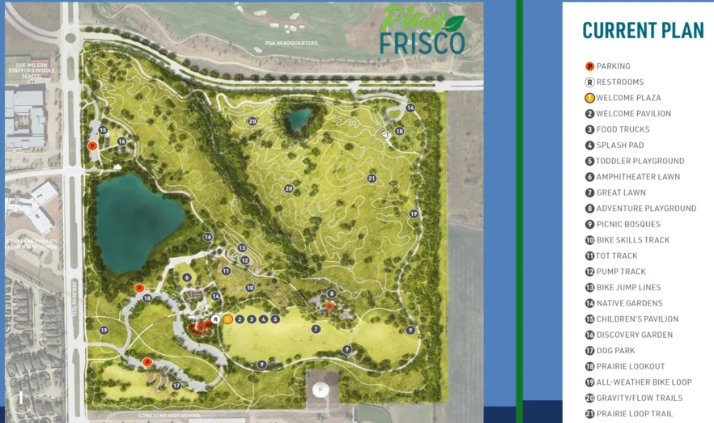
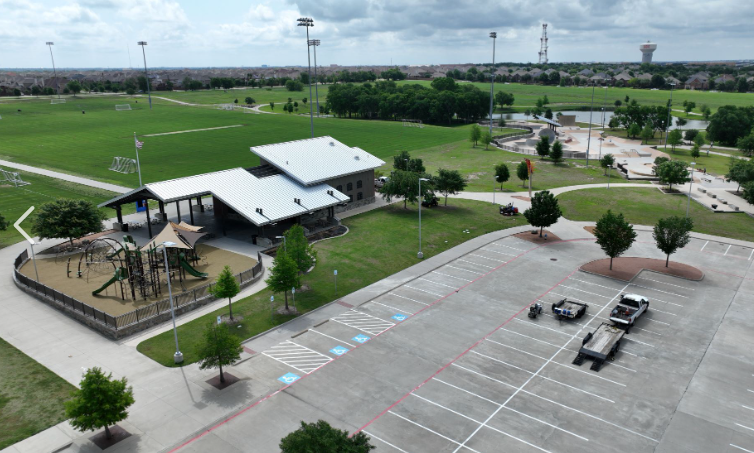
If the purpose of an ethics complaint is to enforce the city’s rules fairly, those rules must be examined consistently, regardless of who files the complaint or who is accused. That brings us to Northwest Community Park, a major public investment that Woodard discussed, advocated for, and voted on during his tenure on council. Frisco Chronicles reviewed a compilation of City Council meeting records covering the park’s planning and development from 2021 through 2025.
The records show that Woodard was involved in discussions about the park’s design, including the extensive bicycle trail system. They also document his participation in votes concerning professional services, project bids, construction contracts, and other park-related expenditures.
The question is not whether a council member is allowed to advocate for a public park. Of course, council members can represent residents, discuss recreational needs, and vote on public projects. The question is whether a council member’s own financial interests require disclosure or recusal under the applicable rules.
Frisco Chronicles understands that Woodard owns property approximately 1.1 miles or less from Northwest Community Park. That distance is based on information supplied for this investigation and has not been independently verified through property records and mapping. If accurate, the reported distance is significantly greater than 200 feet.
That matters because the 200-foot provision cannot simply be stretched to cover any property within walking distance of a park. The relevant legal test must be applied to the actual property, the particular matter before council, and the official’s financial interest.
Still, the broader question deserves scrutiny: Did the development of Northwest Community Park have a foreseeable, special economic effect on property Woodard owns? And were there any other facts that could have triggered disclosure or recusal requirements?
Those questions cannot be answered merely by pointing to a map.
A $40 Million Park and a Council Member Who Advocated for Its Trails
Northwest Community Park became the subject of extensive council discussion as Frisco worked through the design, cost, and construction of the project. The records show that Woodard expressed a strong interest in the park’s cycling facilities.
At a work session on March 2, 2021, work session, he told the design team that existing users of the area preferred a design with greater potential for natural-surface bike trails. The design term indicated it would meet with Woodard to better understand cyclists’ needs. What existing users was Woodard referring to? Himself?
At an October 2021 discussion, city staff described the park’s goal of providing a trail system for beginners and advanced riders alike. On February 20, 2024, Woodard raised concerns about trails he considered disjointed and too narrow. He also asked the design team to reconsider certain features and reiterated his desire for consultation with experienced users of existing bike trails. Again, is that existing user, himself?
Those are documented examples of Woodard’s participation in the park’s design discussions. The records also show his involvement in project votes:
December 6, 2022: Woodard participated in approval of an amendment to the professional services agreement for Northwest Community Park and Frisco on the Green.
December 5, 2023: He seconded a motion approving a consent-agenda package that included rejection of the park’s construction bids after bids came in higher than expected.
November 5, 2024: As Mayor Pro Tem, Woodard moved to award the construction contract for Northwest Community Park. The motion passed 5-0 among the members voting, with Council Member John Keating recused.
November 19, 2024: Woodard participated in approval of a consent-agenda package that included the construction contract for the park’s bike facility.
February 4, 2025: He moved to approve a consent-agenda package that included additional professional services for the project.
March 18, 2025: He moved to approve a consent-agenda package that included a relocation payment associated with Northwest Community Park.
The December 5, 2023, work-session discussion included an option to increase the park’s construction budget to $40 million through additional Community Development Corporation funding. Council ultimately chose to modify the plans and use CDC funding to move the project forward. The records establish that Woodard participated in discussions and votes. They do not establish that his participation was improper, but again, it does raise the question if Woodard had self-interests in this specific park.
Would Woodard Benefit from the Park?
A large public park can make a surrounding area more attractive to potential homebuyers. Trails, recreational amenities, green space, and improved public access can influence how people perceive a neighborhood.
That does not mean every nearby property owner receives a measurable financial benefit, nor does it establish that an official has a disqualifying financial interest under the Code of Conduct. Frisco Chronicles is asking a narrower question: Did Woodard’s property have a particular financial interest that required disclosure or recusal when the park came before council?
The city’s 200-foot rule is not a blanket prohibition on voting for parks, roads, trails, or other public improvements near one’s residence. If the allegation against Thakur is based on the 200-foot provision, the same provision should be read accurately when examining Woodard’s record. Frisco Chronicles would like to know the difference.
Does Cycling Advocacy Create a Conflict of Interest?
Woodard’s advocacy for cycling facilities is well documented in the meeting records. The park’s plans included a variety of bicycle trails and other cycling-oriented amenities. The project also incorporated broader public features, including open space, playgrounds, a dog park, and educational and recreational facilities. Woodard’s interest in cycling and his participation in cycling groups, as described to Frisco Chronicles, may explain why he was vocal about the park’s trail design.
Woodard was very outspoken on this project unlike other projects and that maybe because of his own personal recreational interest or possible financial interest in real property.
Is This About Ethics, Politics, or a Personal Dispute?
Woodard’s decision to raise the complaint issue publicly at the October 6 meeting invites questions about his intentions. His comments placed Thakur’s participation in the attorney-list vote under a public spotlight before the complaint’s merits had been established. Frisco Chronicles also understands that Woodard has publicly criticized Thakur on several other occasions, using the Citizen Input as his bully pulpit.
That history may be relevant to understanding the political context. Where does Woodard’s public criticism arise from: policy disagreements, genuine ethical concerns, political rivalries, or some combination of factors?
The city’s own Code of Conduct recognizes that the timing and publicity surrounding a complaint, the relationship between complainant and respondent, and evidence of the complainant’s motives can be relevant when evaluating whether a complaint may be frivolous. There is a legitimate public-interest question about whether a complaint is being pursued in good faith. The answer should come from the evidence and the established process, not from assumptions about someone’s personality or political ambitions.
Is Woodard pursuing a legitimate concern about compliance with the Code of Conduct? Does he have evidence supporting the allegation? Has he applied the same standard to his own actions? Or has a political disagreement become part of the backdrop to the complaint?
Those questions deserve answers, but Frisco Chronicles will not claim to know Woodard’s motives without evidence.
What About Race? Frisco Chronicles hates to go here but could this be about race? Thakur is the only South Asian (Indian) member of the Frisco City Council. There has been a heightened sense of scrutiny regarding our South Asian community lately in online media and at city council meetings. Frisco Chronicles would like to point out that Frisco is open to all and that treatment has been and continues to be unfair to our good neighbors. That does not stop us from asking could Race be a factor or relevant to what drove Woodard to harass Thakur at Citizens Input several times now. Frisco Chronicles has not established evidence that race played a role in the complaint, and we will not suggest otherwise simply because two officials have a history of public disagreement. It just seems with the current state of tension in Frisco an obvious question to ask.
The Bigger Problem: Who Holds the Ethics Process Accountable?
The public concern that helped drive the 2022 Code of Conduct review has not disappeared: What happens when the people responsible for reviewing an ethics complaint are colleagues of the person accused?
Frisco’s current process attempts to address that concern by requiring a list of three independent private attorneys, with the reviewing attorney selected by the City Manager by lot. The reviewing attorney must meet specified qualifications and cannot be a city council member, city employee, elected public official, or candidate for elected office.
The process also provides for an initial assessment by the reviewing attorney. A complaint may be dismissed on specified grounds, including untimeliness, lack of coverage under the Code, failure to satisfy filing requirements, or facts that would not constitute a violation even if taken as true. A complaint not dismissed at that stage may be referred to council for further review.
The structure provides an independent legal review at an important stage. It does not eliminate every question about transparency, public confidence, or the council’s remaining role.
The public should be able to understand who reviews a complaint, how the reviewer is selected, what standards apply, and what findings are ultimately made. It should also be able to distinguish between a complaint being filed, a complaint being referred for further review, and a proven violation. Those are three different things.
If the city wants residents to trust the process, it must explain the process clearly and disclose the information the law allows it to disclose.
Questions Frisco Chronicles Wants Answered
The records and circumstances surrounding the October 6 meeting leave several questions that deserve documented answers:
1. Will the city release a copy of the complaint and supporting documentation.
2. Which specific council agenda item is at issue in this complaint, and what properties were allegedly within the relevant 200-foot distance?
3. What safeguards ensure that an ethics complaint is evaluated on its merits rather than on political alliances or personal disputes?
Final Thoughts: One Standard, Applied to Everyone
Frisco’s Code of Conduct was adopted to promote public confidence in the integrity, independence, and impartiality of city government. That purpose cannot be fulfilled if residents are left to speculate about complaints, if legal exceptions are invoked without a clear public explanation, or if ethical standards appear to be applied differently depending on who is involved.
Woodard has every right to file a complaint if he believes a city official violated the rules. Thakur has every right to a fair process in which allegations are tested against evidence rather than treated as established facts. And taxpayers have every right to ask whether the rules are being applied consistently.
Frisco does not need an ethics code that exists only to be quoted when someone wants to challenge a political opponent. It needs one that is applied consistently, reviewed fairly, and explained openly. If the rules apply to Burt Thakur, they must apply to Bill Woodard. If they apply to Bill Woodard, they must apply to every other official. And if the city expects residents to trust its ethics process, it must give them every piece of information the law allows them to see.
That is not a personal attack. It is the minimum standard of public accountability. Frisco Chronicles has submitted a response to the Texas AG on why this should be public record. Lastly, Mayor Mark Hill needs to take some accountability. It is our opinion, Hill allowed a former councilman to use Citizen Input for his own personal vendetta and if that is the case, it’s shameful.
Frisco Chronicles will continue to follow the complaint, the city’s response to the public records request, and any evidence that clarifies whether the same standards have been applied consistently. Because ethics should never depend on whose name appears on the complaint.
Disclaimer This article is written as opinion, commentary, and personal interpretation based on publicly available records, meeting observations, agenda materials, and information heard from community sources. Any statements involving motives, intent, conflicts of interest, contracts, relationships, or behind-the-scenes activity should be understood as alleged, suspected, or opinion unless directly supported by cited public records. Readers are encouraged to review any linked materials, attend public meetings, request records, and form their own conclusions. Nothing in this article should be interpreted as a final statement of fact about any person’s legal conduct, criminal behavior, or ethical violations.
Frisco Chronicles recently filed a few PIR’s and surprise, surprise the city has sent them all to the Attorney General for a ruling. The City of Frisco cannot have it both ways. City officials cannot stand before residents and promote transparency while repeatedly routing public information requests through the Texas Attorney General for a ruling on whether requested records must be released. When this happens, residents are left waiting, taxpayers are left wondering, and legitimate questions about what their government is doing remain unanswered.
PIR: Fire Station 9 – Mold Issues
Recently we were alerted by a city insider that Fire Station 9 which was recently constructed, have mold, moisture and mildew issues. We filed two separate PIRs for records concerning the construction of the station and the plans to remediate the mold. We also asked about any “temporary housing” needed and the costs of that since our Fire Fighters should not be sleeping in a mold infested fire station.
We paid for the PIR – $212.94
We paid $151.56 for the second one!
Then we get a letter from ARBH (Abernathy Roeder Boyd Hullett) Lawfirm telling us they have sent it to the Attorney General claiming Client Privilege and Homeland Security Act – claiming we are asking for access codes and passwords which is totally not true. They are also claiming that information relating to competition or bidding could provide and advantage to a competitor.
Just a reminder, TAXPAYER MONEY is being used to build and construct and now they don’t want to show us the bids and reasons for their decision.
What is the city hiding? The fact that we have Fire Fighters in a moldy station that TAXPAYERS just paid for? The fact that we have Fire Fighters sleeping in mold which is dangerous? What are they hiding? If you were going to fight our PIRs then why did you charge us almost $400.00 for the information?
PIR: Woodard Complaint
Recently Former Councilman Bill Woodard filed an ethics complaint against current councilman Burt Thakur. We filed a copy of the complaint, and they sent it to the Attorney General. Now the city is claiming Attorney-Client Privilege. They can withhold that and release a copy of the complaint and what was in the complaint but instead of being transparent they are now trying to claim OH IT IS A SECRET.
PIR: FIRE CHIEF RECRUITMENT
We filed a PIR over a month ago for copies of all public records relating to recruitment, executive search, evaluation, interviewing, selection and hiring process for the position of Fire Chief for the City of Frisco, including the search conducted by any outside recruitment or executive-search firm. We also requested a copy of each Applicant: Resumes/CVs. Cover letters. Candidate profiles.
The city is claiming the information we are asking for (1) contains highly intimate facts about employees’ affairs (i.e. personal financial, medical, family and/or related information) such that its release would be highly objectionable to a reasonable person, and (2) is of no legitimate concern to the public.
We have no issue with the city withholding what is allowed by law. We are not asking for an applicant’s financial, medical history or family information. The excuse the city uses has no legitimate concern to the public would be true if the Fire Fighters issues had not been so public the last few years. One of their biggest concerns has been leadership so it makes it very relevant.
Is what we wrote in our article Fire Chief Search – The Fix Is In true? I mean why would the city go to this extent to hide a resume unless there are no resumes, no search firm, and a process they allegedly may have circumvented?
Transparency Isn’t a Slogan. It’s an Obligation.
To be clear, the Texas Public Information Act allows governmental bodies to seek an Attorney General’s decision when they believe an exception to disclosure may apply. That process is legal. But the fact that a government can seek to withhold information does not mean residents should stop asking why. Which exceptions are being claimed? What specific harm would disclosure cause? Are these requests genuinely necessary to protect confidential information, or are they making public access to government records more difficult than it needs to be? Those are fair questions, and Frisco residents deserve answers.
The responsibility for transparency does not rest solely with city staff or the legal department. The mayor and City Council are the elected officials entrusted with overseeing city government and representing the people who pay the bills. They should be asking how often record requests are being referred to the Attorney General, how much taxpayer money is being spent on those disputes, which categories of records are repeatedly challenged, and whether the city’s approach is consistent with its public promises of openness.
If transparency is a priority, why isn’t the City Council demanding a clear accounting of the city’s public-information practices?
Residents should not have to fight their way through layers of legal review just to understand how their government operates. Public records belong to the public, subject to the legitimate exceptions established by law. Transparency should be the starting point, not a public relations slogan trotted out when convenient.
And here is the bigger problem: every time the city seeks to withhold records, the public is left to wonder what officials are so determined to protect from disclosure. That question alone does not prove wrongdoing, and a referral to the Attorney General does not automatically mean information is being improperly suppressed. But repeated referrals, particularly when they involve matters of substantial public interest, deserve scrutiny rather than blind acceptance.
Mayor and City Council, the question is simple: How can you credibly claim to lead a transparent government if residents continually have to challenge the government’s willingness to release public information?
Frisco Chronicles is not asking for special treatment, it is about accountability, access to public records, and a government that understands whom it serves. The city works for its residents, not the other way around.
In the May 2027 Election, ask candidates what Transparency means to them? Will they support putting meetings on camera for residents to see the recording? Will they push for the more records that are requested to be released. Transparency is not measured by how often elected officials use the word. It is measured by what they disclose, what they explain, and whether they welcome public scrutiny even when the questions are uncomfortable.
Lastly, who recommends a request go to the AG? If the City Attorney makes that decision, then we need to ask if that is a conflict of interest. The law firm makes more money off the city taxpayers for each one they recommend being sent to the AG. Why would the attorney’s office not push for everything to go to the AG’s for a ruling.
If Frisco’s government has nothing to hide, then it should have no reason to fear legitimate public scrutiny. The residents deserve a government that proves its commitment to transparency through its actions, not merely one that advertises it.
Disclaimer This article is written as opinion, commentary, and personal interpretation based on publicly available records, meeting observations, agenda materials, and information heard from community sources. Any statements involving motives, intent, conflicts of interest, contracts, relationships, or behind-the-scenes activity should be understood as alleged, suspected, or opinion unless directly supported by cited public records. Readers are encouraged to review any linked materials, attend public meetings, request records, and form their own conclusions. Nothing in this article should be interpreted as a final statement of fact about any person’s legal conduct, criminal behavior, or ethical violations.
In an age where information travels faster than verification, the line between opinion and journalism has never been more important—or more fragile. When a blog presents itself as a source of truth but operates without real journalism, the consequences can ripple far beyond a single headline. Readers trust what they believe is reporting. When readers know the blogger is a FORMER COUNCILMAN, they assume they can trust him – because our politicians would not lie, right?
Readers make decisions, form opinions, and sometimes even take action based on it. When that trust is misplaced, the damage isn’t just misinformation—it’s a breakdown of credibility across the entire information ecosystem.
At Frisco Chronicles, we believe that words carry weight. Calling something “journalism” is not just a stylistic choice; it’s a responsibility to the public. When that claim is misused—when speculation is dressed up as reporting or bias is masked as truth—it misleads readers and undermines the very foundation of informed communities. And in a city where residents are demanding transparency and trust, that’s not just careless—it’s dangerous.
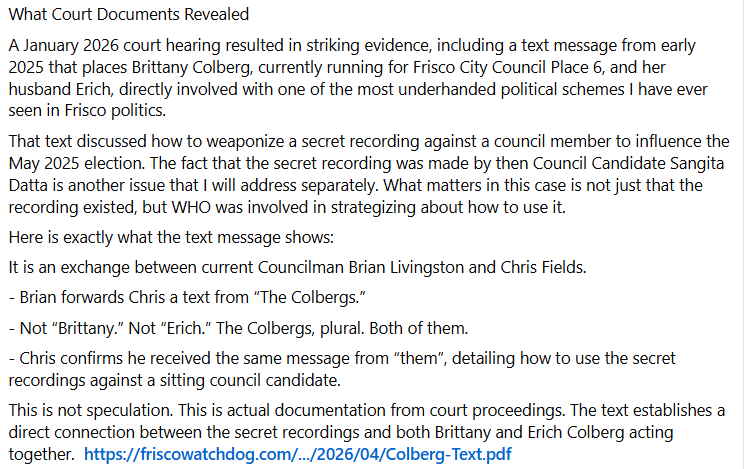
On April 16, 2026, Former Councilman Bill Woodard published a blog speculating that little lies reveal big truths. He hinted to an important legal proceeding between Frisco Chronicles (me) and the Petitioner and explained he would get into that later.
Then Woodard makes a reference “What Court Documents Revealed” which immediately makes the implication that what is about to be written is based on facts revealed on the record. But is it factual, or staged to look factual?
Note: Anything in RED is directly cut and pasted from Woodards Blog. The rest is our commentary.
Woodard starts by giving context using words such as weaponize, strategizing, underhanded, political scheme, and secret recording. Then he drops the names of the Colberg’s and Sangita Datta. He then said what matters in this case is not just that the recording exists, but WHO was involved in how it was used. Woodard is wrong when he says what matters in this case is how the recordings were used. The Tammy Tapes have nothing to do with the petitioner’s claim of defamation or libel. However, his words probably put readers on the edge of their seat.
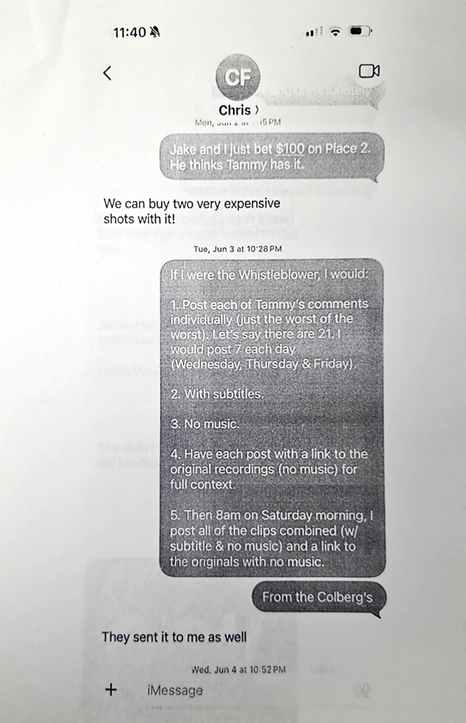
Woodard writes: Here is exactly what the text message shows:
It is an exchange between current Councilman Brian Livingston and Chris Fields.
– Brian forwards Chris a text from “The Colbergs.”
– Not “Brittany.” Not “Erich.” The Colbergs, plural. Both of them.
– Chris confirms he received the same message from “them”, detailing how to use the secret recordings against a sitting council candidate.
This is not speculation. This is actual documentation from court proceedings. The text establishes a direct connection between the secret recordings and both Brittany and Erich Colberg acting together.
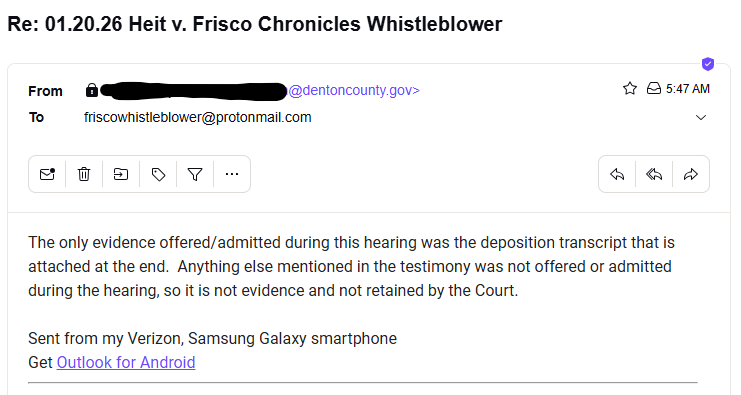
Here is the PROBLEM with Bill Woodard’s article, he claims this is actual documentation from court proceedings and then posts a link to an image of a text message. I filed a PIR with Denton County Courts and the Court Reporter for all documents related to this case including submitted evidence and the transcript of the proceedings. When I received it, I reviewed everything in full detail. However, there was no copy of the text Bill Woodard posted. I went back to the court and specifically showed them what Bill had posted and asked for that evidence as well. You can read the response for yourself:
If the text messages were never entered into court evidence and they are not a part of the court record, HOW DID BILL WOODARD GET A COPY OF THE TEXT MESSAGE?
Why is this important, because he led readers to believe This is actual documentation from court proceedings which it was NOT! Speculation is he received the text from the Petitioner, her attorney Mr. Harbin, or maybe David Ovard (the PGA KING) who also wormed himself into this case and who works at Clark Hill with Mr. Harbin. However – none of it was from actual documentation from court proceedings.Bill Woodard LIED to his readers.
Dissecting Bills Words: Text between Councilman Livingston and Chris Fields
Woodard writes, “Brian forwards Chris a text from “The Colbergs.”
Woodard continues, “Not Brittany. Not Erich. The Colberg’s, plural. Both of them.”
The FACTS show, Brian forwarded a screen shot of just a text with no name, no phone number on it. There is no circle at the top showing who it was from or if both of the Colberg’s were on the text to Livingston, or what phone number it came from. Then in a second text, Livingston says “From the Colbergs” which means he implied it was from them “plural.”
The FACTS show Fields said, “they sent it to me as well” and he was probably replying in plural with that because Livingston made that implication in his text. As for Woodard’s claim, Chris confirms he received the same message he did not confirm that in court records. Chris said “I don’t remember that text, but that’s what he (referring to Erich) said yesterday” referring to their phone call. Mr. Martin then asked what he did with the text and Fields responds, “I didn’t do anything with it.” Mr. Harbin then shows him the text and asks Fields, does this look like an exchange between you and Livingston? Fields responds, “It definitely could be, I just don’t remember it.” A few questions later Mr. Harbin ask Fields again, “so does that refresh your memory that they sent you the text message?” Fields replies again, “Not really, I get a lot of texts.” At no time did Chris Fields confirm he received the text as Woodard claims according to actual court document proceedings.
Another Fact, the “Tammy Tapes” came out the first week of May and this text that Bill Woodard claims “implicates the Colberg’s” was sent June 3rd at 10:28 pm a month later after the tapes were already out. Why is the date of the text message important? It aligns with Chris Fields testimony on page 38 of the transcript. Mr. Martin (the petitioner’s attorney) asked Fields at any point after the tapes were released, did you receive a text from “The Colberg’s” regarding those tapes and a whistleblower?” Fields responds, “I don’t remember, but I had a conversation with Erich about it yesterday.”
Again, it was Mr. Martin who implied “The Colberg’s” plural – which is not proof the actual text was from them both. Fields continues Erich Colberg reached out to him the day before to talk about something (not the tapes or the text) and it just came up in conversation. Mr. Martin continued and asked who brought it up and Fields replied, Erich Colberg. Fields reiterated again, “I didn’t even remember that text.”
Mr. Martin then asks Fields why Erich would bring that up and Fields responds, “lots of people made points about what they would and wouldn’t do.” This shows it was the talk of the town, and many were speculating who, what, when, where, etc.
On page 40 of the transcript Mr. Martin handed Mr. Fields a text message document they received in response to a subpoena from Mr. Livingston which is a text exchange between you and Livingston. The document was never entered into evidence by Mr. Martin to the court records.
The questions by Mr. Martin continue around the “Tammy Tapes” but my question is what does the tapes have to do with the Petitioner and her defamation case? It has nothing to do with the trolls who left nasty comments. What is the point of the line of questioning others to enter it into the record? Maybe it was all a setup for them to use later like Bill Woodard did in his blog.
Woodard then writes “Chris confirms he received the same message from “them”, detailing how to use the secret recordings against a sitting council candidate.”
Next up was cross examination by Mr. Harbin, Frisco Chronicles attorney, and he asks Fields if he has any personal knowledge of who the Frisco Chronicles Whistleblower is? Mr. Fields responds, “I have no proof whatsoever. Mr. Harbin continues, “you also testified that there was no personal knowledge that there’s anybody else other than Mr. Douglass that is ..” Fields responds, “I have no knowledge of the inside workings of Whistleblower.” Mr. Harbin continues and asked Fields, “What is the basis of your belief that there are others that are behind Frisco Chronicles…” Fields responded that he didn’t have anything specific, he just always thought it was a group of people. Mr. Harbin then said, “so purely a hunch?” Fields responded 100 percent.
Woodards Personal Opinion
Bill Woodard continues in his article calling out Brittany Colberg as a liar, when it is very possible, she did not know about the text. I cannot speak for them as I don’t know them. As for why Erich Colberg would file to have these text messages removed, my guess is because they have nothing to do with the case of defamation against the Petitioner. If every Frisco resident who texted friends or talked to friends regarding speculation of “who is Frisco Chronicles,” is guilty, then half of Frisco would be in trouble including Bill Woodard.
We have to ask the obvious again, what is the point of the questioning and the text itself? It had nothing to do with the comments the petitioner claims are defamatory. Why did the petitioner’s attorney not ask them if under a fake name, did they leave defamatory comments on a blog related to the petitioner? Why not ask them if they are Frisco Whistleblower? That would have something to do with this whole case.
The even more concerning thing is that the petitioner’s attorney may have had phone calls and conversations with all these witnesses before they came to court. One could say it was to apply pressure or influence what someone might say, the other thought it was simple preparation. You decided!
False Accusations
As we have said before this was never about libel or defamation, it was about outing the me, the Whistleblower, to try and put pressure on me to shut it down. It was to put pressure and discredit innocent residents who like a Frisco Chronicles post or left a comment. It was to embarrass those who came to court or donated to a go fund me for Frisco Chronicles. It was about applying public pressure, because that is what the Frisco Insiders do to shut those who disagree, or don’t like the Cheney status quo.
Woodard needs to be honest and transparent when it’s uncomfortable. Mr. Woodard, would you like to tell us how and where he got a copy of a text message that was not submitted to evidence and therefore is not a part of the court records or transcripts? Woodard needs to be accurate and honest about Fields testimony because he never confirmed anything.
Livingston and Fields turned those over under a subpoena to the petitioner’s attorney. Court does not have them, so who else has a copy of them? Deductive reasoning would tell you that it was given to him by his “friends” meaning the petitioners legal team, or the petitioner herself. Why would they give a blogger a text without any context to put into his blog? It goes to prove this is about the Frisco Insiders or the machine to shutting me down. They are tired of being the headlines or questioned about dealings in this city.
Woodard wrote “This is not speculation. This is actual documentation from court proceedings. The text establishes a direct connection between the secret recordings and both Brittany and Erich Colberg acting together.” https://friscowatchdog.com/…/2026/04/Colberg-Text.pdf
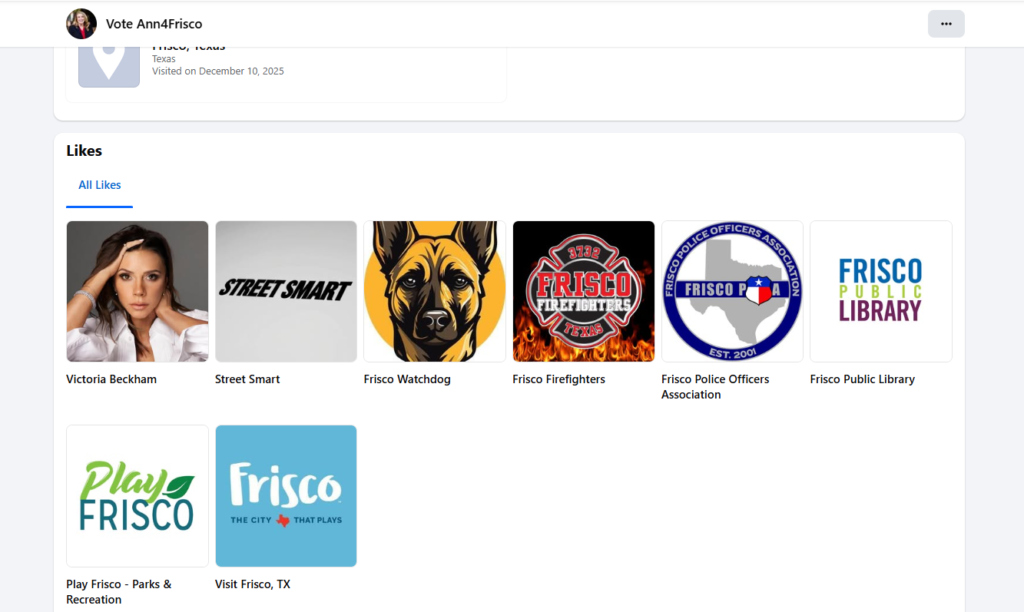
Nothing in the court evidence shows or confirms that the Colberg’s “acted together” on anything. If that is considered evidence to publicly convict someone, then I would argue the fact that Ann Anderson, our new councilwoman, whose campaign page liked Bill’s Blog makes her guilty of working with him and being a part of these false accusations. Or recently re-elected Laura Rummel is guilty of collusion with Bill Woodard because she shared his blog attacking innocent Frisco residents (which she later took down). MYPOINT: THAT IS COMPLETELY RIDICULOUS! A like of a page, a reshare of a post, or a text to a friend is not an admission of guilt on anything.
Mr. Woodard owes the Colberg’s and the readers an apology for misleading them because nothing he published in this specific blog was from actual documentation from court proceedings. His claim is not speculation; it is 1000% pure speculation on his part. Speculation that came out right during early voting in order to possibly upset the apple cart or discredit a candidate.
For legal purposes I must put the following: Disclaimer: This blog includes satire, parody, and comic relief. It contains summarized accounts created solely for humor and commentary. Any resemblance to real events is either coincidental or intentionally satirical. Reader discretion — and a sense of humor — are advised.
Over the past 15–20 years, bringing “quality jobs” or corporate headquarters to Frisco has been a common campaign theme across many city council and mayoral candidates. As Frisco transitioned from a bedroom suburb into a regional employment center, candidates across political factions have run on platforms tied to economic development, corporate relocations, and high-wage job growth.
For communities like Frisco, smart corporate development isn’t just about landing big company logos—it’s about long-term financial health, balanced growth, and protecting taxpayers. Cities like Frisco have to think carefully about what kind of development they pursue and where it goes.
Mayor Cheney and other city leaders have frequently said Frisco “must pursue” major employers so the city becomes a regional job center instead of a commuter suburb. Cheney has emphasized pursuing large corporations and creating office districts where employees can live, work, and socialize.
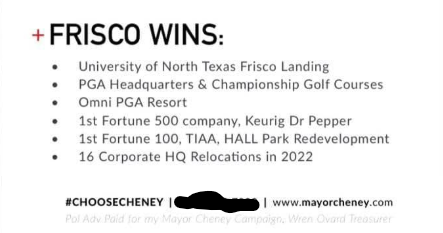
Lifestyle Frisco wrote an article in October 2019 titled “Mayor Jeff Cheney Announces Re-Election Campaign” which centered around Mayor Cheney’s own words. Cheney continues, he was seeking residents votes on May 2, 2020, so he can continue to bring more jobs, expand the tax base, create beautiful neighborhoods, and provide top tier entertainment. He notes that Frisco won our FIRST-EVER Fortune 500 relocation with Keurig Dr Pepper. He continues, the goal is to deepen our Sports City USA brand by adding the National Soccer Hall of Fame, professional lacrosse, and an esports team. His political mailer in 2020 listed his so-called wins. It still does not compare to Plano’s wins that will bring more high paying quality jobs that have a better economic impact to the city.
For years we have listened to candidates and current Council Members talk and campaign about bringing “high-paying primary jobs” to reduce commutes for residents, diversify the city’s tax base, and to support the city’s financial stability. In the most recent special election, we were shocked to learn our newly elected council woman, Ann Anderson stated she was glad that AT&T chose to relocate to Plano. Wait what?
Frisco Chronicles began to question have our city leaders fulfilled their obligations and promises to Frisco residents? Shockingly, no! Residents need to pay attention.
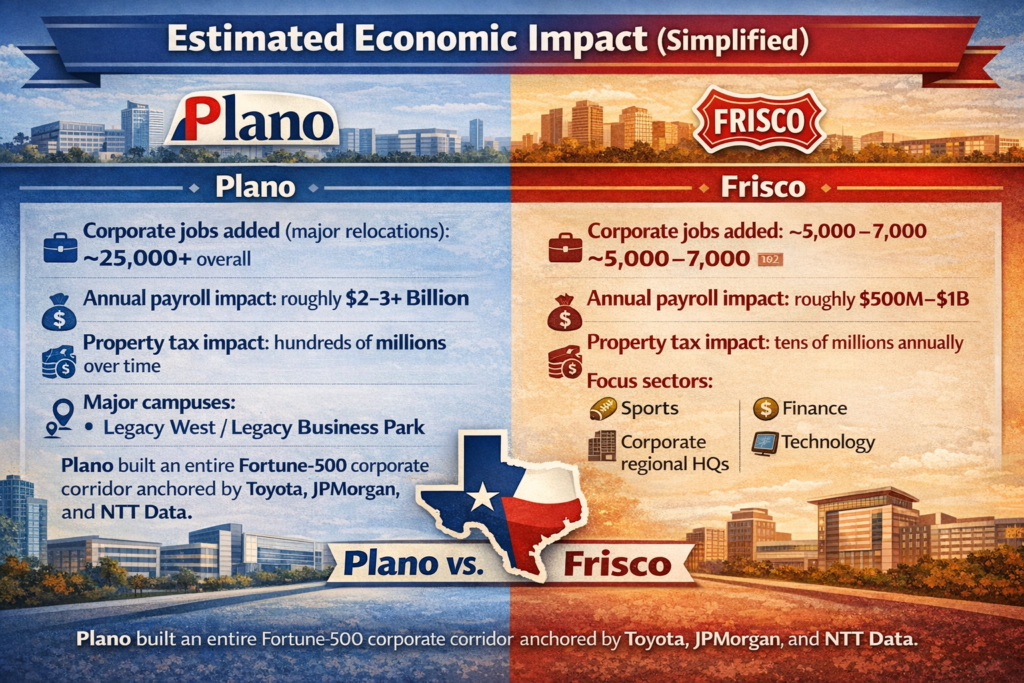
Frisco vs Plano Comparison
Who is the largest employer in each city?
Frisco: Frisco Indepenent School District – 8,800 employees vs Plano: JP Morgan Chase – 11,261 employees
Frisco vs Plano Economic & Corporate Landscape
Which city has added the most corporate jobs?
Frisco: 5000 to 7000 vs City of Plano: 25,000+
Which city has had the greatest Economic Impact?
Frisco Annual Payroll Impact: Roughly $500M to $1Billion vs Plano Annual Payroll Impact: Roughly $2 to $3 Billion
Frisco Property Tax Impact: Tens of millions annually vs Plano Property Tax Impact: Hundreds of Millions over time
Frisco
Major employers are a mix of private and public sector. Frisco has attracted some high-profile corporate offices, but its largest employers tend to be public sector or regional service-focused, rather than Fortune 500 headquarters.
The focus has been on building a diversified but smaller-scale corporate base rather than creating a dense Fortune 500 corridor.
There’s evidence of success in certain sectors, but less concentration of high-paying corporate headquarters jobs compared to Plano.
Plano
Plano has built a robust corporate ecosystem, especially along Legacy West/Legacy Business Park, attracting Toyota Financial Services, JPMorgan Chase, NTT Data, Fujitsu/Ericsson, and Capital One.
The city has successfully attracted major Fortune 500 companies which created tens of thousands of corporate jobs and generated billions in annual payroll and hundreds of millions in property taxes.
Plano’s strategy has emphasized large-scale corporate relocation and campus development, which creates a strong economic multiplier effect.
Community Impact Comparison:
Frisco’s Potential Issue: With a large portion of the top employers in the public sector, Frisco’s economic growth may be more sensitive to government budgets, policy changes, and public funding cycles, rather than the stable expansion seen in private corporate headquarters. This could limit long-term job growth and tax base expansion.
Resident Impact Comparison
Plano: Residents benefit from high-paying corporate jobs, a strong tax base that funds public services, and a built-in ecosystem that encourages additional businesses and amenities.
Frisco: While still attracting quality employers and offering amenities, the job base may be narrower in sectors that generate higher wages and broader economic spillover. Public sector dominance among top employers may limit diversity in employment opportunities.
WHO WINS: FRISCO OR PLANO
Plano emerges as the city with a more aggressive, high-impact corporate strategy that directly benefits residents through employment opportunities, payroll tax revenues, and large-scale infrastructure support.
Frisco has been moderately successful in attracting employers but may face long-term challenges due to the nature of its largest employers and a less concentrated corporate corridor.
ELECTION TIME: VOTE WISELY
You constantly here residents in Frisco complain they are tired of growth without infrastructure. Why is that? Because our city leaders have done nothing to reduce our commute to local jobs or bring quality paying jobs to our community. By putting a heavy emphasis on “TOURISM” and “HOSPITALITY” they have created more traffic issues and attracted less quality paying jobs.
A recent big win the city likes to talk about is Universal Kids Resort, which is bound to add to Frisco’s traffic congestion. City leaders are hoping that over the years tourist attractions will bring in enough tax revenue to offset what the corporate relocations could have brought to our community.
A search of the internet for jobs at Universal Kids Resort displays the following available jobs: Lobby Attendant, Quick Service Associate, Dispatcher, Full Time Lead Technician, Lifeguard, Ride Operator Attendant, Wardrobe and Costume Supervisor, and many more. The requirement a HS Diploma or GED, Customer Service Experience. No pay scale offered for any of the positions. Universal offers very few highly paid management positions.
We did find one job for a Senior External Affairs & Corporate Communications Manager which states a bachelor’s degree in political science, Public Relations, Communications, Business Administration or related field is required. It also says at least 7+ years of corporate communications, legislative, government or external affairs experience is required, or equivalent combination of education and experience.
Why is all this important?
Every election the same people stand before us and ask for our vote, and Frisco Residents who are none the wiser continue to just elect the same regime. The result is our leaders have failed to bring quality paying CAREERS to our community. This will affect us down the road when it comes time to paying the big bonds they have asked us to pass over the years.
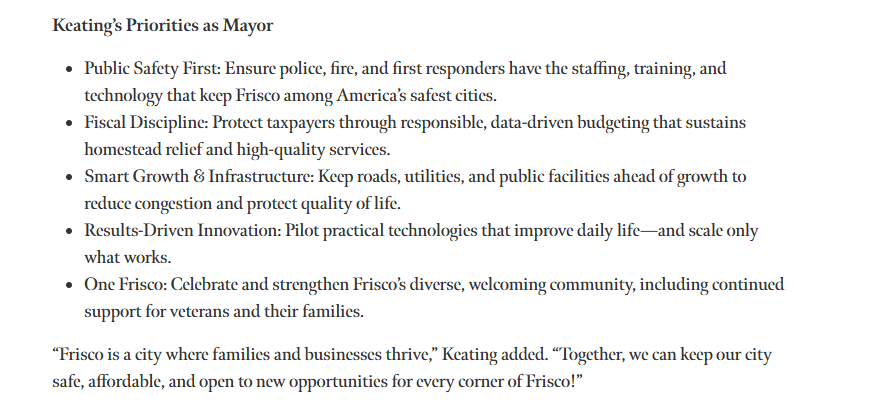
John Keating’s website brags he has served on the council “FOR MORE THAN A DECADE.” Frisco Chronicles is curious if he can name one Corporate Relocation (besides the PGA) that he pushed hard to win that brought high paying quality jobs to Frisco? Keating’s website lists his priorities as Mayor and not one of them directly states the goal to bring high quality CAREERS AND CORPORATIONS that protect taxpayers. He offers the same priorities just re-written that he has failed to complete before in his decade on the dais. Keating’s time is up!
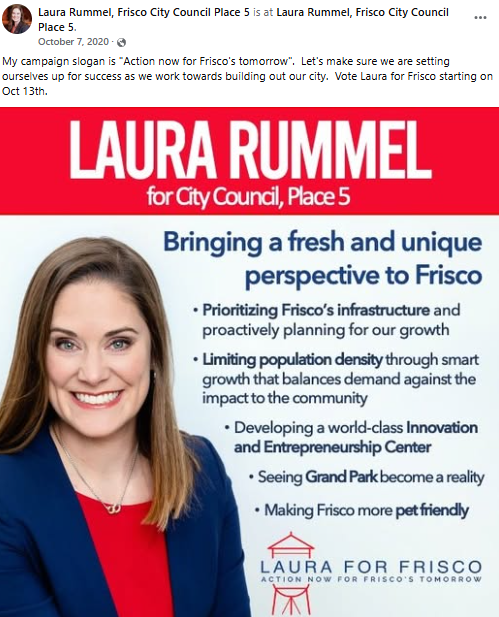
Laura Rummel is back to also ask for your vote! Her website states her priorities include Frisco’s infrastructure, smart growth by asking developers to offer smaller format housing options such as condos, townhomes, zero lot line home alternatives and fuel innovation and entrepreneurship. Her website states, “Start-ups typically provide slow and steady organic growth for the city, as well as bringing high-paying jobs, two attributes I would like to see us continue to recruit here to Frisco.
How will Laura Rummel help Frisco compete with Plano and the economic windfall they are having with corporate relocations? Rummel has had 5+ years on council now and she has no win to call her own! It takes a long time for startups to grow into a Capital One or AT&T and provide an economic impact to residents that we need here.
In closing, when will Frisco Residents say WE HAVE HAD ENOUGH AND WE WANT HIGH PAYING QUALITY JOBS THAT CREATE AN ECONOMIC IMPACT like other surrounding cities. The big wins Frisco claims are great, but they are nothing compared to our neighbor the City of Plano which has built one of the largest corporation corridors in North Texas. Plano employers include major financial institutions, corporate headquarters, tech firms, and large service centers that anchor Plano’s economy and make up a significant share of local jobs. A linear “corporate corridor” lined with major employer logos, emphasizing Plano’s role as a corporate hub
Frisco residents need to ask, “How will we repay the $1 Billion in debt we have?” Frisco leaders have dropped the ball and if you look down the road none of the “WINS” our current leaders like to claim will bring in the billions that major corporate relocations could have. At the last city council meeting you saw them approve a warehouse along the 121 roadway – is that the best use of that land or could it have gone to something else that would have brought in more high-quality paying jobs. Frisco’s future is not as bright as residents would think when it comes to financial stability. The One Billion in debt has to come from somewhere so where will it come from? Get Wise Frisco!
Disclaimer: This blog includes satire, parody, and comic relief. It contains summarized accounts created solely for humor and commentary. Any resemblance to real events is either coincidental or intentionally satirical. Reader discretion — and a sense of humor — are advised.
Largest Employers in Frisco
Employer
Sector
Employees
Frisco ISD
Education
~8,800
Dallas Cowboys
Sports & Entertainment
~2,000
City of Frisco
Government
~1,800
HCL Technologies
Corporate
~1,500
T-Mobile
Corporate
~1,300
Keurig Dr Pepper
Corporate
~1,200
AmerisourceBergen
Healthcare
700+
Baylor Scott & White Health
Healthcare
600+
Collin College
Education
500
Mario Sinacola & Sons
Construction
500
Oracle
Corporate
400
Baylor Medical Center of Frisco
Healthcare
450
Lexipol
Corporate
420
Top Employers in Plano, TX
Plano’s largest employers based on the most recent city and economic data (2025–2026 estimates):
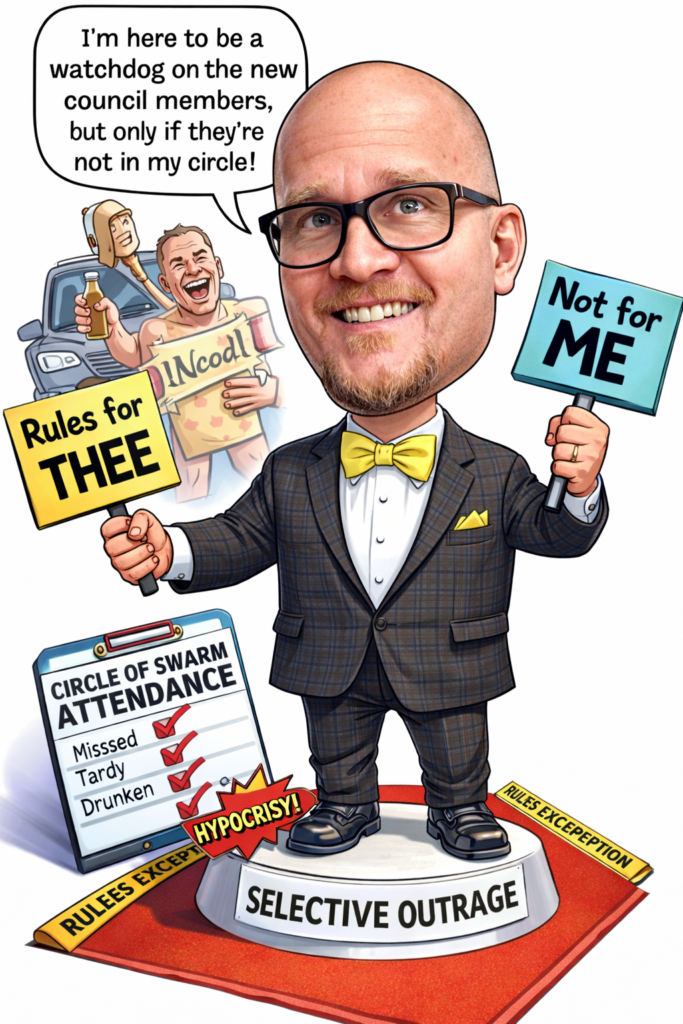
In politics, outrage is rarely accidental. It’s often carefully aimed, strategically timed, and—when necessary—conveniently forgotten. That’s what we call Selective Outrage: when politicians and their allies suddenly discover their moral compass, but only when it points at someone outside their circle.
On December 2, 2025, former Frisco councilman Bobblehead Bill Woodard stepped up to the podium during Citizens’ Input with a speech that sounded, at first, like a heartfelt defense of professionalism at City Hall. After all, according to Woodard, during his 20-plus years in Frisco one of the things he was “most proud of” was the professionalism shown by board and council members while serving on the dais.
Touching. Inspiring. Almost nostalgic.
But as the speech unfolded, what residents actually witnessed was less a thoughtful reflection and more what could best be described as an emotional support tantrum wrapped in a watchdog costume. By the time Woodard finished, his concern for the city’s reputation had been carefully aimed at two of the newest council members—members who, coincidentally, are clearly not part of the inner Frisco Swarm circle.
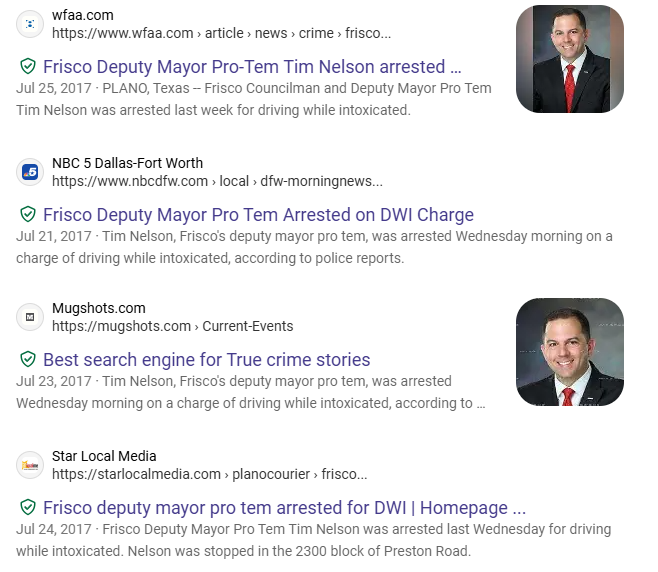
We’ve seen this movie before. In fact, we wrote about it in our earlier blog “Butt-Hurt Politics.” Because here’s the question no one asked from the podium that night: Where was this outrage before? Woodard didn’t rush to the microphone when former Frisco Deputy Mayor Pro Tem Tim Nelson was arrested for alleged drunk driving. There was no impassioned lecture about protecting the city’s reputation then.
He didn’t sound the professionalism alarm when John “Cheating” Keating was allegedly spotted a few years ago over a Fourth of July weekend at a community pool with a woman (not his wife) who happened to serve on one of the city’s boards.
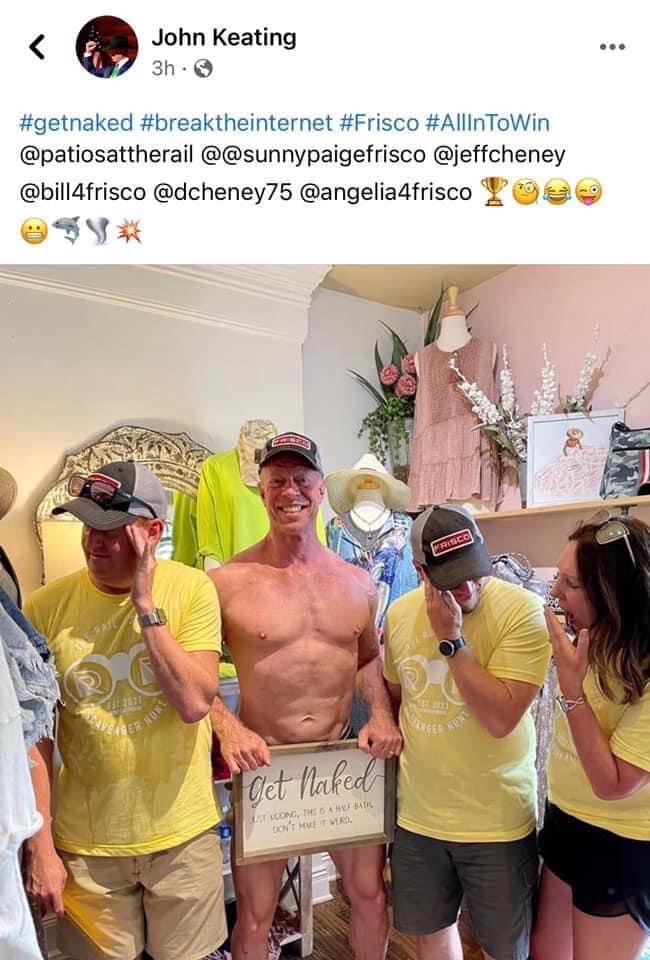
And apparently there was no emergency meeting of the Professionalism Police when Keating once posed holding a sign reading “Get Naked” over his private parts, creating the illusion he was standing there unclothed—while Mayor Jeff Cheney and the First Lady laughed along.
No speeches. No lectures. No watchdog warnings about Frisco’s reputation.
But suddenly, when two new council members stumble, miss a meeting, or crack a joke on the dais, Bobblehead Bill finds his whistle and climbs into the referee tower. That’s not accountability. That’s Selective Outrage.
From his self-appointed pulpit as an anonymous member of the Frisco Swarm, Woodard seems eager to call out mistakes made by newcomers while conveniently overlooking the long list of missteps made by those inside his own political circle. Even more interesting? After hearing Woodard’s lecture on attendance, preparedness, and professionalism, we decided to do something radical: We checked the receipts.
And what we found in the city’s own Governance Board meeting records raises a few questions about whether the standards Woodard preached on December 2 have actually been applied… consistently… fairly…or evenly. Spoiler alert: they haven’t.
But that’s where things get even more interesting. Because if Bobblehead Bill believes showing up late, missing meetings, or leaving early is a threat to the reputation of the City of Frisco… then residents deserve to know whether everyone is being held to the same standard—or just the people outside the Swarm. And that’s exactly what we started digging into.
According to Woodard, missing meetings, arriving late, or leaving early was not just disappointing… it was disrespectful to the citizens of Frisco and damaging to the reputation of the city. Those are strong words. So naturally, we decided to take Woodard’s advice and focus on the facts. If attendance and professionalism are truly the gold standard for serving the public, then it should apply to everyone—past and present. Right?
Let’s Check the Record: Previous Governance Meetings 2022 – 2025
We started by reviewing the Governance Board meeting minutes available through the city website. What we quickly discovered is that the online records are… incomplete.
Still, the minutes that are available tell an interesting story.
Here are a few examples:
June 23, 2022 – Bill Woodard was absent from the Governance Board meeting.
March 15, 2022 – John Keating was absent from the Governance Board meeting.
April 2, 2024 – Bill Woodard left the meeting early.
February 4, 2025 – Angelia Pelham arrived late to the Governance Board meeting.
Now remember Woodard’s speech. His words were clear:
“The citizens of Frisco expect and deserve representatives show up to do the work. On time and prepared.” Fair enough. But if attendance issues are grounds for public lectures at Citizens’ Input, it seems reasonable to ask: Does that standard apply to everyone—or just certain people?
The Curious Case of Missing Minutes of 2026
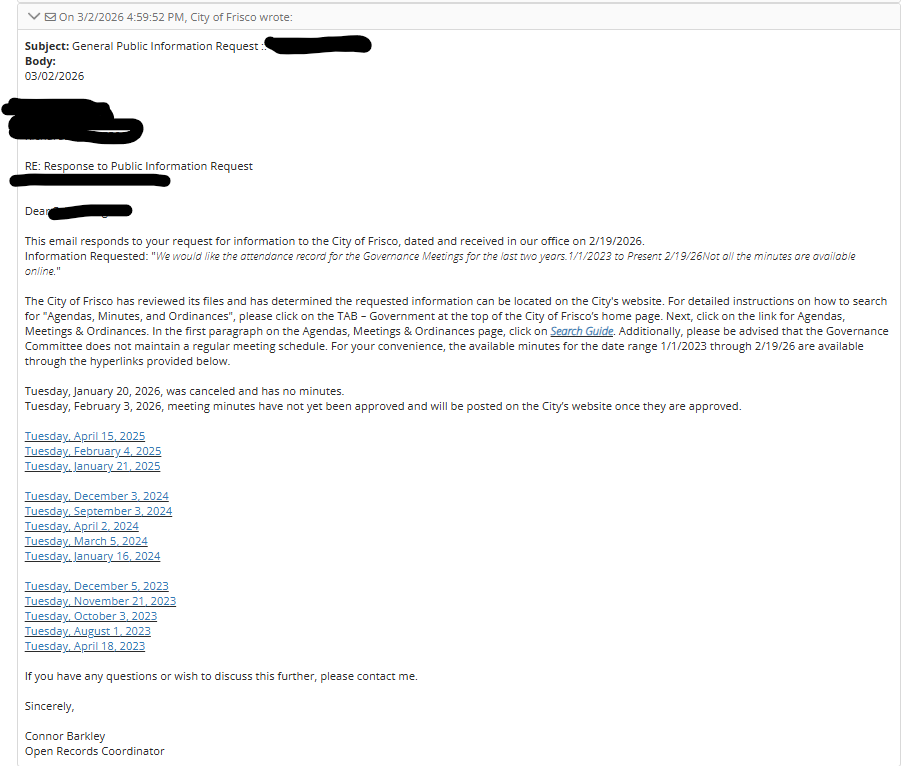
On February 19, 2026, Frisco Chronicles filed a Public Information Request (PIR) asking the City of Frisco for attendance records for Governance Board meetings from January 1, 2023, to the present. We also noted in the PIR that not all meeting minutes appear to be available on the city’s website.
The city responded on March 2, 2026 with a simple explanation:
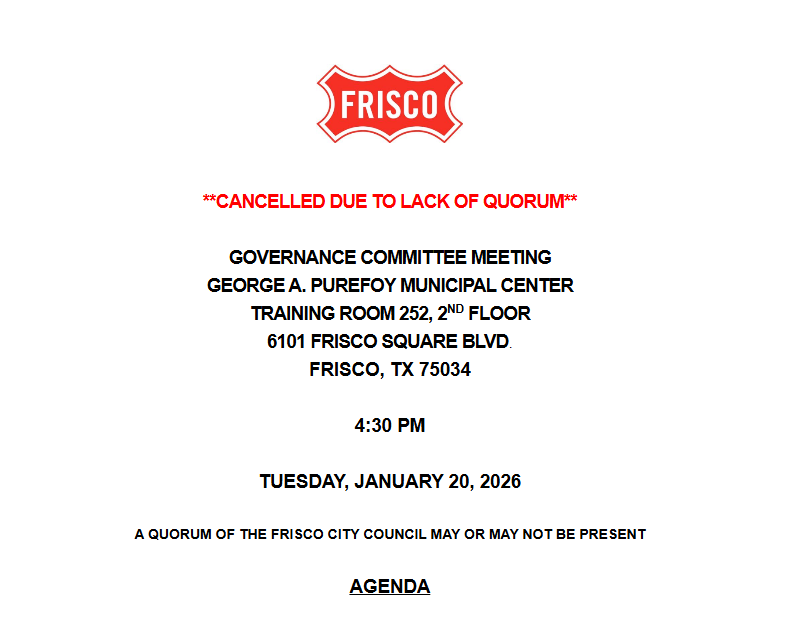
January 20, 2026 meeting shows it was canceled due to lack of quorum. No explanation was provided as the minutes are not posted to the city website.
February 3, 2026, minutes have not yet been approved, so they are not posted.
Then the city closed the request with the status: “Information on Website.”
Things got even more interesting when we looked at the 2026 Governance Board meetings minutes online at the city website.
According to a city insider, the January meeting reportedly lacked quorum because Burt Thakur and Jared Elad misunderstood the meeting date. The next meeting on February 3, a city insider told us the meeting was delayed 20 to 30 minutes because Angelia Pelham arrived late. But since the minutes aren’t publicly posted, residents can’t verify what actually happened. So, we did what any curious citizens would do.
Which raises a simple question: If the minutes exist but just haven’t been approved yet… why not post them with a note that they are subject to approval? Many cities do exactly that in the interest of transparency. But apparently in Frisco, some information moves at the speed of government… while outrage moves at the speed of politics.
The Real Question
Bobblehead Bill Woodard pretends to have an independent point of view and clearly has no issue stepping up to the podium to lecture two new council members about attendance and professionalism. Yet when members of the Frisco Swarm, including himself, miss meetings, arrive late, or leave early, the watchdog appears to take a nap.
No speeches. No Citizens’ Input lectures. No public scolding about the reputation of the city. That’s not accountability.
That’s Selective Outrage.
But Wait… There’s More
After hearing Woodard’s speech about high expectations, we decided to take the research one step further. How many council meetings or work sessions have sitting members council members been late to or been absent from? And, because council members aren’t the only ones expected to show up and do the work we looked into the dozens of boards and commissions, filled with citizen representatives, many of whom were appointed by the same political circle now demanding perfection from others.
The next logical question is simple: Do those appointees meet the same attendance standards? Or does the outrage stop there with just two new council members? That’s exactly what we started digging into next. And what we found might surprise you.
Stay tuned for Part 2: The Attendance Records of City Council and City Boards and Commissions
Disclaimer: This blog includes satire, parody, and comic relief. It contains summarized accounts created solely for humor and commentary. Any resemblance to real events is either coincidental or intentionally satirical. Reader discretion — and a sense of humor — are advised.
Former City Councilman Bill Woodard announced on his old Bill For Frisco Facebook page a change in a Dec 3, 2025, post. He is now going to become the Frisco Dog watching over everything around town. The post reads “after many months of a social media break, I find myself wanting to provide some thoughts and opinions on a variety of topics, Frisco related. He goes on to say this page won’t be for everyone, that’s ok. It is his take on the goings around town. He makes sure to point out this page is not for anonymous posters or run by an anonymous person.
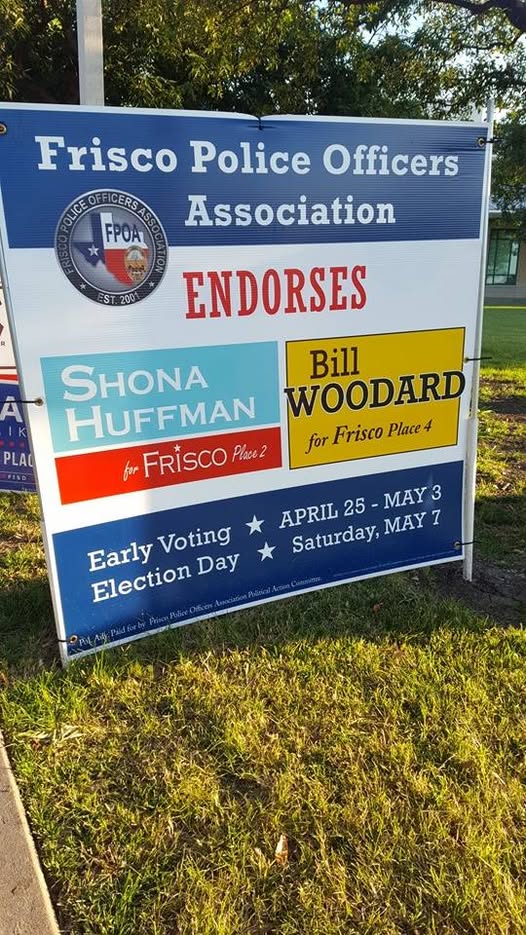
Since the conception of his opinion page he has done nothing but attack the two new council members with his sidekick Tracie Reveal Shipman. In one post from Dec 11, 2025, he goes after Jared and Burt for both accepting an endorsement of the Frisco Fire “Association” which Woodard claims is a union. The post goes on and on in the famous dull Woodard style, but it leaves out one very IMPORTANT THING. WOODARD WAS ENDORSED BY THIS SAME ASSOCIATION.
Why was it not a problem when Woodard accepted the endorsement? Why was it not a problem when his counterparts like Cheney accepted the endorsement? It is only a problem when it is candidates he doesn’t like to get endorsed by the ASSOCIATION. Then the ASSOCATION is a UNION and is BAD!
Simply put, it was Woodard’s way of trying to discredit the endorsement by the association that he openly had no issue accepting the same endorsement and money from before (see picture from his page above). He just simply didn’t like who they endorsed this time. It was outside the Frisco Cabel which is a no, no – you don’t cross the Cabel.
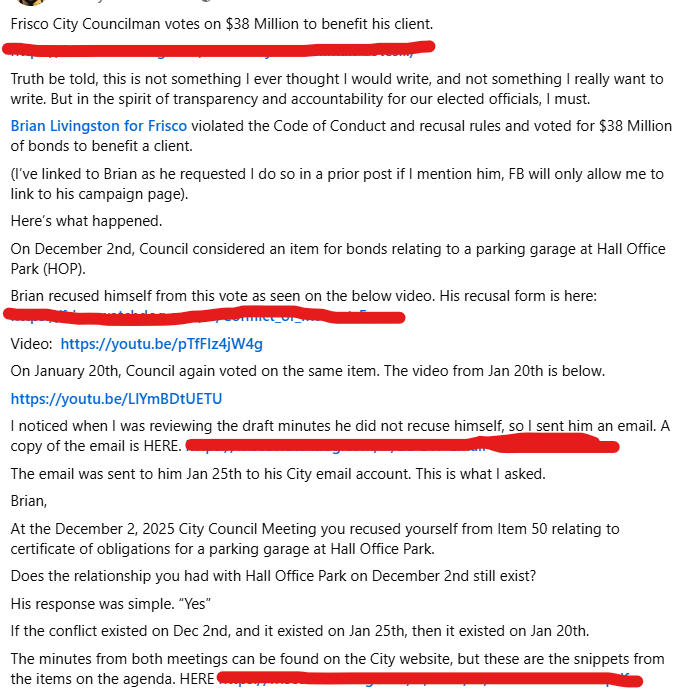
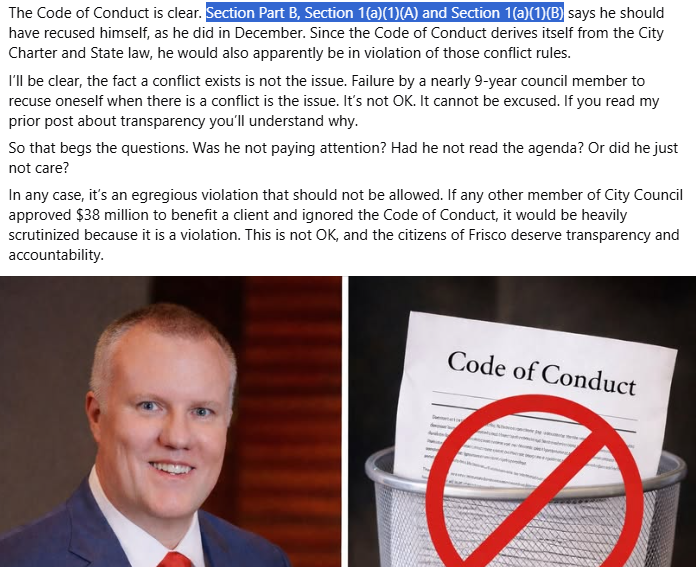
Fast forward to January 31 Bobble Head Bills new blog page writes on an attack on Councilman Brian Livingston accusing him of violating the Code of Conduct, Section Part B, Section 1(a)(1)(A) and Section 1(a)(1)(B) which says he should have recused himself from a specific vote. He calls Livingston’s vote on January 25th an egregious violation.
We reached out to Councilman Livingston via his email and asked him why did he initially recuse himself, was it needed or did he do it out of an abundance of caution?
Then we asked why he did not recuse himself the second time? Mr. Livingston responded to our questions with the following,
“The recent statement published by former City Councilman Bill Woodard stating that I violated the Code of Conduct and/or “recusal rules” related to the recent Frisco City Council votes to provide $38 million in bonds for a parking garage in Hall Office Park is without merit.
After receiving feedback and upon review of my reasoning for my prior recusal, I don’t believe that my recusal related to this subject has at any time ever been legally required. My prior recusal was done only to avoid any appearance of a conflict of interest or impropriety claims.
Furthermore, after reviewing my prior recusal, I don’t believe that any appearance of a conflict of interest or impropriety would exist when looked at by a neutral 3rd party.
I should have realized that Mr. Woodard’s email to me was not an innocent question, but it lacked any question related to a potential concern of a conflict of interest existing.
In hindsight, I wish I would have made a formal statement of my intention and reasoning behind not recusing myself for the second vote and any future votes related to Hall Office Park. I look forward to the opportunity to discuss this if necessary and assure everyone full transparency.”
It is funny because once, Woodard and Livingston were friends. But since Mr. Livingston stepped out to support candidates who were not approved by the Frisco Cabal he is on the outs with the current council and FORMER COUNCIL MEMBER Bobble Head Bill.
Bill The Attack Dog
So here we are. Bill Woodard, no longer on the dais, but still perched high on the porch—barking at passing cars, mailmen, and anyone who dares step outside the Frisco Cabal’s invisible fence. The self-appointed watchdog who insists his blog is about ethics and transparency somehow only finds ethical outrage when the “wrong people” win elections, accept endorsements, or dare to think independently.
Let’s be clear: this isn’t civic education. It’s selective indignation. It’s a greatest-hits remix of grievances, wrapped in long-winded posts that scold residents while conveniently omitting inconvenient facts—like his own past endorsements, votes, and friendships. Transparency, apparently, is only required of others.
What’s most telling is that when facts don’t support the narrative, accusations fill the gap. Councilman Livingston answered questions directly and publicly. Woodard responded not with reflection, but escalation. Because the goal was never clarity—it was control of the narrative.
Frisco doesn’t need another former official lecturing from the sidelines, deciding who is pure enough to govern and who must be publicly shamed. Residents are capable of critical thought. They don’t need Bobble Head Bill translating local government for them like a condescending tour guide.
At Frisco Chronicles, we’ll continue to be the true guard dog and do what watchdogs are actually supposed to do: ask uncomfortable questions, check the receipts, and call out hypocrisy—no matter whose name is on the byline or how long they once sat on the dais.
Stay tuned. The dog may bark, but we’re watching the whole yard.
Disclaimer: This blog includes satire, parody, and comic relief. It contains summarized accounts created solely for humor and commentary. Any resemblance to real events is either coincidental or intentionally satirical. Reader discretion — and a sense of humor — are advised.













I went to her to ask for help with an issue my child that was getting nowhere with the school,…
So whatever became of the $17 million dollars that the city council gave the Mayor to beautify a drainage ditch?
At last count, there are 3 different "spa/massage" businesses in the small office park at the northeast corner of John…
I literally just saw this. Yeah, she used to forward everybody’s emails behind their backs.
You're dropping truth bombs! These mom and pop shops are what should be the least of Karen's worries. If they…